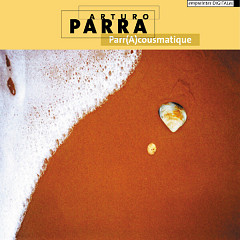
Arturo Parra (1958), born in Colombia, has been living in Canada since 1989. For the last ten years he has been busy composing and performing contemporary pieces, often with the guitar in different contexts. He is interested in sonic exploration, as well as development of new playing techniques and the stretching of the possibilities for the guitar in modern art music. Parra has also been active in the spoken word idiom.
This CD has an interesting background. It all stems from Arturo Parra’s idea back in 1997 to commission works for electroacoustics from several well-known composers. They were Francis Dhomont, Gilles Gobeil, Robert Normandeau and Stéphane Roy; all very successful in their fields. The commission was for pure electroacoustic works, which Parra then would use to compose other works for guitar and electroacoustics. In 1998 both versions of each of the then four works were heard in concert in Canada. Another peculiarity of this project was that the financing was a shared commitment by The Canada Council for the Arts and The Colombian Ministry of Culture.
This CD contains the final mixed results, i.e. the versions that Arturo Parra achieved with the compositions delivered by the four composers mentioned above plus an extra entry managed in the same way, electroacoustically composed by Colombian composer Mauricio Bejarano.
The guitar parts were played by Arturo Parra without the use of any manipulative means, recorded in realtime on an instrument built by Manuel Contreras in Madrid, Spain in 1984.
La basilique fantôme (The Phantom Basilica) begins the selection. Its electroacoustic part is composed by Stéphane Roy. The atmosphere here is that of a remembrance of the souls that have prayed in the basilica, and one has the feeling of centuries of shadowy figures out of the past coming to life once more. A dark breath of air comes at you at the very beginning, but the guitar fingers swiftly along a gallant figure, which gets rhythmic and even very melodious, tenderly touching upon a simple melody, however darkly mirrored and shadowed in the electroacoustics. The rustling movements of long skirts or gowns in an electroacoustic string section sounds like the silent voices of a sea of people, swaying back and forth in time, receding back in the ages and emerging out of the darkness of death; a pale, shy battalion of ghastly shapes, conjured up out of their beyond by intruding visitors. The fabric of this cumbersome piece is dark, with a somber hue, almost not visible in the dusky corners of the basilica, and soon everything will pass, the forlorn shapes unable to retain the energy that keeps them visible or semi-visible for this short duration.
D’or et de lumière (Gold and Light) is composed – its electroacoustic layer – by Mauricio Bejarano. The vision of the composer was a dense forest with a lake, into which a man dives, offering himself up to the God or perhaps the gods. Around the lake – still in the composer’s vision – thousands of bodies (he say “bodies”, not “people”) are lost in a trance dance. The music is grainy at first, fragments of audio shimmering like grains of sand in the sun and between teeth. It strikes me that this project as such is a strange bird at empreintes DIGITALes. The mixed form – especially with the tightly curbed prerequisites of this set — is very hard to do something very good with, as it oftentimes comes out superficial or forced. This release is not totally free of this malice, but I do declare that the result is unusually successful anyway, with this little remark in mind. The electroacoustics of track 2 are delicate, minuscule, tempting, and the guitar remains much a lone elf in this gleaming electroacoustic environment. I wouldn’t mind hearing a developed version of the electroacoustic of this piece by itself.
Sol y sombra… L’espace des spectres (Sun and Shadow… Ghosts Over the Ring), was composed in its acousmatic part by Seigneur Francis Dhomont. In this composition Parra has had the bullring in mind, having the guitar and the tape part confront each other like the matador and the bull. Parra even mentions Manuel de Falla in his introductory text. Without a doubt, this entry is the most exciting so far on the CD, with a richness of sounding material, more equal with the guitar than in the former pieces, in a web of ingenious sounds in which the guitar just adds a peculiar glance, a certain flair, from the so-called real, analog, realtime (explain that word to Einstein!), daily life. This hint at everyday strife is however delivered by Dhomont in a dreamy, mirrored kind of way, and he even uses, figuratively speaking, brass mirrors of The Old Testament, which do not deliver sharp-edged reflections, but hazy approximations of life, and the string theorists of today would say that this is more to the point, since nothing, no matter, no energy, is absolutely certain, but rather a little elusive, floating, evasive… no matter how practical and empiric we believe that we are… These almost twelve minutes of Dhomont-Parra turns out to be a masterpiece, and with Francis Dhomont involved – a man with only masterworks in his catalog – this is no surprise… but it makes me happy anyway, as I was just losing some hope for the mixed form.
Soledad (Solitude) is Gilles Gobeil’s go at this project. Parra says that he aimed the guitar at the expressions of solitude, separating each of the guitar sounds from each other, stripping the instrument of its harmonic properties. A slow atmosphere, a murmur deep down, a long sigh, followed by yet another sigh, spaced far apart, opens a transparency, an openness beneath bridges, at zero-points, in areas with lots of cargo in harbors when no one is at work, a Sunday afternoon at the docks, occasional ants passing over cracks in the cement, cranes resting with bowed necks along the wharf. This is another masterpiece, slightly contoured around a thin-aired space with lots of empty time, lots of un-sounding sounds, a wide gesture over vast areas, water trickling like in a movie by Andrei Tarkovsky; Stalker… and we’re in the Zone, treading it in rubber boots and gas masks, just to make sure… These eerie illusions are skillfully instigated by Gilles Gobeil, and Arturo Parra has followed suite and managed a perfect match. Nothing here feels “mixed”. This is a coherent audio poem in subdued, withheld post-war shreds of darkness, flying up like silent ravens around are hopes…
L’envers du temps (The Other Side of Time) closes the album. Robert Normandeau is the electroacoustician. Parra’s text on the piece takes us into the timelessness beyond time, into a state of mind which is, in fact, in my view, much more true than the daily, frantic dealings with time, because in a universal aspect everything is happening simultaneously, or rather without the hindrance of linear time. Everything that has happened is in the same state, in the same place, as is everything that has not yet happened – and try to define a NOW! Impossible. It’s just a theoretical interface of past and future. Alas, like I like to say: All times are now; all places are here! The initial sounds are like fenders rubbing against the quay-edge as a gentle swell rolls in, from died-down storms far below the horizon. I also get the feeling of crickets measuring time in a hypnotic beating of very short durations, so short and close that they turn into a pitch, a cicada pitch of illusionary time, producing gravity as it curves, having us rest like plummets through the space-time continuum. The music is very gentle, the fender sounds of the guitar mingling with pianistic guitar sounds, in a simmering, vibrating atmosphere which grows denser only to thin out, in a breathing motion, myriads of cockroaches and silver-fish welling up out of planetary cracks in the moonlight outside a coastline steelworks on the Baltic Sea… but in this vision the guitar provides a prayer bead of tones to hold on to in a consoling message from benign spirits in the timelessness…