electrocd
  • This website is also available in English.

More from the blog

29 results
  • 1
  • 2
  • 3
  • 4
  • 5
  • Isostasie, Parr(A)cousmatique in Revue & Corrigée

    “Critique”, Pierre Durr, Revue & Corrigée, no. 55, March 1, 2003
    Saturday, March 1, 2003 Press

    Natasha Barrett est une jeune acousmaticienne britannique installée à Oslo, Arturo Parra est, lui, un Colombien résidant au Québec. Les associer dans cette chronique relève ici d’une forte subjectivité, leurs univers sonores respectifs étant totalement différents, au-delà bien sûr de certaines techniques communes à toutes les musiques électroacoustiques.

    La première pratique une forme de juxtaposition de couches sonores en interaction mutuelle, les unes provenant de l’environnement direct (donc naturelles et parfois reconnaissables), les autres étant transformées. Arturo Parra superpose le travail d’un instrument acoustique, la guitare (un jeu profondément volubile et chaleureux qui caractérise le style latino-américain) et les bandes magnétiques. Tour à tour Gilles Gobeil, Robert Normandeau, Stéphane Roy, Francis Dhomont, piliers d’empreintes DIGITALes, l’assistent.

    L’association des deux créateurs peut se justifier par une partie de la thématique de certaines œuvres. Natasha Barrett s’attache à décrire des paysages naturels, avec sa sensibilité. Red Snow évoque les tourbillons de neige de sa patrie d’adoption. D’autres pièces font référence à cet environnement (Outside Snow Falls, Midnight Sun: Midday Moon… ); elle pratique en somme une météorologie sonore (Replaced). Son intérêt pour les paysages naturalistes se retrouve aussi dans Viva la Silva, évocation de la forêt vierge de Costa Rica a travers les grouillements, piaillements, de la faune (les oiseaux surtout) mais aussi les transformations de la voix humaine.

    Avec Arturo Parra, on retrouve un peu de cette thématique paysagère. Mais la sienne est plus axée sur des paysages dans lesquels il ressent une présence — voire une absence — humaine. La forêt vierge semble encore garder les traces des peuples anciens (La basilique fantôme), abriter un voyageur/aventurier (D’or et de lumière) ou être tout simplement la cadre d’une impression de solitude humaine (Soledad). Le résultat sonore chez lui est très emphatique, volontaire, dynamique, tandis que sa consœur réalise un travail d’une approche plus introspective.

    Le résultat sonore chez lui est très emphatique, volontaire, dynamique, tandis que sa consœur réalise un travail d’une approche plus introspective.

    Parr(A)cousmatique in Octopus

    “Critique”, SH, Octopus, no. 21, March 1, 2003
    Saturday, March 1, 2003 Press

    De la guitare comme vous n’en avez jamais entendu, juré. Croisement magnifique d’avant-garde et d’acousmatique, la dextérité d’Arturo Parra laisse sans voix. Parr(A)cousmatique est plein de surprises, de trouvailles sonores et sautillantes. Il n’en demeure pas moins poignant. Libéré de toutes les contraintes et empruntant sans complexe aux sonorités latines, Parra explore avec style et retenu les possibilités de la guitare. Un disque inattendu chez empreintes DIGITALes, aux arrières goûts de western métaphysique.

    Croisement magnifique d’avant-garde et d’acousmatique, la dextérité d’Arturo Parra laisse sans voix.

    Parr(A)cousmatique in Vital

    “Review”, Ios Smolders, Vital, no. 357, January 30, 2003
    Thursday, January 30, 2003 Press

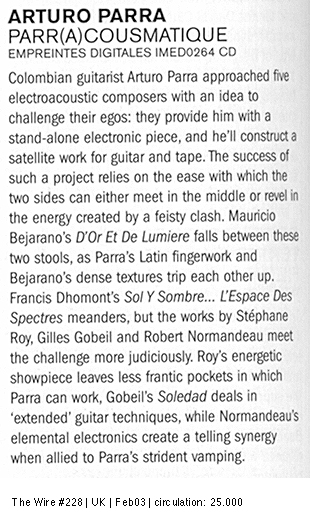
    Next Arturo Parra: this is a guitarist’s view on acousmatic music. I really think that this is the most adventurous of the three releases. The cooperation between musical instrument and tape/computer is difficult because you can identify the instrument from the other sounds, which so easily results in a relation instrument-backdrop. And in a live setting there is the discrepancy between the sound source of the acoustic instrument and the sound from the speakers which separates the two even more. Parra somehow managed to create a very nice balance, though. Parra commissioned works from five composers: Gobeil, Roy, Dhomont, Mauricio Bejarano and Normandeau. These compositions were each the basis for a composition of Parra. So the acousmatic composers didn’t know what Parra was going to do with their piece and Parra composed the guitar on top of what was already there. That is interesting because the guitar is the least versatile instrument here and yet it has to interact with the most versatile abstract noises. Also interesting to know is that the guitar was recorded without any overdubs. In some cases the guitar is tormented and played in extraordinary way but you can also hear melodies, which is quite unusual in an empreintes DIGITALes release. The result is a very dynamic and intense cooperation, very much worth listening to. I most liked the Dhomont cooperation. This “éminence grise” of the acousmatic society never misses a beat.

    … a very dynamic and intense cooperation…

    Parr(A)cousmatique in Splendid E-Zine

    “Review”, Andrew Magilow, Splendid E-Zine, January 20, 2003
    Monday, January 20, 2003 Press

    Unless you have a ridiculously expensive stereo system, there’s no way to grasp the breadth of the dynamic material that comprises these five compositions. What’s shrouded by your crummy computer speakers or sub-par jambox is magically unearthed when you wrap a padded pair of speakers around your head. So, don your favorite set of headphones and prepare for a most unusual meeting of guitar virtuosity and electroacoustic improvisation!

    Colombian-Canadian guitarist Arturo Parra commissioned several well-known electroacoustic composers to create stand-alone tape pieces. In turn, the wildly imaginative Parra took each composer’s portion, wrote complementary guitar parts and mixed it all into several dramatically transformed compositions. The result is Parr(A)cousmatique — a CD that delicately balances the six-string with magnetic tape.

    Stéphane Roy, Francis Dhomont, Gilles Gobeil, Mauricio Bejarano and Robert Normandeau each fashion elegant works that fuse synthetic melodies with noisy electrical excursions. It’s important to note that when each composer wrote his respective piece, it was unclear as to how Parra would incorporate it into his own work. While it’s difficult to separate the electroacoustic parts from the guitar in the final product, it’s reasonable to believe that each composition was created with enough power and depth to stand on its own. Consequently, each composer plays a critical supporting role in Parra’s work instead of becoming an anonymous background studio musician.

    After carefully studying each submission, Parra weaved his skillful and innovative guitar-work into the taped material to create the final product, switching effortlessly from Latin-influenced tonalities to frenetic runs to astonishing climaxes. When tape and guitar convene, an incredible reaction occurs. The two melt into a dense concoction of warm, melodic chords and expressive movements that oozes into your ear canals and coils around your grey matter like that creepy brain eating parasite from The Wrath of Khan.

    Unlike many acousmatic releases, there is an amazing amount of poise and grace in the interplay between participants. Neither tape nor guitar is relegated to a secondary role; instead, a unique synthesis of moving melodies and swarming solos occurs, with each artist taking turns developing the mood or rabidly following a particular improvisational idea. La basilique fantôme begins with flamenco guitar that’s readily juxtaposed with Stéphane Roy’s trickling electronics and intense atonal rumblings. Eventually a friendly sonic fight of sorts develops between Parra’s thrilling abilities and Roy’s processed mechanical bleeps, and it remains unresolved until the tune’s final minute.

    The most characteristic piece of the batch is the collaboration with Francis Dhomont, Sol y sombra… L’espace des spectres. Parra’s baroque style creates varying dispositions, ranging from romantic to frantic. While each artist takes turns being the aural focal point, neither is ever overshadowed by the other. You may assume that the electroacoustics would be sonically overpowering, but Parra holds his ground, attacking the fretboard with dazzling dexterity.

    While chaotic in theory, this unusual coupling of electroacoustic tape rendering and intricate guitar works amazingly well; Parra and his collaborators are not only brazen musical explorers, but also quite conscious that melody and structure can work well in an avant-garde setting. Could this be the beginning of a new collaborative genre? Parra has certainly started off with a brilliant release. Let’s hope there’s more to come.

    … prepare for a most unusual meeting of guitar virtuosity and electroacoustic improvisation!

    Parr(A)cousmatique in Bad Alchemy

    “Kritik”, Rigobert Dittmann, Bad Alchemy, January 17, 2003
    Friday, January 17, 2003 Press

    Seit 1989 lebt der 1958 in Bogotá geborene Gitarrist und Komponist Arturo Parra in Kanada. Parr(A)cousmatique (IMED 0264) ist ein Kollaborationsprojekt speziell für Arbeiten mit Gitarre und Tonband. Die Tapezuspielungen stammen von Stéphane Roy (La basilique fantôme), Mauricio Bejarano (D’or et de lumière), Francis Dhomont (Sol y sombra… L’espace des spectres) und Robert Normandeau (L’envers du temps). Parra übermalt die bruitistisch-programmatischen Folien mit starkem spanischen Akzent zu Stimmungsbildern, in denen sich Archaik und Hypermoderne durchdringen. Parras selbstbewusste, virtuos-avancierte Handschrift versteht es, sich auch in konfliktreicher und geräuschvoller Umklammerung zu behaupten, als subversives, flinkes Graffiti, als phantasievolles Ornament, als stoische Patina, als überlegener Lichtschimmer. Der Gipfel an Intensität wird erreicht zusammen mit Gilles Gobeil bei der schroffen Klangwüste Soledad. Aber gerade wenn man sich mit der Gitarre im Tal des Todes verscharren lassen will, öffnet Normandeau die Schleusen der Zeit und die Sekunden peitschen die Haut wie gemahlenes Glas, während Parra die Saiten rührt wie Urvater Chronos persönlich.

  • 1
  • 2
  • 3
  • 4
  • 5