Sauter au contenu principal
electrocd

Blogue

172 résultats
  • 19
  • 20
  • 21
  • 22
  • 23
  • 24
  • 25
  • 26
  • 27
  • Bruits dans The Wire

    «Soundcheck», The Wire, no 219, 1 avril 2002
    lundi 1 avril 2002 Presse

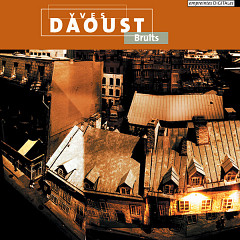
    The wit and character of Canadian composer Yves Daoust are all too rare qualities in electroacoustic composition. Composed between 1997-2001, Bruits is a 30-minute exploration, in three movements, of sounds from the great outdoors. The first movement is a giggly snapshot of a children’s playground. It’s followed by a fastidiously detailed nocturnal landscape close in atmosphere to Bartók’s many night pieces. The final slab is a joyous depiction of Montréal in summer, with passing jazz groups enhancing its party atmosphere. A similar sense of exuberance inhabits the much earlier La gamme, which transforms every music student’s dreaded scales and arpeggios into a cartoon landscape hovering between Varèse and A Rainbow In Curved Air. The bizarre Ouverture explores the history of French-speaking Canada. The Chopin-inspired Impromptu for piano and electronics completes the set.

    The wit and character of… Daoust are all too rare qualities in electroacoustic composition.

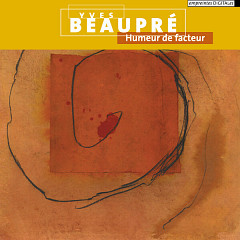
    Humeur de facteur dans Sonoloco Record Reviews

    «Review», Ingvar Loco Nordin, Sonoloco Record Reviews, 1 avril 2002
    lundi 1 avril 2002 Presse

    Yves Beaupré (1954) began his singular artistic and musical career at Université de Montréal, studying harpsichord performance with Réjean Poirier. Then he involved himself in the construction and building of harpsichords, with all the fine arts that this endeavor brought with it. He had to dig deep into facets like historical research and acoustic investigations into building material and timbres.

    Beaupré has been building harpsichords, spinets and virginals for two decades now, rendering him an esteemed name internationally. During his instrument-making career he has built about 100 instruments in his Montréal workshop to date; a handsome collection of artistic gems!

    However, Yves Beaupré’s intense interest in sound — the nature of sound — which he amply put to the test in his almost primeval focus on the smallest timbral effect of construction details of the pure instruments that materialized under his hands, led him further, into a private studio which he set up at home in 1985. Arriving at the art of recorded sound — tape music and electronic music — by way of harpsichord building, he had unusually well-tuned ears and an unusually focused sound-mind. It would seem his very original career would make him perfectly fit for the innumerable variation of timbres of electroacoustic, acousmatic and electronic music.

    Beaupré keeps on building instruments, but a lot of his time these days is set aside for electroacoustic composition. He has, for example, teaming up with Édouard Lock, mounted a magnetic pickup system for harpsichord.

    This release is his first CD. I can hardly think of anyone else who has lived such a long time in a preparatory state — even if that was not the conscious state of affairs, and even if my statement about “preparatory” only has a bearing on the electronic sounds on this CD (maybe to be considered just an off-spring or a side-effect of the craftsman’s craft…), but the thought or vision of electronic, electroacoustic music that takes its inspiration and dynamics from many years of building acoustic instruments and then reaches the world with news of sounds, only — in this particular context — submitting the story of the decades in the workshop in a subordinate clause, thrills me! Nonetheless, this was the road taken by chance or necessity by Yves Beaupré, and here we are with the result in the laser box, and I am inspired by looking at these pictures of the beautiful instruments that Beaupré has built, which you can se at his Internet site — and I also suddenly recall an old friend of mine (not one of the closest friends, but not just an acquaintance either) who went to harpsichord-building courses in Northern Germany in the early 1970s, and so this CD from empreintes DIGITALes opens up many new rooms inside my mind (some filled with memories I had forgotten…).

    Track 1 — Prélude démesuré — commences in a François Bayle “Toupie dans le ciel”-atmosphere and progression… right there in the opening, swirling, rhythmically erotic spinning motion, which you wonder where it will head, out across a slippery slope of glass or ice… In the dark, rhythmic web of pulsation tiny sparks of sonic fire appear, like fireflies in hedges and bushes, and a second rhythmic layer in a higher pitch, counter-pointing the darker pulsation, rises out of nowhere and becomes clear and mosquito-whining. The whole scenery is panning wildly and fast, and the feeling of spatiality is one of fast back and forth-movements inside another, general, stronger movement ahead, as were you bouncing back and forth between the walls of a railway car in a steadily moving freight train across Big Sky Montana or Famous Potatoes Idaho!

    The tingling sensation is that of sand particles or small industrial diamonds falling down on a conveyor-belt, or maybe like early morning sand-in-eyes or the sensation of invisible sand dust between your teeth after an Arizona sand-storm rolling across the highway outside Phoenix, having everybody stop on the curb; the poor guys without AC rolling up their windows, still having the nasty minerals seep in everywhere… yes, such is the seasoning sensation of tingling, grating sounds of minuscule auditory grains in this part of Yves Beaupré’s Prélude démesuré!

    It’s a pleasurable, fast moving sensation, listening to this music; breezy, intricate, at times soaring on a certain level, while still anchored in rock bottom material through darker, ambient audio, which towards the end allows for a repetitious deep percussion, while the grainy level turns into jingle jangle tingle tangle chain sonics, like passing through a hippie curtain of Indian Hare Krishna bells attached to hemp ropes or macramé of cold water flat passages between hallways and bedrooms in London or Stockholm in 1969…

    La Beauséjour is the title of track 2. The music opens with sharp incisions and a turning perspective of timbres, until shortly a surprisingly acoustical zither- or harp sound spreads its gold. I suppose it is Mr. Beaupré sliding his fingers across the strings of one of the instruments he builds. The topography gets rougher here than in the preceding piece, but soon a train line rhythm sets in, and you’re just waiting for the steam whistle to blow — and it’s Long John from Bowling Green… and did you hear that Dylan bootleg; maybe it was “Great White Wonder”, but could’ve been one of the other, early, famous bootlegs by the youngster from the Mesabi iron ore range up in Hibbing, Minnesota…

    You’re inside a trembling oil barrel, as the vibrations tap manically on your tympanic membranes. Sad and absent-minded soft melodies are more sensed than actually heard through the web of sounds, like fragments of dreams or the beginning of thoughts which blow away before taking shape, and much is going on; lighthouse-much on a day when winds are gusting and gulls flutter around the lonely tower out at sea, shrieking, ascending, descending in white, noisy motions above the waves…

    The myriad of little tweaks make me feel the invisible presence of minor munching creatures, munching away at time and duration like some little Sesame Street guys… and the music turns merry-go-round minimalistic, in a modern Italian-style Luca Miti electronica homage to Terry Riley and old gurus at the shores of the Ganges in Varanasi. Phase shifts and in-and-out stitching into the web make you a little dizzy; pleasantly so, like were you somewhat intoxicated by a small amount of hard liquor… and then it all oozes out into some free-form improvisational jazz, like a section of Rotcod Zzaj or some of the flimsier moments of master musician Ernesto Diaz-Infante of California…

    Track 3 is called La Laurendeau, opening on a strong timbral note, flapping out, winding up like a doll-house grandfather’s clock gone completely watery berserk, accompanied by softly bulging aquarium fondlings of water and kind thoughts, floating about like submerged intensions of good will. I think of smiling seals in old Beatles songs, or perhaps Cousteau undersea films, replayed on Discovery Channel. The bulging, swaying quality of this music, paired with the pitch shift effects on the beads of prickly, tiny percussive dots have me lay back in an imagined floating position, hearing bells of submerged cathedrals toll for you know who — don’t ask for whom! — and it’s all a fairy tale of a character and a sensualism not unlike the phase-crazy hydrophone recordings of David Dunn in his wonderful piece “Chaos and the Emergent Mind of the Pond”…

    So far I haven’t gotten any associations at all back to Yves Beaupré’s inspirational instrument building shop in Montréal, which is a good mark, showing that the composer hasn’t made it easy on himself.

    I might quote myself from a posting I did to the CEC mailing list (cecdiscuss@concordia.ca) the other night, when someone wanted all verbal thoughts on music — I guess he basically talked about the writing about music, and even more precisely; program notes — banned, since if the music wasn’t self-sufficient without accompanying words, it wasn’t much to talk about anyway. I said:

    “Listening to music and expressing anything that is awoken or induced by the music can lead to mysterious places that you’ve never visited before, and in the end it may have nothing to do with the music that started that chain of inner events — but the sequence began in the music. Writing about music is riding a jerky horse at a Texan rodeo in Mesquite; a bouncing adventure which might land you in the dust, but that’s the moment when DUST becomes interesting, and you can slip down into the mineral worlds — and you’ll still be writing about music. Let go and let happen, Mr. Man!

    This general approach that I advocate above is inherent in Yves Beaupré’s musical work. He begins in his workshop, but ends up anywhere, as my review plainly tells. This is good! It demonstrates what a fantastic adventure life is; this life, all the ones before and the millions to come. Keep on keeping on! Om Mani Padme Hum!

    Sometimes the pace — though in a constant movement — comes to a peculiar, meditative rest, right there inside the movement forth, and that’s when I like this the most, when the craftsman sort of raises his hands from his work and breathes…

    The 4th track is La Pelots Point. It immediately fills the sounding space available with eerie timbres of the hereafter or the imminent hereafter, or perhaps of a daydream anxiety-event while riding a turboprop waying westward, like in Gordon Lightfoot’s “Early Morning Rain” (beautifully interpreted by Peter, Paul and Mary); that long lost longing for “home”; a metaphysical home of homes, which can not be found as long as we insist on being born all the time, over and over… never getting tired enough of this flickering, blinding sequence of lives that pass, pass, pass — so fast that the stream of lives, seemingly an obvious rhythmic encounter, turns into pitch (which in turn reminds me of how Stockhausen turned pitch into rhythm and vice versa in “Kontakte” of 1959 — 1960). It never ends. It truly never does end! It just twists and turns and spirals through the space-time continuum! Tally-hoe! The Space Cattle Herders are on the move! The Universe is our Home! Make yourself comfortable!

    Sparky, sudden events of short durations kick in and out, giving me nice feelings of early electronic music of the WDR-studio of Cologne, but soon this veers over into the French idiom of poetic acousmatics of GRM (Groupe de recherches musicales) of Paris, equally nicely felt inside my musical frames of reference — and I realize how rich and varied this CD by Yves Beaupré really is. There is no time to get tired of his sounds, but there are places to rest, sections to meditate — and places to mourn, as I hear sounds reminding me of radio transmissions from the ship Estonia which went down all of a sudden in a September storm in the Baltic Sea in 1994, drowning over 800 people — and I used those radio transmissions to compose a radiophonic textsound piece simply called “Requiem”, which I paired with another piece of mine called “The Land That is Not”, dealing with the assassination of Swedish Prime Minister Olof Palme in 1986, on a private CD that will never be commercially available (it was mostly a way for myself to work through these events and try to understand them in a physical, fleshy way)… and here I hear a soft and caring melody in the distance inside Beaupré’s work, slowly disappearing inside deep murmurs as of buses passing by outside, giving off infra sounds, but the soft, melodic, modal sounds reappear, like individual organ pipes of an old stone church in Gotland emitting encoded messages for times to come… and for the first time on this CD I hear people, voices, whistlings, calls… like in a memory or a dream… out of time…

    Track 5 is cryptically entitled La DDB. It has body, and sparkles with gushes of twinkling sounds, riding on rolling carpets of auditory enforcements, embellished timbres welling forth like the northern lights in Lapland a bitterly cold January night… The feeling of friction in the layers of sound that grind against each other also have me think of cold nights, starshine and snowy expanses, where survival can be dependant on a pair of mittens and a thermos with hot soup…

    Growling and cawing sounds conjure up inner sights of secret winter-forest sceneries; a lynx leaving big traces in the snow, the trunks of spruces reflecting from its eyes (bent in a fish-eye manner on the surface of the eyes of a lynx in Lapland) — and a black raven circles the tree-tops… No human in sight, no human for miles and miles and miles — and this secret barely audible inside Beaupré’s music…

    Cosmic forces interact with the smallest nuances of shades across the snow, and with the faintest grain of audio inside this music. It’s all in all! The workshop in Montréal set this music off through wood and varnish and keys and strings, and a lynx and a raven appeared in my mind in Scandinavia! All in all! What is real? What is reality? Anything that isn’t eternal isn’t very real… but maybe everything is eternal, and therefore… real — like my lynx and raven in Beaupré’s music!

    The concluding piece — track 6 — is Péroraison. It smalltalks like kittens on the kitchen floor, or like the almost schizoid thoughts inside the sound poetry of Hebriana Alainentalo, perfectly enacting the absentminded concentration of a little girl of three with a bucket of sand… and in Yves Beaupré’s last work on this amazing CD tiny strands of vibration have me smell the rubber of rubber bands and ponder over the theory of vibrating superstrings vibrating everything into existence… and I hear wolves howling deep, deep inside this piece, like the call of the wild from our own inner wildernesses, sloppily painted over with a thin layer of so-called civilization, which easily crumples like wayward toilet-paper in a brain-storm… and the last minutes of the music is the sensual tapping of fingertips across your forehead and your mind, as the music leaves you in hypnotic beauty and attuned senses.

    … how rich and varied this CD by Yves Beaupré really is.

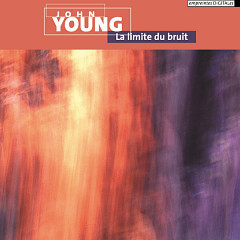
    La limite du bruit dans Sonoloco Record Reviews

    «Review», Ingvar Loco Nordin, Sonoloco Record Reviews, 1 avril 2002
    lundi 1 avril 2002 Presse

    John Young’s new CD on empreintes DIGITALes comes in a beautiful deep blue, with minuscule letters in black. You have to tilt the disc slowly against the light of day to read, but then again; who reads the text on the discs themselves? empreintes DIGITALes, with its completely original packaging (I’m surprised no one else has followed) supplies ample and full documentation on the foldout hard-paper cover, which you slide out of the outer cover. It’s very elegant and stuffed with information.

    John Young (1962) is one of those prolific and talented New Zealand sound artists, whom we have come to appreciate very much. Personally I raised an eyebrow over his humorous and discerning electroacoustic text-sound piece “Sju”, which recently was released on a CD called “New Zealand Sonic Art 2000” from The Music Department of Waikato University in Hamilton, New Zealand. That piece deals with the different pronunciations of the Swedish word “sju”, which means “seven”. It is very hard for any English-speaking person to pronounce the word in a sensible way, but even within Sweden there are at least two major ways of pronouncing it — in fact according to social class, usually! — and a number of minor deviations from those major ways. John Young discovered the peculiarities of this word while residing in Sweden for a while some years ago, and hid deliberations turned into a little masterwork!

    Though born in Christchurch, Young has a mixed background, inherited from an English father and an Italian mother.

    His musical career took off more seriously with a doctorate on the manipulation of environmental sound sources in electroacoustic music. He then continued in the U.K. at the studios of the University of East Anglia, studying electroacoustic composition with another New Zealand émigré (Denis Smalley) renowned wizard of the audios, who has meant more than most for the furthering of methods and ideas in electroacoustic music.

    John Young has lectured at the Victoria University of Wellington and at De Montfort University in Leicester in the U.K. He has also been a visiting composer at a number of institutions, such as the Simon Fraser University in Vancouver, Canada and EMS in Stockholm, Sweden.

    His focus has been mainly on the acousmatic aspect of electroacoustics, predominately on forms based on the distinction between recognizable natural sounds and computer-based studio transformations.

    Track 1 is Pythagoras’s Curtain; a new work from 2001 with a dedication to Denis Smalley attached.

    The first image is extremely palpable. Someone is writing with a piece of chalk on a blackboard, and the placement of the sound puts you right at the interface between chalk and board; you become that interface, and you almost choke on chalk! It’s a fluttering, scribbling dance of Einsteinean formulas, and you sway with the motions, dizzy headed and white with chalk-dust! Magnificent! The blackboard is in your head, right in between your ears, and the piece of chalk is poking around inside your poor mind — especially if you’re listening through earphones.

    Young gradually twists the chalk out of the calculator’s hand, the sound moving sideways into a timbral vibrancy which eventually leads to… a watery sensation… via an incident with crumpling paper… and the winding up of some kind of clockwork — or mechanical toy, maybe — and the watery sounds show up in a sublime counterpoint with the chalk scribbling along, as an added sequence of someone erasing the scribbled messages is introduced, and aah, a balloon; a very popular electroacoustic sound source (Jonty Harrison, for example!).

    This has got to be one of the most successful utilizations of small, close, up-in-your-face sounds ever recorded. The closeness is almost intrusive, and you feel like you have to whisk away some of the too close soundlets like mosquitoes in Lapland!

    However, more distant jingle jangle sounds of hinges — actually, I think, from wet glass being rubbed — provide some perspective, opening the sound space from the very much closed-in to a more open view, where purely abstract electroacoustics move in hypothetical space. Many of the sounds that are introduced as the progression progresses are reappearing in different constellations along the duration. Young handles his sonic pallet with the utmost delicacy, making this piece one of the most exciting and enjoyable in a good while in my ears! The concluding golden timbres of Tibetan mountain passes with the taste of salty yak-butter tea in your mouth do not diminish the experience! Om Mani Padme Hum!

    The 2nd piece presented is Inner, which won Young a first prize at the Stockholm Electronic Arts Award in 1996.

    The sudden inhaling breath is almost shocking. Everyone can identify with physical sounds like these, feeling them right in the body of current residence. Strange elaborations on the breath result in distinctly metallic timbres, joined by cut-up breath, little shrivels of breath, fragments of life-supporting gases in shredded form, having me associate to some of the sound-poets of our day, like Henri Chopin or Bernard Heidsieck.

    Sandpaper layers of air shift like wind in a sand pit, or on the west coast of Denmark where the grass in vain tries to stop erosion. Glissandi turning steadily upwards sound like a graph of terrestrial demographics would look, and voices start talking out of trembling glass, like the whispering spirits of horror at the San Andreas fault showdown… and a culture vanishes to an Atlantis state of affairs…

    The auditory surroundings turn straight into a maze of unintelligible or very complicated sign language, where breath is only apparent as one human ingredient in a seemingly hypothetical or very theoretical state of mind, like were you hominoid, equipped with computer chips and complicated wiring, through which these insisting, intensive, alien sounds move, transmitting messages beyond your control, inside your own being…

    Inner is truly a magnificent display of electroacoustic artisanship! It’s no easy or laid-back place to spend 12 minutes, but rewarding and intriguing. This boy makes trembling glass creak and talk, and just this property of the piece makes it a must for anyone drawn to this obscure art.

    Track 3 is entitled Virtual. This piece begins fast and tight with a conversational flair, though nothing is said — and then a swooping desert wind sets in, like in Michel Redolfi’s “Desert Tracks”, for which source sounds were found in the Mojave Desert.

    Overtones of sandy roughness sweep in and out in a layered noise display, sounding like a giant organ of air and sand rising above the desert floor, where you can see pillars of brownish whirlwinds dance like attentive cobras across the horizon, and the heat and the sand rubs the situation in, leaves no room for doubt; it’s a rough road ahead — but we like these ragged circumstances; backpacks and dusty trekker’s boots…

    Much of Virtual consists of really fast, shifting, fine grains of sound; slices of white noise spread out like construction site blueprints, taken by the wind and rolled up like tacos filled with arithmetic and the whispering of willows and the voices of lost children out of TV static of exorcist movies… or maybe just the distant dying-down of jet engines of passenger planes passing under the horizon on a clear day, the sound spilling down through a crack in the heavens like a spill-over from another universe, from another dimension… setting your tympanic membranes in vibrating motion…

    Big flakes of opposing forces fill the field of hearing, and the whole scenery is crowded with sounds that look like an endless high plateau filled with those South American ants that carry bits of leaves with them, in an ever-moving maze of ant-sails tilted this way and that way.

    Time, Motion and Memory, composed in 1997 but revised in 2001, is track 4. It holds a dedication to Paul Rudy. Ellen Band’s “Swinging Sings” (1992) on Experimental Intermedia XI 124 also deals with the childhood swing. “Swinging Sings” opens with the grinding, whining sound of a garden swing, on which you easily portray a little boy, swinging to and fro in his own thoughts, absent-minded in a summer’s evening under the tree. I think most of us have pleasant memories of our childhood swings, and I still use the swing, sometimes, as a vehicle to hypnotic trance-states of the mind.

    A high shrill sound opens this section, and soon a hint at hinges and chains emerge, but it is in a dreamy, far away atmosphere (memories of childhood; the hypnosis of swinging on a swing at the age of seven, shorts and a summer wind around your knees…) that these faded pictures appear, tinted by age and temporal amnesia; amnesia for all practical reasons, but called up out of the storage by this John Young music… and here we are; suddenly the swing right here in the present moment, loud and clear, chains creaking and squeaking! You sit on the old wooden seat, your fingers clutched to the chains. It’s amazing how close Young can get to a sound, making the listener feel like he is really partaking; that he is the one who is at the scene; the swing slowly moving through a leafy summer’s afternoon in childhood; life a bit sad, a bit on the melancholy side, but a long life possibly ahead, and Mom fixing blueberry pancakes back in the house…

    The other aspect is the purely musical; how John Young takes all these swing artifacts and shoves them around, achieving a chamber piece for swings, right in the long-lost summer of our life, leaving us in the desolation of a longing for a lost golden age, when our senses were clear and unspoiled by schooling and common sense; when life really was the adventure that it really is!

    I admire greatly the utmost compositional care that Young has bestowed on this artful work. Electroacoustic music is really all about composition, of delicate choices and a fingertip sensuality, if anything worthwhile is to be achieved. This work is an electroacoustic masterpiece, musically and mentally; emotionally, considering all the feelings this music awakens. I could live a long time in this music, without intentions, without will; just letting life and time flow through my timeless being in the Universe.

    This CD is concluded with track 5; Liquid Sky, dedicated to Vendela and Isabella, makes me think of a piece called “Precipitation”, realized by David Arzouman in the USA in 1991, harvesting an award at Bourges the same year, in which a heavily manipulated rainfall gradually recedes back to its normal naturalistic sound. The gradual transformation back holds your attention completely alert all the way back to the wet pavement! Young’s work here also had me look up another rainy work of electroacoustics; “Droptrap” by the German composer Werner Cee, which won him a Bourges prize in 1993. His piece is made up solely of the sounds of six water drops, or rather many times six water drops, since the machine that Cee constructed and used handled six water drops at a time. He recorded the sound of the drops hitting different object with contact microphones, and the sound was not manipulated in any other way, just recorded like that onto DAT in real time. He could, however, decide how often the drops out of the six plastic pipes should fall, and so forth, but no filtering or anything took place. The effect is magnificent, and I must remember to listen to this work more often.

    Apparently, then, the electroacoustic lust for water drops has not diminished, and for sure these falling entities, held together by their surface tension, are very practical to work with.

    The beginning of Young’s Liquid Sky is less obvious as to source, the sounds appearing almost in the manner of wind and breath in preceding works on the CD. There is a lot of rustling, as of mice running through piles of newspaper paper, or of flakes of clay or ice shifting position under the force of the weather — but soon a recognizable rainfall moves in, albeit right away giving way to a kind of abstract weather, in which thunderclaps sound more like falling cardboard boxes or tumbling pillbox hat cases from old Bob Dylan songs…

    Tiny grains of sound are interspersed with strong, wavy motions of audio, much like you would apply color haphazardly to a canvas in the more experimental decade of the 1960s. Howling electro-wolves spread moonlight eroticism at reflecting ponds deep down in the spruce forests of this music, and an occasional small fish jumps, its silver belly sending a ray of moonlight your way as you listen to this music which gets progressively more austere, more… enchanted… leaving you at the forest pond with a drifting mist and a fish that doesn’t show up any more, and it’s very still and a bit chilly as the CD spins down to its last revolution. Magnificent!

    … truly a magnificent display of electroacoustic artisanship!

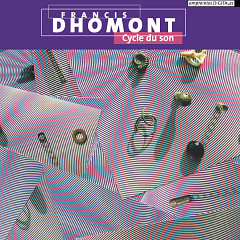
    Cycle du son dans Sonoloco Record Reviews

    «Review», Ingvar Loco Nordin, Sonoloco Record Reviews, 1 avril 2002
    lundi 1 avril 2002 Presse

    Francis Dhomont is — oblivious of his noble age (born 1926) — always and forever the young at heart (characteristics that he shares with Stockhausen and Bayle and Dylan!) Check, for example, his lively participation on the CECdiscuss mailinglist. He is as active as ever in his sound art too, which this new release on empreintes DIGITALes is ample proof of.

    I was looking forward to meeting this good old Maestro in St. Petersburg this coming summer of 2002, when the first “Russian International Festival of Electronic, Electroacoustic, Experimental and Avantgarde Music — Electroshock” is taking place in St. Petersburg under the direction of the proprietor of Electroshock Records; Mr. Artemiy Artemiev of Moscow. Dhomont is one of the many composers and musicians attending this exciting festival, but… Artemiy Artemiev has decided to host the event simultaneously with the Stockhausen Courses in Kùrten outside Cologne, and since I have been asked to attend there (when Stockhausen calls, you do come!), I will miss out on the encounter with Francis Dhomont, who nonetheless is one of my true heroes of electroacoustic art. Hopefully, Mr. Artemiev will check his schedule better next year, if the St. Petersburg Festival will reappear as an annual event. Once upon a time the cultural axis of Europe was an arch from Paris across Berlin to St. Petersburg, and perhaps the time to revive this cultural flow has come now. Let’s hope so, for it was a vibrant, fruitful cultural axis before the Russian Revolution.

    The gentleman Francis Dhomont arrives on this CD with a humorous twinkle in his eye, and part of the shine of his art is this mixture of seriousness and humor, in an almost burlesque, Rabelaisian style. This goes straight to the heart of the listener, and the inside of Existence is repainted with the acoustician’s sonic sable brush, lots of stars twinkling and a small table with a lamp and one chair placed out in the black void of space, centering attention to words being scribbled by good intentions and seasoned with the salt of this earth…

    How good it is that one of these gentlemen with a French beret and a wine glass in his hand, gauloise between his lips, has risen from the café table and walked right into our sound reproduction devices with the art of his poetic mind! Welcome, Monsieur Dhomont!

    Francis Dhomont’s artistic traces go back to people like Ginette Waldmeier, Charles Koechlin and Nadia Boulanger. At about the same time as Pierre Schaeffer, in Paris in the late 1940s, Dhomont independently discovered what could be done sound-wise with magnetic wire; musique concrète being born. In the long run Dhomont gave up traditional instrumental composition to dedicate himself completely to tape work; electroacoustic composition. He lives in a flux between Canada and France; another cultural axis of today, especially in the art of acousmatic electroacoustics, which in France and Canada is especially prolific and poetic.

    Dhomont also writes theoretical texts and essays, and his antecedents show an editorship of L’espace du son published by Musiques & Recherches in Belgium and Électroacoustique-Québec: L’essor published by the Canadian magazine Circuit. Dhomont has also in his career produced many acousmatic radio programs for Ina-GRM of Radio France, and he has co-produced a Canadian radio series entitled Voyage au bout de l’inouï (“Journey to the Unheard-of”)

    Dhomont — in the CD booklet (which of course in the case of empreintes DIGITALes is a fold-out hard-paper contraption, which is utterly original and extremely innovative as well as… pleasant! — and packed with information) — goes on to describe the first of the four parts of Cycle du son; Objets retrouvés (“in memoriam Pierre Schaeffer”): “Both a lamento and a funeral march, this paraphrase of Pierre Schaeffer’s Étude aux objets is not without connection to ornate, figures choral style. Three voices (in the contrapuntal sense of the term), developed from elements drawn from the first movement of the Étude [Objets exposés], embroider and animate the long values of the original subjects that make up the “choral”, which constitutes the fourth voice of the polyphonic composition. The choice of a classical form, so important in Bach, was a conscious one that was designed to honor the memory of Schaeffer. […]

    And so here we have one giant of this art form celebrating another one!

    I listened to the original Étude aux objets by Pierre Schaeffer from the Ina-GRM issue before shifting into Objets retrouvés, concentrating on Objets exposés, and it is of course really a mimicry to begin with, but then I loose myself in the beauty of it all, only waking up to clear reminiscences here and there, where Schaeffer and Dhomont act like soul-mates, though on different planets or in different dimensions — or maybe just separated by a thin, semi-transparent layer of time-lapse, through which only telepathy can penetrate, abiding to the law of non-local connections (Fritjof Capra: The Tao of Physics), which says that occurrences on the atomic level millions of light-years away affect events here, just as clear and distinct as if you yourself slammed your fist into the table to drive home a point in an argument — simply showing that things may not always — or ever! — be as they appear, because appearance is just a convenient way to work perception, which is our way of co-existing with the environment, for practical reasons, but maybe not for any other reasons…

    Anyway, Dhomont’s Schaeffer-music is lightheartedly explorative, bouncing through a jumble of suddenly appearing sonic spheres and cubes, like in a Nintendo arcade game, or in an adventure of virtual reality. The sounds are classical electronic bodies, appearing, receding, reappearing, changing shapes and density, conveying a solid sonic joy of investigation, and the double vision of Schaeffer-Dhomont dances around the stage like Stockhausen’s Lucipolyp in Luzifers Zorn (“Lucifer’s Fury”) from Montag aus Licht (“Monday from Light”).

    This piece is similar to the sight of a child ripping the clothes from a scare-crow out in the farm field, dressing up in the old rags and staggering towards the horizon; playful, spiritual in a special way, very magical… ceremonial even… the child of all ages…

    Track 2 is AvatArsSon; a longer work of 18 minutes. Francis Dhomont has given it a lengthy subtitle: “in six connected parts: Fondation; Avatars; Voix; Aventures; Paysages; À suivre… to the inventors of the treasure… Bayle, Berio, Chion, Dufour, Ferrari, Henry, Malec, Parmegiani, Reibel, Risset, Schaeffer, Stockhausen, Teruggi, Varèse, Xenakis, Zanési… and others too numerous to name…”

    Surely my heart, which largely resides in the body of electroacoustics, beats a little extra at the enumeration of all these great composers, who each and every one has meant so much…

    The jolting, bouncing tendencies keep up, but joined by thermal shocks and timbral layers, as Henryean doors of French sheds creak (Variations pour une porte et un soupir) and areas are opened and closed, whooshing and wheezing atmospheres closing in and opening up; small rooms expanding, the walls shooting out in four directions to the horizon and below, the ceiling lifting into the stratosphere… and suddenly you’re in a summer meadow where a child sits in the grass, as fragments of thoughts flutter around you like a cloud of butterflies; a cloud that explodes, powder of wings setting like a mist around you… and vibrating planes and percussive electronic rhythms merge with watery ascents and descents, your fingers plucking at the spokes of a racing bike wheel at a section of Tour de France that runs straight through your cerebral cortex, where electrical charges transmit messages through the neurons like meteorites across a winter’s sky…

    Thin layers of ice move in above and below each other at different speeds in this music, causing auditory hallucinatory effects, kaleidoscopically tightening and opening, in a breathe of the sound waves.

    Reverse glass paints with thin lines on transparent surfaces, as the sun rises and blinds you with one single ray of light out of the Tibetan high plateau, suddenly hitting hard on your retina, like the light of enlightenment in your post-life Bardo, towards an imminent rebirth… and there’s something reassuringly magical in AvatArsSon as the boy’s voice of Gesang der Jünglinge opens up Stockhausen’s innocent face and curious eyes, penetrating your honesty down to the last drop of coffee-powered creativity…

    A maze of barbed wire — or vibrating stainless pots in a restaurant kitchen — introduce voices, and then the sudden “Dies irae” of Michel Chion’s Requiem… and so many other quotes intertwined in this barbed wire existence of magnificence across the misty expanses of World War I battlegrounds…

    Rolling rocks move like La Mémoire des Pierres by Gabriel Poulard, rocks and pebbles sliding, rolling, bouncing down a decline below an Icelandic glacier in one of Björk’s most gravel-haunting pieces (Aurora from Vespertine; a masterpiece if you’ve ever hiked hard to get to the edge of a glacier in Lapland or in Iceland!), until a minute section from Denis Dufour’s Bocalises — the ultimate glass music! — twists and bulges the sonic field in crystalline refractions of audio… when a terrific havoc breaks out, throwing cardboard boxes filled with styrofoam around the room, like a Picus viridis causing panic in an ant-mound…

    Sirens in the distance and close-up wineglass-rim pings leave room for remnants of coarse sounds falling around you like demolition debris, and tender, tapping bounces of brittle rolling spheres sharpens your attention even more… when church bells toll and crowds in narrow lanes and hooting cars pass by in a carnival or demonstration flurry… only to submerge you into the local shipwreck in the harbor inlet, and all local fish swarm your sight…

    AvatArsSon is a masterly and lustful reflection on the evolution of acousmatics!

    Track 3 is Novars, of which it has already been said that it is the first of the pieced herein to be composed (1989), and that it has been released before. Dhomont has given this also a subtitle: “to music concrète and Pierre Schaeffer, its unfortunate inventor” — and I believe it was Schaeffer who called himself that; “the unfortunate inventor of musique concrète”, and it is a well-known fact that Schaeffer in his older age stood back from his earlier achievements…

    Soft and polished, gently swirling tonalities open this long (19 minutes) work, clearly mirroring some of Schaeffer’s Étude aux objets, but this time around bringing Schaeffer’s aspects way up to the present moment, in high class, reflecting, introverted strands of audio; Dhomont gently and swiftly applying precise timbral nuances with his electronic brush, as the light of day falls in through the many colors of the tinted church windows of his music, projecting rectangles and rhomboids of colored light across the stone floor of the spiritual expanse of the church association… where cats would lick their paws, were they only let in…

    The sacral illusions keep up, as the music gets a bit rough, retreating into a side-crypt filled with brown, unshapely sounds of unsettled arguments and bitter feelings, the furniture moving in kinetic automation in this ill-spirited force-field, almost like in Ákos Rózmann’s Crypt With Table and Chairs or La Monte Young’s Poem for Chairs, Tables, Benches etc. There is furniture at un-rest in this section of the music. An exorcism of sorts is called for… if we’re going to sweat this out, tepee style, medicine man style… and sure enough, a relative calm returns, with minor glitching frictions appearing between time-layers, between now and right before and a long time ago… but the landscape opens up in fresh-air views of canyons and mountains, as vibrations of stylized woodpeckers salute the forested north, be it in Canada, Scandinavia or Russia; many creatures live there which we will never see, and the smell of resin greets us in fresh fragrances out of the awesome expanses of coniferous forests in Dhomont’s sound-painting.

    A wild, almost medieval dance — a gigue of brutal, harsh upheavals — follows, in which love and death grab at each other in an almost even show of force, while shooting grains of sharp, metallic audio move outwards in gravitational trajectories — and it gets calmer again… after the catharsis…

    Indian sandalwood incense rises towards the ceiling of my Scandinavian room, and in the music torch lights flicker in a cave in France, where prehistoric paintings are about to be discovered… and life is richer than can ever be understood by the living…

    The concluding last track of the four is Phonurgie, which Dhomont has equipped with a dedication: “to Inés Wickmann and her found objects”. Inés Wickmann is a Colombian sculptor and artist who lives in Montréal, Canada, married to Francis Dhomont. An interesting project that Wickmann has participated in is the Breathe Project, which also has a bearing on the reviewer’s native Sweden.

    The initial gesture is the same, but then an eerie ring rinses your mind like Harpo Marx’s handkerchief, as thudding, drilling sounds even mimic all too familiar mobile phone irritations… but maybe this is simply reminiscences of short-wave communications… Many grainy properties appear here, like were you emptying sacks of green peas on the industrial conveyor belts of earlier and almost forgotten decades…

    Jet engine magnitudes fill the space completely, big fuselages taxiing out on concrete runways until flapping birds’ wings envision feathered bodies dispersing in all directions…

    Hectic jumbles of entrapped sounds move about madly inside the sonic magicians electronic bottle, reaching speeds that in real life would heat up the confined space to melting of the glass, which would flow out in gluey shapes, like Salvador Dali’s melting watches…

    Dhomont’s sound art has many properties in common with Gaudi’s architecture in Catalonian Barcelona; the prohibition of bourgeois, degenerative 90 angles, the unexpected and uneven distribution of weight and mass, nonetheless balancing out in mysterious calculations of mechanics of materials, like in Sagrada Familia’s exclamation of a joyous, triumphant “Sanctus! Sanctus! Sanctus!

    … the shine of his art is this mixture of seriousness and humor, in an almost burlesque, Rabelaisian style. This goes straight to the heart of the listener…

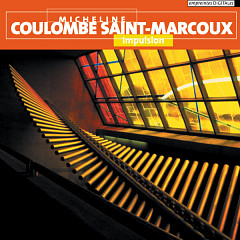
    Impulsion dans Sonoloco Record Reviews

    «Review», Ingvar Loco Nordin, Sonoloco Record Reviews, 1 avril 2002
    lundi 1 avril 2002 Presse

    I sincerely appreciate when empreintes DIGITALes digs into the archives and releases some historical material, which I think the content of this CD must be considered. The composer — Micheline Coulombe Saint-Marcoux — passed into her Bardo and her next life in 1985, and most of the material herein stems from the early 1970s, even though it may sound more modern and current than that.

    I suppose there must be a goldmine of archival tapes in the annals of electroacoustics, and I urge any recording company with tapes on hand to start releasing the material. Almost all historical or archival material that I’ve heard — including the pieces on this CD — has been very enjoyable and of the greatest interest.

    Micheline Coulombe Saint-Marcoux — born in the Canadian region of Lac Saint-Jean in 1938 — moved to Montréal in 1958, 20 years old and bent on a musical career. She began her studies with Claude Champagne [composition] at École Vincent d’Indy in 1960, and continued her studies with Clermont Pépin at the Conservatoire de musique de Montréal in 1963, where she stayed until 1967.

    Of course, these were overly interesting days in the fields of popular music — which turned poetic and even surrealistic with people like Bob Dylan, descending on New York and the world from remote and backwards Hibbing of Northern Minnesota — and contemporary art music, where creativity simply exploded at — to just mention a couple of places — San Francisco Tape Music Center (Terry Riley, Pauline Oliveros, Ramon Sender, Donald Buchla!) and Mills College, if we’re to stay in the North American part of the world. Of course, in Europe there had been lots of things going on in electronic and concrete music since the late 1940s, with Stockhausen, Eimert, Pousseur and many others shaping audio art that flabbergasted even the hip subterraneans of the avant-garde, but in the 1960s this creativity and ingenuity practically exploded, spilling over into mainstream cultural tendencies, and Stockhausen even appeared on the cover of The Beatles’ “Sgt. Pepper” in 1967.

    In these benign circumstances Micheline Coulombe Saint-Marcoux intensified her efforts. In 1968 — the revolutionary year of Rudi Dutschke, Daniel Cohn-Bendit and the May upheavals in Paris — she headed for the French capital at the suggestion of Iannis Xenakis, to study electroacoustic music at one of the idiom’s holy shrines; Groupe de recherches musicales, where she worked with François Bayle (turning 70 in March 2002!) and Guy Reibel. I can hardly think of a better time or a better place to study mind-expanding and limit-pushing audio art than in Paris at the GRM in 1968. That certainly was the right place and the right time. The whole cultural atmosphere was permeated with the spirit of will-do, with the feeling of anything being possible, and with an exploding force of creative curiosity — and in Germany the seeds of the Rote Armee Fraktion (the Baader-Meinhof group) were sown…

    However, Coulombe Saint-Marcoux’s grand tour of famous teachers didn’t end with Bayle & Reibel. She in fact when to school with the great grandfather of musique concrète; Pierre Schaeffer, at Conservatoire National Supérieur de Musique in Paris. She also had private lessons with Mr. Gilbert Amy. As a part of a five-composer initiative she founded an electroacoustic entourage called Groupe International de Musique Électroacoustique de Paris, which traveled the horizons between 1969 and 1973. This woman had a lot of ingenuity and will.

    Upon her return to Canada in 1971 she began teaching at the Conservatoire de musique de Montréal, where she held a position until her untimely death in 1985.

    In Canada she kept very active, working to build an electronic music studio of international stature, together with Gilles Tremblay and others.

    Her engagement in visual arts was intense, and she felt that she was working sounds the way painters — especially her acquaintance Marcelle Ferron — were working colors, and myself, I’ve always felt that much electroacoustic music works just like non-figurative art does, or Japanese calligraphy, or modern ballet of the touring dance companies. Coulombe Saint-Marcoux took great interest also in poetry, theater and dance.

    Track 1 on this CD is a piece by the mysterious title Arksalalartôq, conceived 1970-71. The piece starts like a wild, furious and… fun sound-poetic pastime, or a street theater of sorts, voices and electronic sounds rising and falling in clear-cut shapes. The voices keep mingling with frictional rubber balloon sounds, grunting and breathing, inhaling and wheezing! The music is very irregular, amassing whatever came to mind, it seems, even adopting methods and nuances from Donald Buchla’s Buchla, as it appeared in Morton Subotnick’s early works, and I can trace some of Pauline Oliveros’ experimental, long, winding and merciless gutter gut sounds herein too, both in sounding similarities and a kinship of idea, of concept, of artistic realization.

    Fluttering electronic winds merge with Thomas Buckner-like vocal expressions and earlier French sound-poetic wildman-stuff by Henri Chopin, Bernard Heidsieck or François Dufrêne! Coulombe Saint-Marcoux gets a lot — a lot! — into this comparably short piece; it’s dense, packed with ideas!

    Meowing cat sounds turn on a sexy fragrance, which winds down in a silence that soon is disrupted by iron-grinding metallic audio of the kind we have experienced from Romania and its enfant terrible; Iancu Dumitrescu; spectral music right in the bubbling, boiling middle of Coulombe Saint-Marcoux’s never-ceasing exploration, which nonetheless cuts itself short by oozing down in a typical 1970s electronic echo crack of the kind you might find in works by Rune Lindblad or Gottfried Michael Koenig from that period.

    Track 2 is Contrastances from 1971. Again, a frictional sound gets the lot moving, and then the fast transitions take place again, from obvious piano body sounds; lid banged shut, strings plucked (like had the composer gained access to Ross Bolleter’s outback bar piano decaying through the sunny, dusty decades of hot stuff Australia) — to gushes of steam or contact microphones attached to balloons (however that would be done) and many breathing sounds or air pillar sounds, and perhaps clarinets and flutes being played on the valves without any breath pressing through the pipe…

    All kinds of “atmospheres”, i.e. different size spaces, giving off different kinds of reverberation, are passed through, and Coulombe Saint-Marcoux succeeds in getting a reverse Indian shahnai or perhaps a regular European oboe appear extremely enjoyable and interesting, almost having you wish she would have extended that one particular backwards shahnai into a full-length piece all by itself; the sounds making me feel so airy, flowing with the flow, some distances above the ground!

    Slower replays of whatever source material — appearing to me to be some blown instrument — growl deep down into shamanistic vibrations of mud flows and inching giant glaciers, crevasses opening up in all directions, sucking you down into a cold world of icy walls and an assured preservation for future millennia, or maybe just a crushed, mangled trace of a human… Otherworldly, 2001 (the movie!) sounds have you dance around the monolith, and on this mysterious time-space key the piece winds down…

    Track 3 is called Moustières, and it was composed in 1971 as well. It is a desolate and eerie landscape that opens up, winds tormenting you with their chilly gusts and their gullies of sharp snow, reddening your cheeks as you strive for an uncertain survival. On another plane, a psychological or spiritual, the sensation still is one of danger, perhaps to your sanity at the onset of schizoid tendencies or forced thoughts — or this could be the dark sounds out of the void that engulfs you when you’re lefty behind in a divorce, or when your child abandons you. It’s dark, it’s serious — and the nature of the sounds is sheet-steel-like, frosty, chilly, hard, rough-edged, at least up to the point when voices, not unlike the vocal haphazard of track 1, are introduced, somewhat altering the fearful impressions from before. Still, however, these are sounds from Rauschenberg paintings; frames with scratchy layers of white paint all over the rough canvas; lots of surface imperfections and a crude statement of nihilism… perhaps… and if this is a sensual perception of the Alps, I can hear the thoughts of those giants — Matterhorn, Mount Blanc — slowly twisting their unimaginable weights in eon-long movements which upset the surface tension of the whole planet over time, and Swiss maids walk up and down those grassy flower-fat slopes under the summits, under the glaciers, with goat’s milk in their buckets…

    Track 4 has the title Zones, composed 1971-72. The thin line which spreads out in a timbral band, spiraling on through empty space, is the protruding electronics of Micheline Coulombe Saint-Marcoux in one of its most intriguing appearances, wherein the timbres grow and grow and shift their spectra in myriads of little shining, glittering stars in the grayish fabric of “white” noise, and the more you listen, the more you sense particulars, details, small events inside the big scheme of things, and speeds slowing down, different sections slowing down at their own speed, turning and twisting and swaying the durations, the pitches growling, howling, meowing… as loose bits of a piano sail down in slow-motion around your listening area like fragmentary memories through voids of amnesia…

    Hinges screech suddenly, a door opens on another layer of existence, another strand of thoughts commences, electric insects flutter their wings like high voltage speed freaks, and the sharp sounds tear at your hearing… gleam in your earring…

    Acoustic instruments share your attention towards the end, attack-less tam tams or gongs without recession encircle the steadfast motion of the general body of sounds, eventually winding down in a stooping glissando which ends all sounds…

    The last track — no. 5 — is dedicated to Françoise Barrière and Christian Clozier in Bourges, and it’s entitled Constellation I, of a much later origin than then other pieces, 10 years their junior, composed in 1981. It has the longest duration of the works presented here, with its duration set to a few seconds short of 19 minutes. Stark strokes of the paint-brush, or of the sheet-steel with a steel brush, shows the way through the successive rooms of darkness that have to be passed, into a larger room where a haywire piano plays by itself, up and down the register… and I get visions or flashbacks of staircases and attics, and staircases and cellars, the little window on top of the wall the only escape from something lurking, something hiding inside the dark cellar, or perhaps inside your closed mind, which badly needs prying open, if only this nightmarish life could open up into something less frightening, and when 15 minutes remain of this work a horse neighs loudly through the canvas of the painting on which it is portrayed, hardly visible in the comparative darkness of this house of many rooms, and the reality of the room — which feels unreal like the dress-code of a schizophrenia conference in lap-top super city at the hard end of ages — seamlessly transforms into a reality beyond this reality, but which is a consequence of this reality, and door after door opens up like in a slap-stick Beatles movie, and this music really is a magical mystery tour… Electrical charges shine in quick flashes through your cerebral cortex (this is the music!) like meteors shooting across a winter’s night, calling for the wishes of untold numbers of human beings, flocking through the darkness of the curving planet… and this is the music of Micheline Coulombe Saint-Marcoux too, but as it continues it is molded into something else, and a fun-fair Donald Buchla, Morton Subotnick machine-joy lever-lover kicks in and hoists us upward and forward into further elegies of sexy sonics, wherein the listener surely mourns the presence of this sound artist Coulombe Saint-Marcoux and her swift mind and light hand, adjusting the pitches and the timbres in her magic tool shed under the sky of Bourges in a June so far away… Nature sounds (birds, frogs, human thoughts made audible through a process of identification) merge with instrumental sounds (flutes and what not) and all the electronic wizardry of the early 1980’s into an all-encompassing celebration of existence through sound, brilliantly loved forth, brilliantly loved along… into an electronic khoomei sequence of the high plateaus of the Tibet of your spirit, where you stand in the middle of yourself, gazing up at the stars of an unfathomable space, an irresistible life.

    … an irresistible life.

    Parasites dans Incursion Music Review

    «Review», Tobias C van Veen, Incursion Music Review, no 049, 31 mars 2002
    dimanche 31 mars 2002 Presse

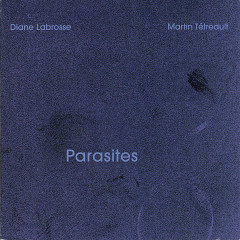
    Beginning with crackled sound, almost abrasive and entirely disruptive, Labrosse and Tétreault shake the listener into thinking that one is listening to a new work by the electroacoustic duo Interface. But things take an entirely different turn within seconds, and interspersing the sound-cackle-crackles with silence leads the listener to humming and resonating melancholic spaces that can only be properly described as underwater caverns. In these caverns are Cave People; and they are composing music. It is a peaceful time, and by the time track 5, sponger, rolls around — these are very short tracks, all about two minutes or so in length, except for track 11, a coal eye, which is 10 minutes — I am fully immersed in the sketches of sound which paint a visual aura to the impressively wide range of experimentation found from track to track. For example, track 6, insomnia of a bed-bug, disrupts underwater-land and introduces radio static-hum which, in a playful mood, dances with the clicks of a clock. That the elements are cavorting with each other should come as no surprise, for like Interface, Tétreault and Labrosse are a live improv duo; but unlike Interface, they manage to maintain my interest by moving through different phases of sound as well as conceptual environments, easily handling slight noise and static, tones, hums, and clicks. Labrosse, according to the liner notes, works solely with “abstract elements.” I am not sure what the entails in terms of gear, the hazy blue picture of the duo leaves the details indiscernible. Tétreault works directly with turntables: no records, just manipulating the sounds to be found in the decks themselves. Given this palette, both Tétreault and Labrosse manage to construct a dramatic and engaging topology of sound which, for the most part, is in the experimental ambient genre, and in moves of inspired stage magic, know exactly when to end a sound that has lost its ability to engage the listener. A succinct and playful album of experimental madness which, despite — and perhaps because of — its overwhelming undertones of intelligence, does not force the listener into obscurity.
    A succinct and playful album of experimental madness which… does not force the listener into obscurity.
  • 19
  • 20
  • 21
  • 22
  • 23
  • 24
  • 25
  • 26
  • 27