electrocd

More from the blog

22 results
  • 1
  • 2
  • 3
  • 4
  • Connexion, Évidence matérielle, Traces, Sources / scènes in Skug

    “Kritik”, Wolfgang Fuchs, Skug, no. 47, May 9, 2001
    Wednesday, May 9, 2001 Press

    Elektroakustik sagen die Einen, Ambient die Anderen. Schwammige Begriffe, die aber doch das Spektrum des kanadischen Labels empreintes DIGITALes gut beschreiben. Verzeiht uns die Schubladen.

    Wenn ich die Gemeinsamkeiten, oder besser die Parallelen der mir vorliegenden Veröffentlichungen auf empreintes DIGITALes beschreiben müsste, so könnte das mit der Umschreibung »Walk In The Park« eventuell gelingen. Gemeint ist damit der Verweis auf Brian Enos Parkbank-Aufnahmesessions, in denen dieser nicht unbekannte Vertreter der sogenannten Ambientmusik – unter welchem Aspekt hier Ambient beleuchtet wird, sei der Unvollständigkeit halber mal ausgelassen – Ausschnitte aus dem täglichen Treiben im Central Park mit seinem Aufnahmegerät konservierte und einer nachträglichen Studie unterzog, in deren Verlauf er jeder Klangprobe einen Wiedererkennungswert abringen konnte.

    Bei Louis Dufort und Denis Smalley werden Bahnhöfe, Industrieanlagen und Flugplatzeinflugschneisen in den Klangraum aufgenommen bzw. dieser um jene Komponenten erweitert. Dieses konkrete Material wird aber nicht nur in zitathaften Einsätzen einem musikalischen Prozess zugeführt, sondern aus seinem ursprünglichen Rahmen herausgerissen, um mehr oder weniger manipuliert und veredelt in die Chronologie der aufgezeichneten Geschehnisse rückgeführt zu werden. Daraus ergeben sich abgeschlossene Klangreisen mit durchaus vertrauten Spannungsbögen – man stelle sich etwa eine spätnächtliche U-Bahnfahrt vom Wiener Stephansplatz mit Linienwechsel nach Floridsdorf vor –, die ein passives Hören (Klangtapete) sehr gut abblocken können.

    Kompositorisch strenger und vielleicht auch arithmetischer gehen die Labelkollegen Adrian Moore und Jonty Harrison mit ihrem elektroakustischen Hantieren vor. Der 32-jährige Moore, ehemaliger Student bei Jonty Harrison an der Universität von Birmingham, gliedert seine Werke auf»Traces«grob in drei Klassen: »those verging towards the abstract«, »those focusing upon re-hearing natural sound-objects« –»Study in Ink«ist das Ergebnis einer musikalischen Studie eines Markerstiftes auf einer Tafel und die Auswirkungen des Austrocknens dieses Stiftes auf dessen Klangverhalten – und »the radiogenic«. Letztgenannter Kategorie weist Moore sein Stück»Sieve«zu, in dem er das eingesetzte Material von Information, Sound und Bedeutung in Bezug auf den Verwendungszweck zu entkoppeln versucht. »If one forces listening at the wrong moment, the clarity of the listening experience changes and something ‘musical’ can sometimes be heard”. Auch bei Jonty Harrisons»Évidence matérielle«steht der Interpretationsfreiraum für den Hörer in einem interessanten Verhältnis zu den vom Musiker intentierten Assoziationsketten. Manche Passagen klingen nach Herumirren auf Straßen zur Rushhour, aus unterschiedlichen Positionen betrachtet. Hinter den Kulissen schöpft Harrison jedoch aus einem umfangreichen Fundus an Tools, etwa aus Holz und Metall im Spannungsfeld zu rein elektronischem Instrumentarium.

    Dieses gekonnte Reduzieren auf die akustischen Ereignisse an sich und das damit einhergehende Fördern und Fordern des Hörens macht das mittlerweile elf Jahre alte Label empreintes DIGITALes zu einer wichtigen Plattform für zeitgenössische Elektroakustik.

    Sources / scènes in Incursion Music Review

    “Review”, Richard di Santo, Incursion Music Review, no. 026, April 29, 2001
    Sunday, April 29, 2001 Press

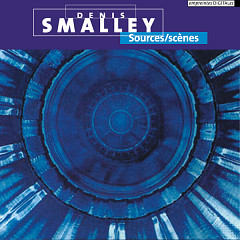
    In what is referred to collectively as the British Connection, empreintes DIGITALes recently released these three discs featuring the works of three prominent electroacoustic composers from the UK. […] Lastly, electroacoustic pioneer Denis Smalley’s Sources/scènes documents five acousmatic compositions realised between 1974 and 2000, thus covering over 25 years of electroacoustic research and composition. The first three pieces (Base Metals, Empty Vessels and Tides) are exercises in utilising single sound sources (metal, garden pots and water respectively). The final piece, Pentes (meaning slopes, inclines, ascents), is an early composition from 1974. It begins as a bustling synthetic landscape of bizarre sounds, cut-ups and explosive clusters; and yet it suddenly shifts into a quiet movement, where a drone gives way to a haunting melody on the Northumbrian pipes, and leaves everything quiet and still. Smalley’s disc probably represents the most dynamic of the three reviewed here; the sounds open up before your senses, become tangible, and carry with them not only an incredible momentum but very strong moods as well. Missing from many acousmatic compositions is the presence of mood, making suggestions and appealing to the listener-spectator’s emotions as well as his senses or his academic interests in sonic structures. Smalley writes in his liner notes that “quite noticeable in all these works is the almost complete absence of a human presence in the sonic fabric: the listener-spectator is left to observe and experience the scenes and spaces, alone.” However, this statement by no means excludes the importance of the listener’s response, rather it emphasises and elevates its importance. He further writes: “between and beyond the loudspeakers, virtual, metaphorical worlds approach and encroach in sonic flow, and are revealed for imaginative contemplation.” Sources/scènes comes recommended for the adventurous.

    … recommended for the adventurous.

    Sources / scènes in Sonoloco Record Reviews

    “Review”, Ingvar Loco Nordin, Sonoloco Record Reviews, April 15, 2001
    Sunday, April 15, 2001 Press

    A new CD from Denis Smalley is in itself a real event; such is his reputation! This CD is one third of the new grand slam from empreintes DIGITALes: the British Connection – though Smalley really does originate in New Zealand… but he moved to the UK already in the 1970s. For a while there, though, I thought the old Empire burlesque (!) had started to brew again… Well, Smalley really initially came to Europe on the French Government Bursary in 1971 to study with Olivier Messiaen in Paris, but also achieved a diploma of electroacoustics at the renowned institution GRM; Groupe de recherches musicales.

    I’ve always held Smalley in the highest esteem, as one who continuously keeps on putting out high quality, high-art electroacoustics. The piece that really blew me away once upon a time was Wind Chimes (1987), released as part of a CD (WER 2025-2) in Wergo’s series Computer Music Currents – on CD 5 of that series (1990). I remember that I’d just set up the gear at home after a major up-grade of equipment. Wind Chimes was the first CD that I played through it – and I was stunned! They guy who helped me bring the gear home and set it up was unfamiliar with any kind of electroacoustic music, and looked completely helpless when the first loud chime cut through the room like a shining sword! So many intriguing sounds; so much imagination, beauty, playfulness, downright auditive obsession! Later on Wind Chimes was released on Smalley’s first CD on empreintes DIGITALes; Impacts intérieurs (IMED 9209). On that CD another piece, which Smalley first issued on Volume 6 of the aforementioned Wergo series – Clarinet Threads – was also reissued.

    So, this is his second CD on the label. I do not usually take much note of what the composer or the label has to say about the different pieces, since electroacoustic music in my view is to be compared with abstract art, I mean abstract, non-figurative painting — which it can be intellectually amusing to discuss the ins and out of, but… that’s that! It might be of interest to some to know what kind of software was used, or which machines – but ultimately it’s the resulting sound that constitutes the end to which the soft and hardware are the means. Only experts and conservators will want to find out the exact chemical make-up of a painter’s paint. Contradicting myself – not uncommon! – I nonetheless recommend the listener to read Smalley’s texts on his music, since they are unusually well formulated, taking on a sort of musical, spatial guise themselves.

    The first piece on this CD is Base Metals (2000). The title alone tells you what to expect; metallic sounds… but maybe this isn’t what you might think anyway, from the title. The events are extended, swooping, like running your hand or your mind along the curved surface of a parked Boeing 747, below and in front of the cockpit windows, down along the bulging nose section, and the sun is shining on a cold spring day, maybe up in Seattle. The metal is smooth, cool, almost sexy under the passage of your hand, and you feel the molecular make-up of the metal, you can sense the atomic jitter, and as you identify even further into the metal you feel, in bewilderment, the shooting trajectories of elementary particles… until you brace yourself, shake your senses and return back up through the worlds of matter, back to your good old self, with your hand almost perversely stroking the jet… and you realize that that’s not where it’s at either, because in real reality your just sitting there listening to Denis Smalley’s Base Metals

    Empty Vessels (1997) is the second entry. In this case it definitely pays off to read the composer’s introduction. Smalley has recorded the air resonating through some large garden pots from Crete and an empty olive jar from Turkey. The recordings took place in the composer’s garden in northern London, which explains why you can hear the sound of rain and passing airplanes, for example. Naturally Smalley has gone further with the resonating sounds, and developed certain aspects of them by the manipulations that are easily accessible to a shaman of sonics! At first you hear the thrushes of a wet garden, but it doesn’t take long for a mosquito and an airplane to arrive and pass at the same instant… The thrushes keep it up, so I suppose the recording was made no later than May. The next plane flies by above the roofs of London, but the resonance it causes in the jars hang on and develop into a murmur of its own, sporting a brilliance of overtones, when the rain starts coming down like miniscule explosions. The rain on the jars produces a rewarding noise, with many beautiful layers of sound that seem to be moving forward relentlessly, as the sound of the rain merges with the intense buzzing of a swarm of bees which perhaps seeks protection from the rain inside the jar, right at the microphone… It’s all seamless, streaming – streaming audio! When you feel too sedated as the environment gears down into a lazy day of leisure with a hypnotic backdrop, Smalley slaps you on the cheek with a sudden impact, which again introduces rain, birds, planes and the vibrating resonance of a rainy London day, when the smoke bends back to the ground and umbrellas make an aerial view of the streets look like mushroom marches of fungi causes. Even thunderclaps echo inside the jars in the garden. It’s a bit like a hidden-away feeling, as if you were curled up inside a drain pipe outside the factory, eating away at your sandwich as the rain pours down; a safe, cozy, secret feeling!

    On it goes. Number 3 is Tides (1984), with the subtitles Pools and Currents and Sea Flight. This was the first work in which Denis Smalley utilized computer transformations of source sounds. This quite much older piece brings us into a marine environment, title-wise, but is it, in context, mostly as an idea, a theoretical construction of relations between events…? Not really. Soon events occur that place you right at the shore of a woodland lake, as the gentle ripple of miniature waves taps the sand and pebbles, and you lie there by your canoe, resting, studying the light summer clouds. You feel all that gravity, but at the same instant you feel your mind letting go, to hover in suspended weightlessness and hypnotic introversion some distance out above the surface of the water. Piece! Rest! Many inner sounds! Visions on the loose! Body let alone! Pearls of sound, reflecting daylight thoughts. Bubbles of sound, emerging, popping. Much is going on here, of an intricate character, on a mystical level, and the piece is long, adding up to no less than 30 minutes; almost French durations! We like it! Leave it out there for a good while and let it brew. Then the fairytale quality is bound to seep up like methane through the marshes, as so often in works by Jacques Lejeune or François Bayle – and the procedure functions in Smalley’s piece! Nature becomes enchanted here, and the elves and the fairies gather around a gray, bearded sage, sitting on a moss laden rock in the meadow, as individual rays of light angle down through the greenish mist, lighting up the wrinkled features of the old magician’s thousand-year-face. Secrets are felt through the vibrating sonic transparence. The sea is never far away, and in the second movement the waves roll back and forth through your head, if you’re listening through earphones. Some chirping sounds call up visions of sea birds, while bell-sounds (without the attack) make me think of some pieces by Jean-Claude Risset (Sud in particular)

    In the last, and oldest, piece – Pentes (1974) – you may hear Northumbrian pipes. Smalley has transformed other instrumental sounds here as well, though without providing any hints as to their origins. Short and noisy events come charging in clusters, violently, and it is apparent that the music is older – but by no means inferior to newer stuff – just… older. Maybe Smalley’s electroacoustic identity hadn’t been thoroughly molded by 1974 either, which is why this piece could have been realized by a number of emerging composers of the time, like Rolf Enström, Tommy Zwedberg or Åke Parmerud. Nevertheless, it’s a massive piece, with dangerously sudden changes of moods and speed… and volume! Later slowly gliding processions of timbral drones let the Northumbrian pipes rise like mist out of the glens… Magnificent!

    Magnificent!

    Sources / scènes in The Wire

    “Classical”, Andy Hamilton, The Wire, no. 206, April 1, 2001
    Sunday, April 1, 2001 Press

    The disc by New-Zealand born Smalley, student of Messiaen and GRM, shows the same oscillation between electroacoustic and soundscape traditions as Jonty Harrison. Base Metals abstract from the resonances of a family of metal sounds sculptures while Empty Vessels transforms recording of air resonating in large garden pots while also capturing environmental sounds. An enjoyable addition to empreintes DIGITALes acousmatic series.

    An enjoyable addition to empreintes DIGITALes acousmatic series.

    Sources / scènes in All About Jazz Italy

    “Recensione”, Jacopo Andreini, All About Jazz Italy, April 1, 2001
    Sunday, April 1, 2001 Press

    Musica concreta, acusmatica [per un approfondimento leggi l’intervista di AAJ a Eric Leonardson cliccando qui], ambient, un percorso a ritroso nelle composizioni di questo neozelandese che ha studiato qua e là nel mondo con grandi nomi della musica (Messiaen, Schaeffer) ed ha contribuito a sviluppare l’amplificazione sonora.

    Registrazioni in cui l’uomo fa solo da spettatore, o quasi, in cui i suoni reali (soprattutto acqua) vengono lasciati fluire — perdonate l’evidenza del verbo — coi loro tempi, sovrapponendosi ad altri amplificati e/o processati elettronicamente. Vasi di ceramica (di Creta e da olive proveniente dalla Turchia, se per voi hanno un suono diverso), pezzi di metallo, pioggia, aeroplani, mosche, ronzoni, tutto preso e stratificato con ritmi da colonna sonora, per un ascolto sicuramente coinvolgente, ma imbastardito (male, per i miei gusti, poi chissà…) da sciabordate di synth armonizzato.

    Si sente pesante la mano della storia, della tradizione e della conservazione della musica elettroacustica e concreta, poche storie, quindi gli appassionati adoreranno questo disco, presentato in una veste ricercata e dal sound perfetto, come se si trattasse di storicizzare il compositore (e magari questo è l’intento) che propone materiali risalenti a quasi venti anni fa come all’anno scorso dal suono e dalla coerenza invidiabile (salvo Sea Flight che esagera con la violenza e i synth, e inserisce una cornamusa sul finale, e fa assomigliare il tutto a una specie di pezzo con tempesta e quiete successiva a rappacificare gli animi). Oppure dalla monotematicità deprecabile (salvo l’altra parte del brano Tides, Pools and Currents, che suona possente e strutturato e quindi “giovanile”, anche se dubito che questa famiglia di musicisti/compositori ami sentirsi “giovane”).

    I bicchieri ogni giorno di più sono a metà, a voi stabilire se pieni o vuoti. (3,5)

    3,5

    Sources / scènes in Westzeit

    “Kritik”, Klaus Hübner, Westzeit, April 1, 2001
    Sunday, April 1, 2001 Press

    Denis Smalley veröffentlicht ein mehrteiliges Klangkonglomerat aus den Quellen der akustischen Umwelt. Base metals entwickelt sich aus einem streng naturwissenschaftlichen Konzept: das Basismetall tritt in eine Verbindung mit anderen Substanzen ein. Im Ergebnis, das Smalley präsentiert, kommt und gehen die Klänge wie die Schwingungen eines metallischen Korpus. Der imaginäre Sound besitzt einen metallischen Grundton, dessen Quelle nach der Bearbeitung kaum noch auszumachen ist. Empty Vessels geht einen Schritt weiter und integriert reale Klänge wie das Vogelgezwitscher und Flugzeuglärm. In Tides schlägt die Natur zurück: Machtige Wellen aus elekronischen Quellen spülen auch störende Geräusche an den Hörstand. Denis Smalley studierte Musik an verschiedenen Universitäten und beschäftigt sich intensiv mit Auswirkungen von elektronischem Sound in verschiedenen Aspekten.

  • 1
  • 2
  • 3
  • 4