electrocd

More from the blog

17 results
  • 1
  • 2
  • 3
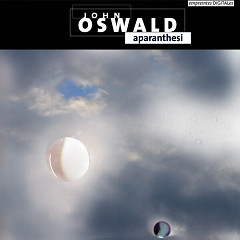
  • Aparanthesi in The Globe and Mail

    “Mystical Sounds from One Note”, Robert Everett-Green, The Globe and Mail, December 18, 2003
    Thursday, December 18, 2003 Press

    Ad Reinhardt used to claim that his all black canvases were the last paintings anyone could make. By the same serious/playful reasoning, you could say that John Oswald’s 65-minute Aparanthesi marks the end of the line for recorded composition, because it contains only one note.

    But what exactly is one note? Apart from pure sine tones, every sound we hear is a messy conglomerate of vibrations that determine not only the fundamental pitch but also the density and flavour of the sound. They are the reason a mosquito sounds different from a violin, though a recording of either can be tuned electronically to one pitch, or subtly altered until the bug seems to be morphing into the fiddle. Apply that kind of manœuvre over a range of 10 octaves, and throw open the studio door to any and all sounds that can be recorded, and you begin to understand why it took Oswald three years to edit his one-note composition down to two versions of roughly half an hour each.

    Aparanthesi is a profound and surprisingly dramatic work. Its open octaves claim a kind of cosmic scale, though many of the constituent sounds are minute, or deliberately camouflaged by other sounds. Each transition remains tethered to the core pitch, which in time takes on the grounding quality of a monotone chant. Even before a group of monks made a cameo appearance in aparanthesi B, the piece has enacted the unity of motion and stillness, and hearing it can be a mystical experience.

    The two versions cleave to two slightly different pitches: 440 kHz (the A used by orchestras and piano tuners) for aparanthesi A, and 480 kHz (the undertone emitted by electrical equipment) for aparanthesi B. The second version, originally developed for a live performance, is the more theatrical, and the more revealing about its source materials. Both exploit the ear’s tendency to preserve a fuzzy zone of acceptability around a given pitch. The relationship between “in tune” and “out of tune” fascinates Oswald, who has made several tuning pieces for live and recorded sounds, and whose music celebrates perfection and deviance with equal fervour.

    Aparanthesi is ultimately about paying attention, to sounds and their qualities, and to the mysterious interrelation of unity and difference. It’s the practical realization of a metaphor coined years ago by R Murray Schafer: the tuning of the world.

    More information about Aparanthesi can be found at www.electrocd.com.

    Aparanthesi is a profound and surprisingly dramatic work.

    Aparanthesi in The WholeNote

    “Review”, Alison Melville, The WholeNote, no. 9:4, December 1, 2003
    Monday, December 1, 2003 Press

    I first discovered this label through Humeur de facteur, an electroacoustic recording created by Yves Beaupré from the various sounds made during construction of a harpsichord. It was a fascinating and revelatory experience, and Aparanthesi by John Oswald is no less so.

    Oswald, born in 1953 to what he describes as “a profoundly amusical family”, is a familiar Canadian figure in the world of new music. He created Aparanthesi, of which two versions appear on this disc, as an exploration of a single pitch, an idea with which he has worked in several earlier compositions. “I was hoping to find an interesting way to follow… the morphing of a pitch through various instrumental, acoustic and electronic forms,” he tells the reader in a lengthy interview contained in the CD package. The results are quite remarkable. Using the sounds of piano, cello, birds, thunder and rain, cattle, a foghorn, and more, Oswald has created an extraordinary, interior/exterior auditory experience. There isn’t sufficient space here to go into further ‘technical’ details; follow the links at www.electrocd.com if you’re curious. What I personally appreciate is Oswald’s invitation to tune into a particular musical sound-world, and then to follow its effects upon one’s own inner world. Kudos to empreintes DIGITALes for providing us with the opportunity.

    … a fascinating and revelatory experience…

    Aparanthesi in AllMusic

    “Review”, François Couture, AllMusic, October 21, 2003
    Tuesday, October 21, 2003 Press

    This album is not about “plunderphonics,” but you’ll find a lot of the sound morphing that has become characteristic of John Oswald’s work. And without the “who-did-he-mistreat-this-time” hook, Aparanthesi stands as Oswald’s most difficult, challenging album yet. It has a lot to offer though and every listen reveals new details — and there are enough in here to last through many listens. The album presents two versions of Aparanthesi, a 30-minute piece built on a single note: A. A piano is at the center of the piece, but it is joined by sine waves, field recordings, strings, and a piano tuner. But everything that happens has been filtered in order to “retune” it to A or one of its harmonics. You can compare it to looking at the world through a lens that would make all light converge toward a tiny point. And yet the experience is much stranger than that, especially since Oswald operates slow morphs between the most unrelated sounds. The two Aparenthesi, studio and concert versions, differ significantly from each other — enough to justify the release of both pieces. The dynamic range is extreme, some sound events happening on the threshold of audibility, and yet both pieces begin with an overwhelming chord (for the concert premiere the audience was asked to wait outside the concert hall while the chord was sounded inside, otherwise it would have been unsafe) that slowly descends toward nothingness. The liner notes consist of another conversation with the fake interviewer Norman Igma in which Oswald takes both tracks completely apart, explaining every little detail as if he was determined to dispel every iota of mystery in the work. Well he fails miserably: even after this difficult read, Aparanthesi stands as one of his most enigmatic works, worth every bit of effort required from the listener, and that despite is rather anti-climactic nature.

    Aparanthesi stands as one of his most enigmatic works, worth every bit of effort required from the listener…

    Aparanthesi in Touching Extremes

    “Review”, Massimo Ricci, Touching Extremes, August 25, 2003
    Monday, August 25, 2003 Press

    It’s useful thinking about the extreme contrasts in John Oswald’s output. Famous for his “Plunderphonics,” a multidimensional musical-genre kind of studio schizophrenia; concretely active as a sax improviser in various new music settings. Yet in Aparanthesi the Canadian composer stretches forms, lights and dynamics out of a single pitch, forcing ears to be constantly in full-receptivity mode and tuning any event to that ‘big note’: a piano chord, a thunderstorm, frequencies that bats would hear better than humans. This concept is fully described and discussed by the author in the CD booklet, which I encourage you to read carefully; what remains to be said is that this is music at the highest depth and introspection levels: its ‘one’ note is at the same time a signal, a promise, a mirror room, an expectation, a blood pulse, those small signs our body transmits at night when silence surrounding us becomes unbearable. Listening to this record is like watching the sun complete its cycle through the day: firm-looking, it actually moves and radiates incessantly and — before disappearing under the horizon — it reminds you another day has passed by and you’re still another little point in that universe you thought you were the centre of. A major milestone in acousmatics history, this work confirms there’s no need to talk too much to get to the point. Yes — you need SILENCE to listen to Aparanthesi.

    A major milestone in acousmatics history…
  • 1
  • 2
  • 3