electrocd
  • This website is also available in English.

More from the blog

18 results
  • 1
  • 2
  • 3
  • Transformations in Array Online

    “Review”, Katharine Norman, Array Online, March 1, 1999
    Monday, March 1, 1999 Press

    The pieces on this CD provide a powerful retrospective of Westerkamp’s work with environmental sound sources. And it is ‘work’ that we hear: these are not unadulterated soundscapes—pristine aural documents of time and place—but carefully wrought sonic forms in which the composer performs a subtle non-invasive surgery on our listening. Sometimes her intervention is more overt; as in Kits Beach Soundwalk where her speaking voice becomes the guide that leads us through a transforming world, suggesting her own sonic dreamscapes and depicting them in sounds along the way. Here we travel together through the shimmering chatter of barnacles to birds, beeps, watery tricklings and even a ghostly thread of Mozart before the low-pitched ‘monster’ of the city returns. This is perhaps the most didactic journey on the CD, but in the most forgiving and imaginative sense of that word.

    Another piece, A Walk Through The City also includes speech, but this time as a poem spoken by its author, Norbert Ruebsaat. His voice, sometimes confined in short-wave radio timbres, sometimes real and reciting, sometimes whispering in the listener’s ear, is the central all-knowing presence in this tale of urban sounds. Westerkamp did not record all the original sounds herself (many are from the World Soundscape Project’s admirable collection) and it sometimes shows in some obviously ‘archival’ recording perspectives. But perhaps this kind of distancing is appropriate in a piece which veers from personal to impersonal, taking the listener on a swooping flight above the real city, where layered children’s voices, reminiscent of Gesang der Jünglinge or evocative mouth-organ strains, emerge unexpectedly from evolving traffic sounds and sliding drones and glissandi. The closing gesture, three separated descents—a tough and final punctuation—is inspired, while the use of spoken poetry in conjunction with such a rich sonic world makes for challenging and ultimately rewarding listening. This is a piece that asks, and deserves, to be heard again and again.

    An earlier piece Fantasie for Horns II, dating from 1979, is for live horns (Brian G’Froerer) and tape; the tape using the sounds of other horns: cars, trains and whistles. An harmonic world characterized by slow drones and filtered timbres becomes the background for a surprisingly Mahlerian horn part.

    Cricket Voice begins with looped rhythmic patterns that are almost minimalist in character, but soon the layered sounds, derived from the cricket’s call, weave a peculiarly tactile fabric. This is a composer who loves beautifully sculpted timbres, often focussing on high frequency and carefully ‘hand-tinted’ spectra, or using low and high pitched sounds in an almost metaphorical sense. Many of the sounds have the clear, crisp hyper-reality of the acousmatic world, but Westerkamp has different stories to tell.

    The final piece on the CD, Beneath the Forest Floor is the most recent, dating from 1992. This forest grows from a low-pitched rhythmic drone and blooms as a primeval world in which birds cross the densely populated space suddenly and without warning. In the other pieces Westerkamp seems, to me at least, present and accompanying the listener: her words, or her musical processes, travel with us. Here, I felt comfortably lost—abandoned in an only occasionally familiar world which rose into an ecstatic sunlit reiteration of piping tones, birdsong and watery oscillations. Just when kitsch-ness was on the cards the music shifted a gear upwards and became a more abstract, transcendent encounter. Reading the liner notes I see this work is, for Westerkamp, about peace and the ‘inner forest’ in each listener. As with all the pieces here, she suggests a signposted listening path. But one gets the feeling that it’s fine to walk around in the woods awhile.

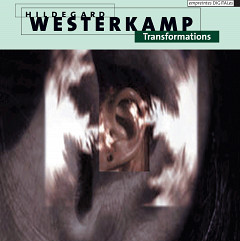
    … carefully wrought sonic forms…

    Transformations in Art Zéro

    “Critique”, Dan Warburton, Art Zéro, no. 14, January 1, 1999
    Friday, January 1, 1999 Press

    Le souvenir du Presque rien #2 de Ferrari — l’idée d’un commentaire non sans ironie du compositeur sur l’action — est évoqué dans Kits Beach Soundwalk de Hildegard Westerkamp; en filtrant les sons de la ville de Vancouver, nous découvrons le monde sonore des bassins d’eau, le souffle des bernacles. Ailleurs sur l’album Transformations [IMED 9631], Westerkamp explore les possibilités timbrales de la nature (des cigales, des corbeaux…), mais son portrait de la ville, A Walk Through The City, est un peu moins convaincant — on se demande si elle n’aurait pas pu choisir un texte plus intéressant que le poème de Norbert Ruebsaat.

    Transformations, Hildegard Westerkamp in eContact!

    “In Review”, Andra McCartney, eContact!, no. 1:1, February 1, 1998
    Sunday, February 1, 1998 Press

    Hildegard Westerkamp says: “I hear the soundscape as a language with which places and societies express themselves.” Her Transformations CD presents five of her soundscape compositions, reflecting work composed from 1979 to 1992, each sounding the depths of a different place, creating a different inner landscape each time I hear them. She works with the sonic and sociopolitical potentials of each place, recording, mixing, and subtly transforming sounds to heighten listeners’ awareness and appreciation of these sites. She is a skilled and careful interpreter of their languages.

    You make it with the skin of the desert night

    Cricket Voice is a musical exploration of a solo cricket song, recorded by Westerkamp at night in a Mexican desert region called the Zone of Silence. The acoustic clarity of this place frames the cricket song, accompanied by soundmaking with the spikes of cacti and other plants, and electroacoustic transformations of these sounds. This composition is as expansive as the desert, intimate as the voice of a single cricket.

    Listen to our cities

    Two of the works, A Walk Through The City, and Kits Beach Soundwalk, are both based on urban soundscapes. In the downtown core, I can become numb to the constant sounds. These works challenge me to listen, to transform, to make quiet places in the city. A A Walk Through The City takes us through Vancouver’s Skid Row area, guided by Norbert Ruebsaat’s poem of the same name. Kits Beach Soundwalk begins at Kitsilano Beach, in the heart of Vancouver, yet at the same time a border. I hear the throb of the city balanced with the tiny sounds of barnacles feeding in the lapping tide. This piece explores many borders—between dream and waking, city and country, water and land, documentary and composition. When it enters the dreamworld of high frequencies, I remember where quiet places in the city can take me.

    Soundmarks and Sitka

    Fantasie for Horns II is the earliest piece in the collection, composed from the sounds of Canadian trainhorns, foghorns, factory and boathorns, and a live part for French horn. Horns are especially evocative soundmarks that give us a sense of place. Each time I hear this piece, I remember growing up by the sea and listening to the moan of the coastal foghorns, reminding me of the awe-inspiring power and energy of the sea. The latest piece on the CD is Beneath The Forest Floor. Most of the sounds for this piece were recorded by Westerkamp in the Carmanah Valley on Vancouver Island, and the piece evokes the stillness and peace of this old-growth rainforest, home to Sitka spruce and cedar trees over a thousand years old.

    I have always found Hildegard Westerkamp’s work to be a particular source of insight and inspiration. It takes me to familiar and new places, encourages me to listen to the sounds around me, and to “transform through listening,” as Pauline Oliveros also notes about Westerkamp’s work. Her music urges me to listen to the language of the soundscape and to express my own relationship to it by working with soundscapes myself. I hope it does for you, too.

    … a particular source of insight and inspiration.

    Transformations in Odradek

    “Kritik”, Thomas Beck, Odradek, no. 3, January 3, 1998
    Saturday, January 3, 1998 Press

    Was soll ich über Hildegard Westerkamp schreiben? Wir haben sie im letzten ODRADEK vorgestellt, und ich bin ein ausgesprochener Bewunderer ihrer sehr sinnlich erfahrbaren Musik, deren Ausgangspunkt oft Umweltklänge bilden, die im Studio bearbeitet werden und dort zu Klangreisen visionärer Schönheit generieren. Es finden sich insgesamt 5 Stücke aus dem Zeitraum 1979-92, die teilweise schon auf Cassette erhältlich waren, wieder. Dabei fällt auf, daß sie es immer wieder hervorragend versteht, den Klängen das Geheimnissvolle zu lassen und die Hörerschaft in eine Aura des sinnlich Fremden zu tauchen. So auch beim Kits Beach Soundwalk, einem zentralen Stück der CD, eine Hörreise in das akustisch Wahrnehmbare, all die Techniken vorgestellt durch die Stimme Hildegards, die zu den längeren und intensiveren Stücken der CD führen. Hier finden sich Cricket Voice, basierend nur auf dem Klang einer Grille oder das dichte A Walk Through The City, das, ergänzt durch ein Gedicht von Norbert Ruebsaat, tatsächlich einen dichten und intensiven Höreindruck dieser Stadtlandschaft vermittelt. Den Höhepunkt bildet allerdings Beneath the Forest Floor, wo die Geräusche meist in ihrer Natürlichkeit belassen werden, und in einer physisch wie sinnlich rasanten Schnitttechnik entfaltet werden, als wäre man tatsächlich in diesen verzauberten kanadischen Wald gefangen. Mir bleibt nichts anderes übrig, als all denjenigen diese CD zu empfehlen, die keine Unterschiede zwischen elektroakustischer Musik und sinnlicher Erfahrung machen, wie auch dernen, die sich gerne einen Eindruck von den Möglichkeiten der Sparte geben lassen möchten.

    Transformations in Splendid E-Zine

    “Review”, Elliott S, Splendid E-Zine, September 22, 1997
    Monday, September 22, 1997 Press

    Normally I’d take the sounds of the city over the ambience of a forest as the urban soundscape is more eventful and full of the unexpected. Westerkamp, though, is so gentle in her use of environmental sounds that the opening track, A Walk Through The City, doesn’t as convincingly find the composer in her element as Cricket Voice or Beneath the Forest Floor. The care given to these compositions is so delicate that you can’t help but feel as though you’ve entered a marvelous world of sound. What’s peculiar is that these sounds are nothing new to our ears, but the manner in which they’re assembled makes us more aware of the surrounding environment. On Kits Beach Soundwalk you can hear the faint sound of the city in the background, but as the narrative progresses the sound is filtered out in favor of magnifying the small sounds barnacles make. If DJ Shadow can be labeled the Jimi Hendrix of the sampler than it makes perfect sense that Hildegard Westerkamp is the Pauline Oliveros of such devices.

    The care given to these compositions is so delicate that you can’t help but feel as though you’ve entered a marvelous world of sound.

    Transformations in La Presse

    “La musique électroacoustique résiste au temps”, Philippe Tétreau, La Presse, June 14, 1997
    Saturday, June 14, 1997 Press

    Écoloacoustique

    Les frontières de l’électroacoustique n’ont jamais été très délimitées; on y met souvent ce que l’on veut, on y entend de tout. Le genre rappelle à l’occasion ce que sont devenus l’essai et le roman: des fourre-tout. Avec Hildegard Westerkamp, établie à Vancouver, il y a bien cette dimension qui rappelle le calepin de voyage où sont colligées diverses trouvailles faites au cours de ses pérégrinations. Son disque intitulé Transformations propose des évocations de la nature ainsi que des échantillons croqués sur le vif qui se rapportent au bruits urbains (A Walk Through The City). Avion, voiture, sirène, arcades, faubourgs populaires, itinerants, pollution sonore, etc. Dans les autres plages du disque, nous reconnaissons bien les vertus écologiques propres à la sensibilité des gens de l’Ouest. Traitées puis montées, les séquences de Westerkamp forment un lyrisme verdoyant. La encore, on opte pour les sons ténus: la douceur confine parfois au romantisme.

  • 1
  • 2
  • 3