electrocd
  • This website is also available in English.

More from the blog

18 results
  • 1
  • 2
  • 3
  • Aérosol in KSVR: Air Force Nun

    “Review”, Troy Date, KSVR: Air Force Nun, March 1, 1999
    Monday, March 1, 1999 Press

    Aérosol by Ned Bouhalassa is rich in highly crafted sounds which are humorous, yet enticing, and always fully aware. Ned Bouhalassa demonstrates on Aérosol his mastery at creating strange and flowing pieces that interconnect with each other flawlessly. I believe that anyone who is slightly interested in strange music should own this disk.

    … anyone who is slightly interested in strange music should own this…

    Aérosol in Splendid E-Zine

    “Review”, Noah Wane, Splendid E-Zine, March 1, 1999
    Monday, March 1, 1999 Press

    Ned Bouhalassa is in a sense part of the third generation of Montréal electroacoustic composers. Unlike the work of the scene’s patriarch, Francis Dhomont, which is very much in the style of ‘old school’ acousmatic composers like Bayle and Chion, or the work of ‘second’ generation composers like Robert Normandeau and Gilles Gobeil (for example), which strives to apply new ‘sound palettes’ to acousmatic ideals, Bouhalassa allows clear and unadulterated influences from more commercially viable music to enter his compositions.

    A great example of this is Jets, where relatively orthodox acousmatically-treated material alternates with what could easily pass for ‘chill out’ music in any dance club. If you like the idea of “acousmatisme” but find it occasionally too stuffy, Bouhalassa might be your man!

    … part of the third generation of Montréal electroacoustic composers…

    Aérosol in Vital

    “Review”, MP, Vital, no. 160, February 3, 1999
    Wednesday, February 3, 1999 Press

    Ned Bouhalassa’s work is far more angular; sounds are sourced from a much wider palette than Copeland’s and are combined in volatile, unpredictable compositions. This CD is also a release in the [compact-compact] ‘short duration’ series and is a reverse-order retrospective (1998-1990) of some of his work. He also had tracks included on the … of Drones series and is himself closely connected to San Francisco’s Sound Traffic Control, “a media arts assemblage that features a unique real-time matrixed spatial audio system through which musicians, engineers, conductors, DJ’s, and sound sculpture form an interwoven surround sound orchestra” (Phew! Their definition—wotta mouthful! I think it means something like: They’ve got a hifi and maybe a working mixer!).

    Aérosol opens with his latest work titled Jets and is based on movement away from… Some sounds scurry off, darting and casting nervous, uneasy glances, others hurl themselves violently towards the edges of the audio field. Also included is the track Move 1, which appeared in another, shorter version on The Swarm of Drones 2CD compilation released in 1995 (Asphodel, again). This piece is ‘based on an idea of representing animal/human movement through sound, and explores the possibilities of generating rich evolving textures from single samples.’ Headphones recommended!

    The track Constamment (autoportrait) dating from 1997 contains sound elements which represent various aspects of Ned’s past and present, and includes several nods and a wink in the direction of what has come to be known amongst the young and frivolous as ‘techno music’—y’know: racy drums which boom, boom for a while and then there’s a whoosh, maybe a girl yells something about shakin’ yer booty and then boom, boom one mo’ ’gain.

    These CDs have been created by two inspired and highly innovative young composers of electroacoustic music. If you’ve not got anything released on this peerless Canadian label, then this is an excellent place to start. If you’re already familiar with their releases, then these two CDs with surely augment your collection. Absolutely brilliant.

    Absolutely brilliant.

    Aérosol in CFLX 95.5 FM

    “Délire actuel: Review”, François Couture, CFLX 95.5 FM, January 28, 1999
    Thursday, January 28, 1999 Press

    Ned Bouhalassa is an electroacoustician from Montréal. When Aérosol was released, he was a fan of techno music and a DJ at a college radio station, but also teached at Concordia University and was president of the Canadian Electroacoustic Community (CEC). This double-sided “serious/less serious” pattern can also be found in his works. Aérosol (referring to the paint cans used by graffitists) is a collection of five pieces composed between 1990 and 1998. One finds on this record a refreshing inspiration coupled with a poetic sense not unlike his mentor Francis Dhomont. Bouhalassa uses the same sonic forms, he has Dhomont’s talent for evocation and his sense of sound syntax, reaching a high level of quality in the art of the “cinema for the ear.” But he also adds a breeze of youth, particularly through the use of techno music elements. Jets and Move 1 are impeccably constructed, but Constamment (autoportrait), a selfportrait, suffers a bit from over-fragmentation, making it hard for the listener to follow.

    … une inspiration rafraîchissante qui cotoie la poésie des sons…

    Aérosol in Gonzo Circus

    “Review”, Peter Wullen, Gonzo Circus, December 1, 1998
    Tuesday, December 1, 1998 Press

    The most modern of the three is the [Canadian based-] Breton-Algerian studio composer Ned Bouhalassa, who goes out to search for inspiration in the street whenever he’s fed up with the studio. On Aérosol he is inspired by street-life, film, science fiction, graffiti and even techno music. Bouffée délirante (1990) is Bouhalassa’s first attempt to make “cinema for the ear.” Attraction is Ned’s nihilistic credo. Magnetic fluxes attract or repel each other. Constamment (autoportrait) is an [electro]acoustic self-portrait in five parts illustrating five phases in the life of the composer.

    empreintes DIGITALes shows with these three new albums that electroacoustic music is constantly in flux and cannot be narrowed into an academic corner. [English translation: Jean-François Delannoy and Berry de Bruijn]

    Aérosol in Hollow Ear

    “Review”, Richard Cochrane, Hollow Ear, March 1, 1998
    Sunday, March 1, 1998 Press

    Bouhalassa is something of a bright young thing in Canada’s electroacoustic scene. And, as befits such a position, he shies away from the academic pigeonhole in favor of something more eclectic and more modern-sounding. The bio says he’s influenced by Nirvana, Sonic Youth, and Public Enemy. I can hear you cringing already; these obvious names conjure an image of an ivory-tower academic trying to get with-it, like your teachers dancing at the school disco. In fact, such influences are very much submerged in a well-developed musical imagination.

    The first track, Jets, will serve as an example of his approach. It’s very much object-oriented; self-contained events move around, develop, overlap and re-appear in an open field. Very effective it is too, and completely abstract, although there are moments which have a more conventional musical texture. The composer astutely identifies these as ‘nostalgic,’ perhaps giving some insight into his relationship with those influences from popular music — and, in a coup of meta-meta-humour, one can even catch a sample of rhythmic, 70s-style robotic speech halfway through Attraction which strongly echoes the Beastie Boys’ Intergalactic, itself a tribute to the age of Space Invaders and Old Skool Hip Hop. Whether this specific reference is intentional or not, this complex, textured, unromantic use of recognizable elements from other music is typical of the rest of the disc.

    Bouhalassa says something revealing in his comments on another track, Move 1, when he refers to the “exchange or contrast between the recognizable (stable) and the unknown (unstable).” Thinking of movement in terms of a series of exchanges between stability and instability, a balancing act of a dynamic equilibrium, is helpful when applied to all kinds of music, but most explicitly to music like this. To think of these sounds as objects is also helpful; they are objects which can explode, collapse, propagate, dissipate, emerge anywhere, combine with one another and produce weird hybrids. Bouhalassa seems most fascinated by the idea of sonic movement, the concept that a sound can become an object which moves in a conceptual space (we are not talking here about the stereo field, of course). It’s an interest which produces difficult music, certainly, and not stuff which follows the conventional musical lines of development. Without conceding that this is “ideal chill-out music” — it’s too surprising, it buffets you and comes at you from strange angles, shouting ‘boo’ — it’s certainly absorbing.

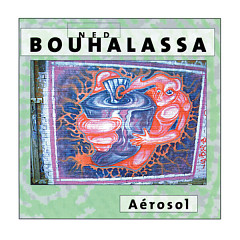
    … something more eclectic and more modern-sounding […] in a well-developed musical imagination.
  • 1
  • 2
  • 3