electrocd

More from the blog

15 results
  • 1
  • 2
  • 3
  • Atlantide; Golgot(h)a in Audion

    “Review”, Michael Draine, Audion, no. 23, November 1, 1992
    Sunday, November 1, 1992 Press

    Two award winning electroacoustic compositions commissioned by the Société Radio-Canada explore issues of spirituality and mortality with markedly different, though equally compelling, results. Using the legend of the lost continent of Atlantis as a metaphor for today’s environmental perils, Michel-Georges Brégent presents his sweeping, complex Atlantide as a ‘radiophonic alarm… to draw people out of their daily lethargy’. Names of ancient civilizalions, deities, and holy texts are combined lo form the mystical language central to the piece. The rapid brass and woodwind ostinatos and fluent female vocals suggest an imagined Philip Glass opera sung by Stella Vander, while the dense mix of field recordings, world music influences, and ethereal electronic sounds tring to mind a roomful of shortwave radios tuned to broadcasts from different historical eras. Walter Boudreau couples visceral high-tech orchestration with Raôul Duguay’s dramatic text for Golgot(h)a, a monody of Christ’s suffering on the cross. Reference points include Olivier Messiaen’s blaslingly apocalyptic Et Expecto Ressurectum Morfuorum, Peter Frohmader, and Magma’s guttral vocal stylings. Basing the music upon a four-voice response by 16th century Spanish composer Luis de Vittoria, Boudreau counterpoints brass, percussion and organ against sampled solo voice and choir with a refreshing sense of proportion (a rare quality in the electroaoustic field). Atlantide and Golgot(h)a constitute two of the most emolionally cathartic works in the computer music genre I’ve yet encountered, and thus their appeal should extend beyond the academic circle much of today’s technologically avant-garde music is targeted at.

    Atlantide; Golgot(h)a in SOUNDNotes

    “Review”, David Olds, SOUNDNotes, September 1, 1992
    Tuesday, September 1, 1992 Press

    With this release, the DIFFUSION i MéDIA company, which has been so successful with its empreintes DIGITALes line of CDs, launches a new label: SONARt. Dedicated to the proliferation of “invisible musics,” SONARt will focus on radiophonic works specific to the broadcast medium. This first release includes two well paired works by successful Quebec composers: Atlantide, by Michel-Georges Brégent and Golgot(h)a by Walter Boudreau. The two works are similar in scope and approach, and have both experienced some international success.

    Composed in 1985, Atlantide is divided into seven sections that use a variety of musical approaches and languages to explore the tale of the lost city of Atlantis. From vocal soloists and childrents choir, through contemporary strings and winds, to saxophone quartet and baroque ensemble, with abundant use of computer synthesis and manipulation, Atlantide moves through a plethora of modes and moods in its submarine explorations. It is quite an effective work, and the 1985 jury of the Prix Italia (an international competition for radiophonic works) awarded it a First Mention and the Special Jury Prize.

    Like Atlantide, Golgot(h)a was commissioned by Société Radio-Canada and was produced in its studios by a cast of dozens. It is a 1990 composition and, like its companion piece, it is roughly a half-hour in length. The original text is by Raôul Duguay and — in a bizarre fashion — is an account of the crucifixion of Christ. Personally, I find the computer treatment of Duguay’s voice unnecessarily unpleasant and some of the text, such as the recurring “photocopy” inexplicable. Overall, however, this is a successful piece that makes skilful and interesting use of a choral response by the 16th-century Spanish composer Luis de Vittoria, upon which all of the music is based. This work was the 1991 winner of the Grand Prix Paul Gilson, awarded by the Community of French-Language Public Radio.

    This CD is an interesting and important release for the fledgling SONARt label, and it is especially encouraging to see SONARt pick up some of the slack left by current CBC/SRC recording policies. One can only wonder at the lack of vision at the “Corporation,” which endlessly releases standard and middle-ofthe-road modern repertoire on its own labels and then ends up leasing out original, internationally successful works to tiny labels. Thank goodness for the foresight and dedication of the people at DIFFUSION i MéDIA.

    … original, internationally successful works…

    Atlantide; Golgot(h)a in Option

    “Review”, Dean Suzuki, Option, no. 45, July 1, 1992
    Wednesday, July 1, 1992 Press

    These two extended radiophonic works by young Canadian composers have a sinister outlook and are quite fascinating. The solo female vocal lines in Brégent’s Atlantide often recall the writing of Daniel Lentz, with similar modular (though never minimalist) construction and pure, straight singing sans vibrato. At other times, the writing is for chamber choir (with vibrato) and various acoustic, electric and electronic instruments wherein the work becomes densely polyphonic, with layer upon layer of melody, color and rhythm. At times the onslaught of sonic information is dizzying. The music itself seems to be informed by rock, industrial, post-modernism and the avant-garde, all without a hint of posturing. Composer Boudreau and writer Duguay’s Golgot(h)a is a powerfully melodramatic work of Ivesian eclecticism, invoking the influential French progressive rock band Magma with similar distorted vocal passages in an unknown tongue, as well as a dolorous demeanor and murky, sullen harmonies and textures. Alongside are bits of Renaissance and Baroque music, inviting comparisons with Giovanni Gabrieli’s polychoral brass or lush Palestrinian vocal polyphony, as well as spiky, updated Stravinskian harmonies.

    … the work becomes densely polyphonic, with layer upon layer of melody, color and rhythm.

    Atlantide; Golgot(h)a in Revue & Corrigée

    “Critique”, Jérôme Noetinger, Revue & Corrigée, no. 13, June 1, 1992
    Monday, June 1, 1992 Press

    Voici le premier disque de la nouvelle collection de DIFFUSION i MéDIA, SONARt, consacrée à des musiques instrumentales de studio. Ici, il s’agit de deux pièces radiophoniques. La première, Atlantide de Michel-Georges Brégent, pour voix, divers ensembles instrumentaux, sons électroacoustiques et sons environnementaux, date de 1985. Décomposée en sept parties, avec des transitions marquées par l’utilisation de sons familiers (animaux, ville, eau), cette pièce est un mélange étonnant de différents genres: une écriture contemporaine marquée de rock, teintée de jazz (ou l’inverse). L’étonnement persiste à l’écoute des voix s’exprimant en langues anciennes et mystérieuses. On pense presque à Magma! Mais tout cela disparaît dans la dernière partie, où apparaît plus le studio (traitements, larsen…), qui marque la destruction d’Atlantide car cette pièce retrace la vie et la mort des Atlantes vaincus par la soif du pouvoir. L’auteur à travers cette image veut nous montrer le danger qui nous guette, et les transitions entre chaque partie par leur aspect anecdotique sont là pour nous replacer dans notre quotidien.

    Golgot(h)a (1991) de Walter Boudreau, avec un texte de Raôul Duguay, est une pièce pour instruments et voix échantillonnée, qui retrace le chemin de croix du Christ.

    Atlantide; Golgot(h)a in SOCAN — Paroles & Musique

    “Une nouvelle étiquette: SONARt”, Johanne Barrette, SOCAN — Paroles & Musique, June 1, 1992
    Monday, June 1, 1992 Press

    DIFFUSION i MéDIA, producteur des disques empreintes DIGITALes consacrées à la musique électroacoustique, lançait en mars dernier sa nouvelle étiquette: SONARt. Cette dernière est consacrée aux musiques instrumentales pour haut-parleurs, conçues en studio, que Jean-François Denis, co-fondateur de DIFFUSION i MéDIA avec Claude Schryer, a baptisées musiques “invisibles”.

    SONARt, toute jeune qu’elle soit, se divise déjà en deux volets. Le premier, radio, propose un compact réunissant Atlantide, de Michel-Georges Brégent, et Golgot(h)a, de Walter Boudreau et Raôul Duguay. Atlantide, fable sonore sur le thème du continent perdu, exploite toutes les techniques d’enregistrement multipistes. Les flûtes de l’ensemble Flûtes Douces, les instruments anciens de l’Ensemble Glaude-Gervaise et les saxophones du Quatuor de Saxophones de Montréal, y côtoient les sons des chœurs, des instruments d’orchestre et des synthétiseurs. En 1985, le Concours international d’œuvres radiophoniques Prix Italia lui attribuait le Prix spécial du jury. Golgot(h)a, qui explore le thème du chemin de croix, s’est mérité le Prix Paul-Gilson 1990 de la Communauté des radios publiques de langue fran,caise. À l’occasion du lancement, Golgot(h)a été créée en concert à l’Église Saint-Jean-Baptiste à Montréal par l’Ensemble de la SMCQ .

    L’automne prochain verra l’inauguration du deuxième volet de SONARt, soit théâtre, avec la transposition discographique de Ne blâmez jamais les bédouins, du dramaturge québécois René-Daniel Dubois, interprétée sur scène l’an dernier par la soprano Pauline Vaillancourt sur une adaptation musicale d’Alain Thibault.

    Atlantide; Golgot(h)a in L’écouteur

    “Critique”, François Bourgouin, L’écouteur, May 20, 1992
    Wednesday, May 20, 1992 Press

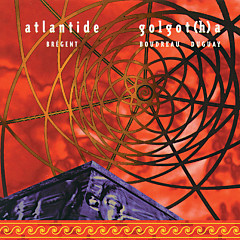
    Produit par la maison montréalaise DIFFUSION i MéDIA qui était déjà productrice des disques de marque empreintes DIGITALes, voici la nouvelle étiquette de disques SONARt qui, comme l’explique le communiqué de presse, se consacre aux musiques “invisibles”, conçues en studio. C’est démontrer beaucoup d’audace et de courage de la part de Jean-François Denis (le fondateur de la maison) de s’aventurer sur un terrain peu fréquenté, ayant un cercle limité d’auditeurs. Toutes ses réalisations discographiques sont impeccables à commencer par les magnifiques pochettes, imprimées de manière non-conventionnelle (Brégent y est même photographié torse nu…) sur un beau papier glacé. Ce CD réunit les œuvres Atlantide de Michel-Georges Brégent et Golgot(h)a Walter Boudreau et Raôul Duguay qui remportèrent chacune d’elles différents prix intemationaux. Une fois de plus, l’auditeur sera transporté dans un monde sonore irréel, inouï, étonnant et surtout déroutant. Un disque qu’on écoute les yeux ronds et la bouche bée. Comme l’indique la pochette, un CD “pour vos oreilles seuiement” mais aussi pour réaliser un voyage fabuleux au fond de l’imaginaire humain.

    Un disque qu’on écoute les yeux ronds et la bouche bée.
  • 1
  • 2
  • 3