electrocd
  • This website is also available in English.

More from the blog

10 results
  • 1
  • 2
  • Troubles in The Sound Projector

    “Review”, Ed Pinsent, The Sound Projector, April 17, 2019
    Thursday, April 18, 2019 Press

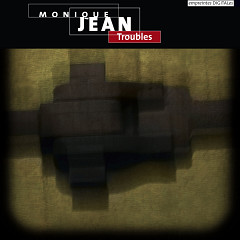
    Another solid set of electroacoustic compositions by the great Monique Jean on Troubles. This particular genius deeply impressed Stuart Marshall with her 2012 album Greffes, when he dug the “violence apparent in these audio autopsies”. No less dark is today’s Troubles, with a nice grim abstract art cover and two heavyweights slugging it out in the musical arena.

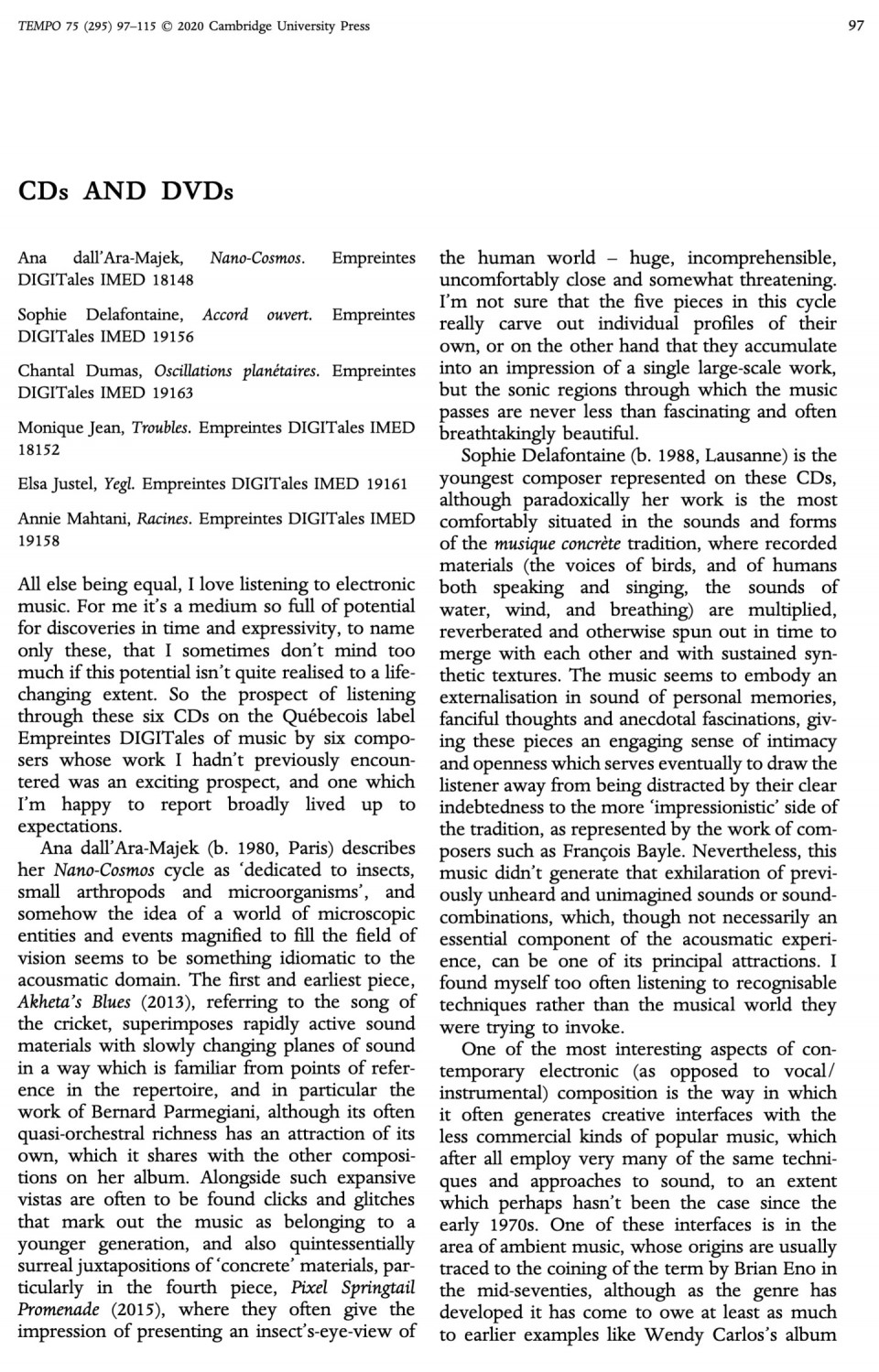
    T.A.G. had me rooted for 25 mins with its solid, mesmerising push of sound; one thing that struck me was her stark lack of baroque detail, by which I mean the digital frills and curlicues which often beset other composers on this label when they overcook their work in the studio. This piece delivers its stern message with no fancy preliminaries. I often get lost reading the highly abstract descriptions on these Canadian releases, but this piece has a meaning I can just about fathom. The acronym T.A.G. unpacks into Trottoir, Ashpalte, Goudron, and the work began by making observations about the weight of people on the streets agitating the gravel. Observing a crowd of protesters may have been one starting point for Jean’s ruminations, but she ended up seeing the mass of people dissolve into “energized shapes”, evidently transfixed by their errant movements; she saw a world of collisions, tensions, and forces moving down bifurcated paths. Urban malaise is a regular theme for phonographers (Philip Sulidae comes to mind), but Monique Jean never settles for bland recordings of street vistas, and does it with conviction, and strong ideas about society and mankind. It ain’t a pleasant vision, but there’s a lot of hard-nosed reality baked into these digital cloppings. It ought to be required listening to anyone who dreams of taking up architecture, or town planning. They’d soon learn what they have to contend with!

    Out Of Joint may not have the immediate bone-crunching faculties of the above, but its generally macabre tone and pessimism are welcome elements, to say nothing of its majestic sweep. The starting point was something to do with Shakespeare, but this is not an attempt to “re-present” that canon of literature in modern compositional form. Monique Jean began by deconstructing a number of interpretations of Macbeth across time — movie versions, stage versions, rewrites. This isn’t to mean she directly sampled the soundtrack of Polanski’s Macbeth for instance; the process that is relevant is “across time”. She’s attempting nothing less than a compression of several different viewpoints and interpretations, attempting to “graft” them together in her music (the Greffes album was full of such grafts). How has history dealt with the “moral and ethical issues” raised by Shakespeare? That is the theme that interests her. At the same time, it’s the multiplicity of voices that she likes, moving away from the attempts to form a single critical consensus of the canon (a problem that has arguably bogged down English literary criticism for at least 100 years). In doing this, she reflects some of the great contradictions and contrasts that are embodied in Shakespeare’s work, what is referred to here as an “entwining of the coarse and the sacred”. It’s much to her credit that she conveys this without using any spoken word at all; Out Of Joint is mostly abstract sound, though with some suitably eerie sound effect recordings such as rainfall and crows calling. A detailed, blackened suite of sheer genius.
    A detailed, blackened suite of sheer genius.
    Troubles in Bad Alchemy

    “Kritik”, Rigobert Dittmann, Bad Alchemy, no. 100, December 1, 2018
    Thursday, January 10, 2019 Press

    Monique Jean, die ‘akadische Sirene’, fand schon mit L’adieu au s.o.s. (2003) und Greffes (2012) BAs Aufmerksamkeit. Troubles (IMED 18152) enthält mit Out of Joint ein Audiodrama, das die tausend Plateaus shakespeare’scher Charakterzeichnung und Weltanschauung nachzittern lässt. Im ungeschiedenen Zugleich von Poesie, Schurkerei, Thron und Nachttopf. T.A.G. = Trottoir, Asphalt & Goudron [Teer] lässt daneben das Fließen urbaner Massen als heterogenen Multitudes anklingen, in demonstrativen Schüben und als subterrane Unterströmung. Als dröhnender Flow vermengen sich schimmernde, schnurrende und dunkel wummernde Klänge mit solchen, die brodelig aufbrausen, wooshen und zerren in bebender, pfeifender, zuckender, kullernder Dramatik. Darin eingeflossen sind Polizeisirenen und Schritte, sublimiert zu den Fanfaren und Rhythmen eines abstrakten Expressionismus in glissandierender, lokomotiver und galoppierender Bewegung. Ähnlich gestaltet Jean die shakespeare’sche Dramatik, hechelnd und flattrig, ruppig und impulsiv, mit dröhnenden Wooshes und stehenden Wellen neben gewittrigen und vulkanischen Detonationen, rhythmischen Motiven, sirrender Konvulsion und surrender Stagnation. Bis hin zu einer martialischen Kriegskulisse und protestierenden Krähen. Allerdings könnte ich, selbst wenn Leben auf dem Spiel stünden, da nicht den Rückschluss auf Shakespeare oder was auch immer ziehen. Wer weiß, was sich — ich wiederhole mich da gern — einstellen würde an Eindrücken, Assoziationen, Gefühlen, Stimmungen ohne die verbalen Leitplanken? Viel mehr als vielleicht ‘Turbulenzen’ wäre als konnotative Annäherung an Jeans Troubles erstmal nicht drin.

    … dramatic, panting and fluttering, rough and impulsive, with booming wooshes and standing waves…

    Troubles in Noise Not Music

    “Review”, jckmd, Noise Not Music, November 20, 2018
    Tuesday, November 20, 2018 Press

    Troubles is Monique Jean’s third solo release, and its two pieces each boast an ambitious conceptual backing. The kinetic T.A.G. was inspired by rippling collective movements by crowds of people, an influence that is represented well by the composition’s litany of synthesized elements that progress with masterful pace and control. Jean’s sonic palette is dominated by the cold and artificial, with both actual recordings that are heavily processed as well as pure synthesis, but she commands this electronic orchestra with distinctly organic movements in mind. Out of Joint continues with that contrast, incorporating more recognizable sounds such as screams and the cawing of crows, but for an entirely different purpose; the piece is a sonic essay on the endurance of Shakespeare’s Macbeth throughout history.

    … she commands this electronic orchestra with distinctly organic movements in mind.

    Troubles in Groove

    “Kritik”, Frank P Eckert, Groove, October 29, 2018
    Monday, October 29, 2018 Press

    Die kanadische Komponistin Monique Jean bespielt diese Zwischenräume ähnlich virtuos. Ihre Werkzeuge sind Synthesizer und ihre liebsten Frequenzen, die ganz hohen. Troubles (empreintes DIGITALes) ist dabei aber schmutziger, von industriell anmutenden Maschinen-Sounds durchzogen und offener im Ergebnis. Ein Erlebnis ist es nicht weniger.

    Die kanadische Komponistin Monique Jean bespielt diese Zwischenräume ähnlich virtuos.
  • 1
  • 2