electrocd

morceaux_de_machines

38 results
  • 1
  • 2
  • 3
  • 4
  • 5
  • 6
  • 7
  • More reviews might be found in the pages of this artist’s albums.

    Critica

    Rui Eduardo Paes, Paes, June 1, 2005

    Os canadianos Aimé Dontigny (gira-discos) e Érick d’Orion (computador) tiveram antes um projecto com o mesmo nome do programa radiofónico que mantinham na CKIA, Napalm Jazz, e se o anterior título (liberum arbitrium) da fórmula morceaux_de_machines era mais comedido do que este Estrapade, a moldura das suas acções continuava a ser o “noise” improvisado, agora elevado à centésima potência com as colaborações, em três das faixas (as únicas registadas ao vivo), de Otomo Yoshihide, Martin Tétreault e Diane Labrosse. Mais do que alguma vez aconteceu, a teatralidade das situações musicais que constroem é uma estratégia assumida, tanto assim que a própria etiqueta responsável por esta edição, a No Type, fala no “théatre de la cruauté” de Antonin Artaud para apresentar o disco, dele dizendo que é “impermeável à falsa sentimentalidade da harmonia” e “ferozmente desconstrutivo”. Decididamente, as abordagens “onkyo” e “lower case” não fazem o pleno da electrónica actual. O que aqui encontramos tem a mesma entrega e o mesmo “drive” do John Coltrane de Interstellar Space, com contribuições tanto da electroacústica “culta” como do hip-hop e do death metal. Os dois músicos falam mesmo em “maximalismo” para descrever tais procedimentos, em clara oposição ao legado minimalista que hoje marca a frente digital.

    Os dois músicos falam mesmo em “maximalismo” para descrever tais procedimentos, em clara oposição ao legado minimalista que hoje marca a frente digital.

    Review

    Tom Sekowski, The WholeNote, no. 10:9, June 1, 2005

    I was warned — the music of Montréal duo morceaux_de_machines would be loud. What I wasn’t told was just how unbearably surprising it could be. The duo made up of long-time radio collaborators on Québec’s CKIA, Aimé Dontigny and Érick d’Orion, obviously enjoy their noise with a side of the twitchings. Ever-shifting landscapes permeate their music from beginning of the disc to its’ closing 75 minutes later. Turntables, prepared CDs, live electronics, computers, samplers, drum machines — it’s all here in its most primal glory.

    Sampling queen Diane Labrosse appears on two tracks, as do tumtable artists Otomo Yoshihide and Martin Tétreault. I dont think the word noise does this duo proper justice. After all, what is defined as noise by one person is not necessarily noise to others. I found many of the pieces calming in their own bizarre way. The drones and high-pitched squeaks are in some strange way oddly appealing. Weird structure actually exists in this madness if you’re willing to listen. Feedback and ear-piercing sounds need not be your enemy. These can actually be your friends. The question remains, are you willing to take the first step towards cementing this relationship? If your answer is yes, then Estrapade [French word for a cruel form of torture used in medieval times] is waiting for your friendship now.

    I was warned — the music of Montréal duo morceaux_de_machines would be loud. What I wasn’t told was just how unbearably surprising it could be.

    Kritik

    ASB, De:Bug, June 1, 2005

    Improv-Noise und Musique Concrète könnten sogar die Tanzflächen rocken, wenn man sie irgendwo ließe. Das bieten zumindest einige Tracks dieses französischen Duos an, die sich hier mit den Turntablisten Otomo Yoshihide und Martin Tétreault sowie Diane Labrosse zusammen tun. Von Tanzmusik kann allerdings wirklich nicht die Rede sein, wohl aber von spannend gemachten digitalen Lärmattacken, die eben auch durchaus mal rhythmisch oder aber ambient sein dürfen. Klasse unakademisch! 3/5

    Review

    Dave Madden, Splendid E-Zine, May 30, 2005

    Other than the self-imposed isolation of a studio, the lack of artistic compromise and proverbial spitting in the face of mainstream success, there’s something that many experimental musicians lack that discourages even the most stalwart fans: a personality. Said individuals often seem academic, overly serious and just plain bland — something that, for better or worse, seeps into their music.

    Fortunately, people like Érick d’Orion (aka Érick d’Orion) and Aimé Dontigny (aka A_dontigny), the duo behind morceaux_de_machines, exist in this world to counter stereotypes of what the so-called avant-garde should do. Their stint under the name Napalm Jazz, both as a radio program on Québec’s CKIA FM and a band of the same name, gives them a different approach to the improvisation/composition realm, one somewhere between Anthony Braxton, Penderecki and Public Enemy. Some listeners dub them the “B-Boys of musique concrète”. Very cool.

    Their set incorporates a fused conglomeration of elements, something that never backs down from a challenge, even if it means bending two poles to meet — a mix that sits comfortably atop a history book while swilling cheap merlot from a paper cup. m_d_m propel Fonçage de pieux with hyperactive scratching, serious cutting that will leave a mark, while Tinkerbell melodies drift in and out over a pulsing, clicking rhythm and processed Rite of Spring-style symphonic punctuation. Everything works itself into a calculated frenzy; d’Orion and Dontigny are careful to keep their mix tight and pristine until they bust into an atmospheric film of sine waves, fragmented and carefully placed breakbeats, nearly exploding again but happy to perch under a cloud of low-frequency feedback. Next up, Onanisme is sure to raise eyebrows in the concert hall and while waking up the professor’s bored children, who’ll exclaim, “This is fun!” It employs an irresistible Neu/Crass quasi-disco beat, founded on a distorted handclap/bass drum pattern and manic, twirling basslines, that weaves and grows, keeping time but having its way with the meter. Guests Diane Labrosse (of Justine and a flock of other acts) and Martin Tétreault (visual artist/turntablist, currently concerned with the sound of the (turntable) motor) add their contributions throughout the disc, notably on Sélavy, where needles meet concrete, machine hum faces envelope filters and Loverboy’s Hot Blooded joins a nuclear aftermath for a picnic in a fallout shelter. Otomo Yoshihide joins m_d_m for Omlegging, bringing his signature “no-record turntable” fidgets, scrapes to trade off with Tétreault and the boys.

    Of course, this genre owes a great deal to the pioneers of the Twentieth Century, from Dadaists to Constructivists to even Classicists. d’Orion and Dontigny are well aware of this foundation, but after they tutor you for your final in Semiotics 502, they’ll drag you along for a night of beers and mischief.

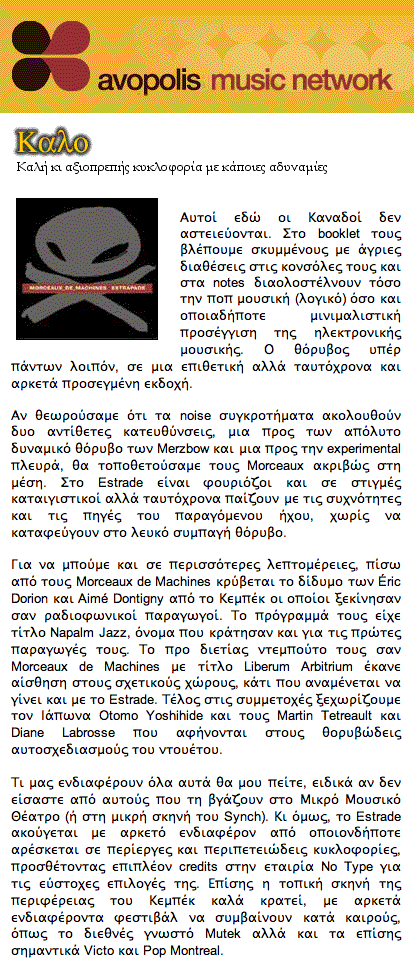
    … somewhere between Anthony Braxton, Penderecki and Public Enemy.
  • 1
  • 2
  • 3
  • 4
  • 5
  • 6
  • 7