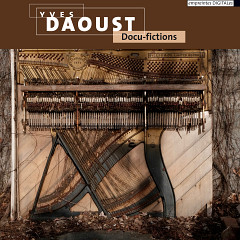
From Québec, here’s Yves Daoust with Docu-fictions (IMED 22182) — an essential release which I recommend. This fellow worked in France for a time and studied composition with Gilbert Amy, who produced the memorable Une saison en enfer.
I don’t pretend to understand that part of his method that allows him to keep “nature” and “culture” separate within the same piece, running parallel to each other in some way, but it sounds ingenious, and here are perhaps some examples of how he puts it into practice. He also steeps himself in the juices of life, and has a genuine interest in humanity; the first two pieces here are versions of his Lily piece (an acousmatic rendition, and a mixed version). Lily was a courtesan and a friend of his; she spilled out the details of her colourful life before his microphone with no shame or restraint, and he recorded the results, making them into this work; on top of the real-life Lily, he added the voice of an actress, who reacted to Lily and added her own feelings and comments. Wish I understood spoken French better than I do; it all sounds pretty steamy and fruity. But also more importantly very real and heartfelt. Daoust interjects a few treatments and editorial gestures, but he’s being true to the voice of his friend. The mixed version from a few years later adds an accordion (played by Joseph Petric, no less) and a violin, and this one’s even more orgasmic with its heavy breathing and there’s more than a whiff of Pigalle sleaze in the mix. Great!
Another gem here is Impromptu 2 from 1995 — that’s right, keyboards and piano layered in with traffic sounds and sirens. The music they’re playing has all been derived from a certain Chopin composition, we are informed; Yves Daoust speaks of the “agitation… abundant energy… tension” which got his creative fluids bubbling. He’s not kidding. Players Poulin and Cronkite do a fantastic job with their crisp, urgent percussive pecks on their 88s, but adding the sounds of the street has been a master-stroke. If only more phonographer and field-recording types could make such bold use of their material.
I’m also staggered by Calme chaos, a daring work from 2011-12, making a very profound comment about modern culture. Daoust perceives culture is in a state of crisis; there’s too much of it these days, we seem to have access to more of it than ever before, and yet “we seem to be outside the continuity, in total disarray”. Perhaps we can’t make sense of the past any more; perhaps we simply can’t tell good art from bad art. The composer doesn’t simply describe the situation, but re-enacts it through composition, using an entire orchestra to make his statement — alongside the pre-recorded tapes. The taped voices (automatic writing, samples, spoken gibberish, and a “flurry of traits”) represent the “chaos” side, while the orchestra do their best to hold on to the past, and try to bring meaning to the muddled information. 17:11 mins of sheer tension result, both exhilarating and fascinating; I’m not sure if it proposes a solution to the crisis, but it certainly presents it in a clear and elegant manner — we’ve rarely heard such controlled chaos. Other composers have battled with this popular theme — one recent instance was Pierre Alexandre Tremblay on this same label with his Newsfeed — but Yves Daoust is I think one of the first to have approached it from the starting point that we’re doing too much “archiving” these days, and he works hard to probe the gap between past and present, highlighting how our collective cultural amnesia is now spreading like a mental illness. Excellent work!