electrocd

Blog

64 results
  • 3
  • 4
  • 5
  • 6
  • 7
  • 8
  • 9
  • 10
  • 11
  • Jean-François Denis, empreintes DIGITALes in Winnipeg Free Press

    Electro Traces Here On New Music Tour”, Randall Mcilroy, Winnipeg Free Press, no. 119:89, February 27, 1991
    Wednesday, February 27, 1991 Press

    Some editions of new music are more moving than others. With a brave new concert tour called Electro Traces that concept applies in several ways.

    For one thing, with four composers and a small squad of performers, the national concert tour of new Canadian electronic/acoustic music, which stops here Friday night for one performance at Centre culturel franco-manitobain, looks more like one of those old rock ’n’ roll package jaunts than a mobile promotion for new music.

    “We’re covering all the bases with this,” enthused tour co-producer Jean-François Denis recently between rehearsals for the tour’s third performance, at The Banff Centre for the Arts.

    The concerts are only part of it. Electro Traces also promotes the new Montréal label empreintes DIGITALes, which has just issued CDs by the four touring composers — Christian Calon, Robert Normandeau and Alain Thibault, all from Montréal, and Vancouver’s Daniel Scheidt.

    For this tour, the composers will appear with Claude Schryer (clarinet), Trevor Tureski (percussion), Jacques Drouin (piano) and Catherine Lewis (soprano). An untimely attack of flu prevented another performer, the visionary American trombone, electronics expert George Lewis, from appearing.

    Denis, 31, whose own musical training includes seven years of classical guitar studies in his native Montréal, followed later by formal studies in electroaoustic music, formed empreintes DIGITALes with Claude Schryer about a year ago.

    At first, he said, the idea was to stage one showcase concert at Vancouver’s Western Front Society to promote the CDs. Then came the chance to do another gig, and soon the troupe found itself “just hopping off around the country.”

    The first shows last weekend in Vancouver went well, he said. “The public was good, the reception was good.”

    The challenge, however, is to reach the mainstream audience that has little or no exposure to modern avant-garde music, especially in Canadian cities where there is no concentrated community of instruction and performance to support it.

    Unlike many electronic-based works, which depend on prerecorded tapes and are thus essentially an audio experience, the music in Electro Traces is designed for live performance.

    Some of the music is performed completely live, with conventional instruments. Other entries mix live performance either with tapes or with an interactive computer system. “We’re having all the types of electroacoustic music on this tour.”

    With eight speakers and a mixing board, the tour sound can be arranged for any performance dimension — it sounded fine in the demi-sphere of the Montréal Planetarium, he noted — and also changed in terms of dynamic and spatial relationships, with the expressiveness of a pianist. “You can have a really different experience with the sound,” Denis said.

    It should also be a different experience for those who expect such sonic explorers to be a grim and scholarly lot. “We’re very nice people,” he said chuckling.

    … a brave new concert tour…

    Claude Schryer, empreintes DIGITALes in The Edmonton Journal

    “‘Cinema of the Ear’ In New Techno-Sound”, Roger Levesque, The Edmonton Journal, February 27, 1991
    Wednesday, February 27, 1991 Press

    Picture yourself out on a brisk walk through pastoral surroundings, maybe in the city’s river valley. It’s that special twilight time at dawn when everything seems very still and quiet, save for your own lungs breathing rhythmically in and out, and the counterpoint of falling footsteps on a gravel path. Suddenly a distant tone catches the ear. It could be the blunt horn of a diesel locomotive or the call of a lonely animal, mechanical or organic in origin.

    Then imagine all the stark atmospheric intensity of the experience magically crystallizing in sound.

    Claude Schryer might call it a “cinema of the ear,” just one of the creative options he and a growing body of composers are working with in the field of “electroacoustic” music.

    That term denotes a certain artistic intent to create within the confines of electronic technology and the studio using both acoustic, electronic and “found” or sampled sources of environmental sound. It’s a weirdly technical method used to shape natural soundscapes, often inspired by common every day experience, and it can be very subtly effective.

    Schryer and his colleague Jean-Francois Denis are two Montréal musicians, both classically trained to begin with, who have been helping to further the electroacoustic movement in Canada.

    They’re currently on a threeweek cross-country tour of major centres with four other like-minded composer-musicians. Called Electro Traces, the tour uses fresh sonic palettes and new means of manipulating the space in which we hear.

    Wednesday afternoon, Schryer and composer Daniel Scheidt (Edmonton-born, now living in Vancouver) host a workshop/performance in Convocation Hall at the University of Alberta.

    As Schryer plays clarinet, Scheidt will man a computer sound console that’s set to interact with the immediate sonic environment.

    Just last year, Schryer and Denis formed the independent record label empreintes DIGITALes (digital imprints) with the intent of putting more electroacoustic music and musicians on the map.

    The first four compact disc releases issued over the past six months use an amazing array of sources to pique the listener’s awareness, pushing at the conventions of what music is all about. Certainly it’s not the first time experimental music has made it to disc, but along with the tour, it does involve one of the most ambitious, carefully produced ventures in the field.

    Three solo projects by Christian Calon, Robert Normandeau and Alain Thibault head the roster, along with a special compilation, Électro clips.

    As that title implies, the producers wanted short musical pieces that might help the listener envision a series of sonic images, like film clips. Twenty-five electroacoustic artists from Canada the United States and Mexico were asked to submit works of about three minutes duration, a time set deliberately to challenge the notion of the pop single.

    The resulting 75-minute disc presents what must be one of the finest overviews of the medium aviilable. Twenty-five black-and-white inserts by photographer Joanne Tremblay accompany the disc, matched with background notes on the artists and music for a beautifuL intriguing release.

    Schryer stresses that while better technology has expanded the possibilities, the artist mustn’t lose his or her soul in the machine, but master the tools.

    “The most interesting electroacoustic artists are the ones who are able to go beyond the technology and — like any interesting artistic medium — say something in a universal way.”

    The future of the music remains to be seen. Schryer agrees that tbe increasingly sophisticated use of sounds and effects in various broadcast media is helping to make the public more receptive to different ways of seeing through sounds, but don’t expect to find his releases on the Billboard pop charts anytime soon.

    Do try them out if you’re looking for a stimulating new sonic perspective on the world around you.

    Daniel Scheidt, empreintes DIGITALes in The Vancouver Courier

    “Computer Composers Create On the Musical Edge”, Alison Appelbe, The Vancouver Courier, February 27, 1991
    Wednesday, February 27, 1991 Press

    Weird but appealing sounds bounce off the walls of the clapboard Western Front building on East Eighth Avenue.

    Simultaneously, it seems as if some giant, gentle cosmic force is tapping the building with a pair of sticks, an organ reverberates at your back, and the pure, sweet line of a clarinet swirls around the centre of the room.

    What is at work is North Vancouver composer Daniel Scheidt communicating through his computer and multi-track synthesizer with Québécois instrumentalist Claude Schryer, to create an interactive work for clarinet and electronics.

    “It’s hard to put a finger on what it is,” says Scheidt, when asked to explain the improvisational nature of the computer-enhanced sound. “There’s a relationship that develops between the performer and my software — there’s that dialogue. The computer is following the live perfonnance. There’s a feedback loop, but it’s more like we’re both talking at once than a conversation. Both are listening to one another.”

    Well, in the world of music-on-the-edge you don’t ask too many questions; it’s better to just listen.

    “I would be very happy for people to say, ‘That was a different way to make music,’” Scheidt continues. “I think we need new wavs of thinking to help solve problems. I think there’s validity to posing the potential for newness. If I’m helping people to loosen up — then that’s my reward.”

    Scheidt is one of eight composer/performers taking part in a cross-Canada tour of live electroacoustic concerts called Electro Traces.

    The others are all from Montréal, and comprise what has been called “the hottest thing on the Canadian new music scene” — a group called DIFFUSION i MéDIA (co-founded by Schryer) that has made a series of compact discs on the empreintes DIGITALes label.

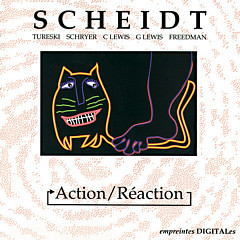
    The tour began in Vancouver last week, with the release of Scheidt’s own new CD, Action/Réaction, featuring interaction with a number of prominent instrumentalists.

    And while the Quebec musicians are most interested in the details of sound, Scheidt, who studied at Queen’s University and the University of Victoria, says he’s more into “the working process.”

    “I’m making music in a non-traditional way. I don’t work with notation — and I’m using the computer to explore different kinds or relationships.”

    He even presents musicians with puzzles and mazes to wander about in, and somehmes his installations invite public participation. However, “sound in the space” is the focus of the Electro Traces tour.

    “All the other composers have a history of presentation — of exploring an acoustic space,” Scheidt says.

    They use an eight-channel sound systern that will ‘spatialize’ the sound and rnove it around. Called ‘acousmadcs,’ it purports to offer a third dimension to musical works.

    Claude Schryer, empreintes DIGITALes in La Liberté

    “Un orchestre de haut-parleurs”, Karine Beaudette, La Liberté, February 21, 1991
    Thursday, February 21, 1991 Press

    Pour ceux qui cherchent une expérience musicale hors de l’ordinaire, la Plug-In Gallery et le Centre culturel franco-manitobain vous donnent rendez-vous le 1er mars à 19h30 à la salle Jean-Paul-Aubry (CCFM) pour écouter de la musique électroacoustique.

    «De la musique électroacoustique, c’est de la création sonore artistique avec appui technologique,» décrit Claude Schryer, un des six compositeurs-diffuseurs et interprètes qui seront à Saint-Boniface.

    Le groupe de six entreprend la tournée pancanadienne Traces électro, pour promouvoir cinq disques de l’étiquette empreintes DIGITALes, la seule compagnie qui enregistre sur disques compacts de la musique électroacoustique.

    Les compositeurs profitent aussi de la tournée pour promouvoir le médium peu connu de la musique électroacoustique, même si ce genre existe depuis 40 ans environ. «A Montréal et à Vancouver, il y beaucoup d’activité dans le domaine, mais dans le reste du Canada, c’est encore en évolution. Suite au concert, les artistes seront disponibles pour répondre aux questions.»

    Les organisateurs de Traces électro emmènent avec eux en tournée un orchestre de huit haut-parleurs. Ces boites de son seront placées séparément dans la salle de concert pour permettre la spatialisation des sons. Cette technique se nomme «acousmatique» et offre une troisième dimension aux œuvres.

    En plus des haut-parleurs, les musiciens seront là avec leurs instruments respectifs. «Par exemple, je suis clarinettiste et je vais interpréter une pièce pour clarinette et ordinateur. Un autre va jouer une pièce pour piano et bande, ou encore pour voix et ordinateur» ajoute Claude Schryer.

    Selon lui, le concert attire ceux qui aiment la musique de concert contemporaine et la musique expérimentale.

    empreintes DIGITALes in The Banff Centre Letter

    Electro Traces Brings New Musical Dimension To Banff”, Jim Hamilton, The Banff Centre Letter, February 20, 1991
    Wednesday, February 20, 1991 Press

    Electro Traces, the first ever cross Canada tour of electroacoustic music, comes to the Margaret Greenham Theatre on Monday, February 25 at 8 p.m.

    This tour brings together several prominent Canadian composers and performers who have strong connections with The Banff Centre.

    Composer Claude Schryer, a former participant in the Music program, has also held various staff positions in the now defunct Inter-Arts program. Daniel Scheidt, who is also a composer, has been involved with the Centre as well. He recorded his soon to be released compact disc, Action/ Réaction, here and was a participant in a number of programs. Finally, percussionist Trevor Tureski and soprano Catherine Lewis have both been participants here.

    The concert will consist of 10 pieces which combine taped music with live instrumental and vocal music. Electroacoustic music is usually described as “music that is heard through loud speakers.” Generally, the instruments used in this genre are less traditional and more electronic than in other fonns of music.

    “To prepare yourself for an electracoustic experience, you must throw away preconceptions about traditional instruments and music and grasp the idea that music is structured sounds,” explains Kevin Elliott, head, Audio Recording, Media Arts, The Banff Centre.

    Although electroacoustic music has been around since the 1950s, it has taken a quantum leap in the last few years. The systems, instruments, and technology have advanced greatly, spreading the parameters in which the performers and composers work. In doing so, room has been made to create exciting works that are breaking new musical ground.

    The sounds can be rich and soothing with one unique tone flowing into another or they can be sharp, percussive, and dynamic, moving with untimely changes.

    The electroacoustic music presented through this tour is of the highest quality in the world. The system being used is specially designed to project sound in a way that envelops the entire room and offers a third dimension to the works. This technique of sound projection is called “acousmatics”.

    The opportunity to experience electroacoustic music will be yours this February 25 at The Banff Centre. Take a chance and open yourself to a new dimension in music.

    Action / Réaction, Daniel Scheidt in The Georgia Straight

    “Computer Whiz Offers Satisfactory Synthesis”, Alexander Varty, The Georgia Straight, February 15, 1991
    Friday, February 15, 1991 Press

    It had to happen just as performers like Brian Eno, Joe Zawinul, and Wayne Horvitz have humanized the synthesizer, adding deep levels of meaning and musicality to an instrument that can so often sound inhuman and unfriendly, computer music is also being brought closer to the point where its technological complexities can be enjoyed for more than merely theoretical reasons. And at least one local MIDI wizard — Daniel Scheidt — is working towards a satisfactory synthesis of craft and intuition, composition and improvisation.

    Five of Scheidt’s recent compositions are featured on Action/Réaction, a new CD issued by the Québécois empreintes DIGITALes label, and this recording shows that Scheidt’s abilities, as a composer and as a manipulator of electronic “reality,” are becoming increasingly strong. (Scheidt’s new works can also be heard “live” at the Western Front on Friday and Saturday, February 22 and February 23, in conjunction with works by Québécois composers Christian Calon, Robert Normandeau, and Alain Thibault. They will also be showcased at SFU Harbour Centre at 5:30 p.m. on Friday, February 22.)

    Scheidt’s particular interest — and the reason why his work is so intriguing — is the integration of acoustic improvisation into an electronic environment. And while the orthodox approach to this is to drop an instrumentalist into a predetermined electronic arrangement, Scheidt’s innovation is to design computerized systems that effectively echo and accompany the improvising musician in musical relation’ ships that expand in depth and complexiq over the length of each piece. By working with instrumentalists of the calibre of trombonist George Lewis, clarinetists Claude Schryer and Lori Freedman, soprano Catherine Lewis, and percussionist Trevor Tureski — all profoundly gifted players, all featured on Action/Réaction, and all performing in the upcoming recitals — Scheidt has availed himself of some of the best improvisers currently active in new music, while his own, highly personalised approach to the electroacoustic medium ensures that they will be shown off in fascinating settings.

    His innovations offer the best of live performance and studio research, Scheidt says. “There’s a very interesting thing that happens in the time domain,” he explains. “When I’m creating the software, I have time on my side. I can spend as much time as I need working out details of the way the syscem is going to behave. But then I take all of that carefully thought-out work and put it into a real-time environment. In essence that allows me to do some kind of time-warp, where I have all the benefits of reflective thought; of time, in an improvisational context. The software allows me to encapsulate a whole lot of thought and have it available to me in an improvisational environment.

    “And, in turn, that allows for a different role for the performer. I’m no longer putting a sheet of paper in front of them and saying, ‘here’s what I want you to do,’ I’m saying, ‘here’s an environment I want you to explore.’“

    Scheidt is careful to separate himself from the Québécois composers that he is currently sharing a record label and a concert tour with. “They have an incredibly defined sonic intention,” he explains. “And they have, from moment to moment, absolute authority over the sound that they’re projecting. I don’t have that concern. My compositional focus is on a much more general method of making music. It’s not that I have a sonic idea that I’m trying to realize, it’s that I have a compositional idea that I’m trying to hear.”

    His is a more collaboracive vision, one that pays more attention to the social aspects of music-making and proceeds more gently with soloists needs and ambitions. In part Scheidt has come to this through world music — a member of Kyai Madu Sari, the SFU community gamelan orchestra, he recognizes that the bulk of the world’s music is at least in part improvised and to his early training at the University of Victoria.

    “There was a feeling there that the craft could be learned, that it was just a matter of sitting down in class and doing it, where we needed to focus as students was on exercising our creative intention,” he says. “Also there was an interest, at that time, in live performance of electroacoustic music, and because of the lack of a structure for notation or instrumentation or anything at all, by default improvisation was going to be a component in what was going on. I obviously don’t think twice at the notion that improvisation is a valid component of music, or a valid thing for a composer to ask a performer to do.“

  • 3
  • 4
  • 5
  • 6
  • 7
  • 8
  • 9
  • 10
  • 11