
Action / Réaction
Daniel Scheidt / Trevor Tureski, Claude Schryer, Catherine Lewis, George Lewis, Lori Freedman
… musicians who are not only impressive technically but also musically eloquent, responsibly open-minded and inventive… — Leonardo Music Journal, USA
… cinq musiciens — remarquables — […] entament un dialogue improvisé avec le cerveau cybernétique. — Crystal Infos, France
- Composer(s): Daniel Scheidt
- Writer(s): Robin Dawes
- Performer(s): Trevor Tureski, Claude Schryer, Catherine Lewis, George Lewis, Lori Freedman
- Author(s): Martin Bartlett
- Cover image: Joe Average
- Canada Council for the Arts
CD (IMED 9105, 1991)
- 1Obeying the Laws of Physics (Daniel Scheidt) (1987), 16:13MIDI percussion and interactive systemTrevor Tureski, percussion
- 2clarinet (bass clarinet) and interactive systemClaude Schryer, clarinet, bass clarinet
- 3soprano and interactive systemCatherine Lewis, soprano
- 3
- 4Norm ’n’ George (Daniel Scheidt) (1990), 20:13trombone and interactive systemGeorge Lewis, trombone
- 5Squeeze (Daniel Scheidt) (1990), 11:00bass clarinet and interactive systemLori Freedman, bass clarinet
- Label: empreintes DIGITALes
- IMED 9105
- 1991
- UCC 771028910526
- Total duration: 72:45
- Jewel case
- 125 mm × 142 mm × 10 mm
- 120 g
On the web
Download (IMED 9105_NUM, 1991)
- This item can be downloaded and/or listened to at empreintesdigitales.bandcamp.com.
- 1Obeying the Laws of Physics (Daniel Scheidt) (1987), 16:13MIDI percussion and interactive systemTrevor Tureski, percussion
- 2clarinet (bass clarinet) and interactive systemClaude Schryer, clarinet, bass clarinet
- 3soprano and interactive systemCatherine Lewis, soprano
- 3
- 4Norm ’n’ George (Daniel Scheidt) (1990), 20:13trombone and interactive systemGeorge Lewis, trombone
- 5Squeeze (Daniel Scheidt) (1990), 11:00bass clarinet and interactive systemLori Freedman, bass clarinet
- Label: empreintes DIGITALes
- IMED 9105_NUM
- 1991
- UCC 771028910588
- Total duration: 72:45
Liner notes
Join the Fray
—
Action / Réaction , the Disc
“It is one thing to aim for a particular timbre of sound and then to search for the means of making such sound and timbre audible. It is another thing to provide for a series of events to happen and then to discover the timbre of the sounds so generated. In the first case one prefers those events to happen that one wishes to hear
; in the second case one prefers to hear those events one wishes to happen. These are not only two different approaches to the composition of music but also two different political attitudes.”—
Herbert Brün , “Infraudibles”,Music by Computers ,von Förster ,Beauchamp , editors. John Wiley & Sons, New York, 1969.
A number of factors combine to inuence the nature of the work represented by this disc. An interest in process, a respect for improvisation, and a fascination with systems realized in software have led me to the development of computer programs designed to interact with performers in real time.
Each piece presented here involves an instrumental soloist performing with an interactive computer system. The software that defines each composition is designed to accept acoustic input from the performer and produce electronic responses. The compositions included in this collection evolved during extensive rehearsals with the individual musicians and would not exist without their contributions. Each recording represents the documentation of a studio ‘performance’ — there has been very little studio editing.
The improvisational nature of the performer’s role is an important aspect of this music. In making the decision to allow the performer to improvise, I have relinquished aspects of compositional control in exchange for a more personal contribution by each musician. An improvising performer works within his or her own set of skills and abilities (rather than those defined by a score), and is able to offer the best of his or her musicianship. Once having become familiar with a system’s behavior, the performer is free to investigate its musical capabilities from a uniquely personal perspective.
Another feature of this work is the performer’s relationship to the musical feedback loop created in conjunction with the computer. The performer provides source material used by the computer system, while at the same time responding to the system’s ongoing audio output. Any gesture made by the performer in response to the computer immediately becomes new source material for the computer to use and can inuence subsequent output. One performer has referred to this model as an “idea expander.”
Part of my attraction to this work is an interest in software as a compositional medium. Working with software offers extreme exibility while at the same time requiring the articulation of creative intent in precise and unambiguous terms. The ability to develop, test, revise, and extend a computer program makes software a remarkably malleable medium for experimental artistic creation.
I find the design of compositional structures intended for interactive exploration during performance to be an extremely intriguing approach to music making — one in which I am able (perhaps forced) to investigate new relationships between composition and performance.
—
Some recommended items
-
 Various artists
 -
-

-
-
-
-

-
-

-
-

-
In the press
Discos
Review
The pieces on this CD evolved through extensive rehearsals with the participating musicians. No fixed score were used
One of the most compelling pieces on the CD, in my view, is
This work creates a new kind of social context in which both the computer/ performer and the computer/performer/listener are engaged in an interactive collaboration that forces a redefinition of traditional notions of musical meaning and identity. The computer is engaged in the process of interpreting what the narrator/singer is doing, since it responds musically to her and acts as an intermediate agent for the audience. The listener, rather than becoming mired in and preoccupied with a language he or she cannot understand, becomes fascinated by the implied meanings and emotional contexts suggested by the texts, as delivered by
The piece works not only because of the flexibility and intelligence of
Taken as a whole, this CD offers a fascinating and provocative collection of pieces. The performers contribute substantially to its quality both through their playing and their intelligent musical interaction with the computer. Each performer involves him- or herself fully in forging a new kind of socio-musical relationship with
Présentation d’empreintes DIGITALes
Né à Edmonton, au Canada, en 1956,
Les pièces proposées reposent toutes sur des systèmes interactifs en temps réel
En conclusion, un disque intéressant mais un peu trop austère à mon goût.
L’électroacoustique sur orbite [6]
Ce recueil nous propose cinq pièces mixtes et interactives. D’une façon générale, on peut dire que la tendance électroacoustique nord-américaine (Québec excepté) reste très attachée à la tradition instrumentale, c’est-à-dire des musiques plus grammaticales que morphologiques. Cette situation est particulièrement sensible dans beaucaup de musiques dites
Lorsqu’on aborde ce domaine, il ne parait pas superflu de considérer sa philosophie. Por son goût de l’aléa et son refus de toute fixation, elle se situe à l’opposé de l’option acousmatique. En outre, c’est l’une des nombreuses manifestotions du retour en force de l’interprète auquel on assiste depuis une vingtaine d’années et de sa patiente revanche sur la
Et puis il y a l’interprète-simulacre
Parmi les multiples tentatives du genre, peu m’ont paru jusque alors concluantes. Le rôle de l’ordinateur y demeure souvent obscur pour l’auditeur et le tour de force technique provoque rarement chez lui l’extase artistique.
Disques
Les logiciels employés sont programmés pour réagir en temps réel aux données qui leur sont fournies (hauteur, dynamique, rhythme, phrasé). Dans
Une remarque
Review
Review
The
So far the very brief description of what happens on
Critique
Review
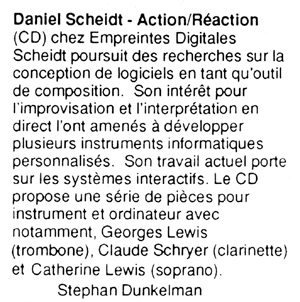
Oddly attractive experimental music, each piece the result of a duet between a particular soloist and a piece of interactive computer software. The computer sets the parameters, the person explores them. Best cuts include the percussion-based
Électricité
Depuis un an, l’étiquette empreintes DIGITALes a fait son chemin dans le monde de l’électroacoustique. Leur cinquième production vient de paraître, parallèlement à un spectacle intitulé
- 31 janvier 90, lancement du compact de
- 28 mars 90, deuxième compact,
- 25 avril 90, c’est le tour du Montréalais
- 2 novembre 90, en plein festival Montréal Musiques Actuelles, c’est le lancement d’
- 22 février 91, lancement du cinquième disque,
- 6 mars 91, sortie montréalaise d’
empreintes DIGITALes continue sur sa lancée. On nous promet une nouvelle parution pour le printemps, un monsieur
Vu l’intérêt grandissant de la clientèle étudiante, un prix de rabais est maintenant offert aux étudiant-e-s pour l’achat de toute la série.
Soit dit en passant,
Quatrième dimension
C’est mercredi dernier qu’a eu lieu le lancement du disque compact
En écoutant
Review
Action/Réaction opens with
The overall presentation of Action/Réaction and the French/English supporting documentation are attractive, pertinent and engaging, an ongoing mark of quality from empreintes DIGITALes.
Review
If you didn’t take the opportunity to get in touch with the Canadian Electroacoustic Community when I mentioned it a while back, you have missed out on some unusual, sometimes unsettling, music. Here’s more reasons to write.
Critique
Ce compositeur de Victoria étale cinq créations réalisées entre 1987 et 1990. Le concept
Review
Computer Whiz Offers Satisfactory Synthesis
It had to happen just as performers like
Five of
His innovations offer the best of live performance and studio research,
“And, in turn, that allows for a different role for the performer. I’m no longer putting a sheet of paper in front of them and saying, ‘here’s what I want you to do,’ I’m saying, ‘here’s an environment I want you to explore.’“
His is a more collaboracive vision, one that pays more attention to the social aspects of music-making and proceeds more gently with soloists needs and ambitions. In part
“There was a feeling there that the craft could be learned, that it was just a matter of sitting down in class and doing it, where we needed to focus as students was on exercising our creative intention,” he says. “Also there was an interest, at that time, in live performance of electroacoustic music, and because of the lack of a structure for notation or instrumentation or anything at all, by default improvisation was going to be a component in what was going on. I obviously don’t think twice at the notion that improvisation is a valid component of music, or a valid thing for a composer to ask a performer to do.“
When Music Meets Software
How do musicians tend to react to the composer’s interactive software structures
The computer was loaded with the software forming the basis for the composition
Is what he is doing ultimately a self-indulgent process, given the limited popular appeal of the music
Daniel Scheidt Record Launch and West Coast Debut of empreintes DIGITALes
DIFFUSION i MéDIA could be called the the most exciting thing on the Canadian NEW music scene. Based on a CD label called empreintes DIGITALes, the project of Montréalers
On Friday night at eight we will welcome DIFFUSION i MéDIA to the West Coast and celebrate the launch of a new CD by Vancouver composer/performer
Saturday’s concert will feature
This tour is supported by a grant from the Touring Office of the Canada Council [for the Arts].
More texts
- François Couture, AllMusic, September 1, 2001
Blog
-
Friday, January 1, 1993 / Press
… musicians who are not only impressive technically but also musically eloquent, responsibly open-minded and inventive… More
-
Tuesday, September 1, 1992 / Press
… cinq musiciens — remarquables — […] entament un dialogue improvisé avec le cerveau cybernétique. More
-
Sunday, March 1, 1992 / Press
… c’est une des meilleures expériences qu’il m’ait été donné d’entendre. More