
Autour
Claude Schryer
… vignettes made of orchestrated, unaltered sounds that recreate soundscapes. — AllMusic, USA
Autour is music for the adventurous listener. — Henry Schneider, USA
Prix Opus 1997-98: Disque de l’année — Finaliste
- Composer(s): Claude Schryer, Hélène Prévost
- Performer(s): Jean Derome, Tom Walsh, Claude Schryer
- Cover image: Sabrina Mathews
- Société Radio-Canada
CD (IMED 9736, 1997)
- 1Musique de l’Odyssée sonore (Claude Schryer) (1996-97), 11:38fixed medium
- 8El medio ambiente acústico de México (Claude Schryer) (1995-96, 97), 16:35fixed medium
- 8Mosaico [Mosaic], 1:04
- 9Océano [Ocean], 2:32
- 10Transportación [Transportation], 2:49
- 11Música [Music], 2:35
- 12Naturaleza [Nature], 2:47
- 13Campanas [Bells], 4:17
- 14Vancouver Soundscape Revisited (Claude Schryer) (1996), 15:10fixed medium
- 21baritone saxophone, trombone, bass clarinet and fixed medium
- Label: empreintes DIGITALes
- IMED 9736
- 1997
- UCC 771028973620
- Total duration: 56:26
- Opak
- 127 mm × 142 mm × 10 mm
- 75 g
On the web
Download (IMED 9736_NUM, 1997)
- This item can be downloaded and/or listened to at empreintesdigitales.bandcamp.com.
- 1Musique de l’Odyssée sonore (Claude Schryer) (1996-97), 11:38fixed medium
- 8El medio ambiente acústico de México (Claude Schryer) (1995-96, 97), 16:35fixed medium
- 8Mosaico [Mosaic], 1:04
- 9Océano [Ocean], 2:32
- 10Transportación [Transportation], 2:49
- 11Música [Music], 2:35
- 12Naturaleza [Nature], 2:47
- 13Campanas [Bells], 4:17
- 14Vancouver Soundscape Revisited (Claude Schryer) (1996), 15:10fixed medium
- 21baritone saxophone, trombone, bass clarinet and fixed medium
- Label: empreintes DIGITALes
- IMED 9736_NUM
- 1997
- UCC 771028973682
- Total duration: 56:26
Liner notes
Searching for the Sharawadji Effect…
In the early 1990’s, Canadian environmentalist
The questions of the survival, of our responsibility for, and interpretation of our environment have haunted me for the last few years and have incited me to compose pieces where both the subject and material are the acoustic environment.
I consider myself a child of the acoustic ecology ideology developed by
The evocative nature of recorded soundscapes fascinate me environmentally, musically and spiritually. My artistic practice involves a process of listening, analyzing, transforming and then orchestrating recorded soundscapes into electroacoustic portraits, in search of, among other things, the “Sharawadji Effect.”
Sharawadji, according to the À l’écoute de l’environnement, répertoire des effets sonores (Listening to the Environment, a Dictionary of Sound Effects) by
The effect comes about as a surprise and will carry you elsewhere, beyond strict representation — out of context. In this brutal confusion, the senses get lost. A beautiful Sharawadji plays with the rules of composition, manipulates them and awakens a feeling of pleasure through perceptual confusion.
Whether in a dreamlike or anxious state, we are sometimes completely deaf to the environment. However, while on a walk or on a journey, our spirit can combine availability, attention, perspicacity and therefore become receptive to new things, including sonic fantasy.”
I wish to thank all of my friends and colleagues who have helped bring this disc to life, and in particular
—
Autour , the Disc
East
South
West
North
—
Some recommended items
-
-
-
 Various artists
 -
-
-
-

-
-
 Various artists
 -
-
-
In the press
Review
Review
For those ot you unfamiliar with the genre,
Review
In this recording the influence of
Translated from Spanish.
Original text
A lo largo de esta grabactón se aprecia la influencia de
Retratos electroacústicos
El trabajo musical de
La relación de
“Si, fue a raiz de que
Author supuso la primera obra en solitario de
Su obra artistica representa una gran variedad y belleza creadora y se compone de piezas para orquesta, para grupos de cámara, teatro, sintetizador, obras vocales… aunque quizás sea el campo del paisaje sonoro y el arte acústico donde se encuentre más a gusto.
“Yo llegué a la electroacústica ambiental a finales de los años 80 y ésta se ha convertido en mi principal lenguaje musical. Opino que la composición electroacústica de paisajes sonoros está intimomente relacionada con el campo visual de la fotografia. Se pueden atrapar imágenes del entorno sonoro y luego procesarlos y representarlos como un reflejo de la realidad ylo como una creación artistica. Es una técnica en la que el entorno acustico es tanto el tema como el contenido de una composición, en frágil equilibrio en el limite entre la representación y la abstracción. La composición electroacústica de paisajes sonoros tiene mucho que ver con el contexto de la musique concrète, estética de la escucha reducida (Écoute réduite) en la que se aprecian los sonidos, independientemente de cual sea su fuente, por su valor masical abstracto como objeto sonoro. Para el compositor electroacústico un ‘objet sonore’ es una fuente de sonido disponible entre otras cosas para la producción masical. Sin embargo, para el compositor electroacústico de paisajes sonoros el ‘objet sonore’ también es una compleja red de información que incluye en potencia la posibilidad de revelar ‘belleza inexplicable’ bajo la forma de Efecto Sharawadji.”
Schryer es también conocedor de los entresijos del mundo editorial.
“Fui co-fundador del sello empreintes DIGITALes junto con
“Mi práctica artistica supone esencialmente un proceso de cinco foses
Review
Now this space music album (or ambient if you wish) is more like the old musique concrète but more understandable.
These are part of
Kritiek
Review
Review
Awareness of the diversity and wealth of sounds around us, a respect for “indigenous” sounds, the sounds of nature, of humankind, of the winds and oceans as well as the machines that dominate our daily aural experience, and the use of these sounds in a powerful artistic form embodied in electroacoustic musicthese are some of the objectives of a growing number of composers over the past quarter century. The World Soundscape Project (WSP) was founded in the early 1970’s at Simon Fraser University (SFU) in Vancouver by Canadian composer
The recent founding of the World Forum for Acoustic Ecology (WFAE) has brought to the fore several young composers who have taken up the cause and spirit of the WSP and developed and integrated its concerns and objectives into their own creative pursuits.
The pioneering spirit and activity of the WSP was highlighted and honored during the 1996 Vancouver New Music Festival where a number of new soundscape compositions were created utilizing the WSP archives at SFU as well as new recordings from Vancouver’s unique sound and seascape. One of these works,
The artistic use of the sound-producing potential of natural objects as well as man-made mechanisms is a fundamental premise of much audio art, sound installation work, and soundscape composition. Stemming from this is a tradition of harbor symphonies where the horns of various seafaring vessels, moored in various cities around the world, are used as a euphonious, bigger-than-life orchestra (that taking place in the city of St. John’s, Newfoundland, part of the bi-annual Sound Symposium, is perhaps the most well known).
For those who have been intrigued by the idea of ‘soundscape’ composition, have never had a chance to experience it, or have wondered what could be done with that great series of recordings captured on your last exotic vacation,
Review
This is a beautifully packaged and generously annotated edition of the Canadian composers work in collaged location recordings of environmental sound with added electroacoustic phenomena from the studio. Three pieces, clocking in between 11 and 16 minutes, offer numerous sound bites a minute or two in length from out there in the world, including a catalog of ambient moments from Mexico. The fourth and perhaps most impressive work features an environmental performance ‘event’ set in Montréal’s harbor utilizing five boats, two locomotives, the bells of the Notre-Dame Basilica and later embellished by a trio of improvising players on saxophone, trombone and clarinet in a vast studio space. The latter is truly ambitious stuff that blurs the line between naive music on a grand scale and environmental ambience as art, quite literally “inviting the listener to engage in games of timbre, space, dimension, time, transparency and intention.”
Searching for the Sharawadji Effect: Electroacoustics and Ecology
Sharawadji
The Sharawadji effect is an æsthetic effect characterized by a sensation of plenitude sometimes created by the contemplation of a complex soundscape whose beauty is inexplicable.
This exotic term, introduced to Europe in the seventeenth century by travellers who learned it in China, designates the beauty that arises without the listener perceiving the order or economy of the object in question.
The Sharawadji effect takes one by surprise ans will carry the listener elsewhere, beyond strict representation — out of context. In this brutal confusion, the senses get lost. A beautiful Sharawadji plays with the rules of composition, manipulates them, and awakens a feeling of pleasure through perceptual confusion.
Whether in a dream-like of anxious state, we are sometimes completely deaf to the environment. While on a walk or on a journey, however, our spirit can combine availability, attention, and perspicacity, thus becoming receptive to new things, including sonic fantasy.
The beautiful Sharawadji affirms itself in contrast with the banality from which it originates. Sharawadji sounds, as such, belongs to everyday life or to known musical registers. They only become Sharawadji by de-contextualization, by a rupture of the senses
The sonic matter that stimulates the Sharawadji effect can differ according to the appreciation of each individual, in a given context
; although the soundscape — and in particular urban soundscapes — can, as a result of their unpredictability and diversity, favour it. The sonic wealth of nature is also conductive to creation of the Sharawadji effect.—
Jean-François Augoyard andHenry Torgue ,À l’écoute de l’environnement, répertoire des effets sonores (A Dictionary of Sound Effects), 1995 [Translation: Claude Schryer ]
The listener, and only the listener,
is the composer of the music.—
Ola Stockfelt ,Cars, Buildings and Soundscapes , 1994
On November 11, 1997 (a day of remembrance) I walked into the concert hall at Théâtre La Chapelle in Montréal for the Rien à voir festival of acousmatic music and was confronted by a shocking contrast between electroacoustics and ecology
It was bewildering to be in this former chapel — in a quasi-religious listening experience — where we consumed virtual music in the hope of being taken on a journey “inside” sound.
This article is about my journey into the soundscape through the medium of electroacoustics and my quest to discover the “unexplainable beauty” in the music of the acoustic environment.
Electroacoustic Soundscape Composition
Electroacoustic soundscape composition is most closely related to the visual field of photography. Images of the sonic environment can be captured, processed, and represented as a reflection of reality and/or as an artistic creation. It is a technique thet treats the acoustic environment as both the subject and the content of a composition, teetering abiguously on the border between representation and abstraction.
Electroacoustic soundscape composition has everything to do with context, as opposed to the “musique concrète” æsthetic of reduced listening (“écoute réduite”), where sounds are appreciated independently of their source for their abstract musical value as “objets sonores” (sound objects). For the electroacoustic composer, an “objet sonore” is one sound source, among others, for musical production. For the electroacoustic soundscape coposer, however, the “objet sonore” is also a complex web of information that includes the potential of revealing “unexplainable beauty” in the form of the Sharawadji effect.
Electroacoustic soundscape compositions can be presented on radio, in installations, in acousmatic diffusion, in interactive performance, etc. However, the key common element in this form of composition is a concern for the context and environment of a given sound.
Listening to Dhomont, Ferrari, and Westerkamp
Industrialization and new technologies have transformed our sound environment. New sounds have appeared, have transformed our concept of hearing, and have modified our aesthetic criteria in a decisive fashion. Just as the effects of industry and technology on air and water have raised concerns about the physical environment, so too, the notion of ecology has emerged recently in the domain of electroacoustics. Artists from diverse disciplines explore and employ the soundscape in their work. Their interesting and timely reflections on problems of acoustic ecology expand the debate on, and nourish discussions of, the quality and organization of the soundscape in urban and natural environments. Artists can become a conduit of our collective memory and help us better understand our acoustic environment, which we rarely actually hear. Thus, the sound artist can propose new associations, acoustic games, and poetic metaphors, and can pose fundamental questions about the coexistence of electronic technology and ecology.
What are the aesthetic and ethical criteria of the environmental electroacoustician
One important aspect of sound ecology is, of course, that it should not be too… sonic. But what should one make of the torrents of decibels spewed out by our loudspeakers, with ever more powerful lows, ultra-lows, mids, highs and ultra-sonics
? Are we the most qualified to preoccupy ourselves with the eardrums of our contemporaries? Just like you, I am cornered by this dilemma, torn apart, trying to invent all sorts of good excuses. Like you, I consecrate kilometres of polyester to preserve the songs of cicadas, frogs, streams and nightingales, to avoid losing them forever. But I am not taken in by these subterfuges and I know very well that we have already entered the age of simulacra. Will they compensate for the disappearance of real life?
I am an electroacoustician and, like Francis, I consider myself also to be an environmentalist. The two activities should not be necessarily incompatible, and yet…
I love machines. I love to touch sound. I love to indulge in virtual sound and to immerse myself in the endless metaphoric and metamorphic potential of electroacoustics. And yet I am constantly faced with the paradox between my electronic art and ecology. Sometimes, I have the impression that I am more a part of the problem than of the solution.
The wise and poetic French composer
I agree with him that we need to learn how to develop our sonic awareness and hope that the electronic technologies of today and tomorrow will help us “tune” our perceptions to and with our environment, so that a balance can be found between natural and virtual sound environments, and also between natural and virtual listening. Increasingly, artists are searching for an ecological balance, not only in the content of their work, but also in their compositional process. Composer and acoustic-ecology activist
Much as technology can annoy and frustrate me and much as the environments in which sound studios exist tend to be unhealthy, it works better for me than composing for instruments. I use technology in my work because it is the best tool for me to express what I want to say through composition. As well, the sound studio allows for immediate interaction with sound, an intimacy, a conversation, like a slow motion improv. In a sound studio one can be a musician and composer at the same time. But I also perceive sound technology as a dangerous tool for composition
: it can distract endlessly from the content of what we want to say; it can demand an inordinate amount of attention to technical detail and it can also distract our audiences from really hearing our work. But no matter how much technology we put between our composing selves and our final composition, between ourselves and our audiences, it is still ears and bodies and psyches that perceive our pieces.
I share her enthusiasm and her hesitations. For years, I’ve been struggling with my identity as electroacoustic soundscape-composer and as acoustic-ecology activist. Hildegard’s sense of equilibrium and wisdom is an inspiration. Indeed, we must be aware of the shortcomings of the electroacoustic medium, while keeping in mind the importance of offering an ecological voice to the loudspeaker.
Never doubt that a small group of thoughtful and committed citizens can change the world. Indeed, it is the only thing that ever has.
—
Margaret Mead
Activism
In the early 1990s, Canadian environmentalist
That is why, in Banff in 1993, I became involved with a group of some 150 acoustic ecology activists in founding the World Forum for Acoustic Ecology (WFAE), an interdisciplinary association for researchers and practitioners from social, scientific, and cultural disciplines, who meet and exchange information about their work and interests related to acoustic ecology. Among other things, the WFAE is participating in the organization of an international conference on acoustic ecology organized by the Royal Swedish Academy of Music, to be held in Stockholm (June 9-14, 1998). The principal theme of this conference is “from awareness to action” and is in tune with the international acoustic ecology’s desire to evolve from an initial period of awareness to direct action.
That is also why, in 1996, in Haliburton, Ontario, I coordinated a group or thirty or so Canadian acoustic ecology activists and helped found the Canadian Association for Acoustic Ecology (CASE). CASE’s focus is on local activities, including sound-walks, anti-noise campaigns, workshops, information presentations, radio documentaries, etc. Similar groups are coming to life in Germany, Switzerland, Sweden, France, Australia, Brazil, and Japan.
These organizations and their activities are directed to finding new methods of teaching and encouraging sensitive listening, of increasing awareness of the acoustic environment, and of promoting both internal and external listening as a tool for growth and sustainable development.
”Not a Very Good Composer…”
I had the shock of my life in 1985, when composer
Indeed, since 1989, I have progressively detached myself from the concert music tradition and have allowed myself to touch sonic matter through electroacoustics. At the same time, in response to the growing world ecological crisis, I have felt a need to become involved in the environmental movement, at both political and artistic levels. And because I had had musical training, I chose a path that combined the ecology of sound with music, in the form of electroacoustics. It seemed most natural for me to become concerned about the sonic quality of our environment. Therefore, I began following in the tracks of composers
I find myself continually fascinated by the evocative nature of recorded soundscapes. I sometimes think of it as a “voice” within the environment reaching out to me. As a result, I want to bring the listener “inside” a space, experience, or sensation, with or without words, with or without transformation, and also with or without “music.”
My artistic practice involves essentially a five-step process
I have found that an essential part of the composition process occurs during field recording. Apart from a DAT machine recording two-dimensional stereo sound on tape, a parallel recording process takes place during field recording. I call it “emotional recording,” wherein the body and spirit also record sensations and vibrations from the space. These emotions can subsequently be called upon to guide the inner structure and spiritual map of the composition. I try to record sounds that, upon repeated hearing, resonate in me and cleanse me and shake me up. I listen for sounds which evoke the fragility of our environment and the importance of awareness, listening, and silence. In general, when I record, I try to meditate on and analyze the space. How does it speak to me
When I record I also try to be aware of the limitations of my recording equipment and to plan how to frame my recordings in terms of my specific needs. Therefore, each recording—the movement of the microphone, the choice of perspective, the background, the levels, the presence of breath (or not), the stereophonic angle—is unique to each project.
Around “Autour”
It is interesting to note the reaction of
Musically speaking, this is elementary electroacoustics, which, far from magnifying its subject, discourages the listener, even the best intentioned. There is no call, nor interpolation from our poet in becoming
; only an applied report on tape of things here and there which offer no perspective… Maybe acoustic ecology is just that: a canvas on which you can do whatever you want without really listening to it… And yet, I agree withR Murray Schafer , one of the instigators of this discipline: the environment (le paysage), is beautiful, but one must do something with it.
Indeed, my work is a simple use of electroacoustics, but I think of it as transparent rather than elementary. It is more difficult than one might think to resist transforming a sound in studio, allowing it instead to “breathe” on tape. François doesn’t seem to hear the voice of the environment, nor understand the notion of the Sharawadji effect as I do. This is his choice as listener and I respect it. It is, however, shocking that he thinks this kind of work has no perspective. It is all about perspective
Acoustic ecology is all about listening to and being aware of the acoustic environment, and though I agree that one must indeed “do” something with the acoustic environment (as
The review certainly shook me up and I am grateful for that. It has encouraged me to question our ability to appreciate this kind of music with “classical” ears and to consider new models of listening and appreciation, as
Ironically, in another review that same day (November 22, 1997), in
This electroacoustician manipulates the microphone like a camera, choosing his angles, enlarging this or that detail, defining a sound image to vary the effects and therefore demonstrating the art of acoustic ecology with audio images that recreate remarkable atmospheres. We are closer to a cinematographic process here than that of music written on manuscript… The sounds of nature and of the city are retained in our memory, rather than the spectacular artifices of cybernetics. Avoiding overwhelming the listener with overcharged effects which are easily forgotten,
Schryer gives an important place to silence, therefore favouring the memory of the chosen soundscape and the sensation of plenitude that he is seeking.
From External to Internal Soundscapes
With
My research began in 1989 with a period of listening to and awareness of my immediate external environment. I composed two “home” pieces,
My next step was to figure out what I was talking about. I asked questions about acoustic ecology and the history of the acoustic-ecology movement in Canada and composed two experimental radio documentaries,
In 1993, I attempted to compose my first “musical,” ecologically inspired, concert-music pieces,
After an extended depression and period of healing meditation and listening in 1995, I came back to composition in 1996 with a set of four electroacoustic soundscape compositions based on locations in North America,
Nineteen ninety-seven brought about the conclusion of a seven-year cycle of electroacoustic soundscape compositions, with
Critique
Le compositeur électroacousticien
Symboliquement, ces compositions représentent aussi les quatre points cardinaux de L’Amérique du Nord et sont présentées sur ce disque dans l’ordre du cercle de vie amérindien (Est, Sud, Ouest, Nord).
On y découvre ainsi un récit sonore inspiré de l’histoire, du caractère et du mystère de la Ville de Québec
Critique
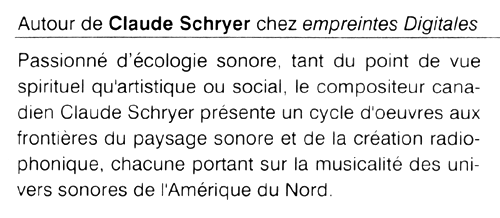
Review
Acoustic ecology is
The tracks are generally one to two minutes in length, and each contributes to a global scheme while being a satisfying experience in itself. In fact, I often found it enjoyable to listen to a brief track and pause before moving on to the next segment. The third section of
From a distance
Entretien: Récepteur Claude Schryer
Compositeur, producteur, diffuseur et organisateur,
Préambule
1- Prise de sons
R&C
Avant de réaliser une prise de son. Je médite sur le lieu, et tente d’analyser et de comprendre l’espace. Je questionne comment le lieu me parle. Quelles sont ses composantes microscopiques et macroscopiques
Je tente de prendre conscience des limites de mes outils d’enregistrement. et de savoir comment “cadrer” mes prises de son en fonction de mes besoins particuliers. Chaque prise de son — le mouvement du microphone, le choix de perspective, de relief, les niveaux, la présence de ma respiration (ou non), l’angle stéréophonique — est unique pour chaque projet.
Par exemple, dans ma composition radiophonique
Lors de la prise de son de cette pièce j’ai enregistré des papillons Monarque dans les montagnes à Angangueo (Michoacan). Il y avait des centaines de touristes dans la montagne et des miilions de papillons. Cherchant, j’ai eu la chance de capter un moment d’unité entre les voix d’emerveillement des touristes, celles de la douce masse des papillons à distance et du frottemenr frénétique à proximité des ailes de papillons… je ne crois pas pouvoir recréer une telle beauté poétique en studio.
R&C
3- Réalité
R&C
L’industrialisation et les nouvelles technologies ont métamorphosé l’environnement sonore
En tant que société, nous devons apprendre à décoder le réel de l’irréel, par l’entremise d’un rythme de lecture abordable de la matière sonore.
Pour l’artiste sonore médiatique — poète du temps irréel — le défi est de taille
Dans cette jungle temporelle, je me réfère aux principes proposés par
L’art de l’électroacousticien environnemental est donc celui de conjuguer les dimensions d’écoute naturelles et médiatisées dans un cadre temporel virtuel qui se veut crédible, révélateur et séduisant.
4- Corps
R&C
Ma philosophie corporelle est d’être à l’écoute de moi-même et de mon environnement, et de me fier à mon intuition pour savoir comment agir et ne pas agir…
Ma plus récente composition,
Le dicton
5- Paysage sonore
R&C
En l991, dans une de mes premières créations
Ce qui a évolué en moi depuis
Mais, un des problèmes aujourd’hui est que la crapuleuse vague
6- Écologie sonore
R&C
Depuis, je me suis impliqué, tout comme mes collègues
Un événement important dans l’histoire du mouvement d’écologie sonore a été le congrès
Un des résultats de ce congrés a été la mise sur pied d’un organisme international pour la promotion de l’écologie sonore
Les écologistes sonores s’interessent à la création de multiples contextes et de situations qui encouragent l’écoute du paysage sonore, le développement de la perception auditive et l’approfondissement de la compréhension sonore de l’auditeur ainsi que l’appréciation et l’observation des actions qui affectent ou modifient la qualité de l’environnement sonore, l’étude des effets d’intervention technologique sur l’environnement sonore, l’étude de la signification des médias électroniques (radio, télévision, musique d’avant et d’arrière plan, etc.) et leur présence grandissante dans le paysage sonore, la protection des paysages sonores naturels, la préservation et la création de temps et d’espaces de silence, le développement d’idéologies concernant le silence dans différentes cultures, la conception d’environnements sonores sains et la création artistique.
Le FMÉS existe aujourd’hui grâce à l’appui de ses membres avec un bureau administratif à Vancouver. Le FMÉS coordonne la publication d’un bulletin d’information trimestriel, le New Soundscape Newsletter, publié par
Aujourd’hui, le FMÉS est dans une phase de transition. Il y a eu un congrès international d’écologie sonore à Paris cette été, organisé par
Ce congrès permettra de consolider et d’organiser les activités de la communauté internationale d’écologie sonore. Les trois thèmes principaux de la rencontre, axés autour des dimensions scientifiques et sociales de l’écologie sonore, seront
Un des projets du Congrès de Stockholm est de faire connaître leur
De plus, en 1996, nous avons fondé une Association canadienne d’écologie sonore (ACÉS), qui a comme mandat d’organiser des activités locales, telles des promenades sonores urbaines, des campagnes de sensibilisation au bruit, des ateliers de formation et d’information sur l’écologie sonore, la production de documentaires radio, etc.
Parfois, je me demande quel héritage sonore laisserons-nous à nos enfants ou encore si la biodiversité sonore du 21e siècle sera suffisante pour soutenir une véritable écologie sonore
Propos recueillis par
- Jean-François Augoyard et Henry Torgue, À l’écoute de l’environnement sonore
: Répertoire des effets sonores. - Paul Virilio, L’art du moteur.
R Murray Schafer , entretien pour Odyssée sonore, documentaire de l’ONF par Louis Ricard.Luc Ferrari , entretien pour Marche sonore 1 (1991), Paris.- Nicholas Gedhardt, A Thread of Musical Thinking —
Glenn Gould ,Bach ,François Girard and an Art of Sounds, Musicworks 67. - Guiganti, Écoute naturelle et écoute médiatisée, Musicworks 65.
- Jacques Garros, Notre corps est la terre de notre esprit. Bongo Bongo.
Pour en savoir plus
- Association canadienne pour l’écologie sonore (ACÉS) / Canadian Association for Sound Ecology (CASE)
- Augoyard, Jean-François et Torgue, Henry. À l’écoute de l’environnement sonore. Répertoire des effets sonores- Éditions Parenthèses, 1995. ISBN 2-86364-078-X. (Un excellent répertoire qui explique les phénomènes sonores de différentes perspectives — scientifique, technique, sociale, artistique, etc.).
- Fort, Bernard et Saint Martin, Dominique. Zoom sur les sons de la nature, Éditions JM Fuzeau. ISBN 2-84169048-2. (Un livre avec cédérom sur l’apprentissage de l’écoute et de la musique contemporaine.)
- Forum mondial pour l’écologie sonore (FMÉS) / World Forum for Acoustic Ecology (WFAE)
Critique
Est
Sud
Ouest
Nord
Certaines musiques s’écouteraient les yeux fermés pour enchanter virtuellement les sens. D’autres proposent avec une grande acuité une réalité des instants fragiles en lisière des presque rien. Ici, la composition plonge ses racines dans l’humus du vivant. L’
Autour de l’électroacoustique
Pour ceux qui l’ignoraient, sachez que Montréal fut du 12 au 16 novembre l’un des rares centres mondiaux de l’électroacoustique grâce à la tenue d’un festival intitulé Rien à voir au Théâtre La Chapelle. Plusieurs électroacousticiens d’ici et d’ailleurs y présentaient leurs œuvres. Parmi eux, soulignons la présence événementielle du Français
Un nouveau disque (disponible au début de décembre) vient donc de s’ajouter au catalogue de la maison empreintes DlGlTALes vouée à la vitalité de l’électroacoustique. Ce premier disque de
Les séquences sonores de
Des quatre montages que l’on retrouve sur ce nouveau compact, trois sont composés de miniatures, sorte de cartes postales sonores qui forment une suite possédant son caractère propre que l’on ne peut confondre aux autres œuvres du disque. Toutes ces séquences montées proposent des itinéraires variés et portent des titres à la fois subjectifs et explicites
Review
More texts
- François Tousignant, Le Devoir, November 22, 1997