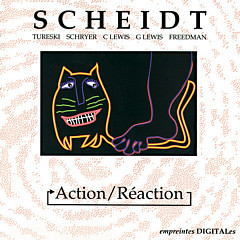
Daniel Scheidt’s recording was realized with the aid of the Canada Council and recorded at the Luscar Studio of the Banff Center for the Arts between July and October of 1990. It contains five works, each of which features an individual soloist performing with an interactive computer software system designed by Scheidt. One of these systems, MOXIE (which utilizes timing routines developed by Douglas Coiling of Victoria, Canada, and is designed to run on an Atari ST computer), takes acoustic input from the performer and produces an electronic response. MOXIE transforms incoming musical material in a variety of ways and sends responses back to the performer and auditors via audio output with MIDI-based synthesizers. Hence, a feedback loop is created between the performer and the computer: the performing musician provides source material, the computer reacts, and this transformed material becomes new input for the performer at subsequent iterations.
The pieces on this CD evolved through extensive rehearsals with the participating musicians. No fixed score were used; instead, each performer freely improvised the material to which the computer responded — including the macro design elements in each piece. Scheidt relinquishes compositional control out of interest in and devotion to improvisation, process and software as a compositional medium. Each performance with an interactive system will naturally be quite different, and the recordings on this disc are for the most part straight runs, with little or no studio editing. Having fought with the issue of an “ideal take,” Scheidt has opted for offering his listeners a documentation of a studio performance rather than a compositionally worked-out realization of each piece. The contributions of each performer, therefore, are of paramount importance. It is clear that, in this recording, Scheidt is working with musicians who are not only impressive technically but also musically eloquent, responsibly open-minded and inventive with regard to Scheidt’s purposes. Furthermore, Scheidt’s software is flexibly wriuen so as to provide intelligent musical responses to each performer’s particular set of skills and style of playing.
Obeying the Laws of Physics features Canadian percussionist Trevor Tureski in an interactive performance with the computer. He performs on an electronic percussion device that functions as a controller, which is routed through the computer into what sounds like Yamaha TX802 synthesizer modules. The piece explores four timbral landscapes, including unpitched, austere, dry percussive timbres; sustained, bell-like colors; dramatically charged plucked sounds; and transformed bell-like timbres. Though the piece is played with conviction and skill bv Tureski, it suffers in this realization from the relative homogeneity of its rhythmic language. There is not much change in the surface rhythm until about 9.5 min into the piece. Further, there is not a distinctive enough middle-ground rhythmic profile to offset this. It is difficult to judge whether this is due to the software or to choices Tureski makes; nevertheless, it points to a potential pitfall of relinquishing control of certain compositional issues relating to phrase structure and rhythmic design in a work where rhythmic profile is so important. A more carefully crafted timbral landscape might have offset this, but as it is, the timbres seem to consist of rather tired-sounding FM presets on a TX802 synthesizer module. To be sure, Scheidt’s principal interest is neither in designing new instrumental timbres nor in creating masterpiece sound objects. However, he can be respectfully taken to task for not paying attention to timbre in a more creatiie fashion, since in the program notes to the piece he professes to be concerned with the exploration of distinct timbral groups. Tureski shows good compositional judgement in his decision to reserve the most climactic section for the end of the piece. The piece also ends in the same wav that it begins timbrally and rhythmically, thereby rounding it out formally. Perhaps this latter decision is too safe a one to make in a work that might have benefited from a less predictable formal approach.
A Digital Eclogue for clarinet/bass clarinet and interactive software, highlights the talents of Claude Schryer, whose playing in the piece explores a variety of instrumental timbres and some extended techniques such as microtunings and multiphonic textures. For the most part, the piece is preoccupied with pitch, especially at the beginning and the end of the work. Motivic relationships are brought to the foreground by both performer and computer. Timbrally, the piece favors slowly evolving FM sonorities that create a flat sonic landscape at the outset, middle and end, forming a kind of arch. Within the arch are dynamic transformations and filterings of the clarinet through the computer, as well as effective contrasting musical gestures and colors coaxed out of the instrument by Schryer. The rounded arch form works to the piece’s advantage, as there is sufficient melodic, rhythmic and proportional contrast within it. Judging from the program notes, this choice of motivically derived pitch relationships, as highlighted by the arch form, reflects a concern with more traditional aspects of musical design.
One of the most compelling pieces on the CD, in my view, is Stories Told, which is also the only one in which the performer uses written material — namely, five texts by Robin Dawes and a setting that Scheidt wrote for the third text, which is entitled Chanson/Song. Dawes’s texts are generated by a computer program of his own design, which performs a statistical analysis of the Oxford English Dictionary to make new words resembling English. The results seem more like a marriage of Gaelic and Latin. These statistically generated words are grouped into phoneme classes that constitute four distinct “dialects” in this piece. Stories Told explores the idea of narrative as an act of storytelling extracted from the content of the story itself. Since the texts are in an unknown language, every listener shares the experience of interpreting meaning only by means of the musical inflections and expressive renderings of the performer, Catherine Lewis, without reference to a specific cultural or societal context. Stories Told holds the listener’s interest because of Catherine Lewis’ imaginative, expressive readings of Dawes’ texts and her exquisite singing of Chanson — eloquently set, with simplicity and memorable melodic profile, by Scheidt and Lewis.
This work creates a new kind of social context in which both the computer/ performer and the computer/performer/listener are engaged in an interactive collaboration that forces a redefinition of traditional notions of musical meaning and identity. The computer is engaged in the process of interpreting what the narrator/singer is doing, since it responds musically to her and acts as an intermediate agent for the audience. The listener, rather than becoming mired in and preoccupied with a language he or she cannot understand, becomes fascinated by the implied meanings and emotional contexts suggested by the texts, as delivered by Lewis, and by the musically interpreted meaning, as offered by the computer. Where is the composer in this relationship? Is the software the composer of the piece, in so far as it is setting the words in an interpretive context. Or is the performer the composer, since she is emoting the words quite differently in each text, and the computer is set up to respond to that? I find it difficult to hear the texts simply as found objects that can be appreciated for sound’s sake alone. They placed me in a context where a search for their meaning could not be avoided. Provocative questions are raised in this piece — and in Scheidt’s work in general — that call for a reevaluation of musical identity and of that which is “social” in the making of music.
Norm ’n George, for trombone and interactive software, features the talents of George Lewis on trombone and NORM, an interactive software environment written by Scheidt. NORM is “the most generalized response system used on this disc,” according to Scheidt, and has continued to “grow and shed its skin” vith each new performance.
The piece works not only because of the flexibility and intelligence of Scheidt’s sofnware, but also because of George Lewis’s keen compositional sense and remarkable ear. In this piece one senses, above all, the presence of a performer listening creatively to the computer and finding humor as well as seriousness in that enterprise — and, no doubt, testing the computer to its limits, since Lewis creates a remarkable array of gestural profiles and timbres with his instrument. Virtuosic, substantial, drawing upon jazz and contemporary extended techniques, Lewis’s playing has purpose, wit and boundless energy, and it builds to a convincing climax. The piece is quickly paced, though it is the longest on the disc. Clearly there is more to the NORM software than simple triggering or imitation of incoming musical events. The computer engages the performer in a spirited dialogue. This is the most musically convincing composition on the disc, due in no small way to George Lewis’s talent, and the one that shows the flexibility and quickness of Scheidt’s software to its best advantage.
Squeeze, for bass clarinet and interactive software, is performed by Lori Freedman on the bass clarinet and NORM interactive software. A static slowly evolving, quiet and meditative work, it serves as an effective contrast to the preceding piece, pointing up the flexibility of Scheidt’s software and its sensitivity both to the material that the performers bring to the interaction and to their playing styles. Freedman’s playing is controlled, effectively building the piece in long-breathed phrases, while the computer creates an amorphous cloud of closely spaced clusters around the sparse melodic patterns fed in by Freedman. The manner in which the piece breathes and builds from the chiaroscuro to the highest register by its end is particularly memorable. If anything, the piece could have gone on a little longer — the ending seems abruptly cut off. Nonetheless, the work presents an appropriate ending to the disc as a whole.
Taken as a whole, this CD offers a fascinating and provocative collection of pieces. The performers contribute substantially to its quality both through their playing and their intelligent musical interaction with the computer. Each performer involves him- or herself fully in forging a new kind of socio-musical relationship with Scheidt’s interactive software. One is hard-pressed to imagine more committed, open-minded partners in such an enterprise. Scheidt has surrounded himself with musicians who enter into this interactive world with passion, invention, virtuosity and purpose.
Scheidt himself continues to spearhead fascinating research in interactive music systems involving human performers and computer software. He is currently affiliated with the Computed Art Workshop at Simon Fraser University’s Contemporary Arts Summer Institute in Vancouver, British Columbia, which intensively explores software as a creative medium. Some of his ongoing projects invobe Yamaha Disklavier technology and interactive software such as Big Piano, with U.S. composer Robert Kyr and Machine/ Mind/ Music, with Canadian composers such as David Eagle, Century and Robert, realized at the Banff Center for the Arts in Alberta, Canada. In these projects, the composer/pianist creates his or her own composition within a musical environment determined by the software. One looks forward to future CD projects from Scheidt and to the possibility of more general distribution of his software.

![Jean-François Denis [Photo: Brad Ardley (SOCAN), Toronto (Ontario, Canada), September 17, 2025]](https://res.electrocd.com/image.php/image/d/denis_je_15346.jpg?width=n2&cropratio=1:1)