electrocd

Blog

101 results
  • 6
  • 7
  • 8
  • 9
  • 10
  • 11
  • 12
  • 13
  • 14
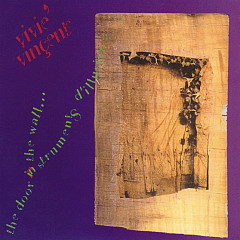
  • the door in the wall… instrumentS d’illusion? in Opus

    “Review”, Scott Paterson, Opus, June 1, 1999
    Tuesday, June 1, 1999 Press

    The harpsichord has been a part of the contemporary concert scene since the early years of the 20th century and it now boasts a considerable body of literature from our time. Montréal-based vivie’ vinçente has embarked on a project to record “the comprehensive contemporary Canadian and Québécois harpsichord repertoire” of which this two-disc set is a part, containing music by 10 Canadian composers as well as Pierre Schaeffer and Calliope Tsoupaki.

    The sound of the harpsichord lends itself to a spare, minimalist style which is shared by many of the pieces on this recording. There is no lack of variety, however. Two of the pieces are written in quarter-tones (especially effectively in Mather’s Saumur), two involve electronics, two involve manipulated recording techniques, and one uses an old tuning system. Most are in a serious, even introspective mode, although Schaeffer’s Bilude humorously mixes a Bach Prelude with musique concrète. All the pieces have in common a desire to explore new sonic possibilities for the harpsichord, a point emphasized by the final track, which consists of seven minutes of silence.

    To be successful, this music requires quite a bit of technical and musical control from the performer, and vinçente has both. There is a sureness and inevitability about these performances that gives each peace an all-important feeling of unity.

    The studio recording is appropriately close as it captures the varying sounds and resonances of the harpsichord. The presentation is very sparse (the dates of the pieces are not even provided), but this too seems to be in the spirit of the enterprise, which is uncompromising but completely committed. This is not a recording for everyone, but new music aficionados will find here an intriguing survey of contemporary harpsichord techniques.
    Aérosol in Henry Schneider

    “Review”, Henry Schneider, Henry Schneider, June 1, 1999
    Tuesday, June 1, 1999 Press

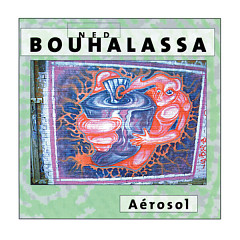
    Ned Bouhalassa is a young Canadian electroacoustic composer who has studied under Francis Dhomont. His recent achievements have included music for the cinema, television, and Internet involving a variety of techno-derived styles. Aérosol is Bouhalassa’s debut release and presents an excellent collection of five electronic compositions that lack the sterile academic ambiance so prevalent in this genre. The opening track Jets is an electronic analog of water, air, and dust jets that leave a trace as they move through space. This is a cool piece as these ‘jets’ hurl themselves in all directions in stereo space. The next piece, Constamment (autoportrait), is Ned’s self-portrait. Consisting of 5 sections, it starts quietly and ends with some hip techno beats. The remaining three tracks Attraction, Move 1, and Bouffée délirante are equally as brilliant. In fact an edited version of Move 1 also appears on the Asphodel compilation The Swarm of Drones.

    If you are looking for some adventurous, but not academic, electroacoustic music, by all means buy Aérosol. Highly Recommended.

    If you are looking for some adventurous […] music, by all means buy [this disc.]

    Musiques naïves in Henry Schneider

    “Review”, Henry Schneider, Henry Schneider, June 1, 1999
    Tuesday, June 1, 1999 Press

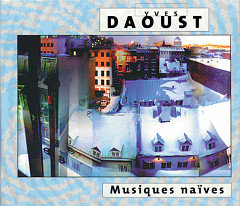
    Yves Daoust is a Canadian electroacoustic composer well versed in the manipulation and processing of natural and found sounds. Daoust currently teaches a course in electroacoustic composition at the Conservatoire de musique de Montréal. Musiques naïves is a collection of six Daoust compositions spanning 1986 to 1994. The opening composition Impromptu is the most recent and an interesting experiment in composition. Daoust recorded Chopin’s entire Fantasie-impromptu in C sharp minor, Op. 66 on a sequencer. Daoust extracted a few key motifs to create a series of ‘Chopin-objects’, which he used as building blocks to convey the feverishness of Chopin’s writing by unleashing floods of MIDI data, pushing this technique to its limits. The result being music that builds slowly from warped strings, organ, and piano to rapid crystalline arpeggios sliced, diced, and layered to create a wall of sound not unlike Paul Dolden or [John Oswald’s] Plunderphonics on Grayfolded.

    The second composition Il était une fois… (conte sans paroles) (1986) is a sound collage that begins with street sounds and children playing on swings. It develops into a quiet surreal dream-like world complete with electronic insectoids and birds making it one three standout compositions on the disc. The third composition Mi bémol (1990) is a short little ditty using processed bell sounds and voices played both forward and in reverse. The fourth composition Résonances (1992) is a difficult piece constructed out of a few bell sounds recorded at the Notre-Dame Basilica in Montréal.

    Water Music from 1991 is another of the high points of the disc. Using the spectrum of sounds created by water Daoust takes us on a sonic journey from a melting icicle to a swollen stream. Dripping water loops create interesting rhythms that merge and cascade into a rapidly flowing stream of sounds. The disc closes with another excellent composition, Fantaisie, a radio collage commissioned by the Société Radio-Canada for the Prix Italia 1986. It commemorates the fiftieth anniversary of French production on the state radio network and is an extremely interesting and fun piece.

    Make no mistake, Musiques naïves is experimental music and exists for the adventurous listener. However, it may be one of the more accessible discs of the genre, especially for its three outstanding compositions.

    … one of the more accessible discs of the genre, especially for its three outstanding compositions.

    Autour in Henry Schneider

    “Review”, Henry Schneider, Henry Schneider, May 1, 1999
    Saturday, May 1, 1999 Press

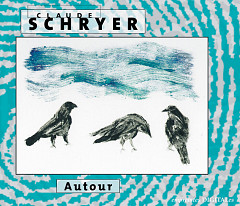
    For those ot you unfamiliar with the genre, Claude Schryer composes electroacoustic and environmental music focusing on the spiritual, artistic, and social aspects of sound. If you accept the definition ot music as sound events in time and space, then Claude Schryer is the maestro. Armed with his tape recorder he roams the world capturing the sonic essence ot each location. Then back in his studio Claude assembles these tapes to create some unusual and tascinating sonic environments. Autour contains three such compositions (Musique de l’Odyssée sonore, El medio ambiente acústico de México, and Vancouver Soundscape Revisited) plus a fourth composition (Autour d’une Musique portuaire) recorded live on 3 March 1996 in Montréal. Musique de l’Odyssée sonore is a sonic portrait of Quebec in seven parts incorporating sounds ot water, insects, trains, horse and cart, church bells, car horns, seagulls, Native American chanting, etc. El medio ambiente acústico de México is a six-part soundscape incorporating similar elements as well as a Mexican shepherd and a man selling Chiclets in a Mexico City subway. Vancouver Soundscape Revisited is a seven part impressionistic portrait of the musicality and poetry of past, present, and future soundscapes of Vancouver. Claude uses hundreds of sounds in these three compositions to create his environments. The sound is crystal clear and the movements flow seamlessly as if you are strolling through them. The final composition, Autour d’une musique portuaire, is an environmental composition for six boats frozen in the port of Montréal, two trains in motion, and the bells of the Notre-Dame Basilica all conducted by Claude Schryer via walkie-talkies. This is truly a three-dimensional expenence that is difficult to capture in stereo. You can feel the boat and train horns as they reverberate, yet to be in the middle of it must have been quite an experience! Autour is music for the adventurous listener. Be brave, take a chance, and explore the world of electroacoustic soundscapes.

    Autour is music for the adventurous listener.

    21 situations in Downtown Music Gallery

    “Review”, Downtown Music Gallery, May 1, 1999
    Saturday, May 1, 1999 Press

    Both Martin from Montréal & Otomo from Japan are turntable innovators whose unique sounds collide and connect in all sorts of weird but focused ways. Martin often plays & takes apart his turntables, hence the sounds of technology breaking down, often without the use of records. Otomo also plays sampler & cds in addition to turntables usually with records. Each of these 21 pieces are short and seem to deal with a few areas of sound at a time. Still, each piece is fascinating as it explores different terrains one at a time. Obviously both of these wizards have developed their own worlds of sound, sometimes twisted and chaotic, sometimes recognizable sound bytes emerge — is that Eye or David Moss I hear in there? One day when the evil music industry has finally gotten rid of records for good, we will be nostalgic for the sounds of scratchy records, skipping pops & repeats and the warmth that only a good virgin vinyl lp can provide. Those days are not so far off. My young niece of about seven years recently asked her father what a record is/was!?! How sad. An enchanting art form that is slowly disappearing. Available only on cd.

    Les corps éblouis in N D - Magazine

    “Review”, N D - Magazine, no. 21, April 1, 1999
    Thursday, April 1, 1999 Press

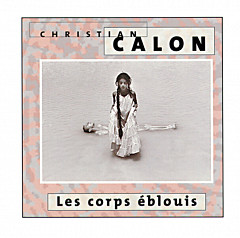
    A beautiful electroaoustic work using only guitar as sound material wich was then processed, transformed and evolved. Rich, engaging and powerful work wich slowly evolves with increasing itensity.

    Rich, engaging and powerful work…
  • 6
  • 7
  • 8
  • 9
  • 10
  • 11
  • 12
  • 13
  • 14