Sauter au contenu principal
electrocd

Aussi dans le blogue

22 résultats
  • 1
  • 2
  • 3
  • 4
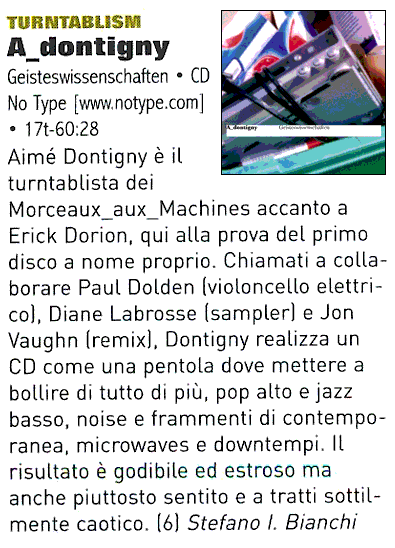
  • Geisteswissen­schaften dans The Wire

    «Electronica», Chris Sharp, The Wire, no 285, 1 novembre 2007
    jeudi 1 novembre 2007 Presse

    As you might guess from the quotation from Guy Debord’s La Sociéte du spectacle which proudly adorns the sleeve of Geisteswissenschaften, Aimé Dontigny revels in a refusenik sensibility. A founder member of free noise collective Napalm Jazz and a dedicated servant of the Canadian New Music Network, his first fully fledged solo CD defies easy assimilation. These constructions take standard tropes such as hiphop drum breaks, saccharine sax solos and swooning romantic film scores, and disfigure them with flurries of disruptive sound. But as the violence is generally held in check, the end results are curiously ambivalent; sometimes it’s hard to work out whether you’re being offered the farthest reaches of sound art or just a particularly cerebral dose of triphop. Somehow Dontigny manages to conjure a strange, splenetic grace from his unruly source material and Geisteswissenschaften remains an intriguing if frequently bemusing listen throughout.

    Somehow Dontigny manages to conjure a strange, splenetic grace from his unruly source material…

    Geisteswissen­schaften dans Spex

    «Kritik», Kai Ginkel, Spex, 24 octobre 2007
    mercredi 24 octobre 2007 Presse

    Geisteswissenschaften, erschienen bei No Type, ist ein wahres Sammelsurium der Querverweise. A_dontigny, der junge Komponist dahinter, hat sich hiermit ein äußerst ambitioniertes Unternehmen aufgebürdet, das vermutlich nur im augenscheinlichen Durcheinander Bestand finden kann, das dem Hörer in der vorliegenden Musik schroff gegenübertritt. Abgedeckt werden wollen schließlich — in Form von Referenzen, kleinen Fetzen und sonstigen Unscheinbarkeiten — ausgewählte Episoden aus (natürlich) Musik, Philosophie und auch aus der modernen Kunstgeschichte. Ob ein solches Projekt gelingen kann, überhaupt gelingen darf? Man begegnet hier einer etwas trockenen Art von Humor, die das heillose Ineinandergreifen zu einem verführerisch ereignisreichen Flickenteppich zwischen Sample-Akrobatik und enervierender Kunstmusik verdichtet. Erstaunlicherweise zieht und quengelt sich jedoch ein recht eigener, charakteristischer Stil durch die 17 versammelten Stücke: Das macht das Zuhören etwas leichter, glücklicherweise jedoch nicht leicht genug, um aus Geisteswissenschaften am Ende tatsächlich schlau zu werden. — Das Hauptkapital dieser Musik liegt schließlich nicht zuletzt in ihren zahllosen Unklarheiten verborgen. Daher: kurzlebig, aber allemal imposant.

    … allemal imposant.

    Geisteswissen­schaften dans Solénoïde Radio

    «Mission», Solénoïde Radio, no 112, 7 septembre 2007
    vendredi 7 septembre 2007 Presse

    Membre fondateur du collectif free-noise Napalm Jazz et du duo morceaux_de_machines, ce compositeur montréalais semble disposer d’une imagination débordante! Erreurs d’encodage, retraitements hypnotiques ou encore manipulations électroacoustiques sont quelques unes des pratiques artistiques que l’individu peut ainsi décliner. Bonifiée par les contributions de trois collaborateurs chevronnés — Paul Dolden (au violoncelle, à la guitare et basse électriques), Diane Labrosse (à l’échantillonneur) et John Vaughn (au mix) — cette expérience séduit par son habileté singulière à concilier créativité et envoûtement.

    … séduit par son habileté singulière à concilier créativité et envoûtement.

    Geisteswissen­schaften dans Exclaim!

    «Reviews — Improv & Avant-Garde», Eric Hill, Exclaim!, 1 septembre 2007
    samedi 1 septembre 2007 Presse

    Aimé Dontigny is a Québec artist with a slippery aesthetic that wriggles free of easy classifications. Having begun with the “free noise” collective Napalm Jazz, his treatment of sound at its root informs his later work, from electroacoustic duos with Diane Labrosse and Chantal Dumas to a recent live performance under the direction of Francisco López at this year’s Victoriaville festival. Dontigny accesses these muscles here but also draws upon his work with Érick d’Orion in morceaux_de_machines, a project that force-feeds noise into the drum & bass paradigm. What Geisteswissenschaften offers is the rapid surveying of a micro-managed patchwork landscape where many styles and ideas compete for space. It opens with the lazy hip-hop pulse of Koons, which is eventually overturned by a chaotic collapse of competing beats, followed by the smooth flow of Pruitt-Igoe, where the electric piano and syrupy strings are just a little too uncomfortably degraded to produce nostalgia. The album begins to describe the worm in the heart of cultural recycling. What many modern electronic albums undertake to preserve through mutation and adaptation, Dontigny slathers with new layers of decay and distance-confusing disorder. The album succeeds by allowing just enough of the “known” to peek through while spinning through its disorienting cycles of hyper-detailed noise.

    … is the rapid surveying of a micro-managed patchwork landscape where many styles and ideas compete for space.
  • 1
  • 2
  • 3
  • 4