Sauter au contenu principal
electrocd

Aussi dans le blogue

22 résultats
  • 1
  • 2
  • 3
  • 4
  • Geisteswissen­schaften dans Bad Alchemy

    «Kritik», Rigobert Dittmann, Bad Alchemy, no 56, 1 septembre 2007
    samedi 1 septembre 2007 Presse

    Aimé Dontigny hat sich weit über die Montréaler Szene hinaus einen Namen gemacht als Hälfte von morceaux_de_machines und in Partnerschaften mit Paul Dolden oder Diane Labrosse. Sein Solodebut fällt unter die Kategorie Plunderphonie und das nicht nur im musikalischen Sinn. Er zitiert Debords Die Gesellschaft des Spektakels und durchmischt kunstweltliche (‚Koons‘, ‚… informel‘, ‚Color Field‘, ‚All-Over‘, ‚Gutai‘, ‚Turner‘) mit philosophischen Anspielungen. ‚Begriffsschrift‘ stammt von Gottlob Frege, auf dessen Logizismus auch ‚Mathesis‘ hinweist. ‚Pruitt-Igoe‘, Minoru Yamasakis Betonburgen in St. Louis, deren Sprengung am 16.3.1972 (zufällig einem Jahrestag der Demolierung von Würzburg 1945) stehen ikonografisch für den ‚Todestag der Moderne‘. ‚Tatline‘ und sein Turm gehören zum ähnlich obsoleten Projektemachen. ‚Aufbau‘ schillert zwischen der Umkehrung von Heideggers ‚Abbau‘, der mit ‚Holzwege‘ auch noch explizit auftaucht, und Der logische Aufbau der Welt von Rudolf Carnap, auf den sich auch ‚Recollection of Similarity‘ bezieht. So ergibt sich ‚Die Fröhliche Wissenschaft‘ (Nietzsche) eines Auf & Ab, sprich De-Konstruktion. Dazu mixt Dontigny Cut-ups aus allen möglichen Stilen, die er zerhäckselt und zerschreddert, mit dem Ziel to make the familiar strange. Statt auf vermeintliche Originalität zu pochen, setzt Dontigny Jonathan Lethems meta-plagiatorischen Essay The Ecstasy of Influence in die Praxis um. Lethem stülpt Harold Blooms Anxiety of Influence um und plädiert in einem Text, der ausschließlich aus Zitaten besteht (!), für öffentliches Eigentum, die Schönheit des Wiederverwendens und eine „Ökonomie des Schenkens“. Originalität verhält sich zu Sampling, Collage, Variation, Remix, Parodie etc. wie Einbildung zu ‚Wirkungsgeschichtsbewusstsein‘. An Stelle der Angst, im Schatten zu stehen, bestohlen zu werden oder sich zu verunreinigen, tritt die „Ekstase der Kontamination“, der Vergiftung, Kreuzung, Verschmelzung. Dontigny schwelgt in einer Portmanteau-Klangwelt, in ‚Koffermusik‘ aus gekreuzten und überblendeten, gestauchten und beschleunigten Fetzen von Noise, Jazz, HipHop, Der Pate III, Satie, Living Strings etc. Wer sich dabei die Quersumme aus John Oswald, Carl Stone, Christian Marclay, Rick Rue, Stock Hausen & Walkman oder den Otomo Yoshihide von Sampling Virus vorstellt, ist auf der richtigen Spur. Jon Vaughns ‚Rondo Mix‘, der diese Ästhetik überdreht, zeigt die ihr immanente Crux — Übereifer, Datenstau.

    Sein Solodebut fällt unter die Kategorie Plunderphonie und das nicht nur im musikalischen Sinn.

    Geisteswissen­schaften dans Startling Moniker

    «Review», DaveX, Startling Moniker, 21 août 2007
    mardi 21 août 2007 Presse

    For quite some time now, there has been no shortage of art that has made comment on the increasing speed with which we are collectively bombarded with communication. Really, the issue has been approached from every conceivable angle — from Alvin Toeffler’s predictive Future Shock, to John Cage [and Lejaren Hiller]’s absurdist HPSCHD, to Negativland’s panicked track Quiet Please on Escape from Noise, to Satanicpornocultshop’s revelatory album Anorexia Gas Balloon; which embraced detritus as an aesthetic.

    It would also be easy to make the case that nearly the entire noise genre is a composite of reaction to (and acceptance of) this bombardment, at times rendering even Toeffler’s worst scenarios relatively tame.

    Unless you’re living under a rock, this isn’t really fresh material. But of course, artists are products of their environment — so the question becomes, “how do I make this new?A_dontigny, half of morceaux_de_machines and a full fan of the underscore, seems to have found himself in such a position with his first solo album for the No Type label, Geisteswissenschaften. For those who aren’t aware, this mouthful of text is more or less the German translation of “Humanities,” as in the study of, etc…

    Much like such studied pursuits, attempting to nail down Geisteswissenschaften is equally futile. A_dontigny flirts at the edge of enough nearly-familiar material and structure to confound any sort of pigeon-holing, meaningful categorization, or understanding. It’s as if he is standing in a secret area of a Venn diagram, particularly in the impressively-crafted tracks featuring composer Paul Dolden. This is intricate music, filled with conflicting patterns which alternate from being ridiculously wrong to being surprisingly right.

    I don’t know if it was A_dontigny’s intent to create a document so laced with examples of our futile struggle for understanding in a world fraught with miscommunication, sheer multitudes of perception, and the odd monkeywrench; but nevertheless, that’s what I’m taking away from it. On a more positive note however, I am still heartened to find that where A_dontigny may see the impossibility of ultimate understanding, he is drawn to create regardless.

    In the end, this urge may be where the real redemption of Geisteswissenschaften comes about — acknowledging that no answer may appear, but that the question is worth asking.

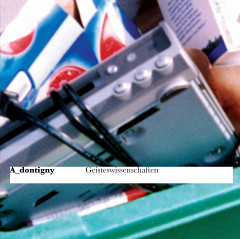
    … acknowledging that no answer may appear, but that the question is worth asking.

    Geisteswissen­schaften dans Vital

    «Review», Frans de Waard, Vital, no 585, 17 juillet 2007
    mardi 17 juillet 2007 Presse

    The A in A_dontigny stands for Aimé, and he is a free noise composer from Canada. His name may ring a bell or two for his involvement in Napalm Jazz (not reviewed in Vital Weekly), morceaux_de_machines (see Vital Weekly 338 and 454), or his duet CD with Diane Labrosse (see Vital Weekly 384). Quite a busy man, but he never made a solo recording and Geisteswissenschaften is his first solo excursion. He gets help from various people on guitar, cello and bass, but by and large it’s a solo work indeed. What exactly A_dontigny plays himself then? That is perhaps a bit harder to answer, but perhaps it’s safe to say that it’s a multitude of precorded sources — meaning vinyl, CDs, mini discs, computer files of existing material that he treats through further computer processing, electronic effects and such like. He may add highly fucked up rhythm machines and/or samplers of any kind, but the end result is quite a fascinating journey through the world of today: we zap around, on TV, on the net, and we get a true bombardment of sound and images — here only sound. A world that would drive a lot of people crazy, or in fact it perhaps already did. Much better it would be to sit down and enjoy A_dontigny’s release. Turn off the TV, switch of computers and let yourself sink back in this crazy world that is madness enough for those who really want to listen. A_dontigny crosses the world with crazy sounds, and an interesting mixture of techniques to approach the world: musique concrète like, noise based and improvised in playing. It all can be done. If the previous releases by morceaux_de_machines were something you liked, then this new release by one half will appeal to you too: it’s by no means half as good; it easily matches the duo.

    A_dontigny crosses the world with crazy sounds, and an interesting mixture of techniques to approach the world: musique concrète like, noise based and improvised in playing. It all can be done.

    No Type: A_dontigny explore les sciences humaines

    dimanche 15 avril 2007 Nouveautés

    Avec Geisteswissen­schaften, A_dontigny aborde directement ou métaphoriquement un artiste (Koons, Turner), un mouvement (les abstractions américaine et française), un auteur (Nietzsche, Foucault, Derrida, Frege) voire même un concept (par exemple l’intraduisible notion de «Wirkungsgeschichtesbewusstsein») et crée un disque en marge à la fois de la musique électroacoustique «traditionnelle» et de l’électronica héritée des sous-cultures industrielle, punk et techno. Un festin partagé avec trois complices: Paul Dolden, Diane Labrosse et Jon Vaughn.

  • 1
  • 2
  • 3
  • 4