Ned Bouhalassa’s music is unusual for an electroacoustic composer — for someone working in an area that one would normally think of as being limited to the world of academia. His work combines the scientific discipline of acousmatics, in which he was grounded, with raw field recordings and MIDI-sequenced fragments in a variety of techno-derived styles, with striking originality and transitions so natural that one hardly blinks an eyelid. He is one of a new group of electroacoustic composers coming out of Canada who are drawing on the rich developments in electronic technique that have evolved over the last 10-15 years through the dance music scene, combining sound sources in a truly postmodern sense, where all sounds are a resource to draw upon freely, without prejudice for style; where all things around us can be, and indeed are, music.
Ned Bouhalassa has been actively involved in the composition and promotion of electroacoustic music since 1987, working with the Canadian Electroacoustic Community, and teaching at Concordia University from 1991-96. His works have been diffused in concert and radio internationally, and he has received awards for his work in Canada and internationally. These days composition occupies him full-time, as he works on commissions for a variety of media, from tape alone to film and dance works.
I began by asking him about his studies in acousmatic music in Montréal, and how his early explorations in electroacoustic techniques still bring a great influence to bear upon his work today.
NB: My first contact with acousmatic music was in 1986, at Concordia University, when Kevin Austin came into the Introduction to Music History class (at the end of the semester) to give a brief presentation of electroacoustics (ea). He played a short tape piece he had composed with another Montréaler, Daniel Feist (also a well-known radio personality). The clip was entitled, Auxferd night burr’d, November 2.A.M. It had no text, but an engaging narrative was played out using musique concrète techniques on a Rastafarian-like voice. What struck me most was that the sounds were bringing all kinds of images to my mind — some abstract, others more recognisable. Upon hearing “Auxferd,” I saw that it was possible to tell a story using sounds alone. I bought a 4-track that summer, and starting experimenting with layering and pitch transposition. I began studying ea that Fall, and soon after, I got involved in the ea community by helping to put on many concerts, working for the Canadian Electroacoustic Community (CEC), hosting an ea music radio show, etc.
I also listened to a _lot_ of ea. I’ve always been very good at taking apart music or sound art by ear. I still remember the night I had an epiphany about multiple layers of processing. I was listening to a radio broadcast of a piece by Francis Dhomont (it may have been Points de fuite), where I could hear the sound of a pencil or some other like-object rolling towards and then away from me. I tried to analyse in my head the techniques used to make that kind of movement, and realised that it involved changing not only the timbre (filtering), but also the amplitude (volume), and stereo position (panning). This may seem obvious when it’s explained like that, but for me, being able to figure it out by listening alone had more impact than any professor’s lecture or text.
I didn’t take my composing seriously though until I won two Canadian young composers’ prizes in the same year (1990). Of course, I knew enough not to expect to make a living from it, but it made me feel stronger, more confident. I was quite insecure about my composing abilities, and getting recognition from my peers helped me a lot. By getting involved with the ea community, I also became friends with people whose work I had greatly admired: Christian Calon, Francis Dhomont, Gilles Gobeil, Robert Normandeau, and others. For me, this was also a fantastic way to learn the craft: to sit around and talk shop with these gifted artists.
Around the same time, I became interested in Hip-Hop, particularly Public Enemy. I liked what they were doing with samplers, adding street ambience to the Funky Drummer, using all kinds of musique concrète techniques. In 1993, I bought my first portable DAT and binaural microphones, and I began making a lot of indoor and outdoor recordings. Listening with headphones while recording really increased my perception of the sounds that I took for granted and hardly ever noticed (cars, general city noise, my refridgerator, a clock ticking, etc). 8 years later, I still go back to these DATs for source material.
I think the period where I fell in love with ea was a particularly exciting one, at least here in Montréal. The composers I listed above and many others were doing their first mature works (except for Francis, bien sur), and there was a regular flow of strong pieces, concerts. I think things starting leveling off in the mid-90s, or maybe it was my interest that diminished. This was also the period when I started to regularly listen to Techno music in (almost) all its forms.
MStation: In many of Bouhalassa’s works he seems fascinated by exploring the nature of sounds, and at time seems to almost get inside of them. The physics of sound is always something that is conveyed very immediately to me by his pieces — perhaps augmented by binaural field recording techniques. In works such as Jets (1996-98), where there seems to be a focus on movement, spatiality and kinetics, I wondered if this was at all reminiscent of early Xenakis, the orchestral pieces based on atomic particle movements.
NB: I can’t say I’m very much influenced by Xenakis. Of course, I’ve listened to some of his pieces, and I always think of him when I create cloud-like stochastic textures (using software like Cloud, MacPod or SuperCollider). I do like to really get into my sounds with a microscope, but in my case, it’s really the EQ and compression. Reverb is something I’m learning to use less. Kevin Austin really helped me understand how to manage digital reverb. I prefer to dig into the unprocessed material first: the acoustic world is so much richer than any digitally-created or processed source.
The focus on movement that you mention is really a compositional technique. I treat space as an equal aspect of sound, which means that I pay the same attention I do to pitch, amplitude, rhythm, etc. The sounds have dynamic trajectories because I program/automate movements across the stereo field (or sound stage). Regarding my fascination with movement, I should mention my acousmatic confreres as influences. I’m also still exploring granular synthesis in all its forms (slow and sparse, or fast and dense). In Move 1, I actually used that process to generate much of the gestures.
MStation: The acousmatic school seems to have quite an influence upon your teachers work, and upon Canadian ea/cm. Do you use any of the principles of acousmatics, i.e. abstraction and hiding or disguising the original sound source?
NB: I’m very intuitive, so I tend to steer away from what can be perceived by some as ‘rules’ or principles. Sometimes a sound that I’ve heard many times before, like an outdoor swing or a car zooming by, will take on a different characteristic when I take it out of its original context and edit it in the studio. If its screaming, “I’m a car!”, and it works for me in the context of writing a piece, then I might not disguise it at all. It’ll be a car for most people, and that’s already so full of meaning… On the other hand, if when looped, filtered, reversed, etc, it takes on a new, abstract, musical character, then it’s no longer a car, and that’s fine as well. In my acousmatic work, I combine both abstract and recognisable, anecdotal sounds. I like to think that when I’m successful, I tell a story that can be interpreted many different ways: you can tell that there’s some kind of underlying narrative, but the relation between the sounds/gestures is open to as many interpretations as there are listeners.
MStation: I very much admire the way you incorporate techno influences into your work — it is with great subtlety, and there is such a fluidity of movement across boundaries of style, that conveys that _all_ the sounds around us are music.
Is there a particular style of techno / drum’n’bass / hip-hop, or a particular group that you like? I guess that when it comes to incorporating techno into ea music it is also a question of what sort of music will work with the electroacoustic sounds, and whether you want things to blend or jump-cut.
NB: I really don’t know what I’m doing when it comes to combining genres… which is a good thing. I know that I won’t write a classic electroacoustic or techno piece, but that’s not what interests me these days anyhow, ‘pure’ anything. I listen to all kinds of music, as much as possible: the radio in the car, in the kitchen, web radio, dj friends, clubs/parties, etc. I get inspired by anything that is exciting. It can be 3 sine waves, or a dense soop of noise, as long as it’s _alive_. We are really blessed here in Montréal, as there are 4 community radio stations, and I can almost always hear something interesting on air. I like fast, hard jungle, like the British stuff (Optical, )EIB(, Dillinja, Dom and Roland, Total Science); IDM/glitch/anything-else-that-fits-that-label, like Autechre (studio more than live), Oval, Ikeda, Pole, Pan Sonic Plastikman; and of course more Brits, like Amon Tobin, Luke Vibert, Luke Slater, Photek, Lamb. Electroacoustic sounds can and should be any sound really, so the question is not so much what to combine, but rather what to leave out. Often, the problems are more technical than poetic. If you have a really heavy, in-your-face techno beat, chances are there’s not much room in the frequency spectrum for anything else, certainly not something subtle. So then it’s a question of filtering the beat to make room for other sounds. I’ve been using electroacoustic soundscapes as bridges to beat sections — or beat sections as lead-ups to electroacoustic spaces… I see people like Matmos doing that, and I think it’s great. They use electroacoustics as a way to create scenes, near-narrative contexts for their rhythmic tracks. I mean it’s really nothing new. Many rock records I used to listen to as a teenager had field recordings or little montages that preceded a given song.
MStation: What software and/or hardware do you use? I gather you’re Mac-based, are you using OS X at all?
NB: I use Logic Audio and the AudioWerk card on a G3 desktop. As for operating systems, I prefer those that finish with a “.5 or .6”! By the time they get to that point, they usually have worked out a few bugs… I’m running 8.6 presently. I love VST plug-ins, especially Pluggo, and I’ve recently started using EXS24 (Emagic’s soft-sampler). The latest, greatest toy in my collection is the new version of Absynth.
MStation: How you find working as an intuitive composer with programs like SuperCollider and granular synthesis apps that often require pretty intensive programming? Are there ways in which you balance these two seemingly opposite approaches?
NB: Since the early days of using a university studio, I have had a two-birds-with-one-stone approach to learning/programming software/synth patches: as I explore a new tool, I try to ‘compose’ gestures that I can later incorporate in a piece. That way, I don’t feel like I’m ‘wasting’ precious composing time. Anyhow, there’s no better way to judge the pertinence of a given program than by trying to make music with it right off the bat.
MStation: Technically, are there particular approaches or applications that you find helpful to acheive this? You already mentioned reverb, which I would assume helps a lot in the spatialisation and dynamic movement of sound. Are there any particular applications or techniques that help you to put a sound under the microscope?
NB: This might seem obvious, but one technique is to use EQ as a microscope. Use the peak filter setting, make a sharp bell, crank up the gain on the cutoff point and sweep around the frequency spectrum. This will allow you to ‘zoom’ in on the sound and find its significant frequency characteristics or formants. You can then decide if you want to highlite or hide the later. One can do so much with EQ alone.
MStation: Again it strikes me that it’s the movement, the dynamics of the transitions between beats and electroacoustics that inspires you… Sometimes I’ve noticed that the forms you use are quite cinematic, not only with the jump cuts from acousmatics to techno, but in the way you set a scene.
I’m aware that you also compose film music, I wondered if you’d like to say a little bit about your current project?
NB: These days, I’m starting work on the soundtrack for a feature film called Jack and Ella (www.jackandella.com). I’ve been given carte-blanche for one of the rare times in my soundtrack career. The music will be a blend of film score, techno and electroacoustics (surprise, surprise!). It’s a wonderful story, full of meaningful dialogue, superbly acted, well shot, etc. The director is my girlfriend, and we both work at home, so it should be an interesting experience!
I also just got a Canada Council for the Arts grant to compose a new 30-minute acousmatic work based on the morphing of sounds, the Berlin zoo, and the myths of Orpheus and Morpheus. I hope to travel to Berlin to record animals and people in the zoo, and to San Francisco, where I will use some of Sound Traffic Control’s resources for resynthesis.
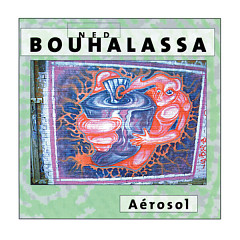
MStation: Many thanks, Ned, and we wish you both all the very best with the forthcoming release of Jack and Ella. Ned Bouhalassa’s album Aérosol is available from empreintes DIGITALes. Jack and Ella, a film by Brenda Keesal, featuring music by Ned Bouhalassa, will be completed in Summer 2001.