Sauter au contenu principal
electrocd

Blogue

267 résultats
  • 18
  • 19
  • 20
  • 21
  • 22
  • 23
  • 24
  • 25
  • 26
  • Cycle du son dans Brainwashed

    «Review», Graeme Rowland, Brainwashed, 2 juin 2002
    dimanche 2 juin 2002 Presse

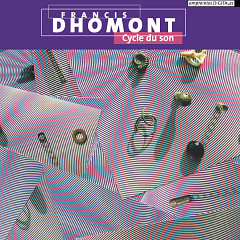
    What can you say about 76-year old composer Francis Dhomont? You could say he’s been given lots of prizes for his noises. You could say he talks a good acousmatic game theory. You could say he wears an eyepatch over his right eye. He first grabbed my attention with his Frankenstein Symphony on Asphodel, a plunderphonic acousmatic journey on which he skillfully cut up and stitched together various excerpts from works by his French Canadian contemporaries. He now tips his hat to perhaps his biggest inspiration. This sound cycle is a fiftieth anniversary homage to musique concrète pioneer Pierre Schaeffer, specifically the first movement of his Étude aux objets, from which Dhomont has sourced his raw materials. There are many furtive similarities to the Schaeffer original, but Dhomont stretches the journey out almost twice as long and eschews Schaeffer’s violent tape splice edits, focusing and magnifying curiously questioning speaker panning whirls into successive new smoothed out seascapes. In the opening funeral march, Objets retrouvés, the sounds seem to be asking themselves what they are, curious to find themselves hanging around their own echoes. Dhomont breathes new life into them and gives them celebratory purpose. The second cycle AvatArsSon paints in the sky from a more varied and clattering palette. Sounds loom into the foreground, shimmer and mutate. Latterly choral vox limbo over glugging mystery spools. Bells ring out across the city full of gleeful honking taxis, soon washed away by tidal waves. This is the most cinematic of the four cycles, in that more untransmuted sound sources are apparent than in relatively abstracted sequences elsewhere. The third cycle Novars was the first to be completed and is the hub around which the others rotate, but since it is sequenced after Objets retrouvés despite being completed seven years earlier, it seems like an extended version thereof. Phonurgie hones and magnifies elements from the previous cycles casting long late summer evening shadows and deep pool reflections, folding mystery into myth. Latterly it seems as if several glass instrument orchestras are playing cut up fragments in reverse as they sink into the sea. A little recurring chuckle is a mirthful reminder of how much fun listening can be.

    Denis Smalley dans AllMusic

    «Portrait», François Couture, AllMusic, 1 juin 2002
    samedi 1 juin 2002 Presse

    A composer of electroacoustic music, Denis Smalley came from a classical music background and followed the academic path. Since 1994 he is head of the Department of Music at City University (London, England). All his works (except a couple of early ones) are for tape or instrument and tape. He has albums out on empreintes DIGITALes, UEA Recordings and Effects Input. His music shares similarities with Jonty Harrison and the composers associated with BEAST.

    Smalley was born 1946 in Nelson, New Zealand. He learned piano and organ at a young age. His first degree was a diploma in organ performance from the University of Canterbury (New Zealand). In his home country he premiered works for organ by Olivier Messiaen and Gyorgy Ligeti in the late 1960s. He taught music at Wellington College for three years before the French Government awarded him a grant in 1971. He studied in Messiaen’s composition class for a year at the Conservatoire de Paris, but he also took the electroacoustic music course dispensed at the time by the Groupe de recherches musicales (GRM). Musique concrète was a revelation to him and he quickly turned away from performance and classical composition to concentrate solely on tape music.

    After completing the Conservatoire’s “Diplôme de musique électroacoustique et de recherche musicale” (he was one of the first students to do so), Smalley moved to England to obtain a Ph.D. from the University of York. His first known works date from that period. Gradual won the Fylkingen Prize in 1975. He was appointed lecturer at the University of East Anglia (Norwich, England) the following year and remained there until his appointment at City University.

    Between 1976 and 1986, Smalley actively promoted electroacoustic music, developing the concept of sound diffusion in England. He is also renown as a theoretician in electroacoustic music aesthetics. He developed the notion of “spectromorphology,” the shaping of sound spectra through time. His other awards include an Euphonie d’Or (Bourges competition) in 1992 for Darkness After Time’s Colours and a Golden Nica (Ars Electronica, Linz, Austria) in 1988 for Clarinet Threads.

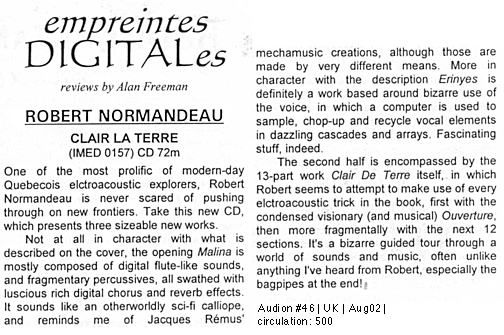
    He developed the notion of “spectromorphology,” the shaping of sound spectra through time.

    Darren Copeland dans AllMusic

    «Portrait», François Couture, AllMusic, 1 juin 2002
    samedi 1 juin 2002 Presse

    Canadian electroacoustic composer Darren Copeland focused his work on environmental sound sources. His approach shares similarities with Hildegard Westerkamp’s, but he never reached her level of international recognition. Copeland studied composition at Simon Fraser University (Vancouver, Canada) with Barry Truax while plundered through the institution’s World Soundscape Collection. He also studied with Jonty Harrison in Birmingham, UK. A man of radio and a gifted creator of theatre soundtracks, he contributed to a few compilation CDs (Storm of Drones, DisContact II) in the early 1990s and released his first album, Rendu visible, in 1998 on empreintes DIGITALes. It was hardly noticed. His interest in boundaries between electroacoustics, radio art and theatre led to interesting but undocumented works, such as his adaptation of August Strindberg’s A Dream Play and the live radio event “Wireless Graffiti,” produced during his collaboration with Vancouver Pro Musica. He is now on the board of the Canadian Association for Sound Ecology and runs New Adventures in Sound Art, a Canadian association devoted to developing electroacoustic music as a performance art.

  • 18
  • 19
  • 20
  • 21
  • 22
  • 23
  • 24
  • 25
  • 26