Sauter au contenu principal
electrocd

Blogue

366 résultats
  • 40
  • 41
  • 42
  • 43
  • 44
  • 45
  • 46
  • 47
  • 48
  • All Your Dreams Are Meaningless, No Type dans Ampersand Etcetera

    «Review», Jeremy Keens, Ampersand Etcetera, no 2003_f, 24 mai 2003
    samedi 24 mai 2003 Presse

    A Canadian duo, this is their first label release and contains two demos — the single long track and a second series of short pieces. The packaging (obliquely) and title appear, from their ’manifesto’, to relate to architectural and social dreams for a better world which always fail. ’I am fatigued by dreams of a better world. They are so many, they no longer inspire’. I read that before listening to the music, and was worried by the sense of ennui — and wondered how the sounds would reflect this.

    Indulge me while I look at the second half first. There are seven tracks in about 30 minutes, and while they track across three years, they are almost an addendum to the opening track. ’Lullaby’ starts with slow backwards voice and tones and then swaps to a piano, almost straight, and soprano (singing a probably well known aria) that is very subtly and skilfully looped. Big crunchy tones, industrially ambient, with a voice entering later, ending woobly in ’Terminal’ before the brief ’No5’ where more big noises segue into tonal pulses. Something of a trend is emerging with ’Solitaire’ when pulsing industrial ambient with hypno-tape is overtaken by a building buzz, then a tapping over that before the voice loops at the end. The oldest piece on the disk is perhaps the most immediately striking (and makes it onto the sampler). A haunting ambience of scrapes tocs and washes is joined by a disturbed voice saying variants of “he’s gone”. Small breath cuts create percussive effects, then we move to ticking scrapes and heavy thudder as a different voice talks about “she’s crying”. ’Tlia3ml’ travels from a high scraping buzz that drops under soft tones but returns refreshed with some percussive, then another short compilation of rumbles choppedsamples ping and other noises rapidly alternating in ’Scission’. The final track is ’Southern yukon/northern bc (and perhaps parts of alaska)’ a slowly burning combination of soft buzz, crackles and binaural ticks that gains little tonalities, puttering, a deep dronal tone, cycling wash, pinging scratches, pulsing and clicks building to a very active state at 10 minutes, some voice, a brief dip and then a full noise assault for a minute which suddenly ends. Snap.

    These tracks demonstrate a fair bit about Coin Gutter — they construct and assemble their pieces, more akin to the electroacoustic style; in that construction they shift the sound of a track quite a distance across its length; they are not averse to either noise or mellifluousness; their sound palette is broad and they focus on the details. As an album in its own right, this collection would not be uninteresting, but the wow-factor on the album comes during the 36 minutes of ’Lift with the knees’.

    The first time I played/scanned this album, just to get an idea of it, the track turned me off, and it was only when I went into full listening did I get into it. The opening few minutes is a noise assault as a high buzz becomes white noises which has things in it but is quite in-there. It slips to one channel and gradually fades to a crackle, after which the piece moves into its more enfolding phase. It is a sequences of musical constructions that slide effortless into each other as an interlocking suite. Composed of all manner of sounds — tones, crackles, drips, phone tones, beats, piano, little noises, blurts and more it is varied and yet consistent. Echoes and shimmers, loops and gradual modulations, changes of pace and mood create a series of musical images, pictures at an exhibition that we are walking through, the aura of one touching onto the next and affecting our view as we bring it into focus. Some are small pictures while others are larger or more intricate. It would be difficult to try and describe each, some reflect the activity in the shorter pieces, though there is less voice in there. The whole coheres and the parts are impressive.

    Either half of this release would be worth hearing and having, together they make a great impression. But definitely one where you need to listen to more than the opening 30 seconds.

    The disk is part of an ’abstract’ (less dependent on beat?) series — Magali Babin was the first and another is slated for later in the year.

    I was lucky enough to get a promo-sampler, and the material on that from the forthcoming albums suggests the next lot (Books On Tape and Bonarelli with 10” vinyl and a Headphone Science album) derive from the third arm (aside from improv) of intelligent and exciting ’techno’.

    The whole coheres and the parts are impressive.

    No Type dans Ampersand Etcetera

    «Review», Jeremy Keens, Ampersand Etcetera, no 2003_f, 24 mai 2003
    samedi 24 mai 2003 Presse

    For once I have split the label reviews — there are two other No Types in here — because of the variety. Recap the story — web label (with host of wonderful free music) mentioned often times in &etc went ’real’ last year in conjunction with DIFFUSION i MéDIA (purveyors of the empreintes DIGITALes electroacoustic label, also seen across the issues, most recently the last). The first batch of releases were reviewed here (2002_3, 7 and 8), and now we see the next fruits.

    The first release (number 1&2) was the double compilation ’Freest of Radicals’ that introduced us to some of the people featured on the ’web — but with new tracks. In an even more extensive production, here we are presented with four studio albums from improv groups representative of the new sound of Montréal, particularly centring on the Casa del Popolo, featuring a slightly overlapping membership. So into it.

    First, this is improvised free jazz — furious, complex, intricate, dense and frenzied. To buy it you would have to be interested in the music — 220 minutes is not for the faint hearted. I find that I listen to it somewhat like the music — in bursts. And in the right mood — my first encounter with Po was fairly negative as I was a bit tense — not relaxing music. And finally it is also hard to describe — so these reviews will be more overviews rather than the usual detailed description. I will also work through in a non-sequential order on the basis of accessibility (to me).

    The Trio is Chris Burns, Nicolas Caloia and John Heward on guitar, bass and drums, and that more traditional lineup delivers the most accessible album. While the instruments are all given fairly equal value in the mix, the guitar predominates, probably because you can do more with it in sonic terms — even more as we’ll see on the other albums. The first six tracks, titled ’Presence #X’ are relatively short, between 3 to 8 minutes, shift through relaxed twangy guitar and a solo in #1, through the faster #2 with some sliding-ping guitar, to the bass driven #3 in which the instruments gradually coalesce but remain tentative. Strange creaks twangs and scratches on #4 develops a western guitar and buzzy bass, while #5 opens with a melodic guitar/bass set, becoming scratchy and edgy before a short drum solo that presages a more extended solo in #6 with light bass and guitar behind out of which some bendy guitar builds. The final track is a more extended 20 minutes and sees the group work through moods which have been presented individually in the shorter pieces, building from a very soft scrape through some buzzing to a drum pushed noise guitar solo, dropping to a brief drum solo joined by restrained guitar and bass, then almost silence before another gradual development to a shimmeringly percussive climax then fading. The instrumentation is well balanced and the approach never gets too harsh on this disk which makes it the easiest listening — though none are easy.

    Next to Belan Mecanique, the superest-group here — six members on sax, trombone, bass, keyboards, guitar and drums. This was my second choice — I initially had favourite, but this set is too diverse for favourites — because while the size of the group tends for a full explosive sound, the diversity of instrumentation provides a broad sound palette which offers the most variation. The group offer a mixture of three short pieces — basically 1 or 2 minute full on aural explosions, and four much longer pieces which allow them to explore their dynamic. The tracks tend to be precipitous rolling sound works where each member is driving away, separately but somehow providing some cohesion, easing back at times. The ear either picks out particular instruments or the engineers place people at different places in the mix at different times. ’Gypt Gore use the idea of action painting in one of their titles, but it works for this too. ’Les elephants n’oublient jamais’ for instance turns through fast honking sax with drums and sliding trombone added, keyboards whizz almost sci fi. A quieter period before the drifting vortex gets bigger and bigger, easing to allow the piano to be heard, then the trombone moves forward, gtr sax and xylophone into a restrained minimal section, piano sax and rim drums swinging in to a soft end. There is a mysterious mood throughout ’Rouages’ that builds to a choppy quacking centre before drifting back to a lighter touch via some descending guitar and trombone laughter. Some more ambient periods (in relative terms) through ’Brule-pourpoint’ emphasise the range that the group can work in while the final ’Racines’ has some nice sax swing and even beer house piano. While there is more democracy in this group, the wind instruments probably are more distinct in the wall of sound with the guitar playing a more supportive role. The keyboards — which include some electronica — provide interesting shading while the rhythm section keeps things moving. The dynamism seen here, and the variations, make this disk very re-approachable.

    ’Gypt Gore is primarily Philemon (sax) and Sam Shalabi (guitar) who were also in Balai. They carry the energy from that group, but the music is constrained by the instrumentation. The music is exciting — they are like a perpetual motion machine as the sax blows wildly and the guitar picks and plays short fast and furious. Luckily there are periods where the playing is slower or more restrained — the slow and sensuous opening to ’Flakes’ for example or ’Narcoma action painting’ which has the speed but seems somehow more relaxed. On a couple of tracks Thierry Amar (bass on Balai) joins and the playing becomes more relaxed: in ’Corridors tresses’ it adds a depth and the solos are gentler and then ’Blue soon’ has a slow bass entry and the sax and guitar are gentler and there is a sensuous sax solo — perhaps having the rhythm instrument gave the group a more grounded approach. An additional guitar (Andrew Dickson) appears on two tracks and again there seems more restraint on ’Flakes’ and there are drones and some nice duets in ’Navigation pacifique’. The full intensity and focus of this album are what make it less easily absorbed, but it is absorbing and dramatic.

    Po present seven ’Provocative Operations’ that combine drums, two guitars (including prepared) and double bass in what was for me the most difficult album. It may be that the instruments have been most removed from their ’natural’ sounds here making it more demanding or the more oblique attacks. It opens with brief warming up before a bubbling machine of sound — scrapey guitar mumbles as the music drives on, and there appears to be some bowing as the music get quieter. In the second part scratching and squeaks with a slow percussion, sounds like violin and piano, building puttery, then ringing prepared guitar, strong bass stepping, a sort of static momentum of sound; lots of short notes with a Chinese feel; growls purrs and plitterplatter to a big climax. The third part has squeaks and growls (of wind?) that dialogue with twangy guitar into a dense web of notes (that sounds like some multitracking but the suggestion is these recordings mirror the live experience). An uncertain rhythm builds through the fourth, the maelstrom of sound including some sitar-guitar, and a rolling drum keeps a couple of guitars in chop. With the fifth piece Po show they can create atmospheric filmic moods, subtle with a Theremin or bowed-saw sound from the guitar. In six things hot up again, the band futzing along as a melodic guitar plays, then paralleled by a fast guitar in a duel/t, softening and rebuilding before some motor-bowed guitar. Finally another more contemplative piece, tinkling, strumming, a hollow percussion (prepared guitar), building a little but held back. This album takes the sounds further and generally brings the listener along with them, if the ears are open and clear.

    This is a daring product for No Type to come out with — people who know the Montréal scene will be drawn to it, but in the wider world there may be more uncertainty. While I wouldn’t recommend this to everyone (in fact I wouldn’t for most things I review — we all have such different tastes and preferences) I would suggest that people who are interested in improvised music, tending to the jazz end, seriously consider it whether as an introduction to the form or an addition to their collection. I enjoyed these disks more than I thought I would — improv is an area I am developing my listening skills in. The variety between and within the performances means that there is much that will interest most people, and it offers a great opportunity (at a good price) to listen to some mainly intense music (though there is some light and shade which allow you to recover) which may stretch your expectations, and should definitely excite you.

    (I don’t generally do this, but I looked on site and this set costs $40 (can) and had a 10% discount when I was there. As a single album costs $25 (can), this is great value.)

    This is a daring product for No Type to come out with…

    All Your Dreams Are Meaningless dans AllMusic

    «Review», François Couture, AllMusic, 22 mai 2003
    jeudi 22 mai 2003 Presse

    This first label release by the Vancouver duo Coin Gutter offers a selection of new tracks and remastered highlights from their previous self-released CDRs. This is a peculiar form of experimental electronica that has one foot in the less glitchy ambiences of the Mego roaster (Florian Hecker, Pita) and another in post-industrial drones (think Cranioclast or Maeror Tri). The album begins with Lift With the Knees, almost 37 minutes long. A mood-shifting piece, it rewards repeated attentive listens, but one wonders if it couldn’t have been shortened or at least split into three separate tracks. Its drifting, elongated ideas make a nice contrast though with the seven sharper-focused pieces following it. Among them is Lullaby: a slowed-down voice croons the intro, followed by a piano/voice lieder (sorry, I don’t recognize this particular one) given the CD skipping treatment. The piece appears childish at first (anyone can rewind or fast-forward on a CD player, right?), but paired with the intro and the other electronics wrapped around, it exerts a strange fascination. The dark Timewise provides another highlight. The disc concludes with the 12-minute Southern Yukon / Northern BC (perhaps parts of Alaska). Beginning as an abstract glitchy construction, it builds up to an infernal finale of digital noise, leaving the listener stunned.

    Beginning as an abstract glitchy construction, it builds up to an infernal finale of digital noise, leaving the listener stunned.

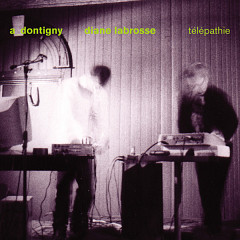
    Télépathie, A_dontigny, Diane Labrosse dans AllMusic

    «Review», François Couture, AllMusic, 22 mai 2003
    jeudi 22 mai 2003 Presse

    It has been said over and over again, but it is true that improvisors develop a certain telepathic sense and that the stronger their link the better the music. In this set recorded live at the Casa del Popolo in Montréal (Canada), a_dontigny (aka Aimé Dontigny), one half of noisicians morceaux_de_machines) and Diane Labrosse display an engaging level of unspoken communication. But beyond the thrilling battle between computer and sampler, beyond its doomsday ambient music and menacing digital experiments, Télépathie takes a symbolic value. This is, after all, a first significant bridge (at least on record) to be thrown between two generations of avant-garde artists from two different spheres. A member of the Ambiances Magnétiques collective since the mid-’80s, Labrosse comes from an avant-rock background (she played in the seminal Montréal groups Wondeur Brass and Justine). The young Dontigny has been involved from the start with No Type, one of the first and most important internet-only experimental music labels. The set begins with the rumble of thunderstorm and crackles of electricity. The proceedings remain atmospheric, dragging the listener in rather gently. By the third track photo satellite), things are getting more raucous as weird feedback and outbursts of white noise take more space. média tactique begins with a recording of poet Denis Vanier reading one of the iconic texts of Quebec’s countercultural movement (which includes the line “Kraft fuck the cheese”). The way the two musicians react to the words, developing its sub-text, evokes René Lussier’s Le Trésor de la langue, but only briefly as the piece evolves into a noisy mutated dub. Things almost get out of hand as decibels escalate, but the pair stop in time — or have been stopped, since the abrupt ending screams of editing. Short, to the point and quite convincing.

    … doomsday ambient music and menacing digital experiments…

    We Remain Faded dans Igloo

    «Review», Boban Ristevski, Igloo, 19 mai 2003
    lundi 19 mai 2003 Presse

    It’s definitely great when someone manages to create a successful, even groundbreaking mix of abstract instrumental hip-hop beats and contemporary electronic music. That’s how this mini-album from Dustin Craig aka Headphone Science feels, or to be more precise, it sounds like a perfect and flexible mix of idm, hip-hop and ambience.

    An excellent combination of firm hip-hop beats are present at the front, ambient sounds are subtly tucked in the background, tiny experimental sounds float in the midst, and occasionally you get mixed vocal clips or jazz tones in between. That’s why this music sounds very fresh, clever and inventive.

    No Type (Brief) Background:: No Type started to release CD’s in 2002 and in a very short time this label has become a favorite amongst open-minded people searching for new forms of contemporary music, be it experimental, noise, idm, improvised, and even post-rock. All of these styles are part of the 2xCD compilation, The Freest Of Radicals; the first (official) CD release for No Type.

    … a perfect and flexible mix of idm, hip-hop and ambience.

    All Your Dreams Are Meaningless dans Phosphor

    «Review», Paul Bijlsma, Phosphor, 18 mai 2003
    dimanche 18 mai 2003 Presse

    The 36 minute long opening track heads of with some hardly audible electronic sounds, before some white noise in the Merzbow tradition takes over. This extreme noise gets calmer after a while and the music even gets soundscape-like, slightly reminding of John Hudak. Lullaby, the next composition, is an experimental piano track with classical vocal art and dramatical noise outbursts. Terminal is a track with long drawn-out cascading electronics. No5 is heads of with pure white noisy that slowly disappears. Solitaire is the combination of a speech and sophisticated cold electronic frequencies that slowly get more in the foreground. The seventhth track entitled tlia3ml features a fine-tuned metal sound. This song as well as the last track remind me of Richard Chartier’s more minimal and hardly audible output. Scission is a short noise composition, slightly more hectical as most other tracks on this album. All in all, a very intelligent use of different atmospheres and clear sounds.

    … a very intelligent use of different atmospheres…
  • 40
  • 41
  • 42
  • 43
  • 44
  • 45
  • 46
  • 47
  • 48