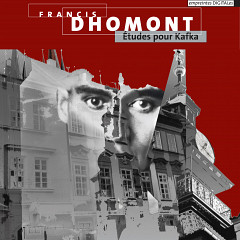
Exploring the possibilities of sound on tape has preoccupied Francis Dhomont since the 40s. His compositions tend to exclusively focus on the manipulation and morphological interplay of natural sounds that are ‘performed’ acousmatically, diffused across a range of loudspeakers. Approaching eighty years’ of age, Dhomont has chosen Kafka as his latest existential theme, following work that centred on the writings on mental illness by controversial psychiatrist RD Laing and the Freudian interpretations of fairy tales by Bruno Bettelheim. The sleevenotes of Études pour Kafka make it clear that these are preliminary studies for a longer, unreleased work, called Le cri du Choucas.
Premières traces du Choucas, the first study of three presented here, is the most sinister. Its suspenseful shifting drones, seemingly sourced from neither glass nor metal but closest perhaps to taught strings, immediately place the listener in an alert, suspicious state describing the walls of a pitch dark tunnel in which unseen automatons scurry and mechanical insects swarm. Dhomont’s spectral filters ensure that the majority of layers have a digitised sheen that obscures their origins, expanding and contracting to create stealthy movements not unlike creeping around Nurse With Wound’s extended soundpools. Occasionally a short moan or syllable is detectable, but distortion and stuttering make the struggle to communicate frighteningly futile.
Human voice is used most extensively on the second piece, Brief an den Vater, which focuses on a narrator reading a letter from Kafka to his father (itself, a failed attempt at articulating why he was so scared of him, which remained unsent), but is also accompanied by a rich bed of tones seemingly created from treated vocal syllables that writhe and fluctuate as they intrude on the reading in an ominous and unstable manner. Both the discernible words and their corruptions are occasionally introduced by the turning of paper and the strong, hurried scribbling of the writer’s pen, presenting the album’s most lucid of sonic meditations on Kafka’s behaviour, while moody, atonal utterances both flood softly and chatter violently with a steely finish potentially describing the inner trauma accompanying the writer’s outward attempts to articulate.
Digitally twisted vocal fragments continue to dominate the last ‘study’, À propos de K, joined again by metallic and glassy tones slicing wraith-like through air, but also interspersed with footsteps on land and in shallow water. This combination fills the irregular aborted attempts to speak with panic, and describes the hopelessness of escape and confusion that Kafka’s protagonists often endured.
Having said that, the title and sleevenotes prime the listener to consider what they know about Kafka’s life and literature before the sounds start to form any allusions. Had the title been Études pour Ballard, or pour Orwell, it would have perhaps been just as easy to connect the sinister, nightmarish sounds to their work. In view of this, Kafka can be considered more a compositional tool, a starting point from which these studies were determined and, as such, the work stands in its own right as a highly stimulating and engaging piece of electroacoustic theatre that will leave its audiences chilled and inspired.
4/5

![Robert Normandeau [Photo: Caroline Campeau, Montréal (Québec), 3 septembre 2021]](https://res.electrocd.com/image.php/image/n/normandeau_ro.12007.jpg?width=n2&cropratio=1:1)
![Martin Bédard [Montréal (Québec), 2018]](https://res.electrocd.com/image.php/image/b/bedard_ma.11713.jpg?width=n2&cropratio=1:1)
![Georges Forget [Montréal (Québec), 20 février 2015]](https://res.electrocd.com/image.php/image/f/forget_ge.7154.jpg?width=n2&cropratio=1:1)
![Natasha Barrett [Photo: Jan Erik Breimo]](https://res.electrocd.com/image.php/image/b/barrett_na_14886.jpg?width=n2&cropratio=1:1)