Sauter au contenu principal
electrocd

Blogue

65 résultats
  • 2
  • 3
  • 4
  • 5
  • 6
  • 7
  • 8
  • 9
  • 10
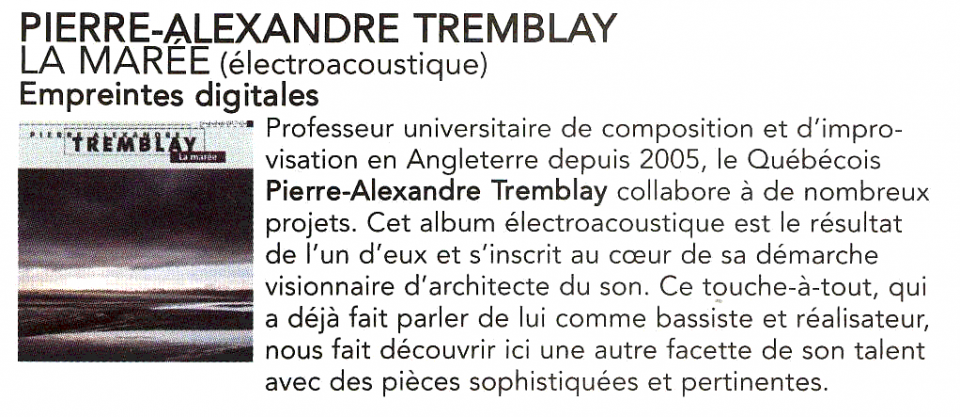
  • Au-delà, La marée dans Revue & Corrigée

    «Critique», Pierre Durr, Revue & Corrigée, no 100, 1 juin 2014
    dimanche 1 juin 2014 Presse
    … l’auditeur appréciera les développements de la clarinette basse, s’extasiera sur les sonorités curieuses de cloches issues du piano Baschet-Malbos, l’extension sonore constituée par la table de Babel et son aura mystérieuse…

    Au-delà dans Chain DLK

    «Review», Vito Camarretta, Chain DLK, 4 mai 2014
    dimanche 4 mai 2014 Presse

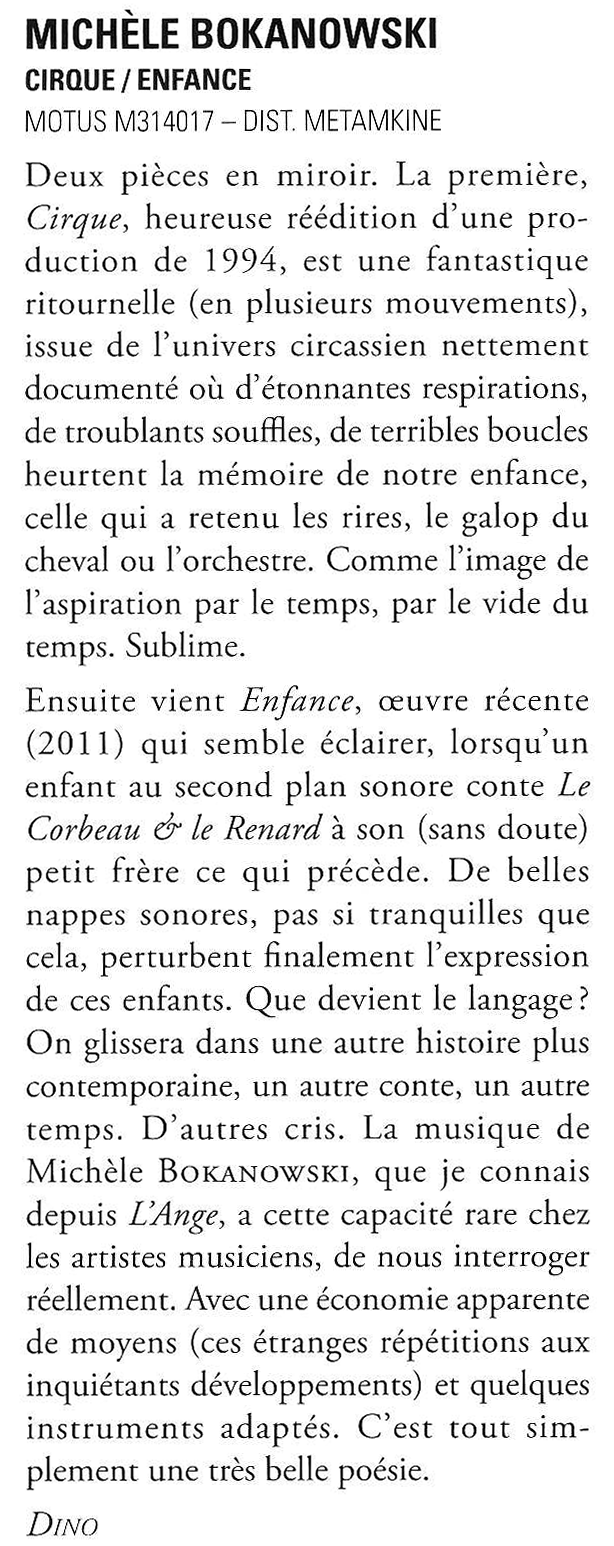
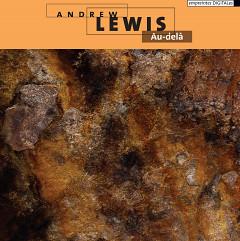
    Au-delà (French expression for “beyond”) is a collection of six amazing acousmatic compositions that got created between 1990 and 2012 by North Wales-based composer Andrew Lewis, one of the original members of BEAST (in spite of the hallucinatory and somehow mesmeric nuances of some stuff by Andrew, it’s not a satanist group, but it’s the acronym for Birmingham ElectroAcoustic Sound Theatre), professor and director of the Electroacoustic Music Studios at the University of Wales Bangor, where he also directs Electroacoustic WALES, a group of composers (mainly former students) which tries to “promote and encourage the creation and dissemination of electroacoustic music within Wales and beyond.” Lovers of the genre, but also newbies, are going to explain the amount of prizes and awards that Andrew gained after listening to this collection by putting his outlandish integration between a rich paraphernalia of acousmatics and a set of interesting concepts forward and such a sonic “strategy” since the initial track Lexicon which renders dyslexia by let rappeling the words of a poem by Tom, a 12 years old bot, into a pit of meaningful noises where Tom himelf seems to appear like a ghost in the cloud of voices which repeat lines of the poem (“Word is my prolem,” “Words are like lifes/lies” — or maybe flies as some buzzing flies which resound after 8 minutes could let you surmise —, “a page is like a map I try to find my way around” and so on…). You’ll get astonished by the bunch of harmonics that Andrew Lewis manages to extract from the sound of breaking glasses on Dark Glass as well as by his odd way of reinventing Wales’ sonic culture on Cân (Welsh for “song”). The oldest compositions of this collection are quite surprising as well: he translated the mountainous landscape around Bangor University studios into a mysterious sonic adventure on Ascent, he turns many sonic entities into ephemeral being on Time and Fire, which sounds like a treatise about transience, while the funnily disquieting Scherzo could let you revive childhood by a mesmerizing and swirling whirlwind of sonic clues.

    You’ll get astonished by […] the sound of breaking glasses on Dark Glass

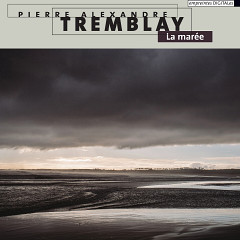
    La marée dans Le son du grisli

    «Critique», Guillaume Belhomme, Le son du grisli, 2 mai 2014
    vendredi 2 mai 2014 Presse

    Sur La rupture inéluctable, la première des pièces de ce double CD, Pierre Alexandre Tremblay ne raconte pas notre histoire, mais j’y vois des coïncidences. Un homme (le soliste?) seul face à des haut-parleurs. En 2011 (c’est l’année de la composition). Une clarinette basse (celle d’Heather Roche) lui lance un appel. Il ne bouge pas. Une deuxième basse, maintenant, sur la première. Cela lui rappelle un air folklorique, ou plutôt (il hésite, maintenant), une composition de Braxton. L’acoustique contre les schémas électroniques, l’homme contre la machine. Un homme seul face à des haut-parleurs qui l’envoutent.

    Je remercie Pierre Alexandre Tremblay pour La rupture inéluctable et pour Mono no aware, ses pièces les plus récentes. Dans Mono no aware, je vois d’autres coïncidences. Dans ces rubans de sons qui m’encerclent et tournent. J’entends en eux la corne de brume de la table de Babel de Jean-François Laporte, mais elle est multipliée. Je cherche d’où vient l’appel et me tourne dans l’autre direction.

    Comme je ne vois pas des coïncidences dans tout ce que j’entends, je passerais à côté des trois autres compositions: Le tombeau des fondeurs, où le piano Baschet-Malbos de Sarah Nicolls sonne des cloches électronique, Still, Again, où la soprano Peyee Chen fait face à un désordre électronique aussi, et Un clou, son marteau, et le béton, où Sarah Nicolls revient au piano pour un exercice romantique que mon pauvre cœur ne peut souffrir… C’est le hasard des coïncidences et le vouloir des compositions. Deux, pour moi, coïncidaient.
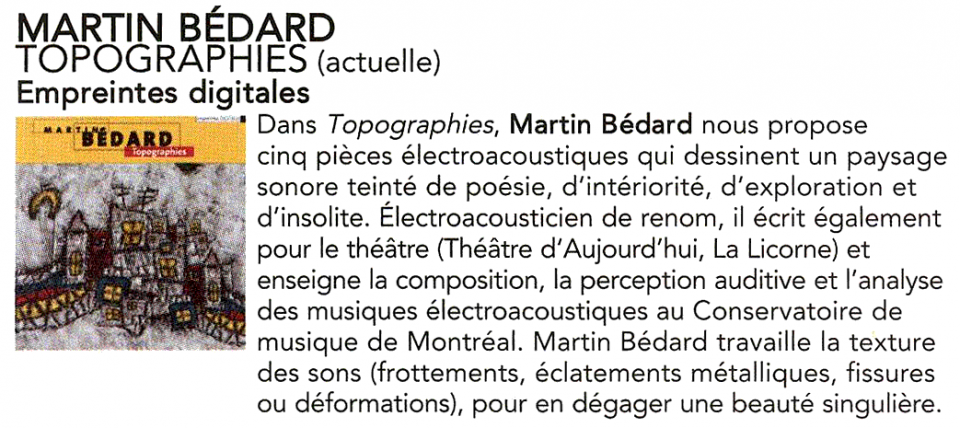
    Je remercie Pierre Alexandre Tremblay pour La rupture inéluctable et pour Mono no aware, ses pièces les plus récentes.
  • 2
  • 3
  • 4
  • 5
  • 6
  • 7
  • 8
  • 9
  • 10