Sauter au contenu principal
electrocd

Blogue

65 résultats
  • 3
  • 4
  • 5
  • 6
  • 7
  • 8
  • 9
  • 10
  • 11
  • Topographies, Allusions sonores, Au-delà, La marée, empreintes DIGITALes dans The WholeNote

    «Four Discs from empreintes DIGITALes», Wende Bartley, The WholeNote, no 19:8, 1 mai 2014
    jeudi 1 mai 2014 Presse

    It’s been close to 25 years since the founding of the unique Montréal-based label empreintes DIGITALes (empreintesDIGITALes.com) in 1989 by Jean-François Denis and Claude Schryer. Solo-directed since 1991 by Denis, the label has produced 130 discs representing 107 composers and specializes in contemporary electroacoustic music, acousmatic and musique concrète. Although these genres of music are not the common fare for most of the concert events listed by The WholeNote, it is important to realize that the technical innovations and ways of thinking that have been pioneered by the practitioners of this music have had a wide influence on a vast array of musical forms and styles as well as media-based art forms.

    One of the most distinguishing features of electroacoustic music in general is that it is composed primarily within a studio environment and is designed to be listened to through loud speakers. And although the ingredients of melody, rhythm and harmony can be an aspect of electroacoustic music, its primary focus is on the sound itself, which can originate from recordings made in a particular acoustic environment, or generated and processed through purely electronic or digital technologies. Sometimes the original sound source is recognizable – such as recordings of ocean waves or the inside of a piano, and in other situations, the sounds have been studio processed beyond recognition of their original context.

    Back in 1990, empreintes DIGITALes offered its own vision of the wide array of possibilities within the electroacoustic genre. It published the groundbreaking Électro clips CD which featured three-minute miniatures by 25 different composers, each one representing a unique approach to working in a studio environment.

    More recently, the label has released four new albums by four unique composers: Martin Bédard (Montréal), Pierre Alexandre Tremblay (Montréal/UK), Andrew Lewis (UK) and David Berezan (Calgary/UK). Although the pieces are of longer duration than the three-minute clips, each disc presents four unique approaches and aesthetic visions.

    Each of Bédard’s five acousmatic compositions on his Topographies CD (IMED 13121) creates a sonic picture of specific acoustic environments, ranging from recordings made in restored jail cells to the soundworld of trains. He also weaves in tributes to what he calls “phonoculture” – lyrics from a Rush song or the audio heritage of a specific community. He is captivated by specific behaviours, whether those be of a night watchman or of metal under stress, and his compositions are expressions of his curiosity.

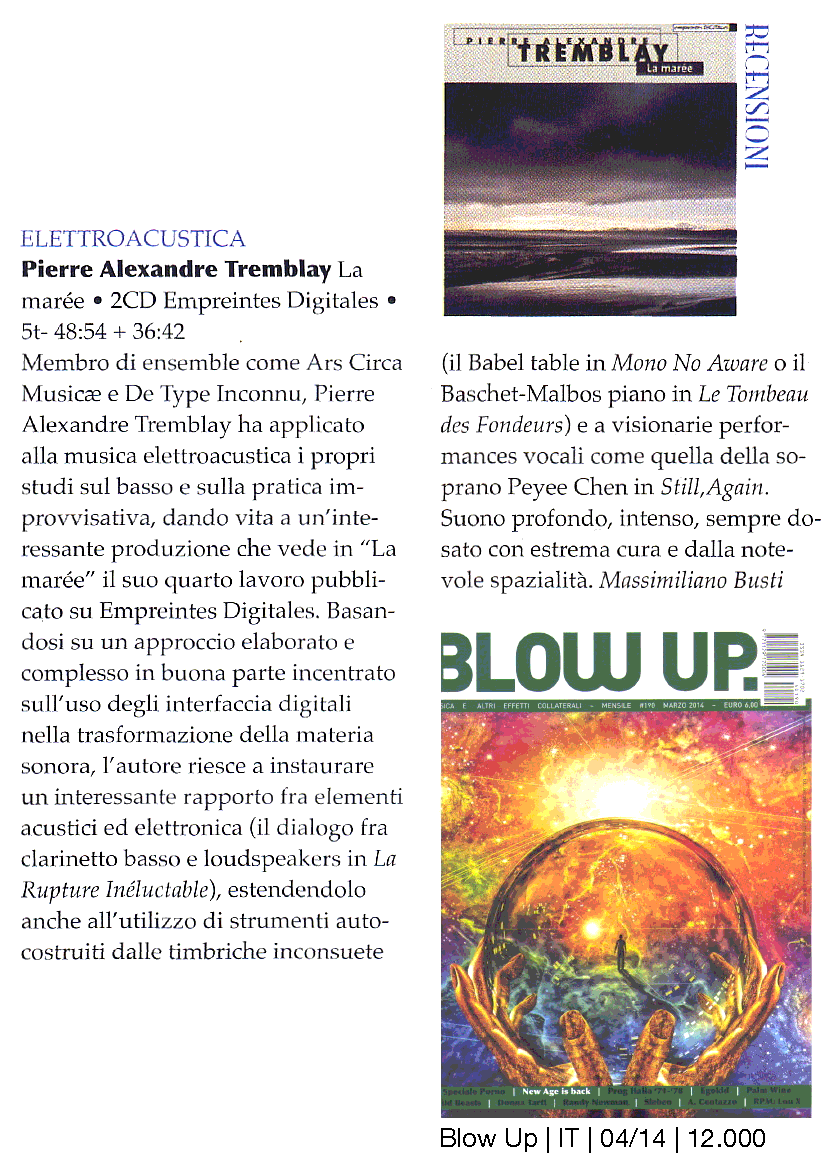
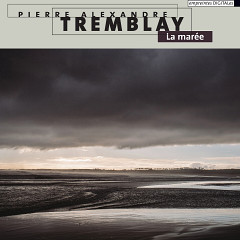
    The five compositions on Tremblay’s 2-disc set entitled La marée (IMED 13123/124) are excellent examples of the interaction between live performers and a form of live processing of the solo instrumentalist. I found his piece Le tombeau des fondeurs particularly engaging with its rhythmic and timbral pulsations that create a seductive sonorous quality suggestive of the casting of a metal or bronze bell or gong. All his pieces are meditations on life, a balancing of contradictions.

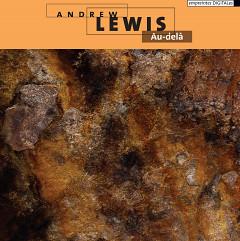
    The music of Lewis on his CD Au-delà (IMED 13125) is a great example of pure acousmatic music in which the original sound sources are heavily processed and the original context is predominantly unrecognizable. However, Lewis’ skill at weaving sounds together creates strong impressionistic and imaginary soundscapes. His track Cân, the Welsh word for song, takes the Welsh musical heritage beyond the traditional sounds of harps and male choirs. Short interjections of these traditional sounds are juxtaposed with more abstract sonic textures.

    And finally, the music on Berezan’s Allusions sonores (IMED 13122) offers the listener a window into the places he has visited. Seeing himself as a composer who collects and “uncovers” sounds as part of his creative process, each of the five pieces reflects places he has personally visited or interacted with. Ranging from the sounds of a Balinese thumb piano to recordings made in Alberta’s badlands to the chirping sounds of temple and palace floors in Japan, listening to Berezan’s music is similar to listening to the ocean. Each piece has a very distinctive wave-like motion with the constant ebb and flow of the sound textures rising up and then falling away.

    These four discs are a testament to the ongoing commitment this independent label has for a very unique and distinct genre of music. It is known and respected internationally and considered the go-to place for the keen listener and connoisseur of electroacoustic music in all its varied forms.

    … known and respected internationally and considered the go-to place for the keen listener and connoisseur of electroacoustic music…

    frequencies (a / fragments) dans Neural

    «Reviews», Aurelio Cianciotta, Neural, 28 avril 2014
    lundi 28 avril 2014 Presse

    Over the last decade Nicolas Bernier has consistently exhibited his sound-artist credentials in a number of different fields. Regardless of the medium of experimentation – installations, concrete music elaborations, live electronics, post-rock, noise or free improvisation, video-art, dance or theatre – Bernier always executes the performance aspects of his works carefully. The Canadian composer often finds inspiration in old equipment (antique instruments, typewriters), which is reworked into complicated setups and recontextualised. This latest release for Line was mastered by Taylor Deupree at 12K and the final result is excellent. The sounds are sharp and are divided into highly refined and delicate sequences that have been arranged meticulously, with dilated assonances forming a pleasant continuum. The system here consisted of a series of purpose-built mechanical devices controlled by computers, working in tandem with a group of solenoids activating a row of turning forks. The resulting sound fragments were combined with synthetic sine waves and everything has been done to balance the acoustic and electronic elements in the work – expressing the proper tension between the constituents of the whole. The author’s vision extends to 19th century science but also includes the tradition of tonal instrumental works, a staple of electronic music in all its permutations. It was by no accident that this work was awarded a Golden Nica in the Digital Music and Sound Art section of the 2013 edition of Ars Electronica.

    … the final result is excellent.

    La marée dans Chain DLK

    «Review», Vito Camarretta, Chain DLK, 13 avril 2014
    dimanche 13 avril 2014 Presse

    According to the words by Professor Pierre Alexandre Tremblay, La marée could be considered as a sort of collection of challenges between five different soloists and their antagonist, the loudspeaker, which trascends its possible reciprocity: “this uneven relationship is reminiscent of the fragility of sandcastles and other human constructions with their daily facing of the patience of the elements. Are these ephemeral joys many revenges over the ineluctable?” Right after you will have listened to the impressive dynamics of this “dialogues” between instrument and loudspeaker, you’ll think Tremblay’s one is just a rethorical question as the perpetual metamorphosis within each track could easily mirror the impetuosity of any kind of event, both “spiritual” or emotional and physical or natural, where the flair for real-time processing by Tremblay, who manages to move heaven and earth by quick and sometimes unpredictable sequences of dissonances and consonances, stillness and excitement, chaos and order, makes each composition really intense. The bass clarinet (played by Heather Roche) on La rupture ineluctable, the opening track of the first of the two cds, let me think about some stuff by Colin Stetson, Wade Matthews or João Pedro Viegas before the strife against loudspeakers gradually escalates over awesome electric interferences and resonant discharges, and some similaraties with other electroacoustic experiments can be perceived in the last piece of the second cd, Un clou, son marteau, et le béton, where piano tones got mingled with electric glops for an intense emotional soup by moving from vertiginous tumbles to suspenseful stagnations. The engaging soprano voice by Peyee Chen on the funny Still, Again, which performs many great stunts and a sort of artistic manifesto about the controversial concept of “okeyness” amidst bouncing balls, plastique-like noises, malleable piano tones, electronic strokes and noise interferences, could be mirrored by some precedent in the wide field of experimental music, but Tremblay’s explosive creativity culminates on the other two tracks where he also tests two invented instruments: the most fascinating integration is maybe Baschet-Malbos piano, which was extensively used on the occasion of a number of celebrative performances for John Cage centennial in 2012. This fascinating instrument and its flower-like head of stainless steel and polycarbonate cones has been played by Sarah Nicolls on the highly cinematic Le tombeau des fondeurs, while Jean-François Laporte’s Babel table elicits the labyrinthine vibrations on the tidal waves of Mono no aware.

    Tremblay […] makes each composition really intense.

    Au-delà dans Headphone Commute

    «Review», Matthew Mercer, Headphone Commute, 5 avril 2014
    samedi 5 avril 2014 Presse

    “Words are like lies.” It’s a key phrase that only occasionally comes through on Lexicon, the first and newest piece on Andrew Lewis’s fascinating Au-delà, collecting works from the last twenty years and covering a variety of strange terrain. “A page is like a map I try to find my way around,” repeat several voices, at times intelligible and at others incoherent. It’s Lewis’s sonic exploration of dyslexia, where words become interchangeable, transposed, manipulated, or otherwise obscured. Lewis’s Wikipedia entry describes Lexicon as an acousmatic piece with video, which I discovered online after the fact, but it doesn’t require the video to appreciate it (in fact, it might be more exciting and disorienting as pure sound).

    Lexicon is based on a poem written by a 12-year old boy, Tom, in which he tries to articulate his personal experience of dyslexia. By presenting an imaginary sonic and visual journey through the text of the poem, Lexicon explores not only the challenges, but also the life-affirming creative potential that dyslexia, and a fuller understanding of it, can bring.”

    In contrast to the sputtering forms of Lexicon, Dark Glass musicalizes the refracting and reflective surfaces of broken glass with significantly more patience. There is an ebb and flow to its odd arrangement, sometimes cacophonous and busy but often then decaying with ambient patience. Therein lies the strength of Lewis’s often bewildering arrangements: he has a keen and innate understanding of dynamics and pacing that feel narrative and unpredictable. Dark Glass might be the closest thing to a performable piece of music, but it still very much resides in Lewis’s preferred world of acousmatic, unseen sound. In its final moments, it ascends with a crescendo that is disorienting and almost scary. It’s a fitting segue into Ascent, another acousmatic excursion from the mid 90s, intended to be a sonic exploration of the mountainous landscape around the Bangor University studios. It’s full of ups and downs and craggy stumbles, with some truly weird textures that represent Lewis’s knack for sound manipulations so well.

    I find myself time and again wondering “How the hell did he make some of this?” And in the age of plug-ins and convenient software, it’s refreshing to be confused by unknown and unseen techniques. Such is the case with Scherzo, my other favorite piece, which closes out the collection. The press release claims that it “brings the listener back to the world of childhood,” but I find Lewis’s vision far more skewed. Children’s voices are time-stretched and manipulated into a chorus of scary drones and disorienting waves of sound. The clever device of stretching voices into tones is exciting, where the human voice and something altogether synthetic are hard to distinguish from one another. Something as harmless as the innocent voice of a child becomes almost nightmarish when put through Lewis’s prism of sound manipulation. Au-delà is not exactly casual listening, but attentive listeners will no doubt be rewarded with Lewis’s talent for obfuscated sound and aural confections.

    Au-delà is not exactly casual listening, but attentive listeners will no doubt be rewarded with Lewis’s talent for obfuscated sound and aural confections.
  • 3
  • 4
  • 5
  • 6
  • 7
  • 8
  • 9
  • 10
  • 11