Sauter au contenu principal
electrocd
  • Un article a été ajouté à votre panier.

Blogue

85 résultats
  • 1
  • 2
  • 3
  • 4
  • 5
  • 6
  • 7
  • 8
  • 9
  • Voyages dans 5:4

    «New Releases», Simon Cummings, 5:4, 4 décembre 2016
    dimanche 4 décembre 2016 Presse

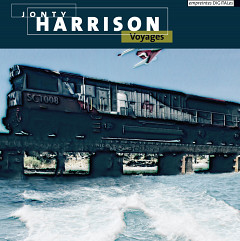
    In Espaces cachés and Going / Places, two recent works by Jonty Harrison on a CD called Voyages from empreintes DIGITALes, the ‘actual’/’virtual’ interplay emerges entirely from Harrison’s use of field recordings. Specifically, the way he shapes and positions them into large-scale tapestries that exist at the delicate liminal point between authenticity (raw and untouched) and artifice (clearly juxta-/superimposed). The latter is emphasised throughout the fourteen minutes of Espaces cachés, something of an essay in qualitative shifts and jump cuts between assembled groups of sound sources. The effect is cinematic, the episodic nature of the piece resembling a sequence of discrete ‘scenes’ — which somehow declare and defy their artificiality at the same time — demarcated by brief moments of disorientation. As its modest but ambitious title suggests, Going / Places doesn’t simply expand this idea, it explodes it, resulting in a 60-minute soundscape in which the structural divisions are no longer clear-cut and often themselves feel like an integral part of the activities captured in the field recordings. At its world première at HCMF 2015 I wrote about the “transparency of Harrison’s methods of collage and juxtaposition”, resulting in music that “certainly isn’t ‘electronic’, and one even hesitates to call it ‘acousmatic’”. That’s even more the case in this two-channel version, which sounds awesome through headphones (in no small part due to the fact the sounds were recorded ambisonically) and has the effect of turning one’s listening space into a vivid kaleidoscopic whistle-stop tour of the globe. But it’s more collage than reportage, and Harrison’s moulding of the recordings into complex fabrics turns Going / Places into a stunningly vivid piece of uncanny metarealism that encapsulates both the physicality and the psychology of the present experience together with aspects of memory and anticipation.

    … a stunningly vivid piece of uncanny metarealism…

    Pierre Alexandre Tremblay dans 5:4

    «HCMF 2016: Seth Parker Woods […] », Simon Cummings, 5:4, 26 novembre 2016
    samedi 26 novembre 2016 Presse

    Friday at HCMF began with a recital by rising star cellist Seth Parker Woods. I’ve had the opportunity to see Woods play once before (at HCMF 2014) and the experience was a highly impressive one, so I was very much looking forward to seeing him in action again. He did not disappoint, performing four challenging works, two of which involved live electronics. […] The unquestionable highlight of the concert, though, was Pierre Alexandre Tremblay’s asinglewordisnotenough3 (invariant), which provided both a composition masterclass in its seamless, aurally non-hierarchical interaction between acoustic and electronic, as well as a performance masterclass in its bravura display of frantic virtuosity from Woods. The work’s narrative was excellent, progressing through a series of evolving episodes each fuelled by the cello, many of them rhythmically taut (though never sounding metrically fixed) with a tendency later to expand out into more sustained soundscapes where the cello’s material was more buoyant. Utterly thrilling, and Woods unstoppable performance was outstanding. […]

    … a composition masterclass in its seamless, aurally non-hierarchical interaction between acoustic and electronic…

    Espaces tautologiques dans The WholeNote

    «Review», Paul Steenhuisen, The WholeNote, no 22:4, 1 novembre 2016
    mardi 1 novembre 2016 Presse

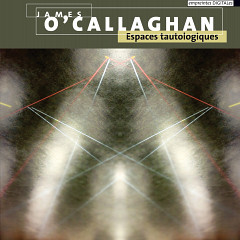
    On his recent electroacoustic CD Espaces tautologiques, composer James O’Callaghan takes us down the rabbit hole into a visceral, endogenous acousmatic wonderland. Although tautologies can be defined as “needless” repetitions, for O’Callaghan, they instead may be an ironic unifying premise for his vagabond auditory adventures, or append extra significance to compositional procedures such as varied repetition, imitation, and augmentation. The first three pieces (Objects-Interiors, Bodies-Soundings, and Empties-Impetus) form a triptych that “imagine(s) the sounding bodies of instruments as resonant spaces.” They contain crisp, natural, and remodelled recordings of passages through remote instrumental spaces, and at times it feels as though the listener is situated inside the instrument. From the rim to the spine of a piano (Objects-Interiors), an acoustic guitar and toy piano (Bodies-Soundings), or the surfaces and recesses of instruments in a string quartet (Empties-Impetus), each piece celebrates the percussions and resonances of a similar, colourful palette of instrumental and digital treatments. O’Callaghan demonstrates fluency with standard techniques of electroacoustic music, but it’s the impetus of the philosophical aspects that takes the pieces to their most compelling territories. The last piece, Isomorphic, is a particularly captivating jaunt through protractions of carefully ordered squealing, chattering textures. While the work shifts from one archetype to another, it’s coherently driven by consecutive, playful morphological relationships that extend from one sound to the next, despite differences of sound source and context. By virtue of the gesture, contour, pitch, and timbral coherence of his materials, O’Callaghan proposes contrasting ways to consider the ornithological chirps, industrial doors, and ambient environments. They can be heard as a perpetual flow, in which all sounds are related as one, or as a duality in which the listener simultaneously compares the ongoing profile similarities of the sounds with their wildly differing origins.

    … each piece celebrates the percussions and resonances of a similar, colourful palette of instrumental and digital treatments.
  • 1
  • 2
  • 3
  • 4
  • 5
  • 6
  • 7
  • 8
  • 9