electrocd

Blog

87 results
  • 2
  • 3
  • 4
  • 5
  • 6
  • 7
  • 8
  • 9
  • 10
  • L’envol in Chain DLK

    “Review”, Vito Camarretta, Chain DLK, July 27, 2015
    Monday, July 27, 2015 Press

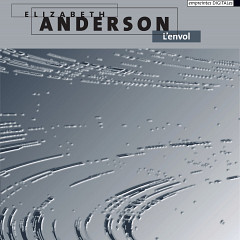
    The renewed interest on electroacoustic and acousmatic sonic material, that labels like empreintes DIGITALes are fostering by means of their publishing efforts, is allowing many hungry listeners to discover quite unknown composers or musicians in this interesting field. In spite of an excellent academic track and a plenty of prizes in international competition — including ASCAP-SEAMUS (USA, 2001), Bourges (France, 1994), CIMESP (Brazil, 1995, 2001, 2003, and 2007), Città di Udine (Italy, 2004), Métamorphoses (Belgium, 2004), Musica Nova (Czech Republic, 2008), Noroit-Léonce Petitot (France, 1998), Stockholm Electronic Arts Award (Sweden, 1994), TIME (2002), and Pierre Schaeffer Competition of Electronic Music (Italy, 2007) —, American-born Brussels-based composer Elizabeth Anderson could be an unknown name for many followers of the scene. Even if listeners who are not so familiar with sound processing couldn’t catch the beauty of this release, L’Envol (French for “the flight”) collects many works by Elizabeth, whose aesthetic research often features metacultural interconnection. Two of the above-listed prizes was given to the opening Les forges de l’invisible, an electroacoustic suite that Elizabeth made by manipulations of some sonic input that she previously created during a residency at the Centre de creation musicale Iannis Xenakis in Paris, between the multichannel electroacoustic studio of City University London and the Studio of Akousma of the Academy of Soignes in Belgium. The main source of inspiration of the two movements — the first one seems to trace different lovels of sonic decay, while the second movement could be the reverse process as the initial particles seems to get gradually amalgamated — was Blake’s poetry and particularly his visionary outlook of progress: she specifically mentions the notorious poem The Tyger, whose “fearful symmetry” has already inspired many musicians and got mirrored by the contrast between creative and distructive forces that animate guts, hearts and behavious of every sonic particles of this suite. Named after the underground fortress that Nazi forces built in northern France, Mimoyecques — the oldest recording of this collection — is a sort of sonic tribute to the forced laborers (more than one thousand prisoners) who died when the fortress was heavily bombed by the Allied air forces in 1944: for this genuine act of remembrance, she combined two sets of sound, being the first one mainly made from sounds that she recorded in the fortress and the second one from the overlapping of different readings in different languages from writings of Hans Christian Andersen, Danilo Dolci, Annette von Droste-Huelshoff, Alexander Pushkin, David Baltuch, Vaino Linna, Bjornstjerne Bjornson, Amir Gilboa and Czeslaw Milosz, intended to mirror the multilingual origin of the died workers. The tracks in the middle — the most recent erecordings — are mainly connected to Anderson’s fascination for space and ancient cultures: Solar Winds, which was dedicated to ancient Mayan astronomers, was based on James Dungey’s open magnetosphere model and interplanetary field lines that got carried by solar winds and interfere with Earth’s magnetosphere, which become a sort of score to give sound to non-sounding astronomical event, while the following … and Beyond proposes an imaginary aural journey beyond heliosphere. The vaguely diquieting Ether and the two movements of Protopia / Tesseract, inspired by Madeleine L’Engle’s novel A Wrinkle in Time, where space / time compression makes intergalactic travels possible, complete this release.

    Even if listeners who are not so familiar with sound processing couldn’t catch the beauty of this release, L’Envol collects many works by Elizabeth, whose aesthetic research often features metacultural interconnection.

    Les lointains in A Closer Listen

    “Review”, Richard Allen, A Closer Listen, July 23, 2015
    Thursday, July 23, 2015 Press

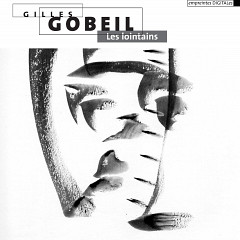
    The final piece of our empreintes DIGITALes triptych demonstrates the diversity of the label, as well as the intelligence of its artists. Québec’s Gilles Gobeil has over 25 years of recordings under his belt, but has not released a solo album since 2008. On Les lointains, he returns with a vengeance, with tracks inspired by Virgil, Hesse and Liszt, and subject matter ranging from the golem to the hydra. Lest we take it all too seriously, he also includes a piece that incorporates the sounds of dishes, a refrigerator and a coffee maker.

    The title track is a joy to decipher, as every sound is sourced from the home of sponsor Folkmar Hein. Inside the apartment, a grandfather clock ticks; outside, the bells of the Rathaus Schöneberg ring. Imagine testing the sonic properties of one’s home: tapping on every surface, sliding every door, testing every appliance. Most people have their favorite sounds (the hum of a refrigerator), as well as some they are less fond of hearing (the rattle of the air conditioner as it shifts from cool to fan). Subconsciously, we suspect that a home is a sort of system, a micro-version of a jungle, filled with mysterious mechanical beasts that creak or whirr without warning. And yet, a strange comfort can be derived by their confluence of sounds. While Gobeil’s treatment emphasizes the crashes and crunches, over time it becomes a tribute to a home and the man who lives within.

    Inspired by Hermann Hesse’s The Glass Bead Game, Castalie starts with the sound of an alarm, then an electronic gate opening, freeing all manner of sounds from their containers. At points harsh and in between gentle (faint birdsong occupying the open spaces), the piece toys with expectations, hiding its moments of transition. Even on repeated listens, one is not exactly sure where the pathway will bend. Composed in 2008 to mark the 60th anniversary of musique concrète, Castalie is a blend of sounds that exist in conjunction nowhere else: take for example the appearance of a crop-duster just prior to the reappearance of the alarm. In the final minute, a melody tip-toes through the background, hoping not to be noticed, outdone by the more abstract foreground.

    Bol-Hydre utilizes the sounds of the bol while adopting the hydra’s menacing mythology: cut off its head and another (or two, for those who read Kirby) will take its place. The percussion continues while the bol [“bowl”] howls and moans its low-toned warning. And yet, there are also bells, along with the sound of passing traffic, as if to suggest danger hidden in plain sight. One would be intimidated even without the prose. At this point, the album seems destined for darkness.

    Gobeil gives into the impulse, introducing Sibylle with a brass blast, followed by a whisper: the gaping maw of the underworld. If Aeneas hopes to descend, he will also need to resist: the hydra was nothing compared to what awaits. Again a bell tolls, like a final plea. Do not do this. Gravel loosens from the path. A voice squeaks like a rusty swing. Clouds of soot obscure the steps. Waves lap at an unseen shore. The sibyl alternates between prophecy and onomatopoeia. The bells return in echoes, until all is devoured in smoke. Golem follows, footfalls colored by construction and percussion, enhanced by film strip and bicycle bell. In the distance, a minyan chants. The שם remains intact.

    As Gobeil closes his collection with a tribute to Liszt, one imagines him opening the curtain a bit. Indeed, a choir seeps in, as do soft horns; the piano enters in the fourth minute. Yet the composition is less a reflection of tempestuous ivory as it is of a tumultuous life: I carry a deep sadness of the heart which must now and then break out in sound. One hopes for Gobeil a happier ending; if at times Les lointains sounds like notes stolen from the underworld, on Des temps oubliés he seems to have borrowed from heaven as well.

    … [Gobeil] returns with a vengeance…

    Le dernier présent in A Closer Listen

    “Review”, Richard Allen, A Closer Listen, July 22, 2015
    Wednesday, July 22, 2015 Press

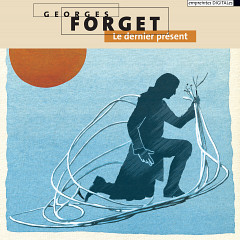
    With tracks inspired by a Terence Malick film, a Melville novel, and poems by Baudelaire and the French sailing champion Olivier de Kersauson, Le dernier présent wears its literary heart on its sleeve. Yet it is an album of few words, the most obvious being a portion of song from the French Foreign Legion. This segment, midway through the album, reminds the listener of the yearning soul behind the mechanical facade. Even when the words, first sung, are echoed in a guttural whisper, the listener can feel the tension between courageous ideal and smudged execution.

    Montréal’s Georges Forget has lofty ambitions, which include the pulling back of bandages to check the condition of wounds. He is not afraid to expose the “melancholy and fatalism” of a war song, or the underbelly of a breathing city. But at times he turns romantic, underlining the brevity of a fleeting romance or the lure of the ocean; toward the end, he even allows a child’s ebullient voice. No single mood unites Le dernier présent, but the sounds – composed and recorded over the past decade – are intriguing in themselves, and hide their surprises between folds of sonic cloth.

    One of the most effective pieces, Urban Adagio, treats the sounds of transit as both texture and percussion, augmenting the chug of trains and passing of cars with footsteps, squeaks and drones. The effect is both soothing and energizing; the more familiar the sounds become, the more comforting, stripping the terrors of night and replacing them with a siren call. Related sounds will appear later on the album, reflecting the artist’s urban background. The more rhythm one hears, the more rhythm one truly hears or ceases to hear, depending on one’s attitude toward the alluring/offensive sound.

    The two “war” pieces are rougher around the edges, as befits their subject. The prize-winning Métal en bouche is filled with hammers and engines, but is offset by smaller noises: a laugh, a coin, a bell. “We move forward, metal in mouth,” writes Wahed Gotref. The slow march pace indicates a battalion, or at the very least, a metaphorical determination. Orages d’acier is less linear: a counterbalance of lulls and explosions, a nod to The Thin Red Line. Before the soldiers sing, there is again the sound of the rails, connecting this piece to Urban Adagio, albeit with a different connotation.

    A secondary theme is that of water, lapping at the hulls in Une île and anchoring the quotes of Seul et septembre and L’appel. In the first composition, the water looms dark, a murky, many-fathomed ocean. But in the second, the waves and the electronic wings are more benign; and by the Moby Dick-referencing closer, the tone shifts to a summer vacation, replete with playground and child. Whenever it is a damp, drizzly November in my soul… I account it high time to get to sea as soon as I can. If the tamer 21st century invites us to get to the sea instead of to sea, it’s still a pleasant reminder that the world is not all metal, transit and war.

    … the sounds […] are intriguing in themselves, and hide their surprises between folds of sonic cloth.

    Growl in A Closer Listen

    “Review”, Richard Allen, A Closer Listen, July 21, 2015
    Tuesday, July 21, 2015 Press

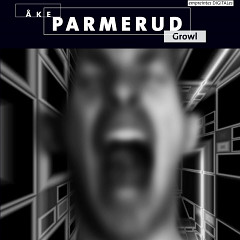
    What do birdsong, vinyl crackle, techno beats and heavy metal growls have in common? They all appear on Åke Parmerud’s latest collection. This seemingly disparate set of subjects unites to form a surprisingly coherent whole. The Gothenburg artist has defied the odds, still going strong at the end of his fourth decade in electroacoustic music. His natural curiosity (“I wonder what would happen if I did this?”) and playfulness (“Get me some growlers!”) combine to form a joyful experience.

    Take for example Electric Birds, the bird composition that once upon a time, Parmerud swore he would never make. Birdsong is one of the most overused tropes in music (especially in ambient – enough already!), yet here the artist still manages to do something new. By isolating specific New Zealand species that sound like electronic instruments, he creates a piece that defies the ears. As he points out in the liner notes, the bass bird is tiny, but really sounds like a bass! While it may be possible that these birds have been dropping in on raves and imitating their sounds, it’s highly unlikely. When Parmerud starts adding electronic touches of his own, the shift is barely perceptible.

    Now to another overused sound: the vinyl crackle. Ever since records first went out of style, nostalgia has produced a strange fascination with static, ironic because many of us are old enough to remember when crackle was a nuisance; we might even return a record and ask for a cleaner copy. A further irony is that the intrusive sound is now used as an inclusive sound, which itself is recorded to a different format. Parmerud’s “ultimate crackle” was initially designed for a 43-channel installation, and we are more than a little jealous of those who were able to hear it as intended; but the recorded version is still a beauty. Beginning (as might be expected) with the sound of a needle entering a groove, Grooves delves into multiple samples derived from countless home recordings, eventually overlapping them to a point that stops short of cacophony but is nonetheless effective. Of course this begs the question, “Can we get this on a record?” I for one would like to stagger these and play a few at once.

    Now to the piece from which the album derives its title: Growl!. The artist sent his youngest son in search of some growlers (in the States, that would denote large jugs filled with beer) to help record a heavy metal composition. This is a lovely image in itself: “Son, fetch your dad some growlers from the corner market.” And wow, are these guys going to need some lozenges. “Hell is us; die we must!” they intone, among other unintelligible words. It’s a powerful piece, bristling with energy and pride; as the vocalists are all from Gothenburg, one can imagine this as a friendly competition that sounds (on the surface) anything but friendly. Raaaaaaaawrrr!

    La vie mécanique includes only the sounds of various machines; it’s a factory gone wild, the type of music that by design is purely industrial. The first sound is that of winding, followed by ticks, rustles, whirs, and finally beats. Visually, one recalls Björk’s In the Musicals, from Dancer in the Dark, but musically, the track has more in common with modern techno, albeit with an early industrial base. A line can then be drawn to the album’s closer, similarly rhythmic although stemming from different sources, including an earlier choral piece and even parts of Grooves. It’s as if the composer decided to invite all of his friends to dine under the same tent, their subsequent conversation revealing their commonalities.

    Growl is a fascinating disc, experimental yet accessible, a wealth of experiences collected in a single binding. At 62, most artists are running on empty; Parmerud still has a full tank.

    Growl is a fascinating disc, experimental yet accessible…

    Fenêtres intérieures in The Sound Projector

    “Review”, Stuart Marshall, The Sound Projector, July 19, 2015
    Sunday, July 19, 2015 Press

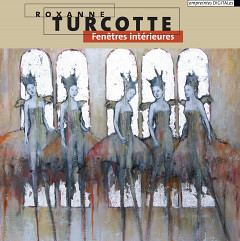
    Canada’s Roxanne Turcotte is more terrestrial in remit, turning eye to the turmoil of a human-ravaged planet (the Fukushima disaster among our many accomplishments), reflecting on our mortality and experience of time and taking a political stand in a piece written for Amnesty International — Tout en rouge — sourced from recordings from a 2012 demonstration an subjected to the usual laboratory procedures. If Elizabeth Anderson seats her compositions in the imagination, then Turcotte’s — produced primarily for installation and radio — are from the heart. Given the number of her dedications to the departed — quite powerfully so.

    At the outset, Fenêtres intérieures opens the window on a naturalistic world of sound and ‘the passing of time seen from the inside’, revealing the numinous in the normal (birds, skates on ice, tires on tarmac) and the magnificent in the mundane [Which is, I suppose, what lies behind so much of this sort of music.], and to remind us perhaps of how much we habitually ignore as we amble about with our Sony headphones. Turcotte seems less concerned with occupying space than with drawing attention to its presence (or absence) via unassuming portraits of our environment (eg the garden aviary of De la fenêtre) that quietly mutate as they grow in stature, as if poised to shock us with a tap on the shoulder the moment we’re feeling safe.

    From an aesthetic point of view I’m less taken with the torrents of (French language) voices that occupy several pieces than I am those consisting of processed, non-human sound per se; particularly those involving musical instruments. OVI (Objet volant identifié) for instance — a pathological study of modified electric guitar (that takes me back to some of the more time-bending instrumental moments on Squarepusher’s mutant jazz Just a Souvenir) — offers welcome respite from the deliberately uneasy cut n’loop vocal antics of Alibi des voltigeurs, and Le piano d’Horowitz manages a similarly deranging feat while almost passing for untreated. At the same time, one finishes listening with the feeling that much has passed the radar undetected.

    At the outset, Fenêtres intérieures opens the window on a naturalistic world of sound and ‘the passing of time seen from the inside’…

    L’envol in The Sound Projector

    “Review”, Stuart Marshall, The Sound Projector, July 19, 2015
    Sunday, July 19, 2015 Press

    Empreintes DIGITALes expands its fold with two more softly-sung heroines of electroacoustic music and at this point one can easily pick a winner among any of the label’s releases, though pick two and you might find little drastic variation. If the label is a leader in its field, its scope is a narrow one: many are the glistening field recordings, processed Japanese musical instruments, hulled and spaghettified voices and avowed interests in humanistic sciences that have graced my humble ears since becoming acquainted [Legion also are the academic accomplishments and international awards held by the composers inhabiting this label.]. But then, why spoil a winning formula?

    While not dramatically at variance with those of her peers, the compositions of USA’s Elizabeth Anderson still sound strikingly fresh (to ears not recently acquainted with this music, admittedly) and there’s a comfortable cohesion to the sequencing of two decades’ worth of work (1994-2014): glass-showers pummelling powerful liquid flumes; radio feedback collaged and spewed; riots of industrial klang and proliferating strands of deranged monologue that lend a historical vintage to earlier pieces such as Mimoyecques (a meditation on imprisonment and death). With no piece shorter than eight minutes, these events course throughout like organic silicon life through a cosmic/atmospheric vastness, though there’s plenty of capacity to be startled by such as the abdominal explosions of Protopia/Tesseract, its lines of low profile flutes and bifurcating, rattling particles: variables that interact with a volatility expressive of the many conceptual oppositions (and harmonies) — principally the spiritual and celestial — that form the basis for much of Anderson’s work: the poetic tension of William Blake’s Tyger in Les forges de l’invisible; the companionship of visible and invisible universes in Solar Winds … and Beyond. Accordingly, her work displays all of the dynamic vigour found in the work of her peers, though it inhabits far remoter cosmic real estate.

    Accordingly, her work displays all of the dynamic vigour found in the work of her peers, though it inhabits far remoter cosmic real estate.
  • 2
  • 3
  • 4
  • 5
  • 6
  • 7
  • 8
  • 9
  • 10