electrocd

Blog

114 results
  • 6
  • 7
  • 8
  • 9
  • 10
  • 11
  • 12
  • 13
  • 14
  • Estrapade in La Médiathèque

    “Sélections du mois de juin 2005”, Pierre-Charles Offergeld, La Médiathèque, June 1, 2005
    Wednesday, June 1, 2005 Press

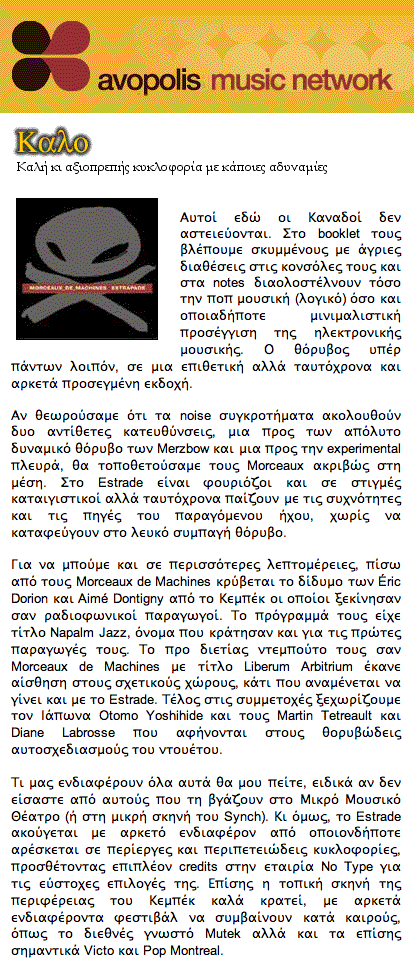
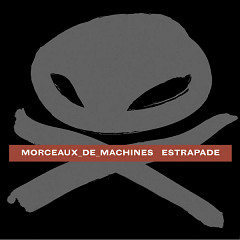
    Joyeux atelier «rhythmic noise indus» (étiquette beaucoup trop limitatrice). Ces Canadiens se veulent maximalistes, ils dévergondent une foule d’objets, électroniques ou non, pour élaborer d’invraisemblables ballets mécaniques, bruyants et pleins de vie. Ils sont accompagnés sur cet album par Martin Tétreault ou Otomo Yoshihide (voir ces deux champions du tourne-disque détourné) et par Diane Labrosse (échantillonneuse déconstructiviste que l’on trouvera en collection jazz sous son nom et dans une quantité de projets musicaux excentriques).

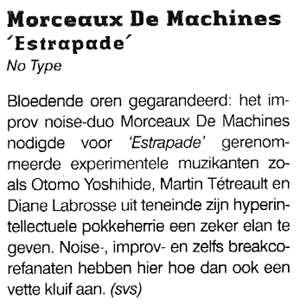
    Estrapade in Paris Transatlantic

    “Review”, DW, Paris Transatlantic, June 1, 2005
    Wednesday, June 1, 2005 Press

    Noise as a musical genre is no longer the bastard child of Industrial, and while many practitioners and aficionados still subscribe to its no-pain-no-gain aesthetic, there’s a whole basketful of young cats out there who just wanna have fun. Think Lasse Marhaug, Maja Ratkje – and morceaux_de_machines, the Québécois duo of A_dontigny and Érick D’Orion, aided and abetted here on four tracks by Diane Labrosse, Martin Tétreault and the ubiquitous Otomo Yoshihide (if a genie ever grants you three wishes you could really piss him off by using one of them to ask for the complete Otomo discography… the other two would be for a house big enough to store it and enough time to listen to it all). Adding a healthy dose of 150plus BPM drum’n’bass’n’gabba is a great idea – you’ll be surprised how likeable even the most vicious sonic knife attacks can be if there’s a mighty backbeat crunching along in the background (the wise old man of Noise, Masami Akita, knows this only too well), but there’s more to these nine tracks than merciless hardcore. Dontigny and D’Orion have a huge arsenal of sonic weaponry at their disposal, from mangled early Neubaten-style metal, vertiginous turntablism (not so much plunderphonics as chunderphonics), scything drones and all manner of digital clutter. The ultimate goal might still be to end up with ears full of blood, but with Estrapade you can dance yourself silly while the earwax melts. Let’s hope these chaps hook up with those Norwegians soon for some transatlantic aural tag wrestling.

    … with Estrapade you can dance yourself silly while the earwax melts.

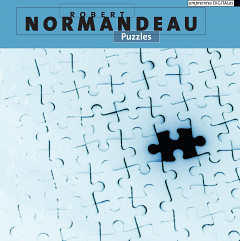
    Puzzles in Paris Transatlantic

    “Review”, Massimo Ricci, Paris Transatlantic, June 1, 2005
    Wednesday, June 1, 2005 Press

    A professor in electroacoustic composition at Montréal University, Robert Normandeau is also one of those composers whose music can sound like a divertissement but, at times, becomes deeply revealing if not disturbing. This duality is immediately evident when one compares the first two tracks on this release: Puzzle, a rhythmic exercise scored for door sounds and vocal onomatopoeia, is lively, almost funny, yet pretty flat as far as psychic impact goes. The following Eden, on the other hand, is a detailed architecture of brilliant loops and almost (Steve) Reichian pulses, where female voices and contrasting illuminations pave the way for an emphatic tonal affirmation that remains forward looking while managing to avoid the obvious. Chorus, dedicated to the victims of 9/11, takes some of the basic chant elements of Judaism, Christianity and Islam and entangles them in liberal electrostatic vocal jargon in which immobility and desperation intertwine, hopelessly waiting for non-existent peace. StrinGDberg, for multilayered hurdy-gurdy and cello, is dramatically minimalist, but its instrumental peculiarities are so incredibly deformed that I could have sworn a vocal source was present. The majestic crescendo of its mechanical subdivision is gospel for lovers of high-density powerful consonance. Closing the DVD, Hamlet-Machine with Actors is, according to the composer, a tentative description of the oppression that society exerts on man, the representation of taboos and the end of art. It’s a dark, thrilling piece where vocal utterances, repeated laughter, lugubrious electronics and a clutter of percussion fuse in a hellish mire, not too far removed from Art Zoyd and Cassiber at their most stirring moments.
    The majestic crescendo of its mechanical subdivision is gospel for lovers of high-density powerful consonance.
  • 6
  • 7
  • 8
  • 9
  • 10
  • 11
  • 12
  • 13
  • 14