
Délires de plaisirs
Paul Dolden
Well, at last. In this day and age of minimal everything, here finally is a self-proclaimed maximalist. — The Sound Projector, UK
… its playful irony and original synthesis of classical, popular, and non-Western styles. — Toonage, Canada
Official launch at the Borderline Festival in Malmö (Sweden) on April 29, 2005.
- Composer(s): Paul Dolden
- Performer(s): Chenoa Anderson, Paul Dolden
- Author(s): John Keillor
- Cover image: Arkadiusz Banasik
- Canada Council for the Arts • SODEC
CD (IMED 0577, 2005)
- 1Entropic Twilights (1997-2002, 03-04), 49:02fixed medium
- 1Twilight’s Nomadic Desire [1/2] (1999-2000), 12:16
- 2Twilight’s Nomadic Desire [2/2] (1999-2000), 9:46
- 3Twilight’s Sleep (1999-2000), 8:11
- 4Twilight’s Ritual Incantations (1998-99), 18:50
- 5The Gravity of Silence. Resonance #5 (1995), 13:44flute and fixed mediumChenoa Anderson, flute
- 64 violins, 2 violas, 2 cellos, 2 double basses and fixed mediumPaul Dolden, violin, viola, cello, doublebass
- Label: empreintes DIGITALes
- IMED 0577
- 2005
- UCC 771028057726
- Total duration: 77:48
- OGpak
- 125 mm × 125 mm × 10 mm
- 50 g
On the web
Download (IMED 0577_NUM, 2005)
- This item can be downloaded and/or listened to at empreintesdigitales.bandcamp.com.
- 1Entropic Twilights (1997-2002, 03-04), 49:02fixed medium
- 1Twilight’s Nomadic Desire [1/2] (1999-2000), 12:16
- 2Twilight’s Nomadic Desire [2/2] (1999-2000), 9:46
- 3Twilight’s Sleep (1999-2000), 8:11
- 4Twilight’s Ritual Incantations (1998-99), 18:50
- 5The Gravity of Silence. Resonance #5 (1995), 13:44flute and fixed mediumChenoa Anderson, flute
- 64 violins, 2 violas, 2 cellos, 2 double basses and fixed mediumPaul Dolden, violin, viola, cello, doublebass
- Label: empreintes DIGITALes
- IMED 0577_NUM
- 2005
- UCC 771028057788
- Total duration: 77:48
Liner notes
Entropic Twilights : Explicating the Plague
At the beginning of the 21st century, listeners are inundated with music that wafts through every commercial space. Shopping malls have become tasting centers, wherein a book shop will pipe in a muzak-ed
With his history of layering hundreds of recorded tracks, aggressively recalibrating the limits of orchestration,
‘Composer’ is another problematic term, because its classical inferences do not encapsulate what
Composers compose for the open air, while
Serious music has been skimpy on visceral thrills for a long time now, perhaps because popular music often is so good at evoking them. But 18th and 19th century listeners attended piano concertos in part for the wild ride of a virtuosic performance, a lively accompaniment, a yee-hah
—
Production Methods for Entropic Twilights
First the work was composed on 140 pages. I remember it took me 137 days to compose the work. While composing I created the click tracks since many of the sections involve complex rhythmic phasing and I needed to see how the bars lined up to control the harmonic rhythm.
Next the individual parts were written out and musicians and singers were hired to perform the individual parts one at a time. I performed all the bowed and plectrum string parts. All the parts with sustained note values (i.e. melodic work) were performed four times each. All the parts were recorded in stereo using two AKG 414 UBL-S microphones. The microphone pre-amp was a tube amp made by Peavey (VMP 2). The signal was then placed through a Klark-Teknic Parametric Equalizer with different EQ curves for each instrument (These curves I have developed over many years of recording). The signal was then placed through a phase angle correction unit, the Barcus Berry BBE. Finally the signal was digitized using a Digidesign 882 I/O. All the performances were edited for greater accuracy. Next all parts involving the inharmonic samples (i.e. pitch shifted saucepans, bowls, wheel rims, various poles, bass drums, various gongs and tams and many types of bells) were created. In the case where samples doubled a performed part, the samples were edited following the rhythm of the live part.
The piece was originally premiered in September 2000. However I was still unhappy with the sound of the piece. For the next two years I re-mastered my three previous solos CDs
I have come to believe in heavy compression of most instruments and voices because otherwise when all the tracks are together, you only hear the strong or penetrating parts of each instrument. (i.e. high notes on brass and flutes/piccolo, the low notes in saxophones, clarinets, vocal vowels which have high pitched formants, etc.). The problem with extensive compression of all tracks is that you start getting that static wall of sound. Secondly, percussive sounds with exponential envelopes cannot be clearly perceived through this wall of sound. (One tends to only hear the tick of their attacks). Therefore I developed dynamic settings for compression with optical-style compressors. One example
Likewise I realized the pitched percussion instruments (metal, bowls, poles, gamelan instruments, plucked strings, gongs, tams, vibes, marimbas etc.) needed to become more sustained and less percussive. I designed extreme low level compressors for each instrument type. These compressors left the peak of each sound where it was and severely brought up the decay portion of the sound. To this decay portion I often added dynamic noise reduction and/or treble enhancers. I also added many short delays, in the 5 to 50 milliseconds range to these instruments in order to imitate the “timbral density” of the orchestral and voice parts. This timbral density for the orchestra instruments was created by recording each part four times. In addition for these pitched percussion instruments I often used multiband compressors and expanders designed to pull down the upper register during the bright attack portion. Lows and mids were brought up or down in conjunction with the previous low-level compressor.
Another sound quality problem I had in previous mixes was the build up of resonant peaks resulting in a muddy sound when many tracks were playing fast. In particular the resonant peaks of particular instruments become an almost steady hum or drone killing the rhythmic drive. For example both the piano and cello have strong resonant peaks between 85 and 110 Hz. When you have many tracks of the same sound source you get this sonic sludge in these resonant regions. In previous works I had worked with finding numerous resonant peaks and using notch filters to remove them. However acoustic instruments often have many closely spaced resonant peaks and by the time you are up to 10 or 20 notches you are starting to get a very thin sounding cello, piano, toms, etc. I realized I needed more of a gap or space between each note than was possible with human performance. In other words an extreme short staccato. This was done through fancy applications of gates in order not to cut off the initial attack transients of each note. First an extremely fast optical compressor was used to darken the sound after the initial attack. The next unit, the gate, was triggered by seeing only the bright attack transients. Next, another fast attack VCA high ratio compressor was used to even out the levels. Often a dynamic treble enhancer was added and/or a “de-clicker” to remove the clicks that did occur by gating. Often somewhere in the chain of plug-ins a multi-band compressor/expander was needed. For each part I also produced a very fat or full sounding compressed version which did not use gating. In the final mix I would have the staccato or gated version and the legato compressed version at the same time. I would achieve a balance between the two and sometimes vary their mixture levels. In some passages only the gated versions appears in the final mix. When only using the gated version identification of the instrument is often impossible. However following the pitch pattern is possible because the gated short notes ended up being around 20-40 milliseconds long.
A similar approach was used on cymbals, shakers, guiros, hi-hats, toms, timpani, bass drum, low gamelan tams, electric bass, acoustic bass, contra bassoon, tuba. A short gated version and a fat compressed version were produced for each performance. In the final mix the gated version produced the rhythmic articulation and compressed version produced a resonant big sound. In the final mix there was a tendency to use more of the gated version when the two rhythmic sections had “pulled apart” either through the use of phasing or two different tempos. The most time consuming part of all this work was when I had sounds for which I could not gate electronically. For example, all the electric bass parts I went through and edited in a silence between each note. Therefore the gate had a chance to identify each note separately and then shorten each that note accordingly.
There were other processes involved to get the sound of
My intention in
As a final comment I realize my music, particularly since
—
Featured Musicians in Entropic Twilights
— [ii-05]
Some recommended items
In the press
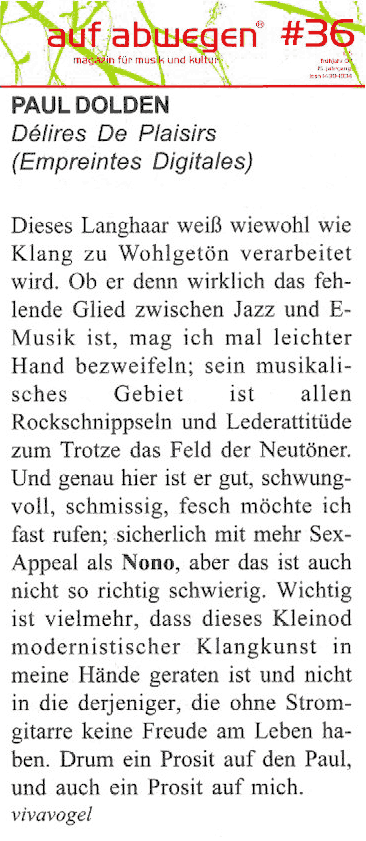
Kritik
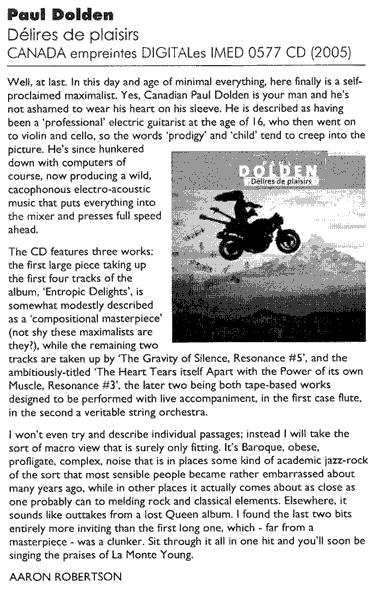
Review
Paul Dolden
[Reprinted from Vancouver Review #6, Summer 2005]
Critique
Kritik
Caleidoscoop
Een delirium voor je plezier, kan dat
Paul Dolden vs Gilles Gobeil
Tape-Aufnahmen als Basis und das Tonstudio als unverzichtbares kreatives Element bilden die gemeinsamen Ausgangspunkte für die beiden zeitgenössischen Komponisten aus Kanada, deren musikalische Manifestationen in Form zweier Alben auf empreintes DIGITALes unterschiedlicher nicht ausfallen konnten
Ganz anders geht es mir mit
Review
Review
Composer
Review
Always a composer who has understood the meaning of density in a work,
If you’re wondering if
Recension
Tamed Beast
After decades of pissing people off, Burnaby-boy-cum Montréaler
Until this release,
A downright populist piece, ET features jokes, simples tunes, and pratfalls of sudden stylistic redirection
One big difference from the earlier material is the grab bag of styles from which he freely draws. Palestrina’s vocal writing can be heard alongside Ravelesque orchestration, punk rock, jazz, disco, African drumming, and gamelan gongs. In his hands, this approach is no mere crazy quilt of alternating musical genres. He not only layers sounds but also lays them out sequentially. The parts weave together thematically, reinforcing each other via four brief, friendly tonal melodies in the key of C, producing musical pranks of lightness and subtlety.
ET even goes as far as outright, delighted cheesiness. One such moment is right at the beginning as a portentous heavy-metal guitar solo wails tearfully, metal-ballad style, over gongs and winds heard at super-low registers. The composer himself performs the solo, in real time. He’s an immaculate, feeling player, and this ballsy overture hails the central theme of the piece
The 20th century and all its unsmiling avant-garde composers, such as
In the 19th century, classical music actually competed with all other forms of entertainment, often holding its own without patrons or government funding. Sometimes its composers did, however, have unstoppable competition. There’s a tale of one 1860’s night in Paris, where three illustrious piano virtuosos, —
Of course, on other evenings all three pianists made heaps of money and endured a dozen curtain calls. On those occasions, no other marketable distraction could compete with the public interest in their playing, or with the scores that had been written for them. The point, here, is that classical music used to be a competitive cultural force and now it’s moribund, swept aside by movies and cheap internet pornography-and that fact angers
But ET doesn’t sound angry. It’s like a rectified collusion of the musical patter we hear in public spaces. Imagine all the piped-in music from different stores in a shopping mall playing simultaneously. What
It’s a battle worth fighting, and, on this front,
ET demonstrates how the world can be drawn back to classical music through entertaining sophistication. While the avant-garde searches for a new musical language by means of wispy dissonance, this piece consists of comically consonant counterpoint, producing a visionary artistic direction in the form of a wild ride-like a roller coaster designed by NASA. This is
The importance of a composer’s pleasure cannot be underestimated. It brings to mind a tame about
A Passion for Sound
Paul Dolden : le plaisir du son
Une équation se dessine d’emblée lorsqu’on écoute
Autodidacte
Rockeur dans l’âme,
Et des prix, il y en aura plus d’une vingtaine d’autres. Presque chaque année, une de ses œuvres reçoit une récompense par ses pairs de l’industrie musicale contemporaine et électroacoustique canadienne. La bonne nouvelle se répand ensuite hors de nos frontières et dès 1984, ses œuvres sont primées en Italie, France, États-Unis, République Tchèque, Suède, Angleterre… Un pied de nez à certains autres compositeurs canadiens, puisqu’il n’a pas le profil académique universitaire requis, mais bien seulement un baccalauréat en histoire générale…
Revisiter ses œuvres
Pour qui voudrait entendre le fruit de sa créativité, l’essentiel de ses enregistrernents figure chez empreintes DIGITALes. Son avant-dernier,
Rétrospective en Suède
Après plus de 20 ans de carrière, et quelque 40 œuvres plus tard, la reconnaissance ne s’est pas démentie. À la fin avril,
Avril a vu la parution de son dernier disque,
More texts
- Brett McCallon, Splendid E-Zine, December 16, 2005
- ASB, De:Bug, November 22, 2005
- Ingvar Loco Nordin, Sonoloco Record Reviews, November 1, 2005
- Frans de Waard, Vital, no. 495, October 5, 2005