
Histoires d’histoire
Paul Dolden / Maurizio Grandinetti, Łukasz Gothszalk
In a word, astounding
! — Avant Music News
This music definitely inhabits the “more is more” realm. […]
Dolden ’s sound is “unique” to say the least. […] Give this album a listen, and prepare to fractalize yourself. — Avant Music News
Prix Opus 2016-17: Disque de l’année — Finaliste
- Composer(s): Paul Dolden
- Performer(s): Maurizio Grandinetti, Łukasz Gothszalk
- Cover image: Luc Beauchemin
- SODEC
CD (IMED 17143, 2017)
- 1Music of Another Present Era (2013-16), 44:18fixed medium
- 1Marsyas’ Melodies (2013), 7:53
- 2Shango’s Funkiness (2014), 8:42
- 3Entr’acte (2014), 4:32
- 4Air of The Rainbow Robe and Feathered Skirt (2015), 12:34
- 5The Cosmic Circle Dance (2016), 10:38
- 6BeBop Baghdad (2013), 18:03electric guitar and fixed mediumMaurizio Grandinetti, electric guitar
- 7Show Tunes in Samarian Starlight (2012), 16:32
B -flat trumpet and fixed mediumŁukasz Gothszalk,B -flat trumpet
- Label: empreintes DIGITALes
- IMED 17143
- 2017
- UCC 771028214327
- Total duration: 79:04
- OGpak
- 125 mm × 125 mm × 10 mm
- 50 g
On the web
Download (IMED 17143_NUM, 2017)
- This item can be downloaded and/or listened to at empreintesdigitales.bandcamp.com.
- 1Music of Another Present Era (2013-16), 44:18fixed medium
- 1Marsyas’ Melodies (2013), 7:53
- 2Shango’s Funkiness (2014), 8:42
- 3Entr’acte (2014), 4:32
- 4Air of The Rainbow Robe and Feathered Skirt (2015), 12:34
- 5The Cosmic Circle Dance (2016), 10:38
- 6BeBop Baghdad (2013), 18:03electric guitar and fixed mediumMaurizio Grandinetti, electric guitar
- 7Show Tunes in Samarian Starlight (2012), 16:32
B -flat trumpet and fixed mediumŁukasz Gothszalk,B -flat trumpet
- Label: empreintes DIGITALes
- IMED 17143_NUM
- 2017
- UCC 771028214389
- Total duration: 79:04
Some recommended items
In the press
AMN Review
The other two releases (
I should know by now that the unusual is the usual when it comes to
AMN Review
In my label introduction, I mentioned that the music on empreintes DIGITALes generally falls into the Acousmatic / Electroacoustic / musique concrète style. Well, I’m going to have to take issue (with myself at least) because, as the good
And what about the compositions themselves
Defending his work ethic aside, on to the music itself. I’ve seen the term “maximalist” thrown around quite a bit when describing his work (labels/cans… I know). This music definitely inhabits the “more is more” realm. You can begin anywhere within this 80-minute album and the first thing you will probably notice (after your brain re-sets itself to assimilate the microtonal, odd tunings, and polyrhythms he liberally employs), is the sheer amount of detail in each piece. Electric guitars and keyboards (the Electro) stand proudly next to the army of flutes, brass, cello, choir, percussion, and trap sets (the Acoustic) to create a living, breathing beast of a thing. Certainly, something that takes a myriad of listens to even begin to understand, if understanding it is indeed possible. Yeah, this music takes work.
The work will pay off though, depending on your attentiveness and personal ear it may be sooner, or later, but it will pay off. Without going into detail about each and every piece, the album is comprised of 3 long compositions. The first 44-minute piece,
I can’t really think of many composers working in this style.
Paul Dolden? Tear Down That Wall!
But first, some history. Waaaaay back in a time known as the 1980s, this Ottawa-born composer, after doing hard time as a rock guitarist, decamped to the Sonic Research Lab at Simon Fraser University [(SFU)] in Vancouver where he forged some of the most unique music ever carved out of the Western formal tradition by using the recording studio to sculpt masses of meticulously recorded instrumental tracks into fantastic walls of sound.
By the end of the decade he had released a 2-CD set titled
At first,
From Veils to Walls
Things really began in 1985 with “
In pop music, by contrast, we might remember English pop group
Fast forward ten years and
The titles also represent the 3 stages of revolutionary history as discussed by historians
1) Below the Walls signifying revolution, usually violent.
2) Dancing on the Walls is the celebratory dance on the rubble of the revolution.
3) Beyond the Walls is the post-revolutionary period, usually turning counter revolutionary and more violent than the first period.
There were those who found it all too much, especially in Vancouver where, at the time, contemporary music was (and largely still is) seen as a less confrontational and more communal endeavor.
The late
You could say the music was ahead of its time but Paul, being interviewed in 1992 said that the idea was absurd, that you simply cannot be ahead of your time. Our best hope is that audiences will find the music of the true present at the time of its creation.
During a 2017 visit to Québec’s Laurentian region where Paul now lives and records, I conducted an informal interview at a roadside diner near Val-David. It coincided with the release of his CD [“Music for Another Present Era” or]
I had only sporadically kept up with Paul’s music in the years since he left for Québec and was fascinated to hear its evolution into something much different but with the familiar stamp of rigourous conceptual formulation and production excellence. Since creating the Walls cycle, Paul’s music has evolved, been pulled apart, given more space and fully embraces the music of the world. It is friendlier… and funnier.
I suppose, overall, it’s a post-modern play on how we can have different historical periods of music existing at the same time. To me that very imagining is a contemporary thing. I can imagine ancient Greece because I’ve seen films like Fellini’s Satyricon where the soundtrack is a fanciful mash-up of styles, or images of Syrian ruins that you’d see in a history book.
We’re so conditioned by the number of images and sounds that we’re constantly consuming that I think it’s important to be playful with it all. I think I’m being “of my time” by doing so even though I’m often talking about historical themes in my music with pieces like
Now there’s been a massive expansion of the technical capacity for music creation and it’s become affordable and ubiquitous. But in the public at large there’s been a serious loss of attention to contemporary music outside of popular forms. It seems that there’s been no “trickle down effect” of discovery despite the fact that we have more and instant access to every kind of music 24/7.
But it’s the employment of algorithms that’s the problem. They suggest that “if you listen to such and such then you will also like such and such”. So if I listen to one heavy metal album (because every so often I need to hear some metal
I started reading the back covers to learn how he made this music. I thought it sounded so insane that I had to buy it just to hear it. It was his stochastic 60s work with all the math involved in the composition and I thought “What
You have to remember that when I made
So we should assume then that the power of sound and complex music may well have reached its peak with the Walls Cycle and may never be absorbed or appreciated by any but a small band of fanatical devotees. Fair enough. The sun will explode one day and none of this will matter anyway. In the meantime it seems as if
But history, as we now plainly see, sometimes bears repeating if only to recall how we may have missed its lessons. Accordingly, Paul has put the Walls Cycle up for listening at Bandcamp. It is sad that many will only listen on a computer speaker system. I’d urge you to go full retro and order the CD for hi-fi home playback. Turn off your mind, relax and float down stream…
Then bring yourself up to date with
Review
Electroacoustic storyteller
The outlier (of sorts) is the jam sesh in
Critique
Guitariste, violoniste et violoncelliste,
Toujours à la recherche de ce que nos ancêtres ont composé et dont la plupart des œuvres ont complètement disparu, ne laissant pour toute trace que des systèmes de notations musicales au déchiffrage souvent approximatif,
Regroupant trois pièces créées entre 2012 et 2013,
Review
Nobody — but nobody — makes music that sounds like
The ‘doddery’ demeanour i previously spoke of, the result of both density and microtonal confusion, continually rears its head, resembling the effect of amateur musicians struggling with both their instruments and their ideas (think of the
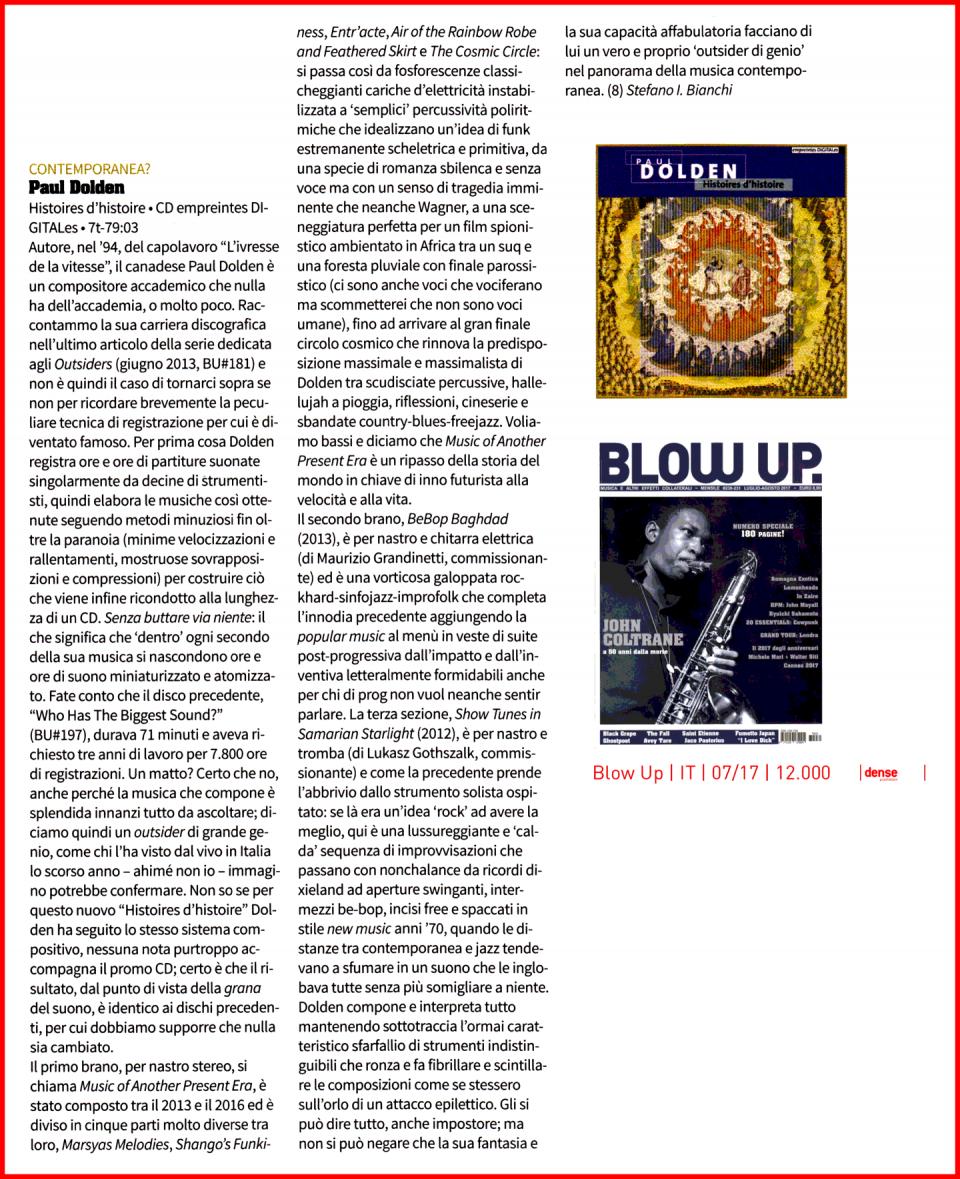
Contemporanea?
Review
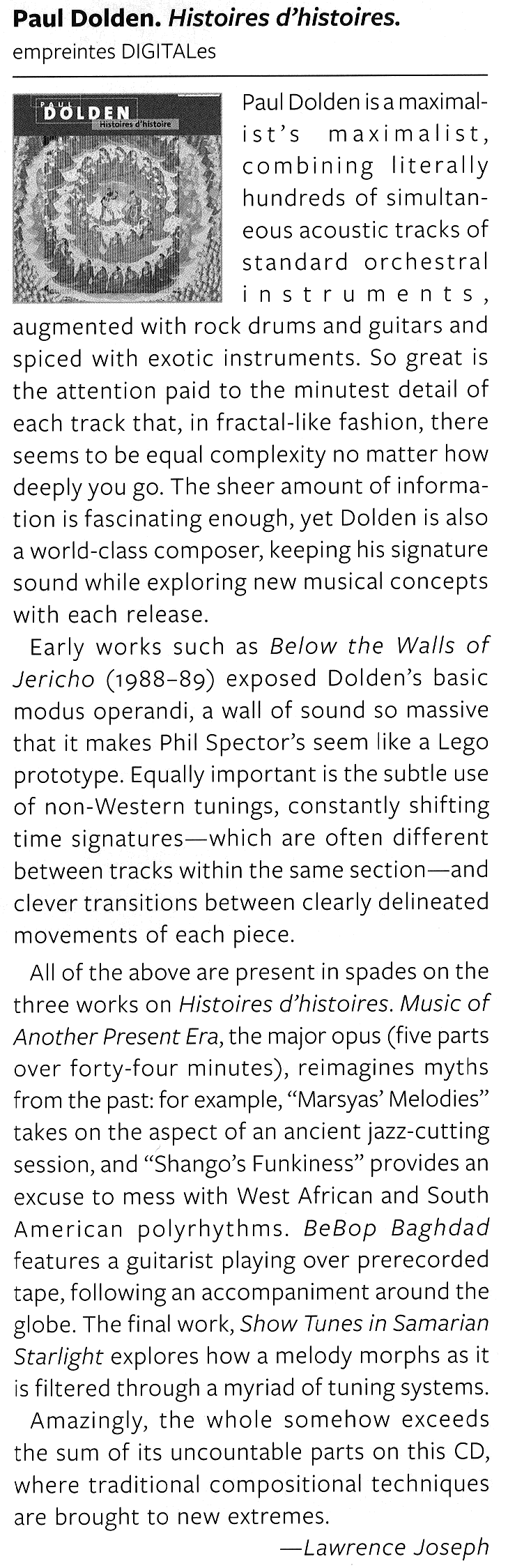
Unusually for this genre, the press release on
It’s a collection of long, expansive and ambitious avantgarde classical pieces that combine ‘proper’ modern classical in the style of
Two further long pieces, each a few years old, fill the CD almost to its brim. The eighteen-minute
It’s an extensive 80-minute journey through a whole heap of ideas, sounds and moods, a real patchwork quilt of organic ideas arriving and departing with plenty of energy and a hint of frivolity. That playfulness and slight shortage of coherence disempowers it somewhat from being a really ‘wow’-inducing listening experience, but it’s a very out-there listen.
Review
Blog
-
Thursday, August 26, 2021 / Press
In a word, astounding
! More -
Thursday, January 14, 2021 / Press
This music definitely inhabits the “more is more” realm. […]
Dolden ’s sound is “unique” to say the least. […] Give this album a listen, and prepare to fractalize yourself. More -
Sunday, July 26, 2020 / Press
… a unique and unmistakable voice in Canadian contemporary music… More