
L’ivresse de la vitesse 1 [Intoxicated by Speed 1]
Paul Dolden
…
Beyond the Walls of Jericho […] is among the most monumental works of electronic music you’ll ever experience. — 5:4, UK
… a prolific label for electroacoustic music as well as provocative experiments in conceptual sound. — e/i magazine, USA
Re-processed, remixed and remastered, no less
- Composer(s): Paul Dolden
- Performer(s): Peggy Lee, François Houle, Vivienne Spiteri
- Author(s): Arthur Kroker
- Cover image: Luc Beauchemin, Cheryl Holizki
- Canada Council for the Arts • SODEC
- This item is also included in the L’ivresse de la vitesse box set (IMED 9417/18).
CD (IMED 0317, 2003)
- 1L’ivresse de la vitesse (1992-93), 15:49fixed medium
- 2Physics of Seduction. Invocation #3 (1992), 18:30cello (or viola or violin) and fixed mediumPeggy Lee, cello
- 3Revenge of the Repressed. Resonance #2 (1993), 7:12soprano saxophone (or alto saxophone or tenor saxophone) and fixed mediumFrançois Houle, soprano saxophone
- 4Dancing on the Walls of Jericho (1990), 16:15fixed medium
- 5Physics of Seduction. Invocation #2 (1991), 13:19harpsichord and fixed mediumVivienne Spiteri, harpsichord
- Label: empreintes DIGITALes
- IMED 0317
- 2003
- UCC 771028031726
- Total duration: 71:35
- OGpak
- 125 mm × 125 mm × 10 mm
- 50 g
On the web
Liner notes
Why Remaster Old Works? (L’ivressse de la vitesse 1 )
In the late 1970’s I started to write and produce music involving hundreds of parts or tracks. In the early days, the analogue recording medium was very noisy when bouncing (or premixing) tracks together. Things improved throughout the 1980’s and ’90’s, but a large multitrack digital tape recorder was still out of my financial reach. By the late 1990’s the new computer and hard drive speeds finally provided me with an affordable multitrack solution. For the first time in my life I was able to achieve the balance between individual voices that I had so carefully notated in the original scores. I achieved further musical clarity and a new depth of sound by using quality compression, equalisation and reverb. To remaster, I went back to the individual tracks. This was a huge undertaking. For example, a piece like
Recordings always ‘freeze’ or crystallise musical and spectral meaning for the listener. An odd sound combination that you have grown fond of in the old master may not appear in the same way in the new one. However, I think you will agree that I have stayed true to the original compositions. I changed some musical moments and transitions in
I invite you to discover many new levels of meaning and clarity in the new masters, which are much closer to my original artistic intention.
—
Crash Music [from the 1994 Edition]
What is the speed of music
In this wonderful world, as we drift aimlessly across the mediascape, floating among the debris of all the seductive objects of desire, voyeurs in the cultural boutiques of which our bodies are only random and transitory terminal points, we can finally know the terminal blast of music to be our very own lost object of desire, the field across which bodies are coded, tattooed and signified in an endless circulation of spectral emotions.
If music is so seductive today, that is because it finally delivers on the catastrophe that is our last historical illusion. Music as interesting, therefore, only in its dark and implosive side, in that impossible space where music prefigures our own dissolution into a spectral impulse in the circulatory system of the mediascape. The fascination with music today lies in its violence as a force-field that scripts bodies, codes emotions, processes terminal identities, and rehearses our own existence as crash bodies, by its violent alternation as a scene of ecstasy and inertia.
Sounds appear from nowhere and they decay rapidly. They move across the field of our bodies, and then disappear. They have no real presence, only a virtual and analogical presence. Sounds without history and without a referent.
The brilliant musical compositions of
(A fragment of this introduction is excerpted from
—
Intoxicated By Speed, the Discs [from the 1994 Edition]
The music on these two discs represents two different but related compositional strategies. The first compositional strategy is represented by the creation of the four solo tape works and the second strategy is the creation of the five works for soloist and tape.
The creation of the solo tape compositions involves the composition of several hundred simultaneous musical parts or lines on large manuscript paper. Each part or line is individually performed on an acoustic instrument and recorded. Once all several hundred parts have been individually recorded, they are digitally mixed together with usually no, or very little, signal processing or electronic effects. This working method allows for new and complex polyrhythmic and microtonal tuning relationships between parts that could never be performed by a live ensemble. This compositional technique also allows for unique orchestration and density possibilities that can be constantly transformed.
The exclusive use of acoustic instruments in these recordings could be partially explained by the fact that I regularly perform on the violin, guitar and cello. Therefore I hear a richness of human expression in acoustic instrumental performance which, to me, is largely absent in any other electroacoustic production method. Indeed the sound worlds found in these recordings could not be created by current electronic synthesis techniques, which are unable to produce a large palette of convincingly different timbres or sounds. The narrowness of this range of unique timbres prevents the type of orchestration strategies that can occur for acoustic sounds in which large numbers of sound sources can be combined and the individuality of each sound is somewhat maintained while there is a contribution to the overall sound. Likewise, this music could not be produced by current sampling techniques, which cannot create convincing long musical phrase structures which develop according to the compositional language of each piece.
The second compositional strategy featured on these two discs combines a live soloist with segments from three of these solo tape compositions. Often new tape portions are added in order to compliment the timbral quality of the soloist’s instrument. In creating these works for soloist and tape, many details of the tape become masked by the soloist’s sound. However, by being able to clearly hear one part, one gains a new perspective on my sound world, as the solo line often highlights fairly hidden musical gestures and directions. Moreover, one has the wonderful contrast between the tape, in which hundreds of musical parts often create anonymous massed textural effects, and hearing the soloist with all the subjectivity, subtlety and detail he/she brings. As such one could compare the soloist to a clear single line in an abstract dense visual field which creates a type of definition and clarity by its sheer contrast to the surrounding density. In other words, the tape works stand on their own but are heard in a different manner when they are combined with a soloist. Another analogy would be when viewing a crystal in which we know it is the same object even as we turn it and get different visual perspectives.
The contrast between the anonymous mass effect of the tape and the singular effect of the soloist also works as a metaphor for the relationship between the individual (the soloist) and society (the mass effect of the tape). The implication of this metaphor is discussed in the following section entitled
With the exception of
—
Acknowledgements [from the 1994 Edition]
The music on these two discs represents two different but related compositional strategies. The first compositional strategy is represented by the creation of the four solo tape works and the second strategy is the creation of the five works for soloist and tape.
The creation of the solo tape compositions involves the composition of several hundred simultaneous musical parts or lines on large manuscript paper. Each part or line is individually performed on an acoustic instrument and recorded. Once all several hundred parts have been individually recorded, they are digitally mixed together with usually no, or very little, signal processing or electronic effects. This working method allows for new and complex polyrhythmic and microtonal tuning relationships between parts that could never be performed by a live ensemble. This compositional technique also allows for unique orchestration and density possibilities that can be constantly transformed.
The exclusive use of acoustic instruments in these recordings could be partially explained by the fact that I regularly perform on the violin, guitar and cello. Therefore I hear a richness of human expression in acoustic instrumental performance which, to me, is largely absent in any other electroacoustic production method. Indeed the sound worlds found in these recordings could not be created by current electronic synthesis techniques, which are unable to produce a large palette of convincingly different timbres or sounds. The narrowness of this range of unique timbres prevents the type of orchestration strategies that can occur for acoustic sounds in which large numbers of sound sources can be combined and the individuality of each sound is somewhat maintained while there is a contribution to the overall sound. Likewise, this music could not be produced by current sampling techniques, which cannot create convincing long musical phrase structures which develop according to the compositional language of each piece.
The second compositional strategy featured on these two discs combines a live soloist with segments from three of these solo tape compositions. Often new tape portions are added in order to compliment the timbral quality of the soloist’s instrument. In creating these works for soloist and tape, many details of the tape become masked by the soloist’s sound. However, by being able to clearly hear one part, one gains a new perspective on my sound world, as the solo line often highlights fairly hidden musical gestures and directions. Moreover, one has the wonderful contrast between the tape, in which hundreds of musical parts often create anonymous massed textural effects, and hearing the soloist with all the subjectivity, subtlety and detail he/she brings. As such one could compare the soloist to a clear single line in an abstract dense visual field which creates a type of definition and clarity by its sheer contrast to the surrounding density. In other words, the tape works stand on their own but are heard in a different manner when they are combined with a soloist. Another analogy would be when viewing a crystal in which we know it is the same object even as we turn it and get different visual perspectives.
The contrast between the anonymous mass effect of the tape and the singular effect of the soloist also works as a metaphor for the relationship between the individual (the soloist) and society (the mass effect of the tape). The implication of this metaphor is discussed in the following section entitled
With the exception of
—
Recorded Musicians [from the 1994 Edition]
Recorded musicians in the
Voices
sopranos
altos
tenors
basses
Recorded musicians in the
Voices
soprano
alto
tenor
baritone
Recorded musicians for
— [x-03]
The Possessed Individuals [from the 1994 Edition]
The program notes for the works represent the evolution in my thought structure to this philosophical outlook. For example, the program notes for the
Musically, the five works chronologize different strategies for combining the live aspect of a potentially irrational, irregular and wild soloist with the disembodied virtual reality of the tape. As mentioned above, in some instances the soloist enters and plays with the virtual world of the tape. At other times, the historicized subjectivity of the soloist is in musical contrast with the tape and, in this sense, the Possessed Individual is one of the last great heroic figures
Notwithstanding these limitations of written discourses, it is sufficient to say that in the virtual reality of these recordings our heroic virtuoso, or Possessed Individual, is a possible portrayal of subjectivity in ruins at the end of the second millennium, and yet simultaneously a meditation on the dark, and fatally attractive and seductive universe of The Possessed Individual.
(Title taken from and writing inspired by the book
—
Some recommended items
In the press
Review
Another composer who has been polishing off, smartening up and reissuing old works recently is Canadian
The first thing to say about this is that the word “remaster” isn’t remotely adequate to describe what’s going on here. Usually that term indicates a digitising and cleaning-up of old materials to make them as pristine as possible and then reassembling them into a new master that, in essence (and ideally), is the same as the original but showing greatly improved clarity and balance. In
The second thing to say is that there shouldn’t be any perceived issue with an artist wanting to do this. The gripe about technological issues is something many composers (including myself) have made about their earliest electronic works, and the desire to get closer to the original musical intent is surely an admirable one. Of course, it’s an attitude that can run amok, and one only has to look to
I don’t blame
Yet — and this is one of the main reasons why I absolutely love
I have to admit I miss the original 1992 opening of the piece, where vague and elusive hints of instruments slowly grow into an increasingly dense texture. That’s gone in both the 2003 and 2020 versions, which hit the ground running with frantically busy tuttis. There are some structural hiccups too in the 2020 version that, to me, somewhat diffuse the flow — most notably around four minutes in when everything briefly stops before the funky bass and drums start up, dissipating the energy amassed by that point
Anyone discussing
My recommendation is to seek out all three versions, as they each have something that the others lack. For the 1992 original you’ll need to turn to Discogs to track down a copy of the earliest releases of
Recensione
Territorial Imperatives: Canada’s boldest and brightest labels…
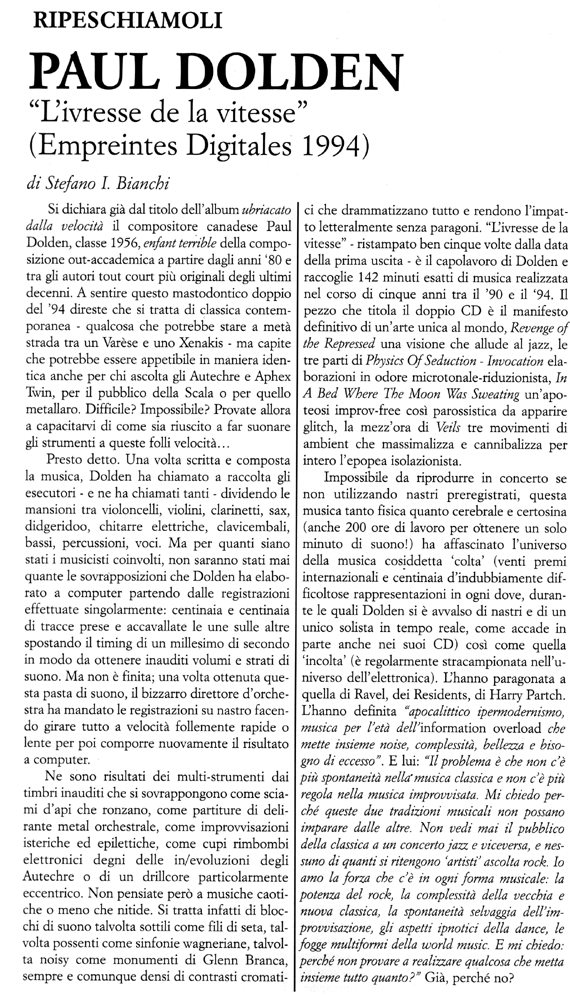
[…] The minimum one can say of empreintes DIGITALes is that it is a prolific label for electroacoustic music as well as provocative experiments in conceptual sound. A few recent releases graft the varied interests of academic and acousmatic music together via the intriguing work of, say,
Review
Lucky
The most representative piece here,
Review
I invite you to discover my new levels of meaning and clarity in the new masters, which are much closer to my original artistic intention.”
There is no mercy administered, and no time to adapt
This long work opens in an industrial scenery
A jazzy, feverish jinglish kind of beginning moves through the
Polishing sounds wipe the curving walls of a contrast medium drenched tunnel, which eventually is filling up with a torrent of audio from the treacherous ill will of the toppling-over sonic ingenuity of Mr.
It gets worse, worse… It gets worse… as jittering atoms gather for a mingling vernissage evening at the horizon of events, right around that black hole in the midst of all our lives, or in a laid-back agony at the Restaurant at The End of the Universe (I bow to Mr. Adams who gave some meaning to my meaninglessness).
Beyond the Walls of Jericho (1991 — 1992).
Again, as in the preceding re-issue, there is no mercy at all.
Slowly, carefully, softly emerging, very different from the other piece before it, unraveling a smooth, romantic painting motion in the clarinet, distant and closer and close
Relaxed hands seem to be waving through these laid-back suburban communities, but just for a while, because the midday rescue vehicles soon dash through layer after layer of red-hot guitarisms, cauterizing by-standers and storeowners down the block. A stew is brewing somewheres, bubbling with venom
This, though, is poetry
Dolden
A quite wonderful, glassy sound, organ-like, subdued-fanfare-like, opens
Surely, this didn’t come across this brightly and ingeniously on the earlier release. I heard it the first time when it appeared on the Cultures Électroniques release from the GMEB competitions in 1990, where it won the composer the first prize for electroacoustic composition.
There are many layers of sound relieving each other or adding to each other, and the sheer roughness and simultaneous clarity of some of them bring on levels of corrugated auditory surfaces I have never heard or touched before, bringing me into joyous discovery for the first time in a long listening while, as
Dolden
A dark motion rising cautiously out of semi-instrumenty realms, emerging into clarity and tactile reality, spreading its auditory fragrance like opening petals… and you feel yourself soaring down inside the space inside these petals, as if docking with a giant space ship — and yet it feels so familiar behind that veil of uncertainty and semi-transparent reality, the violins, the orchestral familiarity, hundreds of years of tradition carried towards you on outspread fingertips, like a gift from undisclosed benefactors… There are some incredibly close encounters herein, with the strings, which you practically ride, trembling madly with them… only to find yourself suddenly distanced into the room, the strings grouping themselves neatly into an ensemble up on a little stage… and then you’re down into the instruments again, the strings of the violin fully charged high-voltage transmission lines through your vicinity
Dolden
It’s hammer time right off, as you veer here and veer there… eventually catching hold of some materializing matter in the shape of sturdy tools inside a machine-scape of some industrial environment, as the industrial sounds re-group into Christmas time Santa workshops of speedily constructed toys and half-perverted goblins by endless conveyor belts… and it’s a Disney culture gone seriously wrong. After a while a peculiar, metallic percussion, irregular, brings on reminiscences of
Dolden
The inconspicuous beginning mix of roughness and timbral modality builds up strong levels of conviction, so watch your output levels. A playful melody, sort of heard from way inside a hall, or from behind a corner in a restaurant, reveals where the musicians are poking about in there scores, kind of nervously and absentmindedly, a half hour before they have to start playing for real, for pay. There is a distance in the way
Dolden
This piece was one of the first
Morse-like percussive codes are emitted from inside the body of sound
There is an ominous, fateful feel to this work, as if it was describing events so vast and so immensely forceful that acceptance is the sole possible attitude from our point of view. This music seems to deal with the inevitability of the sun eventually turning into a red giant, or events like that, or perhaps with the natural loneliness of the soul — and one feels, as a reaction to
Critique
empreintes DIGITALes, étiquette montréalaise spécialisée dans les musiques électroniques et électroacoustiques entreprend cet automne des fouilles dans l’œuvre surprenante du compositeur canadien
Critique
empreintes DIGITALes fait paraître ces jours-ci trois disques de
Review
Vancouver native, Montréal-based
Review
Culling material that covers a decade of work,
Review
2 CDs in this CD box, on the first one there are 5 tracks on the 2nd one 6 tracks. Listening to the 1st track (CD 1) it seems as I am listening to a jazz-band or a symphony orchestra in overdrive, fast music. The booklet learns us that
Critique
Review
Double CD wich compiles works dating from 1984-85, such as
Translated from Spanish.
Original text
CD doble que comprende haceres de los años 1984-85 como es la pieza
100 Records That Set the World On Fire, While No One Was Listening
Canadian electroacoustic composer
Kritik
Eine DoCD des hochgehandelten kanadischen Elektronikers, die Anfang 1994 erschien, randvoll mit Musik. Die Hälfte der durchweg längeren Stücke sind reine Tapearbeiten, die andere Hälfte um jeweils Solisten ergänzte Tonbandarbeiten. In beiden Fällen hat
Review
While many electroacoustic composers strive to create new timbres through synthetic means,
There really is no other artist working in the same fashion as
Review
There is so much musical output contained on these two discs that it took me several listenings to come to grips with it all. In the liner notes,
The title cut and the last work in this collection, both for tape alone, could not be more contrasting.
With the exception of these two pieces, I gravitated toward the pieces that featured solo instruments because of the focus they provide. This may be because
The harpsichord part in
Review
One of my favorites, if only because of the
Gravikords, Whirlies & Pyrophones
“What is the speed of music
Review
Mr.
The inclusion of the three-part work
I should mention that all of the source materials for the pieces on these CDs are completely acoustic. There is no synthetic material, and extremely little processing. M.
Interview
Since 1981
Could you comment on your reuse of materials in the current works of the Resonance cycle for live performer and tape.
The mother piece for the Resonance cycle is the tape piece
Reflect on musical performance as you perceive its importance to musical language and composition.
It is hard for me to imagine not having the experience of being a performer and trying to be a composer. Instrumental and vocal performance is the living history of musical thought and gesture, and to really understand instrumental writing a background in performance is necessary. Also, during a performance, whether it is for six friends in the front room or more than 800 at a professional concert, there is an excitement, an adrenalin rush, and a certain type of concentration that one can understand as a performer. To write utilizing that energy and style of thought will always lead to more interesting music.
In the last two years, performance, for me, has taken two directions. I no longer play other people’s music. I have learned two of my own compositions, one for guitar and tape, and one for violin and tape. This process has informed me of what it’s like to play one of my scores, and what it’s like to be a soloist with a tape accompaniment. The other type of performance I am doing is free improvising on guitar, violin, and cello. For me this is primarily an exploration of sound and gesture that I keep more private because I do not find it musically profound. It is a process to go through in which i enjoy the discovery of combining notes, sounds, and colours wliich sometimes feeds back into my compositional practice.
How do you retain a balance between the individual character of instruments and orchestration with so many tracks
First of all understanding orchestration, and secondly, engineering. In terms of orchestration, it is important to understand how each instrument sounds in each register, and what happens when different instruments are combined. This goes beyond a textbook knowledge and requires a good aural memory because there are endless permutations. Important aspects of this are knowing which instruments mask which sounds, and which ones fuse with others at particular dynamics and/or ranges.
After one has created a score of notation, this must be translated to a recorded signal which is well produced. For my music, the most important aspects of engineering are
As far as maintaining the individuality of instruments, my work in the ‘80s was primarily concerned with the concept of the fused sound, therefore there was a decreased emphasis on being able to hear a particular line or instrumental colour. Over the last few years I have become more interested in hearing individual lines or groups of lines in the multiplicity of 400 parts.
Could you comment on your present exploration of twelve-tone equal temperament
Tuning has been very important in my work. In the ‘80s I was only writing in microtonal systems, many of which I designed myself. I used just intonation and particular microtonal systems which often meant there would be anywhere from thirty to sixty notes per octave, which led to the fused sound of those works. I do find a certain clarity in twelve-tone equal temperament, and in some ways it almost seems sparse after ten years of microtonal work.
The main reason for the return to equal temperament is that all microtonal systems, I discovered, led to a certain type of stasis. It seems that I have, at this level, reinvented the wheel, because equal temperament was designed to facilitate faster moving harmonic rhythm. My music has gradually become more concerned with harmonic rhythm, so that moving to equal temperament has been quite a natural progression.
I find the return to equal temperament makes writing much easier because everything is instantly transposable and invertible. The problem with many microtonal systems is that when a harmony is inverted or transposed many notes have to be slightly adjusted. So I am able to write much faster now. One of the reasons I left twelve-tone equal temperament originally is because all of the intervals are mistuned except the octave, and you hear this particularly with the more consonant intervals.
However, I am primarily writing fast music these years, so you do not really hear the mistunings, because at higher speeds the ear does not have enough time to register this aspect of equal temperament. I am slowly starting to think about how to integrate my current writing with all of the experience I gained in microtonal music. I am trying to envision a type of music that has a very fast moving harmonic rhythm, but also moves through different types of microtonal ideas, and comes back to equal temperament and keeps moving to avoid that whole static aspect of microtonal systems.
You have stated a belief in the revolutionary potential of music lyinq in the transcendental aesthetic experience or moment. Can this moment live on in the listener/society and develop into something beyond itself
I would like to think this ecstatic aesthetic experience is always goinq on in every culture. Certainly in western culture/society it has a different emphasis in different art forms, and areas of human endeavour, at different times. At present we definitely live in a film culture as people say to me they go to the film to “lose themselves.” For art music right now, most people do not search out these moments. In fact, the most common response we receive is that we tend to confuse people rather than allow for transcendental ecstatic experiences. But this is a larger social problem because the musical languages we are using are currently unrepresented in the media, which is where most people find out about works of music.
Which composers are your major influences now
Composers who always inspire me, and will probably always inspire me to write, are
How often do you visit historical structures in your music
When you listen/write/perform music all of the time, inevitably you absorb without thinking the historical structures. For instance, we all speak in sentences and paragraphs, which immediately creates a structure in our verbal discourses. Obviously not all structures are equally fascinating or equally great. I think most historical musical structures operate implicitly in my music and I may not even be aware of them. I am, like most composers, more aware of structures that I think are more original, or at least those I had to spend a certain amount of time consciously thinking about.
Recently, I started writing pieces not knowing ahead of time where I am going, whereas before I would compose the structure first. Currently, I consider how much new information do I keep introducing, and how much information previously in the piece will be repeated or reiterated with variations. It is that tension between old and new material, and working it out, that becomes the structural tension I am conscious of when writing. For the listeners, structure is somethinq to hang their hats on, so I am always aware of the tension between when they are beinq completely confused and when they are kept at the edge of their seats in anticipation.
Explain the extensive relationships that exist in your cornpositional language between melody and harmony, and notes and timbre. Also, how do you accomplish syntax in the field of electroacoustics, where the focus traditionally has been on sound collections
Good music is always about numerous things — notes, counterpoint, melody, harmony, colour, and structure. Electroacoustic theory over the last few years has created a paradigm for discussing music in which syntax, or the language of music, is contrasted with morphology, which is the actual sound type, including anything from the sound of footsteps, to oboes, to the final textural quality of the sound. Traditional electroacoustic theorists have argued that what makes electroacoustic music special is its focus on morphology, while instrumental music is mainly concerned with syntax. I do not find this distinction new or revealing. I am convinced that good composers throughout history have always been aware of the colouristic possibilities of music making, but perhaps did not have all of the terminology for it that is currently at our disposal. I would suggest that we could select very syntactically based composers such as
To place myself on this continuum
Critique
Review
Review
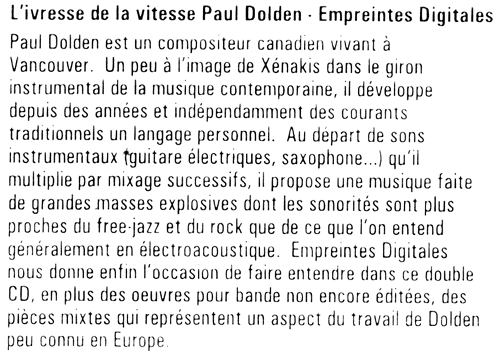
Each of the nine works by Vancouver’s
Critique
Chacune des neuf pieces électroacoustiques de ce disque du compositeur vancouverois
Chalmers Award Recipients
Soundcheck Review
Most people use the recording medium for purely documentary purposes
Spiritually,
This double CD (selling for the price of a single) also contains a number of works for instrumentalist and tape.
Review
Review
The title of
Hors des sentiers battus
Ce qui ressort vraiment de ce coffret sont les deux pièces centrées sur le thème de Jéricho. Avec un tel sujet, on imagine bien à quoi s’attendre et on est servi. Mais Dieu que c’est puissant
Vous pourrez aussi découvrir, sur la même étiquette des œuvres de
Review
Okay, so your X’mas victims have wrapped their heads around musique actuelle but you’re worried because now they want to get into electroacoustics. Fear not, for Vancouverite
The Electronic Universe, Daring Music: empreintes DIGITALes
Un discorso un pò diverso può essere fatto per il CD di
Che altro aggiungere
Critique
Enfin, pourrait-on dire, un musicien imaginatif et bien formé qui sait utiliser le matériau sonore à des fins artistiques et possédant une véritable personnalité de créateur, de l’originalité, du souffle, de l’intelligence. Rares sont les véritables compositeurs qui œuvrent avec ce médium difficile qu’est l’électroccoustique.
Critique
More texts
-
Andrew Lewis, Contact
! , no. 10:1, September 1, 1996 - Steven & Alan Freeman, Audion, no. 33, September 1, 1995
Blog
-
Monday, August 3, 2020 / Press
…
Beyond the Walls of Jericho […] is among the most monumental works of electronic music you’ll ever experience. More -
Saturday, October 1, 2005 / Press
- Wednesday, June 1, 2005 / Press
… a prolific label for electroacoustic music as well as provocative experiments in conceptual sound. More