electrocd

More from the blog

23 results
  • 1
  • 2
  • 3
  • 4
  • Clair de terre in wReck thiS MeSS

    “Review”, Bart Plantenga, wReck thiS MeSS, December 9, 2001
    Sunday, December 9, 2001 Press

    Clair de terre on empreintes DIGITALes is yet another disc in the continuing saga of ED, which is a label devoted to electroacoustic composition of the [generally] most provocative kind. The label’s artists seem devoted to pushing the envelope of what sound can do. There are always dramatic turbulences and breathtaking shifts in timbre, sudden shifts between aural clutter and provocative stillness, complete with organic sounds electronically manipulated and a determined effort to make sense out of the surrounding din. Normandeau is currently pursuing the horizons of acousmatic music: “his compositions employ aesthetic criteria whereby he creates a ‘cinema for the ear’ in which ‘meaning’ as well as ‘sound’ become elements which elaborate his works.”

    … dramatic turbulences and breathtaking shifts in timbre, sudden shifts between aural clutter and provocative stillness…

    Clair de terre in Blow Up

    “Altrisuoni in breve”, Daniela Cascella, Blow Up, no. 43, December 1, 2001
    Saturday, December 1, 2001 Press

    accademico facendo attenzione alle suggestioni di contesti ad esso estranei. Malina fa dello shakuhachi lo strumento attomo a cui ruota una suggestiva composizione di silenzi e dolci frasi melodiche. Erinyes è un lavoro sulle voce ispirato a “Elettra” di Sofocle. Nella mitologia greca le Erinni punivano i delitti tormentando i colpevoli con un rumore assordante: il brano crea una dimensione claustrofobica congelando e reiterando singoli frammenti vocali ordinati su diversi toni e altezze. Clair de terre presenta tredici movimenti nei quali si succede una varietà ben amalgamata di soluzioni sonore con inaspettati e graditi risvolti ritmici e noise. (7/10)

    7

    Clair de terre in Jade

    “Chronique”, Julien Jaffré, Jade, December 1, 2001
    Saturday, December 1, 2001 Press

    On a souvent perçu en certains astrophysiciens des poètes qui s’ignoraient. Robert Normandeau crée ici des structures cinématiques fortes, acousmatiques par essence dont la puissance narrative matérialise des images fortes dans notre esprit.

    C’est aussi le travail de recomposition d’un fait (les pas d’Homme sur la lune) partiel, une interprétation possible reconstruite par déduction, à la manière des historiens ou des astrophysiciens (notamment ce jeune Français qui cherchait à signifier par calcul les émissions sonores d’un trou noir.) Une démarche où le tâtonnement et la remise en question sont indissociables. Du cinéma pour l’oreille cher à Jérôme Noetinger, de l’acousmatie proche de ce qu’en entend François Bayle, pour un travail sérieux et amusé qui tient davantage de l’archivage sonore (la musique de Normandeau évoquant tantôt des musiques rituelles indiennes, tantôt des ambiances sombres à la Hermann) que d’un album classique, au bon sens du terme. Un assemblage sonore limpide qui oscille avec vivacité entre séquences stridentes et plages d’accalmie qui nous plongent avec plus ou moins de facilité dans un état second. Robert Normandeau a reçu de nombreux prix.

    Un assemblage sonore limpide qui oscille avec vivacité entre séquences stridentes et plages d’accalmie…

    Clair de terre in Ampersand Etcetera

    “Review”, Jeremy Keens, Ampersand Etcetera, no. 2001_20, December 1, 2001
    Saturday, December 1, 2001 Press

    Normandeau’s album is less punctuated, somewhat academic in origin, and yet more lyrical: the first two tracks use mono-sources (voice, flute) while the third is an “exercise”. The opening Malina is based solely on shakuhachi as played by Claire Marchand, and presents the sound largely uncompromised — some stretched to drones, some editing — but presented in is captivating simplicity.

    With Erinyes Normandeau uses the voice as his instrument: taking recitation from a production of Sophocles’ Electra for which he composed the music, he uses a treatment known as “freezing” to extract voice sounds. He has then orchestrated and structured them into a dramatic piece. Shifting between tonal stretched voices and short looped fragments, chants and ululations, rapid, slow and fragmentary passages, he has created a percussive musical piece that draws you in and holds you — changing pace and tone subtly, without unnecessary underlining, ending with an extended strangled cry. It reminded me somewhat of parts of Roger Doyle’s Babel.

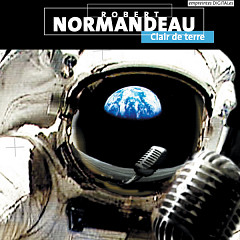
    Clair de terre combines electroacoustic and cinema — each of its 12 parts represents a cinematographic technique (“Narrow frame” “Rhythmic editing”) and relates it to a musical technique. After a spacey Overture (Ouverture) — the piece was stimulated by the famous photo of the earth from space — with a launch, swirling tones and beats, computer squiggles and blips; each part is structured as a “soundspace, an object’s sound, the sound of a musical instrument, and vocal onomatopoeias“ (Erinyes is part of the onomatopoeia series). The parts are not presented sequentially, however, but combined in short and subtle pieces, for example, the shakuhachi plays its tones over chattering base in Primary and secondary colours (Couleurs primaires et secondaires), a train runs through Camera mobility (Mobilité des plans), a squeaking door, electric guitar chords and so on, concluding with Wide frame (open space) (Cadre large (espace ouvert)) where pipes lead a melody before some percussive punctuating finales. Each of these movements is a marvellous miniature of about 3 minutes duration, based on excellent choice of sound sources, that combine to create a dense and complex work. At times the links are obvious (the cutting in Rhythmic editing (Montage rythmique), the sound palette in Primary colours (Couleurs ternaires), Dazzling’s (Clarté (éblouissement)) fireworks) others take more consideration — but it develops into something well beyond an academic exercise. A fascinating conclusion to a very approachable album.

    Each of these movements is a marvellous miniature […] that combine to create a dense and complex work.

    Clair de terre in Virgin Megaweb Megactu

    “Nouveautés”, Virgin Megaweb Megactu, December 1, 2001
    Saturday, December 1, 2001 Press

    Musicien québécois travaillant depuis des années autour de l’art contemporain (danse et installations), Robert Normandeau offre, avec ce volume récapitulatif, un panoramique de ses expériences électroacoustiques et électroniques en un superbe travail de mise en espace du son et de ses variations. Aujourd’hui, séduit par les sirènes techno, on le retrouve aussi sur label Rephlex d’Aphex Twin pour des compositions plus punchy. À suivre…

    … un superbe travail de mise en espace du son…

    Clair de terre in Metamorphic Journeyman

    “Review”, Metamorphic Journeyman, November 21, 2001
    Wednesday, November 21, 2001 Press

    Having produced several instrumental and mixed works, his current endeavors are focused on acousmatic music. More specifically, his compositions employ æsthetic criteria whereby he creates a “cinema for the ear” in which ‘meaning’ as well as ‘sound’ become elements which elaborate his works. Along with concert music he now writes incidental music, especially for the theater. His works are performed and broadcast around the world and have received prizes and mentions in numerous competitions. “Earthlight. One of the strongest images of the achievements we witnessed during the 20th century. These pictures of the earth taken from space will forever stay in our minds.” Normandeau’s Clair de terre is build up with a cinematic structure as the titles of each movement reveals. The two other titles introduces us to Normandeau’s world when he composes for the stage (theater). They are made up of sonic elements he used for music composed for the stage. This is Robert Normandeau’s fourth release on empreintes DIGITALes.
  • 1
  • 2
  • 3
  • 4