electrocd

More from the blog

23 results
  • 1
  • 2
  • 3
  • 4
  • Clair de terre in Sonoloco Record Reviews

    “Review”, Ingvar Loco Nordin, Sonoloco Record Reviews, November 1, 2001
    Thursday, November 1, 2001 Press

    It’s with a certain nervous apprehension and an expectant joy that I listen to very new music, and any piece of art stamped 2001 has got to be considered within that framework. It’s NOW! music; telling tales about the present and the recent. Even if the subject matter should happen to be antique stuff, the way it is expressed is now, simply by its placement on that timeline. I’m very curious about things like these; new expressions of art; art providing one of the finest and most refined essences of human life, reflections on human life.

    Robert Normandeau’s name is mentioned with respect by connoisseurs of electroacoustic music. He is a founding member of the CEC (Canadian Electroacoustic Community), and he has a number of very good CDs to his credit, for which he has been amply praised and awarded.

    Malina (2000) (for Brigitte Haentjens) is the first track on this factory-fresh CD from empreintes DIGITALes. The piece is developed on the contents of a play, which in turn is based on the 1971 novel Malina by Ingeborg Bachmann (1926–1973) – an example of how the arts may spill over into each other’s domains in a fruitful way. The stage adaptation of the text is a poetic reading of it, which, says Normandeau, “makes use of the unsaid, silence, and atmosphere in a way that allows the music a place that it seldom enjoys in theatre.” Indeed the soaring beginning is a lone but husky shakuhachi, which immediately moves into a layer behind a sonic film of moist weather and soft caresses of oriental erotism, wherein blowing mouth-sounds whisk the rushing air around the corners of wet words, unspoken and silent, just hinted at by the bulging oral cavities which form soundless atmospheres of unheard echoes and immobile gestures towards the heart and the stars. The sometime choo-choo train sounds call up visions of Vietnamese rice fields, through which an elevated embankment with a rail runs, while on high the falcons circle, certain to spot their pray, remaining in these Normandeauisms in patient spirals of restful movements, eyes gleaming with the intense gaze of birds of prey. The squeaks of un-oiled carriages, dragged along mud roads by small people in large hats, rise out of Malina, and even if these associations were in no way intended by the composer, he has no power over them when the music has left his workshop. The associations stirred by his electroacoustics inside somebody else’s brain, way across the Atlantic Ocean, in a Scandinavian rural outpost, whirl as they will, and all I can do is jot down these notes of the fleeting images passing on the inside of my eyelids…

    Erinyes (2001) (for Anne-Marie Cadieux) is centered around the voice, springing out of the voice, a voice carrying no morphemes of meaning, solely offering onomatopoetic mimicries, shadowy movements of subconscious intentions, disappearing in the mist of amnesia and the defensive act of mental repression. The vocal sounds used herein were taken from a production of Sophocles’ Electra set up by Brigitte Haentjens in Montréal in April of 2000, for which Robert Normandeau provided the music. The Erinyes were “the keepers of the shadows” in Greek mythology, and their chief purpose was to punish evildoers, but they put a scare on anyone… Normandeau puts the voices through a number of treatments, but he likes to focus our attention on the method of “freezing”, i.e. stopping the sound and investigating it inside out. I don’t suppose there is much need of scientific explanations into this. The main thing is the result, the experience — the creative flow – and it’s at play here! As a demonstration of the fast flight of the frightening creatures of the ancient Greeks, this way of casting the shadows of sounds down a vocal fast-track is ideal, filling your listening night with eerie notions and creepy feelings of guilt and remorse; too late, too late… Violet clouds are gathering, and darkness falls from on high… “Mama, put my guns in the ground; I can’t shoot them anymore…” – and could I clear my conscience of guilt I’d be a saint or a god, but being but a human under these cold stars, they could be coming for me; the Erinyes…

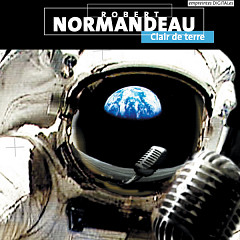
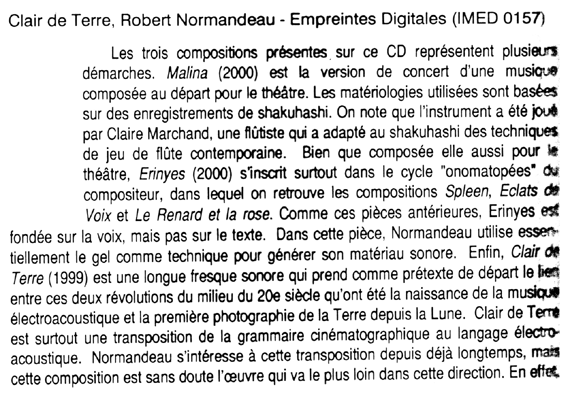
    In Clair de terre (1999) Robert Normandeau makes use of his collection of sounds, gathered during the passage of ten Earth years. In his introduction Normandeau lingers on the peculiarity of humans to historically always place themselves or the world in which they live at ground zero, at the center of the universe. This has been the case, as when the humans believed that Earth was the center, around which the rest of Creation was revolving. Later they thought that their local star was the center. One peculiarity which remains till this day (which Normandeau doesn’t mention) is that the humans of today – especially Western Man – honestly believe that this life is the one and only life, but of course it will in time be obvious even to westerners that we’re passing through a chain of lives, which no one really can estimate the length of – and life in itself does not end; it’s our perception of Time; of beginning, of end, which is wrongly perceived. Normandeau points our attention towards the more practical and widespread cosmic awareness – on the materialistic level –, which began with the first photographs of Earth taken from space, clearly – in a very brute way – placing our home among the stars. Subsequently the camera and its artistic or scientific terms determine this piece. Clair de terre – after an overture – is divided into twelve section, which all “systematically explore the grammar of cinematography”, transposed into the language of electroacoustics. The titles are Cadre étroit (espaces clos) (“Narrow Frame [Close Space]”) – Couleurs primaires et secondaires (“Primary and Secondary Colors”) – Mobilité des plans (“Camera Mobility”) – Montage rythmique (“Rhythmic Editing”) – Montage métaphorique (“Metaphoric Editing”) – Durée des plans (“Duration of Shots”) – Clarté (éblouissement) (“Brightness [Dazzling]”) – Taille des plans (“Proportion of Shots”) – Couleurs ternaires (“Ternary Colors”) – Micro montage: Obscurité” (“Micro Editing: Darkness”) – Cadre large (espace ouvert) (“Wide Frame [Open Space]”). Each of the twelve moments of Clair de terre is “composed of a soundscape, an object’s sound, the sound of a musical instrument and vocal onomatopoeias.” The “Overture” introduces a blipping sound, as from a scientific instrument or probably some monitoring instrument at Kennedy Space Center, because you hear the nervous conversation of people intensely involved in something in the background. The basic rhythm of the blips keep on resounding, but in the bass, in deep, rhythmic waves pounding the shore of the mind, the beaches of human understanding – as sweeping, soaring trebles bore away into deep space, extending our conception of the Universe and ourselves… Other sections of the work are quite different, though, with crunchy micro sounds nibbling at our sleeves, falling like bread crumbs around our kitchen tables, blowing up like sharp dust in our faces, half blinding us as we head for fresh water… In yet other sections deep drones rumble through our conceptions of Time and Space, in a post-romantic delusion of Wagnerian tragedies and large-scale intrigues, involving all the Nordic deities of old. One soundscape has the Doppler effect of a passing train move by in – perhaps – a Pierre Schaeffer homage. There really is no end to the ingenuity of Normandeau at setting these collected sounds of his at work in elaborated, colorful images of imagination. His sonic palette has many colors, many timbres, many surprising – and beautiful – evolutions.

    … deep, rhythmic waves pounding the shore of the mind, the beaches of human understanding — as sweeping, soaring trebles bore away into deep space, extending our conception of the Universe and ourselves…

    Clair de terre in The WholeNote

    “Review”, Paul Steenhuisen, The WholeNote, no. 7:3, November 1, 2001
    Thursday, November 1, 2001 Press

    In the late eighties and early nineties acousmatic art in Montréal captured international attention. Among the forerunners was a young Robert Normandeau whose music possessed a soulful enterprising intensity.

    As a short-lived golden age began to fade after 1992 and the practice fell into some question, I was starting to feel very uneasy about the music outputted by Normandeau. Technical strides and artistic exploration were being made, the music was even developing a pop sensibility (which I admired), but somehow the youthful grit was beginning to fade. However, with his new CD release Clair de terre my fears for the worst have been quelled. He has recaptured that earlier intensity and most of all without turning back on the discoveries of the intervening years.

    The pop sensibility is certainly still there. In fact, it smacks you in the face when you hear the opening blasts of a shakuhachi in Malina. In the minutes that follow Normandeau shows his range as a composer by weaving through an oceanic tapestry of moods and sentiments that journey far beyond contemporary or traditional conceptions of shakuhachi music with a subtlety and depth that confirms his maturity and artistry. The other works continue on a similar theme of playful interplay between recognition and departure. The powers of acousmatic art to push beyond common associations could never be more evident as they are with the music of Normandeau at his finest.

    Normandeau shows his range as a composer by weaving through an oceanic tapestry of moods and sentiments…

    Clair de terre in AllMusic

    “Review”, François Couture, AllMusic, September 1, 2001
    Saturday, September 1, 2001 Press

    Clair de terre (Earthlight), Robert Normandeau’s fourth CD, adds three works to his available catalog. All were created between 1999-2001, thus this album picks up where Figures (1999) left. Malina could be seen as an acousmatic study of the shakuhachi, a Japanese bamboo flute. One would expect a particularly ethereal piece, but Normandeau manages to find strange twists and turns to the soothing sound of the instrument. Erinyes continues to explore the deconstruction of speech into onomatopoeia. This time, the composer used the recording of a production of Sophocles’ Electra for sound material. The piece does not reach the same heights as the prize-winning Le renard et la rose, the previous installment in the series. The highlight of this disc is the 36 minute suite Clair de Terre. Through 13 short movements, Normandeau revisits some of his favorite sounds and techniques, devising an ersatz of his own work while framing the whole thing with a space-age theme. He clearly enjoyed the process — so does the listener, won over by the buoyancy and playfulness of the work. From freeze techniques to more basic sound collage and even an ephemeral reconstructed beat, Clair de Terre is fundamentally entertaining, a rare comment for electroacoustic music. The relation of some of the parts with the whole are not always as strong (or obvious) as they should, but one sympathetically looks over the details.

    Clair de terre is fundamentally entertaining, a rare comment for electroacoustic music.

    Clair de terre in The Irish Times

    “Review: Sonorities Festival of Contemporary Music”, Martin Adams, The Irish Times, May 8, 2001
    Tuesday, May 8, 2001 Press

    The four days of the Sonorities Festival of Contemporary Music offered a hectic round of musical and other events. There were nine concerts between Thursday night’s (which was reviewed in this newspaper on Saturday) and the final concert on Sunday afternoon, plus a steady round of research presentations, discussion groups and lectures. The last included an appetising overview by Síle O’Modhrain of the Massachusetts Institute of Technology’s plans for its Dublin-based offshoot, MediaLab Europe.

    One major loss was the cancellation of Sunday night’s concert by the Lotus String Quartet (and their subsequent one in Dún Laoghaire) because of the illness of a player. They were to give the première of Kevin O’Connell’s String Quartet, plus important 20th-century works.

    So the weekend was dominated by electroacoustic music, largely because the festival was hosting the annual conference of Sonic Arts Network, a British-based concert, education and information resource with a worldwide membership, plus affiliated institutions. SAN’s mission to develop the relationship between technology and music was reflected in an impressive array of electronic gadgetry and inventiveness at each of its concerts.

    Technology’s temptations are not easily resisted; nor is its diversity easily controlled. Sound creation and reproduction have developed enormously. Axioms of what art should be have lost their power. This is a world of true and idealistic anarchy, where each work seeks to define its own terms.

    The most emphatic affirmations of that kind tended to have a message. For example, Richard Whitelaw’s Urban Odysseys 2 uses the voices of homeless young people in collage with natural and artificial sound; Nikos Stavropoulos’s New Order applies similar techniques to speak of globalisation and Americanisation. Their emphasis excludes interpretation. Other collages of everyday sound, such as Robert Mackay’s Postcards of the Summer and John Levack Drever’s Phonographies of Glasgow, leave things more open.

    Some of the electroacoustic works were more obviously musical, albeit with metaphorical undertones. Iain McCurdy’s Collapse “focuses upon the gestural characteristics of various materials under stress and strain”, and Peter Manning’s In Memoriam CPR evokes the Canadian Pacific Railway, yet neatly side-steps depiction. They typified Alistair MacDonald’s observation in the programme note for his own The Tincture of Physical Things, that “much electroacoustic music tries to perform a sort of alchemy… to change the nature of “ordinary” materials.’

    Apart from a concert of jazz improvisations, only six of the 33 works played from Friday to Sunday used “ordinary” instruments. Examples were Michael Clarke’s Prism, which filters trumpet notes through a battery of spatially separated microphones and loudspeakers, and Rodrigo Sigal’s Tolerance II for tape and cello, an absorbing exploration of contrasting yet coexisting sonorities. But the highlight among these pieces was Phases by the Argentine Horacio Vaggione (b. 1943). Its language was a blast from 30 years past; but its tension between pre-recorded sound and the natural sonorities of piano and clarinet — wellplayed by Philip Mead and Linda Merrick — had a concerto-like focus which rendered irrelevant any concerns on that account.

    For electroacoustic music, the search for order within an infinite range of possibilities seems inescapable. Some composers succumbed to technology’s temptations, and the gestural language was sometimes too reminiscent of composers as far back as Varèse. But it seems significant that most pieces lasted between nine and 15 minutes, and that so many differing works should have large-scale patterns in common: closure initiated by a late recall of the opening, ABA structures with variation or compression in the last section, recurrence of distinctive events, etc.

    Nothing suggested a resolution of these issues more than the music of the conference’s guest composer, Robert Normandeau. Born in Québec City in 1955, Normandeau seeks to define syntax and meaning, often by borrowing concepts from cinema — colour, framing, closeup, and so on. He commands the medium through total craftsmanship, an acute and critical ear, material precisely fitted to its purpose and a control of time and unfolding ideas which is almost symphonic. Erinyes, commissioned by the Sonorities Festival, left the impression of complete integrity and of things to be discovered on repeated hearing. Clair de terre was more demanding. One of the most telling points about its enormous variety was that the 35 minutes it lasted felt more like 20.

    … total craftsmanship, an acute and critical ear, material precisely fitted to its purpose and a control of time and unfolding ideas which is almost symphonic.
  • 1
  • 2
  • 3
  • 4