electrocd

Blog

64 results
  • 1
  • 2
  • 3
  • 4
  • 5
  • 6
  • 7
  • 8
  • 9
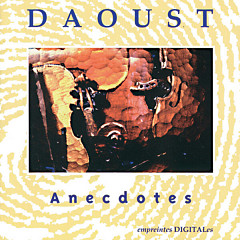
  • Anecdotes in Le Devoir

    Anecdotes de Yves Daoust”, Carol Bergeron, Le Devoir, September 9, 1991
    Monday, September 9, 1991 Press

    LE PROFESSEUR et compositeur de musique électroacoustique Yves Daoust lance aujourd’hui un disque compact sous étiquette empreintes DIGITALes et intitulé Anecdotes et qui rassemble des œuvres reflétant le travail de ses 12 dernières années. Cet événement a lieu à 17h à l’Espace libre de la rue Fullum et sera suivi d’un mini-concert où l’on pourra entendre des extraits du disque et rencontrer l’auteur et les interprètes, soit le pianiste Jacques Drouin et la flûtiste Lise Daoust.

    … des œuvres reflétant le travail de ses 12 dernières années.

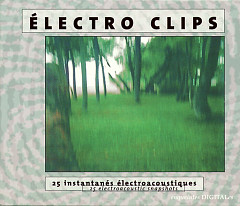
    Électro clips in Computer Music Journal

    “Review”, Kevin Austin, Computer Music Journal, no. 15:3, September 1, 1991
    Sunday, September 1, 1991 Press

    Few releases are so integrated in medium and message. Most CDs continue the tradition of simply being a medium for the storage and transport of sonic artifacts, sound recording being the twentieth-century equivalent of the Guidonian hand. Like the unjustly neglected Nonesuch recording commissions from the mid-1960s most of the works included on the Électro clips release were created explicitly for the recording medium.

    Électro clips is the fourth CD from the Montréal-based label empreintes DIGITALes. It consists of 25 commissioned 3-minute works by 24 North American composers. The release, timed to coincide wich New Music America held in Montrcal in November 1990, carries on a centuries-old tradition of asking composers to write within predefined constraints for a specific occasion or event.

    Coproducers Jean-François Denis and Claude Schryer desired to merge the 3-minute popular song form with the concept of the vidco clip. The invited composers embraced this task to varying degrees. I find the most interesting works on the CD to be those written with that goal as the original inspirational seed, rather than those that are reworks of longer, preexisting compositions.

    Like most labels specializing in electroacoustic music, empreintes DIGITALes continues to lace the daunting challenge of distribution, the costs, and its vagaries. To reach as wide an audience as possible, the recording is accompanied by a 58-page booklet that is trilingually French, English, and Spanish. It includes biographies of the composers, program notes, and a series of 25 photographs commissioned from the Quebec City photographer Joanne Tremblay.

    Thirteen of the composers represented were born in the 1950s, and five of them in the 1960s. Eleven live in Montréal, four in Toronto, four in Vancouver. Four are from the United States, and one is from Mexico. The compositional and electroacoustic orientations are the polyglot that is rather characteristic of the Canadian Electroacoustic Community. This is part of this collection’s charm and strength, and a great part of its beauty.

    As an educational tool, this CD could be a major resource. The 3-minute constraint provides a balancing framework for the study of compositional styles and schools and the works provide excellent examples for analysis.

    Using the analytic hierarchy from linguistics — morpheme, vocabulary element, syntax, and semantic — these compositions can be parsed and described at each level. The following should clarify how I am applying these terms to music. By “sonic morpheme,” I mean the lowest level and smallest sonic unit; an indivisible instance of sound, that which constitutes a particular timbre’s integrity. “Vocabulary” is the set of sound sources that populate a given composition; the “orchestra.” This set may consist of one source or multiple sources (uni- or multi-family), and may include members that combine attributes of more than one source (cross-families). The term “syntax” can be applied to various units of music composition, just as it is when applied to natural language. Note-to-note transitions, phrase, section, and whole-composition structures all have a syntactic element. So, there is micro-syntax and macro-syntax. Both concern the application of transformations, transitions, constraints and procedures. Electroacoustic music often uses syntactic plans such as collage, layering and continuous transformation. “Semantics” (or what the composition “means”) may simply be the result of all the previous levels of organization. This might be the case in pure music. The semantic level is perhaps more distinct in program or other music that is based on metaphor, direct source quotation of text-sound or life-sound, or other extra-musical (personal, emotional, social, or political) statements. Each of the pieces presented exists on all of these levels, with some of them resting more solidly and completely on some subset of levels.

    John Oswald’s Bell Speeds, a sampled bell played at numerous octaves, resides heavily in the area of vocabulary (simple, uni-family, predictable within the sampled-instrumental model). Syntactically and macro-structurally this work is uncomplicated, producing a memorable sonic identity with a relatively low semantic complexity John would probably point out that this structuralist approach completely fails to hear the piece (see Konybski, above). Tamed structuralism appears in the self-replicating algonthmic composition What If by Daniel Scheidt, and the tonally fractal piece by Bruno Degazio entitled Humoresque 901534.

    Political statements form the basis of several of the compositions, making them semantically deep. Examples include Charles Amirkhanian’s Bajanoom (“Separation”) and John Oliver’s Marimba Dismembered. The latter contrasts and compares the violent confrontation of the Guatemalan Mayans over land claims, to the native resentment with Quebec’s nonresponse to the Canadian constitutional accord (Meech Lake). Social injustice is the fœtus in Yves Daoust’s Mi bémol and Christian Calon’s Temps incertains.

    There are numerous, multilevel continua for sonic, æsthetic, and pedagogical exploration, including the problem of sonic identity, both internally within each work and across all 25 of the compositions. The obviousness of sound processing is one of the criticisms frequently hurled at electroacoustic music. Histoncally the indiscriminate slathering of sounds with reverberation has been one of this genre’s weaknesses. Several of the works on this CD have stimulated lively discussion as to whether the processing is integral or mearly decorative. This leads back to the question of sonic identity and the special case of quotation.

    Quotation, in its broadest sense, is present in just about all of the pieces on this collection, from the sonic “objet réalité” tradition of musique concrète in Yves Daoust’s Mi bémol. to the quotation of traditional instrumental sources found in Craig Harris’s wonderful piano in Somewhere between.

    Quotation may be clear or hidden, sonically and metaphorically. Francis Dhomont’s masterful epithet Qui est-là? retrospectively examines his own work and the works of those who influenced him. It ends with an original quotation about the unknowability of the self by others, and of others by the self.

    The use of text in more than half of the pieces is clearly a type of quotation. In both Amnon Wolman’s Man-Bridge and Robert Normandeau’s sampled child’s voice in Bédé. text is used to convey information at all levels of organization, from the sonic morpheme to the complete semantic statement. In some cases, speech rhythms are preserved and the utterance is completely stripped away. Several compositions make an indirect reference to such rhythms, not in an obvious fashion, but rather as a profound underpinning for their macro — and micro — structure. Such is the case in Jean-François Denis’s Point-virgule, Martin Gotfrit’s The Machine’s Four Humours, John Oliver’s Marimba Dismembered and, in a completely unvoiced work, Simulant by the Toronto composer and sound-poet Richard Truhlar.

    Some of the works on the CD obtain meaning through their reference to other media, easily recognized musical styles, or readily identifiable experiences. A few examples include the comical, horror-film qualities of Roxanne Turcotte’s Minisérie, Javier Álvarez’s Mambo à la Braque with its upbeat, boogie-woogie jazz references, and Breathing Room by Hildegard Westerkamp, with its peaceful life-force evocations.

    At a practical level, an adventurous, independent producer today must explore the potential audience and consider how and where the product will be used. Possible applications for Électro clips run the gamut from personal entertainment, to radio and concert presentations, educational uses, and as material for integration with other media (e.g., dance, film, or theater).

    Possibly the most commercially viable application of this material is in radio, where there are plenty of 3-minute slots calling for interesting diversity. Within an academic environment, Électro clips will prove itself of great value. Discussions of style and electroacoustic languages can be pointedly illustrated because of the diversity of the materials and the brevity of the works.

    Concert venues with multiple speaker systems (8 to 16 or more not being unusual in Montréal) can reveal a hidden dimension in many of the works. Those pieces with collaged, environmental realities benefit enormously from the articulation of space. A brief list of the works in this category includes Dan Lander’s I’m looking at my hand, Christian Calon’s Temps incertains, Claude Schryer’s Les oiseaux de Bullion, and the Calon/Schryer collaboration Prochaine station. Works such as these really depend on the spacial parameter, not only with respect to acoustics, but also in terms of their extramusical content. Multiple speaker facilities can make the difference between an intimate and an aloof performance.

    Few releases are so integrated in medium and message.

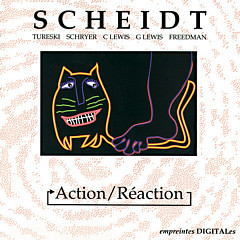
    Action / Réaction in Option

    “Review”, Scott Lewis, Option, no. 39, July 1, 1991
    Monday, July 1, 1991 Press

    Scheidt is a composer who has created software that responds to the input of acoustic instruments. On this album the instruments are percussion, clarinet, trombone, and voice. Obeying the Laws of Physics Trevor Tureski’s percussion into shimmering webs of metallic sound. Scheidt uses four timbres, some of which sound like chimes or synthesizer rather than drums, almost making Tureski the composer and Scheidt the musician — Tureski is deciding the rhythms and Scheidt the nuances of the sound. At first some of the pieces bothered me; I focused on the computer modifications, seeing them as sometimes annoying add-ons. After a couple listens the acoustic origin and the electronic mutations seemed more integrated, sometimes creating evocative landscapes, sometimes electroacoustic duets, as in Norm ’n George, which uses the ever-fine tromboning of George Lewis. Still, the most effective moments are those where the sound of the original instrument is audible but modified, rather than those where all one hears are the generic computer-generated sounds that creep in from time to time.

    empreintes DIGITALes in Computer Music Journal

    Electro Traces Canadian Tour”, James Harley, Computer Music Journal, no. 15:2, June 1, 1991
    Saturday, June 1, 1991 Press

    Electro Traces took place from 22 February through 9 March, 1991, and was the first pan-Canadian concert tour of electroacoustic music. The tour was realized by the Montréal-based group DIFFUSION i MéDIA, who also produce the empreintes DIGITALes series of CDs, several of which have already been reviewed in the journal. The Electro Traces tour featured the work of several Canadian composers and performers, including works by Christian Calon, Robert Normandeau, Alain Thibault, Claude Schryer, Jean-François Denis, and Daniel Scheidt. Seven concerts were held in cities from Vancouver in the west to Quebec City in the east. A custom “sonic diffusion” system was designed for the tour for real-time spatialization of the performances using the “acousmatic” techniques pioneered by the GRM in Paris.

    … the first pan-Canadian concert tour of electroacoustic music.

    Jean-François Denis, empreintes DIGITALes in SOCAN — Canadian Composer

    “On the Edge”, Sylvain-Claude Filion, SOCAN — Canadian Composer, June 1, 1991
    Saturday, June 1, 1991 Press

    In January 1990, Montréal composer and ex-Concordia University professor Jean-François Denis fulfilled a long dormant dream of creating a label devoted exclusively to electroacoustic music. Now 18 months later, empreintes DIGITALes (for “digital imprints” or “impressions”) has released six compact discs.

    Denis and his partner Claude Schryer started North America’s first independent electroacoustic label to fill a perceived need: “We saw all these Canadian electroacoustic masterpieces that nobody could hear unless they were in the right town on the night of a concert,” Denis recalls. The company operates with substantial assistance from the Canada Council for the Arts: “Without them, we could hardly get involved in record production at all.”

    The first six titles are Ligne de vie: récits électriques, devoted to works by Christian Calon; Lieux inouïs, featuring five works by Robert Normandeau; Volt, a group of eight works for MIDI piano, soprano, saxophone quartet and tape by Alain Thibault;

    Électro clips, a collection of 25 electroacoustic “snapshots” by composers from various countries; Action/Réaction, featuring five interactive works by Vancouver’s Daniel Scheidt; and the newly released Anecdotes, a group of compositions by Yves Daoust.

    empreintes DIGITALes releases are distributed by Scandinavian Record Import (SRI) of Peterborough, Ont., and through the Canadian Music Centre, as well as in France, the Benelux countries, Japan, the UK and the US. “Our manufacturer has just delivered the second pressing of our first discs; of which 1,000 copies had been made initially,” says Denis. “And Électro clips, released last November, sold out in six months.”

    How would Denis classify electroacoustic music? “It’s hard to place it in a specific category. It’s music that puts the emphasis on timbre before anything else. Yet it’s not laboratory music: the final product is sophisticated.”

    Denis is full of plans. He is currently working on a series of records of longer pieces to be sold as cheaply as possible. But he remains realistic: “Of course, the second pressing of our original recordings indicates a degree of profitability and could help me financially. But let’s face it, what we’re selling remains very much a fringe product.”

    … North America’s first independent electroacoustic label…

    Jean-François Denis, empreintes DIGITALes in SOCAN — Le Compositeur Canadien

    “empreintes DIGITALes”, Sylvain-Claude Filion, SOCAN — Le Compositeur Canadien, no. 2:3, June 1, 1991
    Saturday, June 1, 1991 Press

    Originaire de Montréal, d’esprit vif et dynamique, Jean-François Denis dorlote un bébé qui grandit très vite: l’étiquette empreintes DIGITALes, consacrée à la musique électroacoustique et lancée en janvier 1990.

    Pour cet ex-enseignant de l’Université Concordia qui a été parfaire ses connaissances au Mills College de Californie, la naissance d’empreintes DIGITALes n’est pas le fruit du hasard. «L’intention était vieille, explique Denis, c’est un projet que j’avais depuis quelques années. Il a commencé à se concrétiser en août 1989 lors de l’obtention de nos premières bourses.»

    Appuyé par le musicien Claude Schryer, Denis a créé l’étiquette pour combler un besoin. «II y avait des chefs-d’œuvre au Canada en musique électroacoustique et il n’y avait absolument aucun moyen de les entendre, sauf si le hasard nous plaçait dans la bonne ville un soir où se déroulait un concert.»

    En créant leur propre étiquette, Denis et Schryer mettaient sur pied la première compagnie de disques indépendante de musique électroacoustique en Amérique du Nord. «Naturellement, on vit de subventions, s’il n’y en avait pas, on pourrait difficilement se lancer dans la production de disques», de préciser Denis. C’est pourquoi les six premiers albums mis sur le marché, grâce au Conseil des Arts du Canada, ne regroupent pratiquement que des artistes canadiens. «II y avait du rattrapage à faire, bien sûr, mais nous voulions aussi monter un catalogue assez rapidement, afin de mieux convaincre les distributeurs et les détaillants.» Les six albums sont: Ligne de vie: récits électriques, consacré à l’œuvre de Christian Calon; Lieux inouïs, qui regroupe cinq œuvres de Robert Normandeau; Volt d’Alain Thibault, qui réunit huit pièces pour piano MIDI, soprano, quatuor de saxophones et bande; Électro clips, un disque collectif qui comprend 25 pièces de compositeurs de divers pays durant chacune trois minutes; Action/Réaction, qui regroupe des œuvres interactives de Daniel Scheidt, de Vancouver, et Anecdotes, qui illustre les œuvres du compositeur Yves Daoust s’étalant sur plus de dix ans.

    C’est la compagnie Scandinavian Record Import (SRI), basée à Peterborough (ON) et le Centre de musique canadienne qui distribuent les disques d’empreintes DIGITALes. Grâce à des contacts personnels, les disques sont aussi distribués en France, en Belgique, au Luxembourg, dans les Pays-Bas, au Japon, dans le Royaume-Uni et aux États-Unis. «Nous sentons un succès certain, affirme Denis, le fabriquant vient de nous livrer le second tirage de nos premiers disques, qui avaient été pressés à 1000 copies chacun. Électro clips, paru en novembre, était épuisé six mois à peine après sa sortie.»

    Difficile de confiner la musique électroacoustique dans une case précise. «Pour moi, d’expliquer Denis, l’électroacoustique est une musique qui s’intéresse au timbre sonore avant tout. Une musique qui va au-delà de la matière sonore, en scrutant l’intérieur pour articuler ces timbres sonores. Mais ce n’est pas de la musique de laboratoire, le produit est décanté.»

    Non seulement l’électroacoustique semble vouloir être de plus en plus accessible, mais elle décroche même des succès à la radio! Électro clips a été le #1 sur le «Top 40» de la station communautaire CITR de Vancouver. Radio-Canada fournit aussi un appui solide quant à la radiodiffusion.

    Pour Jean-François Denis, le futur est chargé de projets. On élabore déjà une série de huit ou neuf disques qui ne comprendront que quelques pièces et qui seront diffusés à très bas prix. «C’est vrai que la réimpression de nos disques laisse entrevoir une rentabilité, et pourra renforcer notre autonomie, mais il ne faut pas se leurrer: on reste un produit hautement marginal.»

    … la naissance d’empreintes DIGITALes n’est pas le fruit du hasard.
  • 1
  • 2
  • 3
  • 4
  • 5
  • 6
  • 7
  • 8
  • 9