electrocd

Blog

2899 results
  • 96
  • 97
  • 98
  • 99
  • 100
  • 101
  • 102
  • 103
  • 104
  • Who Has the Biggest Sound? in The WholeNote

    “Review”, David Olds, The WholeNote, September 29, 2014
    Monday, September 29, 2014 Press

    I have not often experienced epiphanies in this life. The first I remember was as a teenager on a family holiday which took us to Washington, D.C. and included a visit to the National Gallery of Art where, wandering off on my own, I turned a corner and found myself face to face with Salvador Dali’s The Sacrament of the Last Supper. That was a profoundly moving moment and all at once I understood what was meant by the term masterpiece. That would have been in the late 1960s. The next came in 1984 while attending the finals of the CBC National Radio Competition for Young Composers. That year the only prize awarded in the electronic music category went to Paul Dolden for The Melting Voice Through Mazes Running. Although this extremely dense and dynamically intense work drove a number of people from the hall with fingers plugging their ears, I was enraptured by its visceral power. It was that work which inspired me to commission radiophonic works for my program Transfigured Night (1984-1991) at CKLN-FM. With the assistance of the Ontario Arts Council and later the Canada Council I was able to commission a dozen composers, beginning with Dolden who produced Caught in an Octagon of Unaccustomed Light which went on to win the Third Prize of the Luigi Russolo International Competition (Varese, Italy 1988).

    Some 30 years later Dolden is still at it, honing his technique which involves recording and layering hundreds of tracks of instrumental and vocal sounds, and more recently including field recordings — cicadas, grasshoppers and crickets in the current instance — to create works of vast sonic complexity. The predominantly acoustic nature of the sound sources — although there is an extended electric guitar solo included here — is integral to his process which, while using technology to stack the layers, does not manipulate the samples electronically thereby leaving the purity of sound intact. In essence Dolden, who plays most of the instruments himself, creates and conducts a vast orchestra which could not exist in the everyday world.

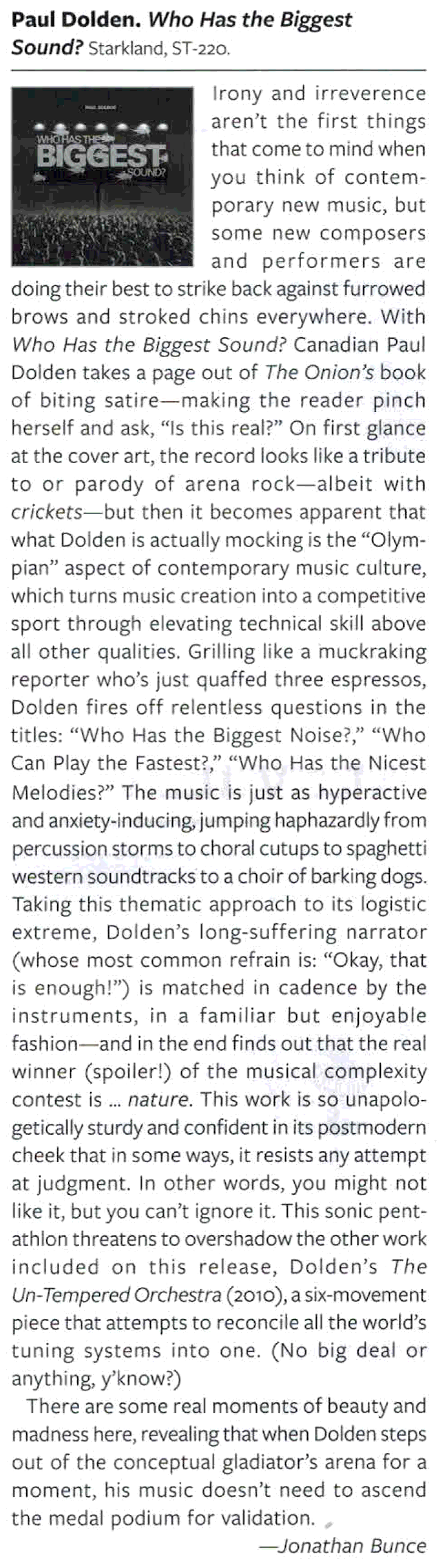
    Paul Dolden’s latest release, Who Has the Biggest Sound? (Starkland ST-220 starkland.com), includes two titles. The somewhat tongue-in-cheek, or at least playfully self-referential, title track which includes a narrator (Dolden) asking questions such as “Who can play the fastest? Who has the dreamiest melodies? Who can talk faster: crickets or man?” was co-commissioned by Réseaux des arts médiatiques (Montreal) and Diapason Gallery (New York). Although the narration seems a little condescending and self-indulgent, the layered textures that constitute the bulk of the composition are incredible to behold, or more accurately, behear.

    The companion piece, The Un-Tempered Orchestra, commissioned by the Sinus Ton Festival (Germany), takes Bach’s exploration of the equal-tempered tuning system in the Well-Tempered Klavier as its point of departure. Whereas Bach demonstrated the viability of the then new symmetrical division of the octave into 12 equal steps, Dolden’s intention is to establish a “non-symmetrical building which uses non-tempered tuning systems, many of which have no octaves […] to create a new musical space within which Western and non-Western musical practices can co-exist […] a big modern multi-cultural family.” He goes on to say “In order to construct this house, first I wrote simple diatonic melodies and chord progressions. Then I recorded Eastern and Western performers reading these lines in their native dialect or tuning system. With the aid of new technologies I edited all these performances to fit under one symmetrical roof. […] Specifically we see our current Western [style] of playing reflected back to us and distorted by ancient musical tuning systems. By combining different musical languages and styles we invert time: what is old becomes new and vice versa. Please enjoy these moments of musical transcendence.” I know I did, but buyer beware. These sounds are big, bold, brash and often abrasive, and listening is not recommended for the timid.

    These sounds are big, bold, brash and often abrasive, and listening is not recommended for the timid.

    Who Has the Biggest Sound? in Vital

    “Review”, Dolf Mulder, Vital, no. 950, September 22, 2014
    Monday, September 22, 2014 Press

    Paul Dolden is a Canadian composer of electroacoustic music. He started at a young age playing guitar, cello and violin. Exploring the possibilities of recording techniques he gradually entered the realms of electroacoustic music. His music is often made from hundreds of digitally recorded instrumental and vocal performances, creating a virtual orchestra. This is his main tool. He became a very respected composer of electroacoustic music, with his composition L’ivresse de la vitesse (Intoxicated by Speed) released by Empreintes Digitales, as a landmark recording. His new work Who has the biggest sound? is his first release since nine years! This is due to the fact that Dolden follows very time-demanding procedures. For the title work “he worked full-time over a 3-year period from November 2005 to December 2008, logging over 6000 hours in the studio”. The second composition, The Un-Tempered Orchestra took about 1800 studio hours. In both works one can identify the original instruments, as Dolden uses long samples. But also processed to an extent that cannot be realized by playing the instrument. There is a similarity with the work of Noah Creshevsky, who also sticks to identifiable acoustical sources for his electroacoustic music. Concerning the structure of the pieces, Dolden’s music remains close to popular music, which is the case for other American composers on Starkland as well. This makes this music accessible and also humour is not far away. Some pieces sound as an speeded up Philip Glass-track. It is at a more detailed level that this multi-layered music moved me. One hears strange combinations of sounds and odd patterns that simply fascinate.

    It is at a more detailed level that this multi-layered music moved me. One hears strange combinations of sounds and odd patterns that simply fascinate.

    Allusions sonores in Liability Webzine

    “Critique”, Fabien, Liability Webzine, September 19, 2014
    Friday, September 19, 2014 Press

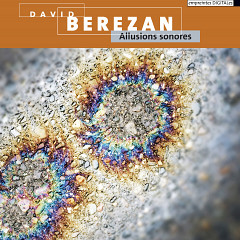
    Canadien vivant au Royaume Uni, David Berezan signe avec ce deuxième album son intérêt pour les sonorités asiatiques mais pas uniquement. En tout cas, la musique acousmatique de Berezan est clairement régionalisée. Chaque morceau d’Allusions sonores correspond à un lieu défini, son environnement mais aussi à des sonorités précises qui tient évidemment à du field recordings mais aussi à une instrumentation particulière. Ce qui ressort surtout de ce disque c’est bien l’association qui est faite de toute cette matière. David Berezan, comme beaucoup des compositeurs acousmatiques, construit et modèle, transformant le réel pour créer chez l’auditeur la vision d’une réalité différente qui s’approche bien souvent du fantasme. Pour autant, ce fantasme repose sur quelque chose de profondément concret, une musique qui se base sur le vivant pour en créer une réalité augmentée. Fatalement, cette réalité se focalise sur le vivant et sur ce qui l’entoure. Tout y est alors amplifié, nous arrivant aux oreilles comme une information décryptée et débarrassée de toutes les scories qui pouvaient empêcher sa compréhension. Mais, au-delà de ça, Allusions sonores est aussi une exploration de paysages très différents les uns des autres faisant se rencontrer le monde industrialisé à celui encore assez proche de la nature mais qui n’est jamais abandonné de l’homme. Allusions sonores donne donc dans le vivant et l’organique sans jamais perdre de vue que la musique qu’il construit à partir d’une matière brut, sert également à décrire et imaginer des lieux précis, des moments de vie que l’on observe d’une manière quasi effacée mais admirative. David Berezan passe d’un pays à l’autre, d’un continent à un autre, d’une culture à une autre tel un ethnologue qui observerait ce qui se passe sans jamais chercher forcément à l’expliquer. Il fait simplement ressortir la beauté de sons et de rythmes qu’ils peuvent générer. En ce sens, il fait ressortir quelque chose d’unique qui ne peut être reproduit deux fois de la même manière. L’invitation vers l’ailleurs fonctionne alors à plein régime et on se laisse forcément embarquer.

    L’invitation vers l’ailleurs fonctionne alors à plein régime et on se laisse forcément embarquer.

    Who Has the Biggest Sound? in Gapplegate Classical-Modern Music Review

    “Review”, Grego Applegate Edwards, Gapplegate Classical-Modern Music Review, August 14, 2014
    Thursday, August 14, 2014 Press

    When your ears meet the immediate present, the music that notifies you that it is not, certainly, 1910… Nor is it 1930, 1950, 1970, or even 1990… When you hear music that tells you it is 2014, is it a cause for celebration? Perhaps not celebration necessarily, but certainly it causes you to wake up a little bit, take stock of where you are and where we all are. To rethink the possibilities that music holds for us.

    Electroacoustic wizard Paul Dolden and his Who Has the Biggest Sound? (Starkland 220) has that kind of abrupt contemporaneity. He is a sample creator and manipulator, sample here meaning a recorded sound sequence of any sort. His samples can be quite lengthy (as opposed to the typical use of samples in the commercial music world) or quite short. Most importantly the samples, whether they are borrowed from source materials or fashioned by Dolden himself (I believe here much of it is the latter), are made anew by virtue of Dolden’s acoustic-musical vision, his eccentric and unexpectedly wayward combinatory logic, which is the critical element at work here.

    He combines, electronically transforms and re-sequences diverse sounds into often surprising juxtapositions, for an electroacoustic orchestral melange that shows extraordinary creativity and a sense of direction.

    There are two interrelated works presented on the album, the title track Who Has the Biggest Sound? (2005-2008) and The Un-tempered Orchestra (2010). Both have a jagged abstractness about them, yet an organic through-flow, an asymmetry and also a sense of poetic humor, which is somewhat rare these days.

    The Un-tempered Orchestra seeks to counter Bach’s Well-Tempered Clavier by creating something the opposite, a six-movement work that uses non-tempered tuning and is as formally amorphous as Bach was formally ordered and symmetrical in his brilliant way.

    Who Has the Biggest Sound? is in 15 parts and following the tongue-in-cheek title creates a sonic largess and diversity that adapts and parodies styles at the same time as it has sound-color innovation as its most serious goal.

    The results in both cases are almost unworldly at times, gamelan sounding clanks, orchestral audio super-exotica, insects, animals, rock chaos, percussion blasts, a cowboy melody, a tango, you practically name it and there’s something in there you will find. And the point of all this diverse material is an intent to refabric our perceptions and expectations of what is what in a rather radical way.

    That he succeeds in creating phantasmagorical universes that give you genuine pause attests to his ingenuity, vision, brilliance even. Paul Dolden shows us that he is one of the most consistently interesting and inventive electroacoustic composers-assemblers today. He is most definitely a force to contend with here in 2014 and no doubt (I would hope) for many years to come.

    Highly recommended!

    That he succeeds in creating phantasmagorical universes that give you genuine pause attests to his ingenuity, vision, brilliance even. Paul Dolden shows us that he is one of the most consistently interesting and inventive electroacoustic composers-assemblers today. He is most definitely a force to contend with here in 2014 and no doubt (I would hope) for many years to come.

    En orbite in Vital

    “Review”, Dolf Mulder, Vital, no. 944, August 11, 2014
    Monday, August 11, 2014 Press

    Et/Ou is a collaboration of Martin Tétreault and Michael Langevin. They started in 2007 and released a first album in 2013: En orbite and so En chute libre is their second statement. Tétreault needs no introduction here. He is a longtime avant garde composer and player with the turntable as his main instrument. Langevin has a history as a drummer in the heavy metal band Voivoid. Also he was and still is engaged in numerous experimental outfits and projects. In most pieces ont his album Langevin drums with a pulse or beat. The patterns sound rather simple and not very demanding. Repetition is an important characteristic like in Duo02. They are completed by noisy textures produced by Tétreault. Their music surely arises from dialogical interplay between the two. The ingredients both players supply, do not lead in each piece to something that arises above the combination of both ingredients. The sound constellations by Tétreault offer far more depth and complexity and make a contrast with the rather straight drumming. So let us say, it is an unusual work and for that reason an interesting one. Maybe I miss the point here, but their improvisations didn’t inspire me.

    … it is an unusual work and for that reason an interesting one.
  • 96
  • 97
  • 98
  • 99
  • 100
  • 101
  • 102
  • 103
  • 104