Sauter au contenu principal
electrocd
  • This website is also available in English.

Aussi dans le blogue

22 résultats
  • 1
  • 2
  • 3
  • 4
  • Bruit-graffiti dans Les Inrockuptibles

    «Musiques», Philippe Robert, Les Inrockuptibles, 3 avril 2001
    mardi 3 avril 2001 Presse

    Le bruit, voilà le thème de ce disque de l’électroacousticien canadien Marc Tremblay, ancien élève d’Yves Daoust dont le chemin musical a croisé celui de quelques improvisateurs dont le platiniste Martin Tétreault. Quelle que soit sa nature, une sonnerie de téléphone, des voitures qui passent au loin ou un avion dont les réacteurs déchirent le ciel, le bruit, qui est une des composantes essentielles de notre univers quotidien, nous ramène inéluctablement à l’instant qui passe, à un chaos sur lequel nous n’avons aucune prise. Selon Tremblay, le bruit serait un élément perturbateur dans la quête de l’harmonie. Pas certain: souvent, on ne perçoit plus ce qui est familier. Aussi, pour redécouvrir le bruit, et qui sait, l’apprivoiser, Tremblay s’est attelé des années durant à en explorer le potentiel expressif, dénichant de la poésie là où beaucoup n’entendent plus qu’agression. Bruit-graffiti part donc du postulat que les objets parlent, et propose une espèce de symphonie réaliste à partir d’objets bruyants articulée en six parties qui renvoie l’auditeur à son quotidien. Ainsi sont évoqués la voiture (dont le son du moteur est quasiment devenu le fond sonore de la vie urbaine), le téléphone (sa vie, ses voix), la maison (la chasse d’eau!), la bourse (ses échanges économiques) et les réminiscences de l’enfance. On devinera à l’énoncé de ces thèmes que la démarche du compositeur, basée sur le cut-up qu’explore également, mais à partir de musique existante uniquement, John Oswald, s’inscrit dans une filiation qui va de “Revolution #9” des Beatles à AutoJazz de Barney Wilen en passant par Toilet piece de Yoko Ono. La pièce la plus étonnante est un hommage au western qui ravira les cinéphiles: on y entend, mixées, des sources altérées provenant de La Prisonnière du desert de John Ford et El Dorado d’Howard Hawks. Coups de fusils, trains à vapeur et bribes de Rambling Man d’Hank Williams recomposent un film imaginaire. Pour le seul plaisir des oreilles celui-là.

    Bruit-graffiti dans Deep Listenings

    «Recensione», Massimo Ricci, Deep Listenings, no 20, 1 avril 2001
    dimanche 1 avril 2001 Presse

    Marc Tremblay cattura meglio l’attenzione grazie allo sfruttamento di suoni comuni (esemplare il primo brano, Vroum, composto da rumori di veicoli a motore e traffico urbano cuciti in studio). Di dubbio gusto invece un brano basato su un noto sanitario da bagno che si usa quotidianamente… Il CD è divertente ma non un capolavoro.

    Bruit-graffiti dans SAN Diffusion

    «Review», Mathew Adkins, SAN Diffusion, 1 avril 2001
    dimanche 1 avril 2001 Presse

    “… are you coming yet… are your nipples erect… ” perhaps not… but your ears are certainly in for an amusing treat. This short passage of telephone sex from «… Ceci est un message enregistré…» is one of many snatches of sonic graffitti that litter the sound world of Marc Tremblay. For Tremblay “Noise is the child of chaos. It confronts us daily and can come to symbolise all that is accidental in life… l Iove to discover the poetry in the noise that surrounds us.”

    All six works on this disk seek to explore the poetic quality of everyday noise in its various guises. On the surface these works appear to be light-hearted, even flippant, imbued with a real sense of ironic amusement. Beneath this surface however, there is a darker side, one which utilises many of the anecdotal materials to provide social comment — Cowboy Fiction (1998) exposes the imperialistic mentality of ‘the White man’, «… Ceci est un message enregistré…» (1994) — the way in which technology, though allowing us to communicate faster and quicker, can actually heighten our sense of physical insularity, and L’argent… toujours l’argent! (1990), our voyeristic love of gameshows that allow contestants get rich quick.

    Vroum which opens the disk is a homage to the automobile replete with samples from The Beatles to Formula One. The piece’s gestural energy is contained in noise based samples derived from various car parts while more pitched elements are derived from car horns. Though this is a substantial piece, at fifteen minutes it seems a little long. This is due in part to the long drawn out central section based predominately on a sequenced car horn could have been shorter to keep up both the spectral and the gestural from the opening. Nevertheless, this opening piece gives you a taste of what is in store for later.

    In contrast to the two extended opening works Vroum and Conte sous la lune — celebrating the naivety of childhood, Résidus (clip dadaïste) (1995) is the shortest piece on the disk and is an ironic evocation of Duchamp’s Fontaine. Résidus (clip dadaïste) must lay claim to be the first electroacoustic work to include a sonic vomit. Tremblay considers this piece “a small variation on the sounds that we hear — but do not really hear — in washrooms.” This is a real cinema for the ears piece which is nothing if not graphic!

    Cowboy Fiction (1998) although in the same amusing cinematic vein of the other pieces is the only one actually acknowledged as being part of a larger multimedia project. It forms the second part of an on-going project entitled Rêve de cowboy. The sonic material for the piece comes from the sound tracks to the French version of Howard HawksEl Dorado, John Ford’s The Searchers, and a version of Hank WilliamsRambling Man with a few locomotives and gun shots thrown in for good measure. For me this is the strongest piece on the disk.

    Tremblay’s world is a crafted in-your-face melange of sonic debris, that engage in an amusing but ironic commentary on the noises that surround us. I had great fun listening to this disk and laughed out loud on numerous occasions. There are few electroacoustic composers that are able to combine craftsmanship with ironic humour as Tremblay does so effortlessly. Enjoy.

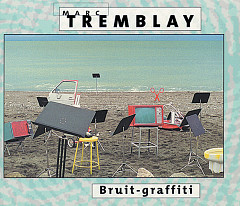
    There are few electroacoustic composers that are able to combine craftsmanship with ironic humour as Tremblay does so effortlessly.

    Bruit-graffiti dans Bad Alchemy

    «Kritik», Stefan Hetzel, Bad Alchemy, no 37, 25 janvier 2001
    jeudi 25 janvier 2001 Presse

    Marc Tremblay aus Québec lässt mich, einmal mehr, einrnal wieder, am Konzept der musique concrète (ver-)zweifeln. Auf Bruit-graffiti (empreintes DIGITALes, IMED 9949) präsentiert der 40 jährige tape composer Kompositionen von derart naiver Selbstbezüglichkeh, dass kh zunächst meinen Ohren nicht trauen wolte. Nicht nur, dass das erste Stück Vroum. heißt, es beginnt auch noch mh Autohupen und einem Schnipsel aus Baby you can drive my car von den Beatles. Tremblay ebenso entwaffnendes wie enervierendes Konzept ist hiermit auch schon erschöpfend aufgedeckt: Stuck Nummer zwei Conte sous la lune handelt von der Kindheit und verarbeitet — na was wohl — Babyquaken, Teddyquieken und Xylophongeklimper, auf Cowboy Fiction. ist Pferdetrappeln, Dampflokschnaufen und Pistolengeknalle.zu hören. Welches Klangmaterial L’argent, toujours l’argent… (Das Geld) zugrunde liegt, verrate ich jetzt nicht mehr…Tremblay Herangehensweise als “kunstfern” zu bezeichnen, wäre vielleicht zu tief gegriffen, sprechen wir lieber von den (handwerklich übrigens makellosen) Hervorbringungen eines eher schlichten Gemütes, eines Menschen mit Sinn für Alltags- und Trivalkultur, der eben einfach keine Lust hat, symbolistische Lyrik oder abstrakte Philosopheme zu vertonen. Doch ist der Preis, den Tremblay für diese (Schein) “Einfachheit”. und “Zugänglichkeit” zahlt, hoch: er heißt Plattheit, Absehbarkeit’, Beliebigkeit.

    Bruit-graffiti dans Vital

    «Review», Henry Schneider, Vital, no 258, 15 janvier 2001
    lundi 15 janvier 2001 Presse

    “Bruit” is French for noise, noise that is innocuous, bothersome, undesirable, and pointless. Marc Tremblay is a French Canadian electroacoustic composer who explores six interpretations of these aspects of noise on this album. The opening composition Vroum is an aural exploration of the automobile using samples of The Beatles (Beep beep mmm beep beep, yeah), car horns, car doors, starting engines, driving cars, etc. These are those mundane sounds we hear everyday brought into a new focus. The second composition Conte sous la lune is intended as an homage to childhood. It is a quiet piece with tinkling chimes, fluttering electronics, and infants laughing and bathing all sampled and processed. The third piece Résidus (clip dadaïste) can be quite revolting to some listeners. Tremblay plays with the sounds we hear in a bathroom: flushing, belching, farting, vomiting, washing, etc. and a bit more out there than Roger Waters’ Body Music. Résidus (clip dadaïste) builds to a toilet flush of major proportions, probably not something you want to have playing as dinner music. The fourth composition is Cowboy Fiction where Tremblay samples the soundtracks from the French version of Howard Hawks’ El Dorado, John Ford’s The Searchers, a cover of Hank Williams’ Rambling Man, locomotives, and guns. This is an ingenious blend of these sources that results in a dream-like vision of Hollywood Westerns with the White Man (John Wayne) taking the land by force from the Indian. The fifth composition is «… Ceci est un message enregistré…», a sexy little number exploring the sonic realm of the telephone: ringing, hidden defects, dead-air moments, anonymous voices, and its decadent use for phone sex. The disc closes with L’argent, toujours l’argent…. This piece is a study of money as sound material and is more ambient/cosmic in nature than the other pieces. Bruit-graffiti is the perfect addition to your sound collage library.

    … an ingenious blend… the perfect addition to your sound collage library.

    Bruit-graffiti dans Hang Up

    «Critique», Hang Up, no 1, 4 décembre 2000
    lundi 4 décembre 2000 Presse

    Nouvelle production du musicien québécois, avec ici des enregistrements en forme d’étude et d’analyse sur des bruits qui nous environnent et qui occupent leurs places…

  • 1
  • 2
  • 3
  • 4