Sauter au contenu principal
electrocd

Remembering Japan

Hans Tutschku

… it does represent the composer’s attempt to engage with Asian culture and communicate with its society, while still pursuing his own compositional interests. The Sound Projector, Royaume-Uni

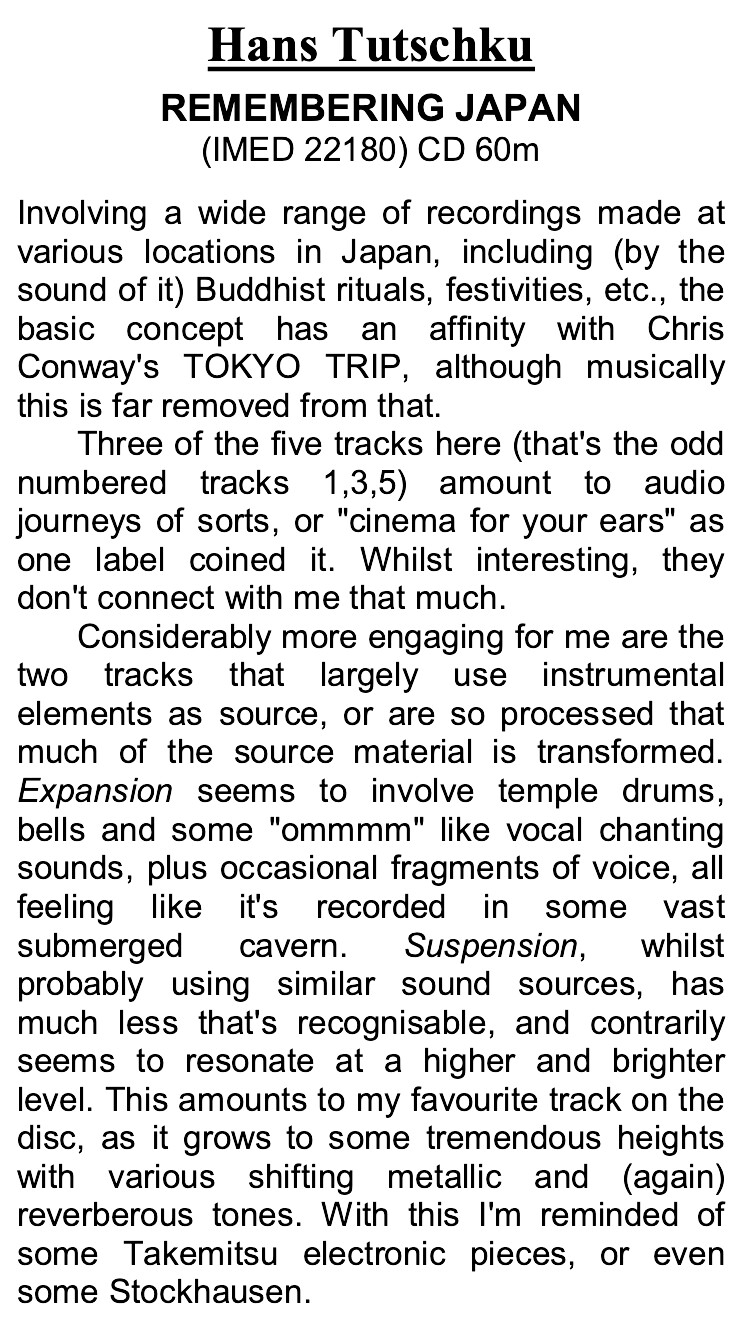
With this, I’m reminded of some Takemitsu electronic pieces, or even some Stockhausen. Audion, Royaume-Uni

Livret numérique PDF de 19 pages (6 Mo) inclus dans le téléchargement

  • Harvard

CD (IMED 22180, 2022)

  • Étiquette: empreintes DIGITALes
  • IMED 22180
  • 2022
  • UCC 771028218028
  • Durée totale: 60:12
  • OGpak
  • 125 mm × 125 mm × 10 mm
  • 50 g

Téléchargement (IMED 22180_NUM, 2022)

Quelques articles recommandés
La presse en parle

Review

Ed Pinsent, The Sound Projector, 1 avril 2024

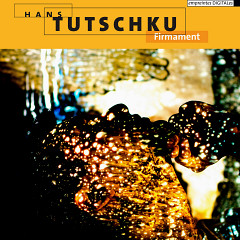
Hans Tutschku is the German composer whose Firmament (2015) release for this label we quite enjoyed, especially Issho Ni with its mosaic-like assemblage of voices from around the world making a very optimistic and utopian “global unity” statement in sound.

Today’s record Remembering Japan (empreintes DIGITALes IMED 22180) is an hour-long suite presented in five separate parts. It might not be so directly idealistic as Issho Ni, but it does represent the composer’s attempt to engage with Asian culture and communicate with its society, while still pursuing his own compositional interests. He stayed there for three months in 2014, not only working and improvising with other musicians, but also capturing a goodly bundle of field recordings in his basket. It’s interesting that he didn’t draw any lines — nature, culture, religion, ceremony, and daily life in Japan were all of equal interest to him, and this is reflected in the broad sweep of the record. On each of the five parts, which all carry subtitles, he’s attempting a different electroacoustic experiment; Expansion for instance works with large open spaces and vast distances, while Abstraction is more focussed on making transformations to the sounds, sometimes leaning towards “extreme forms” as he calls it. At all times he’s trying to move us through time and space, bringing together these remote and separated parts of the continent and looking for overlapping conceptual areas that join things together. Some of the keywords of interest in his text include “calm”, “dreaming”, and “peaceful” — but, as the listener will find, the peaceful mood is very often disrupted and troubled.

Abstraction is probably the most exciting piece for rock music and extreme noise fans — it sits in the very centre of the suite, uses a lot of rapid edits and fast-moving rhythms, and generally seeks to tap into the essence of what I can only assume is the pulsating energy of Japanese life. Yet it still feels oddly distant and detached, as if Tutschku wasn’t especially moved or affected by what he saw. There’s not much trace of humanity, or even animal life, in these fragmented glimpses. Quite different, and in some ways more successful, is the lengthy Suspension piece which follows, where without reflecting anything specific about the country, the composer proposes to record his impressions in what, for him, is intended as an oasis of calm. Interestingly in this case, “calm” doesn’t equate to a completely untroubled state of mind, and the contrasting tones do generate mild sensations of apprehension and uncertainty. Barely a single recognisable sound source to be found on this Suspension; his electroacoustic changes have been particularly profound, and the piece may be a very strong example of what he regards as key to his working method, using the notions of “memory” and “space” as the way he will structure the work.

In short, it seems the word “Remembering” in the title is doing most of the heavy lifting; perhaps this record is more about Tutschku’s internal mental workings than about the country of Japan.

… it does represent the composer’s attempt to engage with Asian culture and communicate with its society, while still pursuing his own compositional interests.

Review

Alan Freeman, Audion, no 73, 1 mars 2023
With this, I’m reminded of some Takemitsu electronic pieces, or even some Stockhausen.

Kritik

Rigobert Dittmann, Bad Alchemy, no 117, 23 janvier 2023
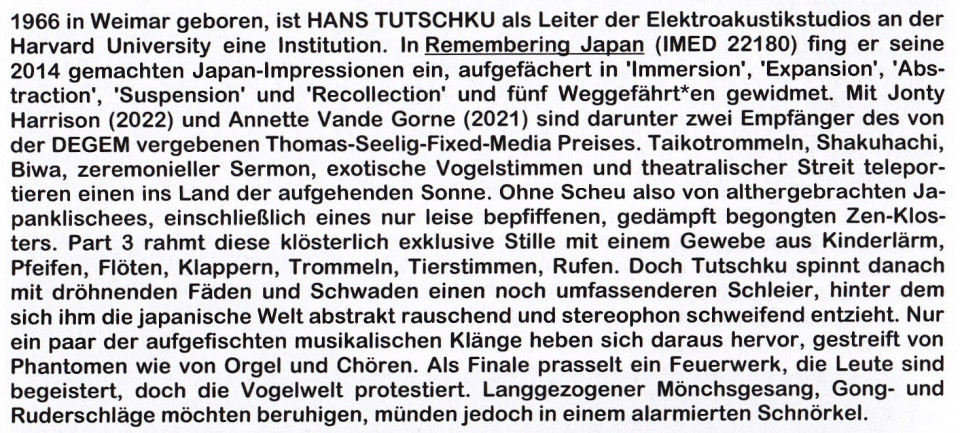
En guise de final, un feu d’artifice crépite, les gens sont enthousiastes, mais l’avifaune proteste. Le chant prolongé des moines, les coups de gong et d’aviron voudraient rassurer, mais ils débouchent sur une volute alarmante.

Recensioni

Girolamo Dal Maso, Blow Up, no 296, 1 janvier 2023

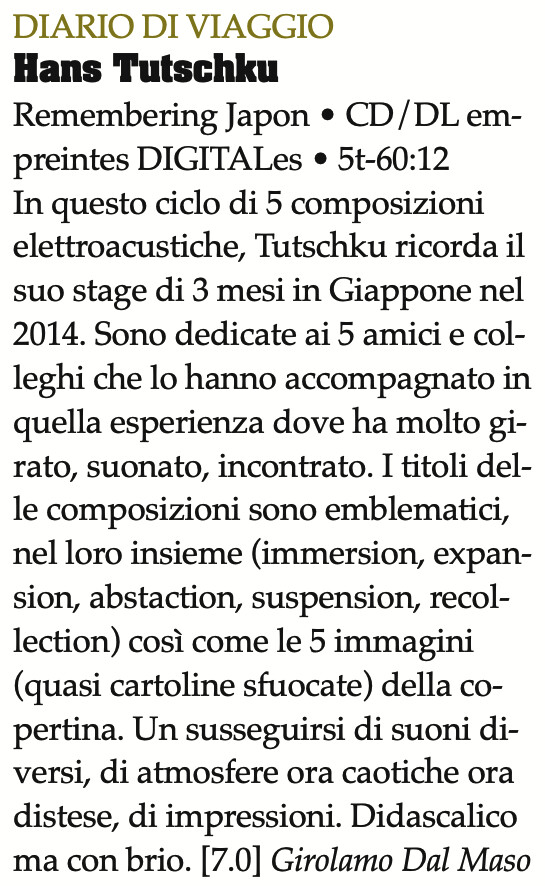
In questo ciclo di 5 composizioni elettroacustiche, Tutschku ricorda il suo stage di 3 mesi in Giappone nel 2014. Sono dedicate ai 5 amici e colleghi che lo hanno accompagnato in quella esperienza dove ha molto girato, suonato, incontrato. I titoli delle composizioni sono emblematici, nel loro insieme (immersion, expansion, abstaction, suspension, recollection) così come le 5 immagini (quasi cartoline sfuocate) della copertina. Un susseguirsi di suoni diversi, di atmosfere ora caotiche ora distese, di impressioni. Didascalico ma con brio.

… avec panache.
7

Release Tipp: Hans Tutschku, Åke Parmerud, Martin Bédard & Marie-Hélène Breault und Vanessa Massera / empreintes DIGITALes

Radiohoerer, 15 novembre 2022

Umgeworfen hat mich das Duo Martin Bédard & Marie-Hélène Breault deren Musik, wie eine riesige Welle über einen hereinbricht. Wie ein Actionfilm oder so ähnlich. Mitunter ist es auch brachial, aber akustisch ungemein überzeugend. Åke Parmerud’s Musik ist eher dunkel. Verfremdete Celloklänge, überhaupt arbeitet er viel mit Streicherklängen, welche dann in atemberaubende Soundcollagen münden. Natürlich wird das Erinnern von Hans Tutschku an seine Japanreise durch viele Fieldrecordings unterstützt und wie er das ganze verarbeitet und erweitert, das ist spannend. Bei der Musik von Vanessa Massera denke ich mehr als bei allen anderen an eine Filmmusik. Eine sehr beeindruckende und herausfordernde Musik.

Une musique très impressionnante et stimulante.

Autres textes

  • Frans de Waard, Vital, no 1361, 14 novembre 2022
Blogue
  • mardi 2 avril 2024 / Presse

    … it does represent the composer’s attempt to engage with Asian culture and communicate with its society, while still pursuing his own compositional interests. Suite

  • vendredi 3 mars 2023 / Presse

    With this, I’m reminded of some Takemitsu electronic pieces, or even some Stockhausen. Suite

  • mardi 24 janvier 2023 / Presse

    En guise de final, un feu d’artifice crépite, les gens sont enthousiastes, mais l’avifaune proteste. Le chant prolongé des moines, les coups de gong et d’aviron voudraient rassurer, mais ils débouchent sur une volute alarmante. Suite