Sauter au contenu principal
electrocd

Jean-François Denis

47 résultats
  • 1
  • 2
  • 3
  • 4
  • 5
  • 6
  • 7
  • 8
  • 2 – 3 avril 2010: empreintes DIGITALes à Qwartz, Paris

    vendredi 19 mars 2010 Général

    La maison de disques empreintes DIGITALes a de nouveau été invitée à participer aux événements du Prix des musiques nouvelles Qwartz dont la 6e édition aura lieu le 2 et 3 avril 2010 au Palais Brongniart (métro Bourse) à Paris (France). Venez nous retrouver dès 14h au stand #36: l’entrée au Marché est gratuite. Jean-François Denis et Christian Zanési participeront à une table ronde consacrée à l’héritage de Pierre Schaeffer le 2 avril; le lendemain à 18h Mathew Adkins spatialisera son Symbiont sur l’acousmonium.

    Jean-François Denis, empreintes DIGITALes dans Tokafi

    «empreintes DIGITALes: Label Profile», Tobias Fischer, Tokafi, 22 janvier 2010
    vendredi 22 janvier 2010 Presse

    Labels come and go. But even within this fast-changing world, where everyone with internet access can set up a record company and start releasing music, some outfits have proved more valid, relevant and meaningful than others. On January 31st, Canadian imprint empreintes DIGITALes will celebrate its 20th anniversary as one of the world’s leading label for electroacoustics and true to its title, it has certainly left some fascinating fingerprints.

    As artistic director Jean-François Denis recounts, the world was a different one when he published the first four albums all the way back in 1990 and the notion of devoting a label entirely to a music so far away from mainstream sensibilities and obvious medial tangents must have appeared wildly optimistic. And yet, Denis’ brainchild got off to a remarkable start and quickly started extending beyond its homebase of Montréal into an international platform for ambitious Composers and Sound Artists.

    Over the years, empreintes DIGITALes has not only developed a recognisable musical style, but also been at the forefront of technological development, switching to the multichannel possibilities of DVD-Audio in 2005. Its visual taste has been of an equally tasteful quality and today expresses itself in elegant cardboard boxes with extendable trays. By Spring of 2009, its catalogue had grown to include over 450 works by more than 90 composers from over 20 countries, on almost 100 releases. As easy as it may be to set up your own record company in the digital age, today’s record companies have a long road ahead of them to match that.

    The past twenty years in a nutshell

    We started in 1989 in a bid of making the music available for a first release in January 1990. Our plan was to begin with 4 discs; we did not want to be another 1-disc label. We selected the compact disc for its better sound quality and longer duration as the only medium for our releases. At that time many people were suggesting that we also release on cassettes! In 20 years we saw different audio formats come. and go almost completely.

    In 1990, there was basically no independent record label specializing in electroacoustics. The first years proved to be a greater success than expected, probably because we simply did not have any real idea about the “commercial” or medial potential for such discs; the novelty dimension, the great quality and variety of local, national and international composers, the sound quality of the discs, the bilingual, French — English liner notes, the packaging, for which we used the conventional jewel case until 1996, then our first deluxe carboard box until 2000 and since then our current cardboard box… all of this contributed to the excitement.

    By the late 1990s, the situation had stabilized. Many more labels were founded around the Western world; compact disc production was simpler and more affordable — and the supply was thus bigger.

    In 2000 we changed some of our production methods and invested more energy into our web site, which was started in 1995, by refocusing it and automating it. The Internet was growing and “net labels” started to appear, meaning the supply was even bigger. In 2005, we selected a better-sounding disc format, the DVD-Audio, as our main format.

    Since 2000 an important shift towards digital compressed audio format happened in the popular music industry, namely in 2001-03 with the iPod and later, the iTunes Music Store. While this change of access to music and “attitude” towards the disc had a great impact on the whole, “specialized” music remained somewhat protected, at least for a while. We only started to feel a change, a decrease in impact, in sales, over the past 3-4 years.

    About serving the download market

    I do not surf the Internet looking for “mp3” of works available on empreintes DIGITALes, nor any other audio files for that matter. So I do not know for sure. My guess is that someone somewhere most certainly has “ripped” works from our discs, converted them in lower or medium grade mp3 and has placed those in peer-to-peer networks.

    We are now living in a time where the music on empreintes DIGITALes has to also become available as digital files, authorized so far composers may get some fruits out of this activity. For the last 3 years we are seeking methods to make high-definition (HD) audio files available. Unfortunately we have not yet found an aggregator — as digital wholesalers are now called — that does.

    About the process of getting press coverage, radio play and concert opportunities

    The advantage of being a “niche” is that people in a niche tend to build networks, groups, magazines, events. In 1990 we had to learn everything, and we naturally discovered networks. In 2009 I’d say the same thing. Some networks have came and gone, newer ones, newer platforms were created.

    There is less and less (conventional) radio airplay time for experimental- and contemporary music; most larger national broadcasters are pulling back from curious, avantgarde, exploratory music.

    Generally in concerts electroacoustics tend to have a wider reach. More and more soloists and small ensembles tour with some mixed and/or live works, including those in programmes with instrumental repertoire. Concerts with acousmatics are slightly different. But in the very recent past I have witnessed sizable crowds attending concerts of acousmatics within the context of festivals of live electroacousitcs or even electronic music (the term understood under its current usage).

    About artistic changes and constants

    As an artistic director, the notion of a “living room listening experience” has always been important to me. The refocusing within electroacoustics to acousmatics was made in order to improve the listening dimension. (Acousmatics on disc is the work “itself”; while mixed and live — or other “recorded” — music is a “documentation” of the work.)

    But your question refers to the aesthetic level and in that respect I cannot say that within the last 20 years the genre has been substantially “revolutionized.” The means of production / composition have change greatly to extremes, from hard-to-access studios in institutions to domestic laptop computers, but thinking has evolved just as naturally. Listening to Portrait d’un visiteur by Christian Calon is just as great as a musical experience today as it was when first presented in public 25 years ago.

    About the relationship between the label and its homebase of Montréal as well as its composers

    Our relationship with the city is symbiotic. Because of my role with the label and, until recently, my role with a concert organization in Montréal, one could feed the other, and vice versa. But in my view the label has never been a Montréal.label, it was simply based in that city. Within only 4 years the offer quickly became international with discs by composers from France, UK and Belgium.

    A personal relationship with composers is very important. Trust and sharing of visions; understanding and acting upon our interacting roles. Working on the long term with, where/when possible, several releases in mind. As to my reasons for releasing something or not, I often say that I need to grasp/feel the integrity of the composer process, but there are of course several other factors, including timing, economical and legal ones.

    About the future of the label and acousmatics

    The goal was foremost to make the music available. With today’s possibilities empreintes DIGITALes is far from the only means for such a goal. But however easy it is to get one’s music on the Internet via one’s own website or even via well-organized outlets (such as CDBaby, for instance), the role of channeling, organizing, presenting of a specialized “label” will be required with or without physical discs.

    Younger generations of composers are exploring the genre, naturally evolving it. So there is a future. There is a future for creation, invention, daring propositions…

    There is a future for creation, invention, daring propositions…

    Jean-François Denis, empreintes DIGITALes dans Musicworks

    «empreintes DIGITALes Turns Twenty», John Keillor, Musicworks, no 105, 1 décembre 2009
    mardi 1 décembre 2009 Presse

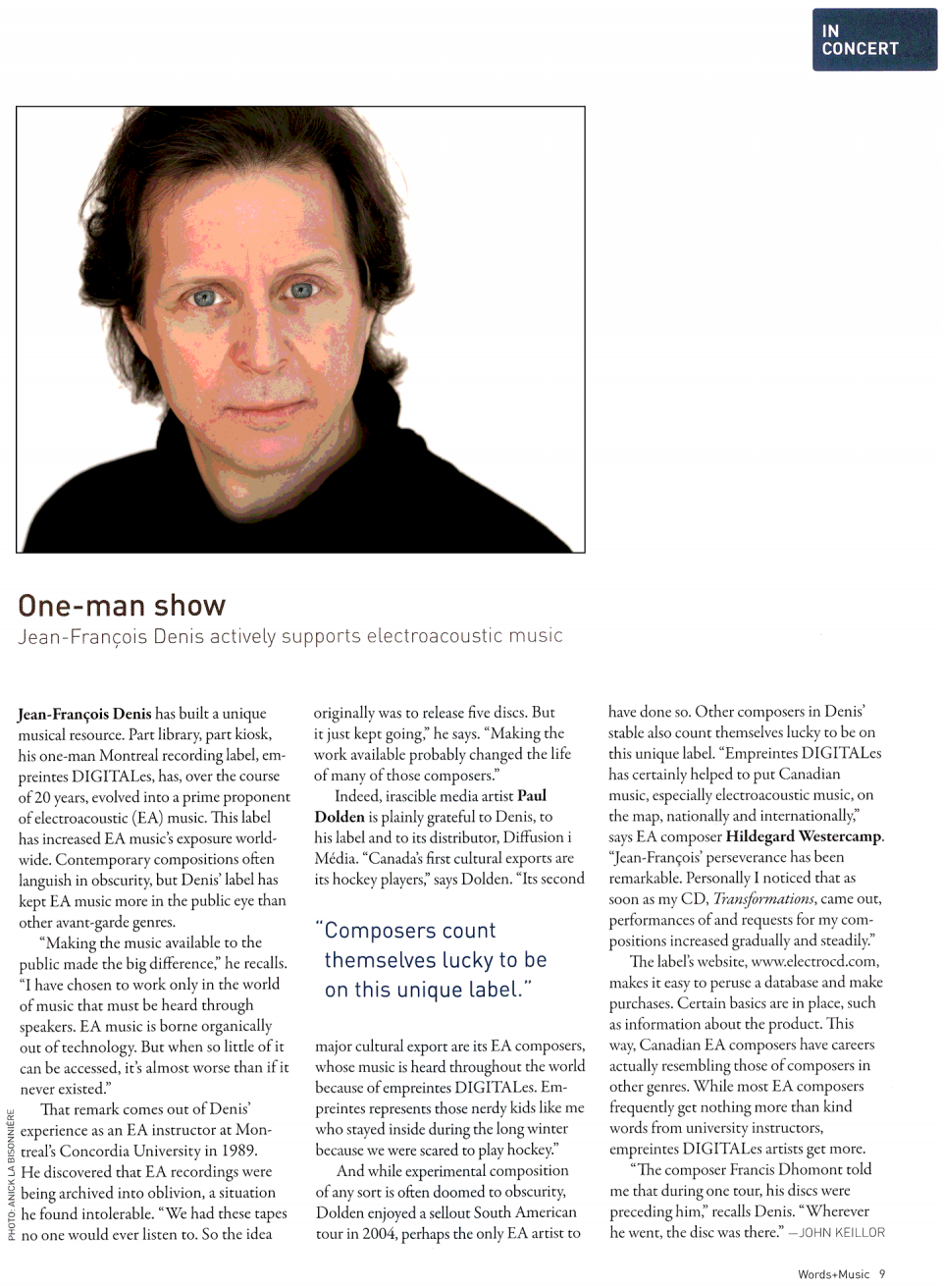
    Canada has an abundance of resources including petrol-soaked sand, hockey fans, and electroacoustic music. These national assets can be found, respectively, in Alberta, in bars, and at electrocd.com. Most countries have no way of knowing what their electroacoustic scene consists of, but Canada does, thanks to Montrealer Jean-François Denis, whose web site, recording label (empreintes DIGITALes), and distribution company (Diffusion i média) make our nation a trailblazer of electroacoustic production and archiving.

    Now in its twentieth year, Denis’ label appears to be as strong as ever. He explains how the project took shape. “I was a teacher of electronic music at Concordia University,” says Denis by phone, “and of course I was a composer, too. I shared an office at the time with [British–Canadian electroacoustic composer] Kevin Austin. We were accumulating lots of tapes at Concordia for concerts. Some of these tapes were musical treasures that no one else would ever have the opportunity to hear. That’s the germ of the whole project: trying to make this music available.”

    So how does one make a specialty record label? In Denis’ case, he was forced into it. “In 1989, we started surveying several composers,” Denis explains. “The idea of starting a label, or at least, creating a musical collection, got positive feedback from several composers in Ontario and Québec. However, none of the labels we approached were interested in a collection of electroacoustic music. Nobody wanted to do that, so I set it up myself.”

    It’s easy to understand why the labels weren’t interested in Denis’ plan. Electroacoustic music is a strange genre, and is both everywhere and nowhere. We music fans still have to define electroacoustic music for most people. When we say “rock” or “hiphop” or “drum ’n’ bass,” no one needs an explanation. But electroacoustic music is more widespread than people realize. It’s present in movies, for instance, on web sites, and in video games, as well as in choreography and theatre.

    In the field of music specifically, electroacoustic music can be heard across genres ranging from Stockhausen to Aphex Twin. Electroacoustic material lurks beneath techno’s surface. Underneath the dance rhythm are those sounds that electroacoustic composers sculpt so carefully. “Electoacoustic composers bring that background stuff to the foreground,” says Denis. “There’s a different emphasis, a reverse. It’s not actually so very exotic.”

    empreintes DIGITALes has had an impact on electroacoustic composers. By making the work available, the composers become more visible. The label has helped many composers reach out internationally. Denis is, in part, shaping Canada’s international music reputation. “The key for new music is to be heard,” says Denis, adding, “Instrumental composers are stuck without a label for new instrumental music, because it’s a lot more expensive to record a chamber ensemble or an orchestra.” Electroacoustic music without performers is far easier financially. It’s also less complicated to play on the radio, though few stations will program the genre. Nonetheless, it seems true that Canadian electroacoustic music has more of a reputation than our instrumental material because it’s consistently available in recorded format.

    Paul Dolden and John Oswald are two Canadian composers on empreintes DIGITALes whom savvy Europeans have told me are part of our international reputation. The attention they’ve gained from audiences abroad causes Denis to be as much concerned with the mechanics of media as he is with being an impresario. When I started [empreintes DIGITALes] compact discs were the only format,” recalls Denis. In the last twenty years things have evolved greatly. The big difference is the MP3, which has changed how music gets distributed. “The Internet is changing how we think about bringing music to people,” continues Denis. “And since that was my first goal, I’m always questioning if my work is truly fulfilling that goal. I’m not interested in moving into an online-only format. However, in 2005, I did move from CD to DVD-Audio, which provides a better standard of sound quality than does CD. It also brings into play the option of surround sound, and allows for the musical dimension of space, which is key to many electronic works. Fifteen DVDs have been released so far. Of course there is less and less of a need for the physical disc,” continues Denis. “But in three to five years from now, access to the Internet may be different. There’s no telling how fast it will be. When I started, people were telling me to stick to cassette tapes,” he laughs.

    Music sales and distribution is in flux like everything media related. iTunes is ubiquitous today, but it didn’t exist five years ago. Five years from now where will we be? Access to music is more and more widespread, and difficult to control.

    As the media continues to morph, Denis will continue to focus on music for loudspeakers. He’s very strict about what the label will produce. He remains a traditionalist, shepherding a technology-based musical tradition into our developing Information Age.

    “This is a label of excellence,” concludes Denis, “I can say that because I’m the artistic director. There are some masterpieces in our catalogue, which is good for electroacoustic music, and for the arts in general.”

    empreintes DIGITALes has had an impact on electroacoustic composers. […] The label has helped many composers reach out internationally.

    Jean-François Denis, empreintes DIGITALes dans SOCAN — Paroles & Musique

    «L’univers électroacoustique de Jean-François Denis», Benoit Poirier, SOCAN — Paroles & Musique, no 16:1, 1 mars 2009
    dimanche 1 mars 2009 Presse

    C’est lors de ses études à l’Université Concordia, au début des années 80, que Jean-François Denis s’est initié à la musique électroacoustique et a découvert la grande liberté qu’elle permet. Pour le musicien, producteur et éditeur, qui avait appris la guitare classique très jeune et fait ses classes au sein d’un groupe rock progressif, ce fut une révélation. «Ce qui est fantastique avec l’électroacoustique est que l’on est en concert, dans la création d’une œuvre que personne n’a entendue auparavant, c’est qu’à peu près tout peut se produire. C’est la liberté totale! Il y a cette possibilité.»

    Ont suivi une maîtrise (en Californie) dans ce créneau musical, puis un poste de professeur, à Concordia. «Dans mon bureau, il y avait une magnétothèque assez imposante: plus de 700 titres. Là-dedans, il y avait des chefs-d’œuvre qui méritaient d’être entendus plus qu’une fois en concert ou à la radio! De là est née la volonté de rendre la musique électroacoustique accessible.»

    Ce courant musical n’est pas nouveau. Soixante années d’exploration ont donné fruit à un impressionnant patrimoine. De quoi certainement ravir un pionnier comme le compositeur français Pierre Henry, à qui l’on doit la célèbre pièce Psyché Rock [co-composé avec Michel Colombier en 1967], popularisée par Maurice Béjart et Costa-Gavras, en 1967. Cette musique dite concrète, comme on la nommait à l’époque, a d’ailleurs fait des petits. «Aujourd’hui, note Jean-François Denis, quand on écoute de la musique électronique, qui est un genre musical cousin, si on enlève certains paramètres comme la pulsion, on retrouve, chez les créateurs, des approches très similaires à celles de la musique électroacoustique.» Mais cette musique, qu’il compare au monde de la poésie, suscite l’engouement d’un nombre relativement restreint de personnes. «Historiquement, je pense qu’il y a toujours un décalage dans la musique par rapport à son temps.» Les inconditionnels sont principalement concentrés en Europe (Angleterre, Scandinavie, France, Belgique et Allemagne), ainsi qu’au Québec. Il y a également quelques îlots aux États-Unis et au Japon.

    Pour être en mesure de rejoindre ces mélomanes, Denis fondait, à la fin des années 80, la maison d’édition YMX Média et la compagnie de disques empreintes DIGITALes. Celle-ci n’est pas la première à avoir vu le jour dans ce secteur pointu, mais sa pérennité et son catalogue, probablement le plus vaste du genre, la démarquent: 584 œuvres réparties sur 98 disques, dont le tout dernier paraissait en novembre 2008. «Avec l’approche d’édition musicale d’une part, et, d’un autre côté, la production de disques, d’avoir ces deux structures-là séparées, mais liées, c’est assez unique.»

    D’autres entités sont venues par la suite se greffer à l’entreprise: les disques SONARt, l’étiquette web No Type et le portail electroCD.com. Alors, qu’à leurs débuts, son équipe et lui faisaient la promotion des catalogues imprimés par la poste — «C’était presque moyenâgeux.» — ils ont fait figure de précurseurs en étant parmi les premiers, soit dès 1995, à se doter d’une vitrine sur Internet. De même, alors que les créateurs devaient jadis trimbaler tout un arsenal, ils se présentent aujourd’hui sur scène avec, sous le bras, leur portable. Et une foule de sonorités en tête.

    Au fil des ans, Jean-François Denis a siégé à plusieurs conseils d’administration, tels que la Communauté électroacoustique canadienne, le Centre de musique canadienne, section Québec et Réseaux des arts médiatiques, dont il est aussi l’un des fondateurs. Il a mérité plusieurs bourses et prix, dont celui de la Ligue canadienne des compositeurs, en 1994, pour son engagement exceptionnel à l’égard des compositeurs canadiens.

    En plus de composer et de donner des prestations, il a d’autres projets en chantier. Celui, entre autres, d’amener les secteurs télévisuel et cinématographique à s’intéresser de plus près à la musique électroacoustique. À plus court terme, Jean-François Denis est actuellement à finaliser la programmation d’une grande fête, en collaboration avec l’ensemble des diffuseurs de musique électroacoustique. L’événement, qui se déroulera tout au long de 2010 à travers l’Occident, soulignera le 20e anniversaire des éditions YMX Média et de son étiquette phare, empreintes DIGITALes. L’idée première, souligne-t-il, est de faire circuler encore plus, avec l’argument des 20 ans, la musique électroacoustique afin de mieux faire connaître ses créateurs.

    Ce qui est fantastique avec l’électroacoustique […] c’est qu’à peu près tout peut se produire. C’est la liberté totale!
  • 1
  • 2
  • 3
  • 4
  • 5
  • 6
  • 7
  • 8