
Paul Dolden dans The WholeNote
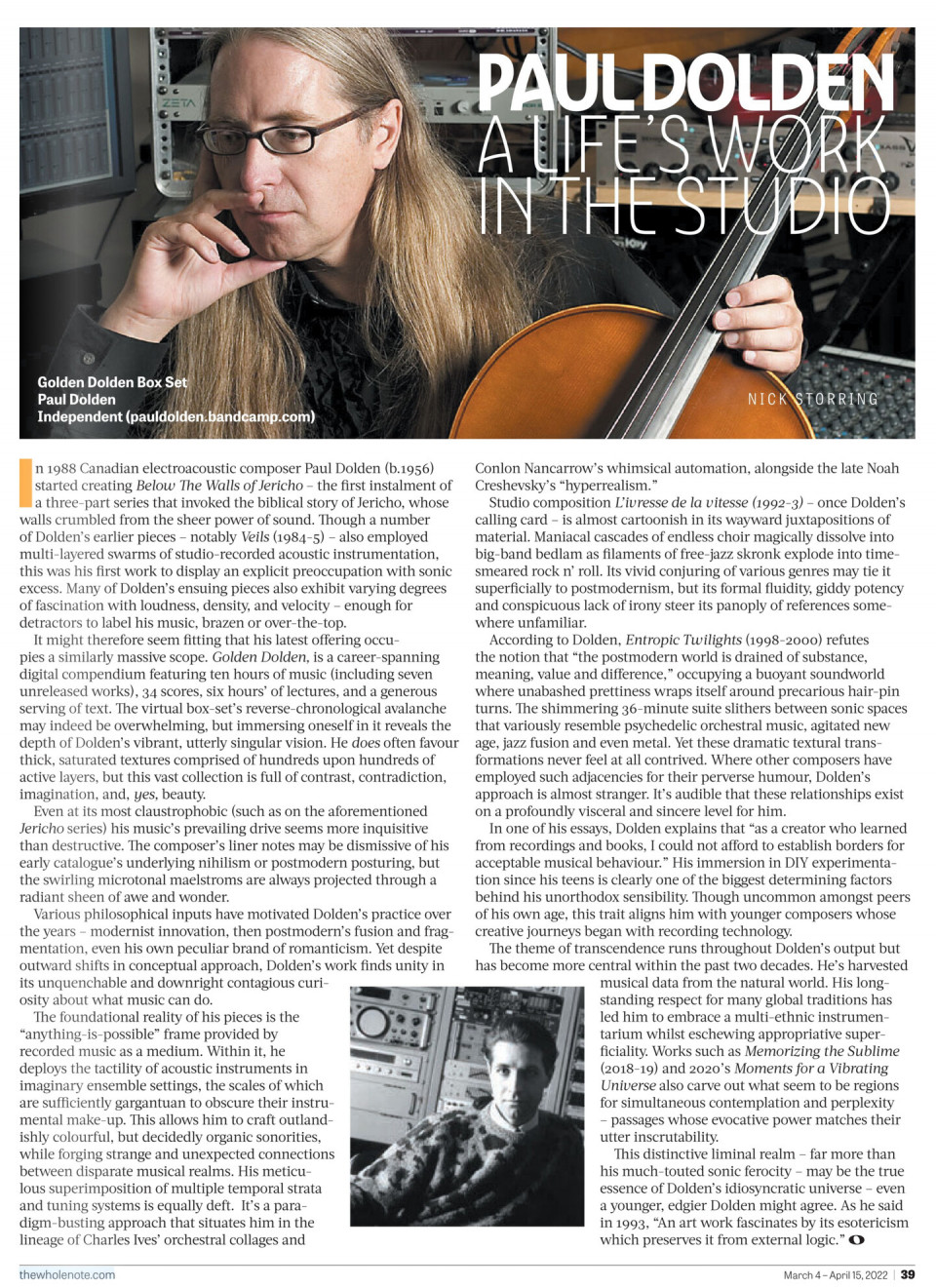
![Paul Dolden [Photo: David Strong, Montréal (Québec), 2006]](https://res.electrocd.com/image.php/image/d/dolden_pa.8256.jpg?width=n2&cropratio=1:1)
Histoires d’histoire, Paul Dolden dans Avant Music News
The other two releases (
I should know by now that the unusual is the usual when it comes to
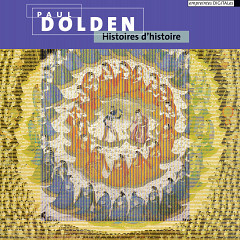
L’ivresse de la vitesse 1, L’ivresse de la vitesse 2, Paul Dolden dans 5:4
Another composer who has been polishing off, smartening up and reissuing old works recently is Canadian
The first thing to say about this is that the word “remaster” isn’t remotely adequate to describe what’s going on here. Usually that term indicates a digitising and cleaning-up of old materials to make them as pristine as possible and then reassembling them into a new master that, in essence (and ideally), is the same as the original but showing greatly improved clarity and balance. In
The second thing to say is that there shouldn’t be any perceived issue with an artist wanting to do this. The gripe about technological issues is something many composers (including myself) have made about their earliest electronic works, and the desire to get closer to the original musical intent is surely an admirable one. Of course, it’s an attitude that can run amok, and one only has to look to
I don’t blame
Yet — and this is one of the main reasons why I absolutely love
I have to admit I miss the original 1992 opening of the piece, where vague and elusive hints of instruments slowly grow into an increasingly dense texture. That’s gone in both the 2003 and 2020 versions, which hit the ground running with frantically busy tuttis. There are some structural hiccups too in the 2020 version that, to me, somewhat diffuse the flow — most notably around four minutes in when everything briefly stops before the funky bass and drums start up, dissipating the energy amassed by that point
Anyone discussing
My recommendation is to seek out all three versions, as they each have something that the others lack. For the 1992 original you’ll need to turn to Discogs to track down a copy of the earliest releases of
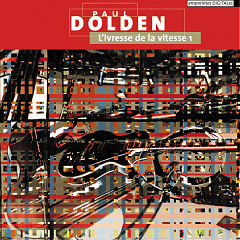
Histoires d’histoire, L’ivresse de la vitesse 2, Paul Dolden dans Vancouver Review
But first, some history. Waaaaay back in a time known as the 1980s, this Ottawa-born composer, after doing hard time as a rock guitarist, decamped to the Sonic Research Lab at Simon Fraser University [(SFU)] in Vancouver where he forged some of the most unique music ever carved out of the Western formal tradition by using the recording studio to sculpt masses of meticulously recorded instrumental tracks into fantastic walls of sound.
By the end of the decade he had released a 2-CD set titled
At first,
From Veils to Walls
Things really began in 1985 with “
In pop music, by contrast, we might remember English pop group
Fast forward ten years and
The titles also represent the 3 stages of revolutionary history as discussed by historians
1) Below the Walls signifying revolution, usually violent.
2) Dancing on the Walls is the celebratory dance on the rubble of the revolution.
3) Beyond the Walls is the post-revolutionary period, usually turning counter revolutionary and more violent than the first period.
There were those who found it all too much, especially in Vancouver where, at the time, contemporary music was (and largely still is) seen as a less confrontational and more communal endeavor.
The late
You could say the music was ahead of its time but Paul, being interviewed in 1992 said that the idea was absurd, that you simply cannot be ahead of your time. Our best hope is that audiences will find the music of the true present at the time of its creation.
During a 2017 visit to Québec’s Laurentian region where Paul now lives and records, I conducted an informal interview at a roadside diner near Val-David. It coincided with the release of his CD [“Music for Another Present Era” or]
I had only sporadically kept up with Paul’s music in the years since he left for Québec and was fascinated to hear its evolution into something much different but with the familiar stamp of rigourous conceptual formulation and production excellence. Since creating the Walls cycle, Paul’s music has evolved, been pulled apart, given more space and fully embraces the music of the world. It is friendlier… and funnier.
I suppose, overall, it’s a post-modern play on how we can have different historical periods of music existing at the same time. To me that very imagining is a contemporary thing. I can imagine ancient Greece because I’ve seen films like Fellini’s Satyricon where the soundtrack is a fanciful mash-up of styles, or images of Syrian ruins that you’d see in a history book.
We’re so conditioned by the number of images and sounds that we’re constantly consuming that I think it’s important to be playful with it all. I think I’m being “of my time” by doing so even though I’m often talking about historical themes in my music with pieces like
Now there’s been a massive expansion of the technical capacity for music creation and it’s become affordable and ubiquitous. But in the public at large there’s been a serious loss of attention to contemporary music outside of popular forms. It seems that there’s been no “trickle down effect” of discovery despite the fact that we have more and instant access to every kind of music 24/7.
But it’s the employment of algorithms that’s the problem. They suggest that “if you listen to such and such then you will also like such and such”. So if I listen to one heavy metal album (because every so often I need to hear some metal
I started reading the back covers to learn how he made this music. I thought it sounded so insane that I had to buy it just to hear it. It was his stochastic 60s work with all the math involved in the composition and I thought “What
You have to remember that when I made
So we should assume then that the power of sound and complex music may well have reached its peak with the Walls Cycle and may never be absorbed or appreciated by any but a small band of fanatical devotees. Fair enough. The sun will explode one day and none of this will matter anyway. In the meantime it seems as if
But history, as we now plainly see, sometimes bears repeating if only to recall how we may have missed its lessons. Accordingly, Paul has put the Walls Cycle up for listening at Bandcamp. It is sad that many will only listen on a computer speaker system. I’d urge you to go full retro and order the CD for hi-fi home playback. Turn off your mind, relax and float down stream…
Then bring yourself up to date with
Paul Dolden dans Chain DLK
We recently had an in-depth conversation with Canadian electroacoustic composer
Chain DLK
Paul Dolden
Chain DLK
Paul Dolden
My curiosity about modern music began when I was about 14 years old. In the late 60s and into the 70s, the idea of a new music, a new art, a new society, etc. was on everyone’s mind. So there I was, a 14-year hippie child buying my
During my 20s, I transitioned from a full-time performer to a full-time composer. Now I only perform on my own recordings and with a few friends just for fun. Composition and audio technology has taken over my life
Chain DLK
Paul Dolden
Musicians would all become like
In addition, many of us had the dream that a new music would transform culture and society.
For sure, as time went on, and the 70s turned into
At the level of day-to-day tools, I can remember the excitement of getting my first 4-track tape recorder and then an 8-track tape recorder. I remember programming a mainframe computer in 1977 with Stochastic and Gaussian distributions and thinking I was hearing something new.
Back then, I could have never imagined that today, on a home computer, I would be recording, mixing and processing hundreds of tracks of sound.
Chain DLK
Paul Dolden
They are also important for discovering ways to use audio technology to manipulate sound.
Having restated the “official” history of electroacoustic music, I do hope that in the future they tell the full story of technique and tool development. For most of us, it was the development of these techniques, at the same time or earlier, by
Chain DLK
Paul Dolden
When we say contemporary music, we usually mean music that does not sound like 19th-century music. By contrast, for years, I have been following a lot of composers who continued writing in the tonal tradition with clear structural articulations or “climaxes”. About 60 of these composers, living or recently dead, are documented by
Among my reasons for listening to these composers is that I still struggle with most modern music that is constantly dissonant in our tuning system. Twelve-tone equal temperament (12ET) was designed to create tonal music that can modulate rapidly. The most accurate representation of our 12ET semi-tone in the harmonic series is the distance between the 84th and 81st harmonic. Let’s face it
As far as audiences go, there are lots of people who love my music in various ways, and when I do a concert the audience is enthusiastic about what I am presenting.
Performers today are amazing, and I have had a chance to work with some of the best over the last 35 years. We often talk about how music language has developed so rapidly over the last 100 years. I suspect an ever-greater growth has occurred in instrumental technique.
Chain DLK
Paul Dolden
I could talk on and on about compositional technique in the each work, but most of my concerns are clearly summarized in the introduction to the main score for the CD.
Instead of talking on and on about the early works, I would like to take this space to clarify an important aspect of these works that many people are left confused by.
Two times in my life, I have gone through a massive re-mastering of early works (everything before 2004). This often takes almost a year to do. I go back to the original recordings and remix and master. This habit is inspired by the ever-improving sound of modern audio technology. I also do this because it often takes me years to fully understand the music and how to maximize the mix for the work. Remember, the works involve hundreds of musical parts occurring simultaneously. This musical understanding of a work could be compared to the career of many conductors. Conductors often talk about conducting the same work for 30 years and preferring their later performances because they understand the work better. Likewise, I prefer the later masters and, yes, they are more true to my original music score for the work.
The first major re-mastering job was done in 2000-2002. These re-mastered versions were published by empreintes DIGITALes at that time on CD. After years of listening, I re-mastered the works again in 2012. Only recently have I turned these new masters over to empreintes. I hope they will have these 2012 versions on their streaming service soon.
I promise my listening public I will not re-master or “re-conduct” my works again
Chain DLK
Paul Dolden
Like my previous work, the main artistic inspiration is history or stories from the past. In this work, a different historical myth inspires each movement, hence the title.
Chain DLK
Paul Dolden
The program notes for the works usually had a historical/philosophical idea I was trying to capture in music. These ideas were based on topics as wide ranging as the biblical Walls of Jericho, the Romantic notion of music creating the social revolution, the postmodern idea that the speed and density of the information of our times are creating an intellectual and emotional stasis, etc., etc. With such big ideas, the music itself had to be larger than life
But whatever my artistic intentions were is of little importance. The listener will always decide for himself or herself the meaning of an aesthetic encounter. The real artistic or aesthetic moment happens in the relationship established between the listener and the music. For example, the Walls cycle of works has been described by some as transcendentally beautiful. By contrast, I know of two scientific experiments in which the same music was used to create an environment of pain for the test subject.
Chain DLK
Paul Dolden
Chain DLK
Paul Dolden
In this cycle of works, I am studying different musical styles and nature sounds to uncover their relationships. In short, nature’s sound patterns create most of the music and are everywhere in this cycle. For example, the same intense microtonal and polyrhythmic patterns of a swarm of insects are modeled onto brass, wind, and string parts. In this work, I found that country music sprang to life alongside the howling hounds of the open plains, and that Spain begat Flamenco alongside crickets that chirp in 6/8
Many of the titles in this cycle of works are questions, because I am creating an imaginary battle of the bands in which, for example, our soloist tries to play faster than the accompaniment, which is music based on cricket sounds, or our string orchestra tries to play a more mournful melody than the combined pitch bends of a herd of cows.
By the end of this cycle, my belief that I or other musicians were “original” music thinkers was shattered. With the musical styles I explored in the work, I found each of their fundamental music patterns pre-existing somewhere in nature. Perhaps we are only mimicking what already exists, given, for example, that it is now estimated that insects first appeared 480 million years ago.
I should add that, for the listener looking for a Soundscape work, I would not recommend this cycle of works. All my source material, the nature sounds, were transformed into music, and the unsuspecting listener hears what I hope is a series of entertaining and engaging moments and goes on a musical journey unaware that they are listening to insects or barnyard animals. The lack of clear identification on my part, between human music style and natural source, is because I believe that any artwork that is totally complicit in its own absorption, so that it no longer makes apparent sense on the surface, will exercise a remarkable fascination. In short, an artwork fascinates by its esotericism, which preserves it from external logic.
Chain DLK
Paul Dolden
- I have been trying to figure out for years how to combine textural writing and density with the singular identity and memorable aspect of melody.
- I have become frustrated as a listener and as a composer with the metronomic or “steady tempo exactly on the beat” aspect of classical music. Therefore, I have been exploring how to use what are called groove rhythms as a basis for the “skeleton of time” in my work. These rhythms are based on performances of African, Latin, jazz or rock music.
Secondly, the tempo of my work is almost always changing, usually quite slowly, inspired by Indonesian music but also observable in many ragas and Western improvised music, including rock and jazz. - From the beginning of my career, I questioned the idea of only 12 tones to an octave fixed at set vibrational rates (i.e. A=440). During the 1980s, and for the last 15 years, I have developed my own tuning systems or used historical tuning systems. I often use the more “true” or “natural” Just Intonation, but I am also interested in discovering new types of irrational dissonances. For example, one of my favorites is to design non-octave tuning systems or tuning systems with no octaves or 5ths. By that point, throw out the entire ear training you ever did and start all over
! Marshall McLuhan coined the term “global village” 55 years ago, and yet most musicians specialize in a specific style of a specific genre.
I have always been fascinated with all the music of the world and have tried in my own humble way to bring it all together into one artistic vision.
I am not interested in “cross over” music, or fusion. Instead, I want to understand and use the deep grammar of different music to create a unified aesthetic picture. I hope this is not another version of cultural imperialism.
On the other hand, I do realize my ambition of combining diverse music and orchestrations is based on being a privileged Western educated male who can listen to Indian or Thai music on recordings and read books on this music. And the fact that I grew up in a surplus economy, which allowed me at age 16 to buy, at the same time, my first Les Paul and Sitar. The same surplus economy which has allowed me access to recording gear which meant I could learn how to balance all these different types of timbres and gestures through the use of equalization, compression, expansion, transient and sustain shaping tools, panning, spatial enhancement tools and extensive mixing.
The listener will have to decide whether my music represents another brick in the wall of Western decadence and decline, or if it is part of a new perception and understanding of what it means to live in the Global Village.
Chain DLK
Paul Dolden
Chain DLK
Paul Dolden
Needless to say, these two “concertos” that appear on the CD pose a challenge for most listeners, who are expecting a set proscenium arch or background around the soloist. In this case, Maurizio and Lukasz rose to the occasion of a stage that is constantly changing size, shape, colour and mood.
Chain DLK
Paul Dolden
Chain DLK
Paul Dolden