Sauter au contenu principal
electrocd
  • This website is also available in English.

Blogue

201 résultats
  • 3
  • 4
  • 5
  • 6
  • 7
  • 8
  • 9
  • 10
  • 11
  • Alibi dans AllMusic

    «Review», François Couture, AllMusic, 11 octobre 2001
    jeudi 11 octobre 2001 Presse

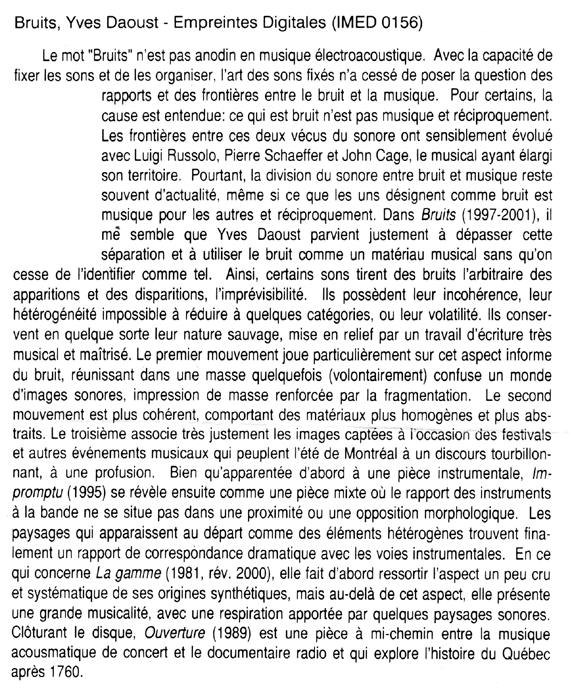
    Alibi is Jacques Tremblay’s first solo CD. It culls six tape music works created between 1990 and 1995. Except for the three-minute Jeu d’ondes, all pieces are lengthy and divided in multiple movements. Tremblay’s main source of inspiration is psychoanalysis. A quote from Carl Gustav Jung underpins Hérésie ou les bas-reliefs du dogme (“Heresy or Dogma’s Bas-Reliefs”). In this long, complex piece, the composer accumulates quotes about various historical events, all related to Man acting on the behalf of God (i.e. using religion as a moral motor or excuse). The facts are presented pseudo-objectively; Tremblay’s commentary is inscribed in the sonic movements. Oaristys and L’intrus au chapeau de spleen both play on the unconscious, suggesting eroticism in the first case and an initiatory journey in the second. Both pieces’ dramatic tension resides in the unsaid. In comparison, La robe nue and Rictus nocturne sound a little thin, even though the second takes jazz for subject. But the promised “jam session” never materializes. There is something of Francis Dhomont’s art in Tremblay’s music, his ability to toy with the subconscious; but while Dhomont actualizes his fascination with psychoanalysis in storytelling, Tremblay remains stuck in the evanescent. His works evoke many things, but the listener comes out of them without a lasting impression. Nevertheless, Alibi makes a good album of “classic” electroacoustic music.

    Annette Vande Gorne dans AllMusic

    «Portrait», François Couture, AllMusic, 11 octobre 2001
    jeudi 11 octobre 2001 Presse

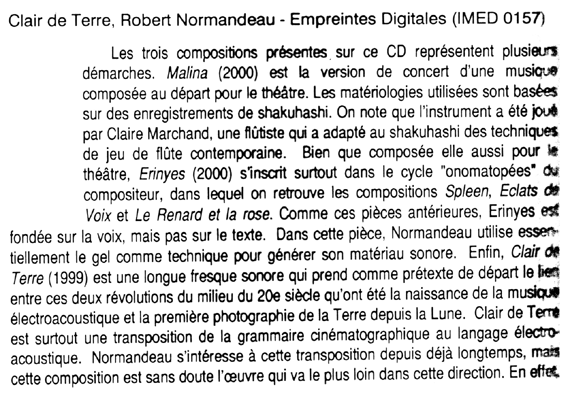
    One of the leading female electroacoustic composers of the generation born with “musique concrète” (“discovered” in 1948 by Pierre Schaeffer), Annette Vande Gorne has illustrated herself not only through her works, but also as a teacher, theoretician, animator, and promoter of electroacoustics in Europe, especially in her native Belgium. Her major works from the 1980s and 1990s have been published by the Quebec label empreintes DIGITALes on two CDs, Tao (1993) and Le Gingko(1995, reissued in 1998 as Impalpables).

    Annette Vande Gorne had already completed her classical music studies at the Mons and Brussels Royal Conservatories when she first came in contact with electroacoustic music. She was in France for a brief stay at the time. The works of Pierre Henry and François Bayle made her see in acousmatics an uncharted territory. She took training courses with Henry, François Delalande, and at the Groupe de Musique Expérimentale de Bourges, and studied electroacoustic composition with Schaeffer.

    By 1980 she was active as a composer while teaching classical music history. In 1982 she founded the Musiques & Recherche center and the Métamorphoses d’Orphée studio, two of the earliest electroacoustic institutions in Belgium. She organized the first festival L’Espace du Son (Brussels, Mons) in 1984 and published the review Liens while putting together a documentation center on acousmatic art. Starting in 1986 she was appointed professor of electroacoustic composition at the Royal Conservatories in Liège, Brussels and Mons.

    Vande Gorne is often drawn to metaphysical subjects. Her cycle Tao is a reflection on the four basic elements of taoism. Her relation with words is also crucial to her work. Following Francis Dhomont’s example, she forays into text-music relations. Her collaborations with poet Werner Lambersy are particularly successful.

    One of the leading female electroacoustic composers…

    Moment dans Touching Extremes

    «Review», Massimo Ricci, Touching Extremes, 3 octobre 2001
    mercredi 3 octobre 2001 Presse

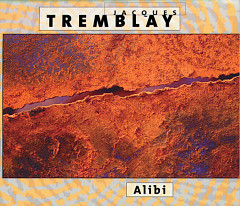
    This young German composer served an ace with his creation, far away from the usual empreintes DIGITALes ambiences which you’re used to bath in. And so, no concrete or ‘classic’ acousmatics; instead, a stunning twilight of sound stratification, just like linear clouds in a half-sun, half-rain day. A deep digging composition, you’ll need concentration at ‘10’ to fully appreciate its mastery; rest assured you’ll be richly rewarded. empreintes DIGITALes keeps being high in the bill of consistency, as far as avant-garde labels are concerned.

    … a stunning twilight of sound stratification…

    Impulsion dans Voir

    «Disque en forme d’hommage», Réjean Beaucage, Voir, 1 octobre 2001
    lundi 1 octobre 2001 Presse

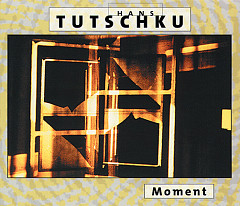
    Le disque consacré à Micheline Coulombe Saint-Marcoux a été lancé en prélude aux concerts entourant le 30e anniversaire du Studio de musique électroacoustique du Conservatoire de musique du Québec à Montréal, dont elle coordonna les débuts avec Gilles Tremblay et Otto Joachim. En 1967, elle se voyait décerner un premier prix de composition du Conservatoire et le Prix d’Europe avec une œuvre pour grand orchestre et ondes Martenot, ce qui lui permit de travailler, en 1968, à la suggestion de Iannis Xenakis, avec le Groupe de recherches musicales (GRM) et de suivre les cours de Pierre Schaeffer, inventeur de la musique concrète. En 1969, elle participa à la fondation du Groupe international de musique électroacoustique de Paris, avant de revenir enseigner à Montréal en 1971.

    Convaincue que «le véritable créateur se définit par son refus de perpétuer les expériences passées», elle composera sans regarder en arrière et contribuera grandement au développement de la musique électroacoustique. C’est ce que ce disque nous propose de (re)découvrir. La production est d’une grande qualité, et c’est un véritable bonheur que d’entendre cette musique qui se composait beaucoup avec des ciseaux et du scotch tape, et qui n’hésitait pas à laisser parler le son sans le grimer outre mesure (c’était avant le Macintosh et les programmes tout fais!).

    La production est d’une grande qualité, et c’est un véritable bonheur que d’entendre cette musique…
  • 3
  • 4
  • 5
  • 6
  • 7
  • 8
  • 9
  • 10
  • 11