Sauter au contenu principal
electrocd
  • This website is also available in English.

Blogue

272 résultats
  • 11
  • 12
  • 13
  • 14
  • 15
  • 16
  • 17
  • 18
  • 19
  • Sous le manguier dans e/i magazine

    «Review», Alan Lockett, e/i magazine, no 3, 1 juin 2004
    mardi 1 juin 2004 Presse

    If Ghislain Poirier’s debut, Il n’y pas de sud, turned heads, this second album will make them spin. Here a similar elemental landscape is revisited, with greater ambience and confidence. Dub plays around at the edges, not in its rhythms, more in its obsessive deployment of the textures and resonance of reverb-delay technologies. But technology is not foregrounded. At its deepest level, the music here is somehow primordial, almost devotional. There are shades of the ritual ethno-ambient of the likes of Jorge Reyes, updated for the post-electronica generation. Trails of languid melodies unravel, lightly fizzing around the edges with the distortions and microtones of effect transformations, attended by occasional subdued beats. The oneiric L’hiver neige sets the tone, pulsating brasslike drones and low-end kalimba gently warped with an effect halo quickly establishing the keynote trancelike state. After a slow motion drift through recontextualised Basic Channel/R&S sonics on Se reprendre, we embark on the central part of this collection-a series of pieces all inhabiting roughly the same sonic territory. Ti-a soliloquy of stretched out baliphone tones employing delay to explore the architectures of attack and decay-segues into Torpinouche — a cavernous resonance of phased pluckings insistently returning to a tonal center. And successive pieces employ a similar timbral template. The sounds of actual or simulated kalimbas and baliphones enact meditative instrumental incantations, teasing out a desertified hypnography which is not so much blissed out as sunstruck. Color-bleached, out of focus, this is a haunted, sometimes almost mournful, otherworldly music that somehow occasionally recalls, of all things, Seefeel’s dislocated gauzy guitar derangements (circa CH-Vox). Sous le manguier leaves the abiding impression of a suite of tone poems creating an imaginary soundtrack for certain exotic topographies of distant folk memory.

    … a suite of tone poems creating an imaginary soundtrack for certain exotic topographies of distant folk memory.

    Quality Hotel dans e/i magazine

    «Review», Christopher Murphy, e/i magazine, no 3, 1 juin 2004
    mardi 1 juin 2004 Presse

    The second in a series of live recordings produced during Montréal’s Mutek Festival, Quality Hotel features the combined talents of Stephan Mathieu, Radboud Mens, Janek Schaefer and Timeblind flexing their collective sonic muscle. Recorded in Mens’ hotel room, the scene was a solid mass of cabling, four artists linked umbilically as they coaxed their machines to life, gently easing sound into the atmosphere of a sunny June morning. Listening to the album arouses memories of warm summer days in Montréal: friends meeting and exchanging ideas freely, music trickling from laptops into an overworked mixing desk, Schaefer manipulating his twin-armed turntable and simultaneously adjusting settings whilst Chris (Timeblind) Sattinger struggled to get his recalcitrant laptop to co-operate. The result: 48 generous minutes of warm melodies occasionally surfacing above a sea of hesitant and gentle static. The tracks, numbered after the hotel’s floors, are a series of calm meditations, a suite of crystalline studies that unfurl gently, bearing all the characteristics of the artists’ trademark sounds, a perfect balance resulting from rich improvisatory dialogue, After a gentle opening, Fourth Floor sees staccato pulses emerge from a gently wielding hiss before fading to the machine hum of Seventh Floor, a growing chord punctuated by low-end grumble and shimmering pinpricks. By Ninth Floor we’re in full flow, elegiac chords drifting momentarily before collapsing into an ocean of sibilance-old vinyl at its glorious best. The closing track, Eighteenth Floor, sees a distant melody dissolving amidst a spacious digital landscape of pulses and glitches, its 16 minutes easing gently out to create a silently embracing void. Mathieu, Mens, Schaefer and Timeblind coax their machines into a beautiful display of restraint and mutual respect. The results are spectacular and, one hopes, not the last of these spontaneous hotel room encounters.

    The results are spectacular…

    Bleak 1999 dans e/i magazine

    «Review», Tobias C van Veen, e/i magazine, no 3, 1 juin 2004
    mardi 1 juin 2004 Presse

    Bleak 1999 is a historical document of minimal techno, referencing from its opening chords and depressed tempo the pathos of Plastikman’s Consumed, an overwhelming heaviness of being that, for the most part, was shunned by critics, signalling the death knell of minimalism and its sparse questioning of techno’s shotgun marriage with rave culture. Given the negativity of 1999 and its ill-formed critique of inquisitive and emotional moves by the underground practitioners of experimental-leaning electronic music, Jirku’s Bleak 1999 couldn’t have been released at a better time. When Thomas Brinkmann reformulated Plastikman’s Conceptual ashes, adding a playful, acidic funk to the silence, he chose to leave half-buried the unassimilable elements: the somber tred of speaker casualties, the sobriety of sinewave masochism, the mindfuck of high volume sadism. It is with all the sweet charm of a gravedigger that Jirku sifts through his own psychoarcheology of minimalism’s past, remapping our memory as the tomb of the present. In 2003, the dusky grit of roughshod glitches over low hums and pulses slowly pace, back and forth, over beats of a dub tempo, yet bearing none of the conventions of dub’s over-appropriated echo-response. In 2003 we are led back to 1999, that apocalyptic year of dot-com bubbling. The triggers of memory aside, Jirku’s album suffers from his usual weaknesses: a stock beat and often, monogamous percussion. But what drifts forth as unique are the drones and the textures, the sediments weaving layer upon layer of drifting palor, the high ambient paths weighted by their earthly embodiment in the soil of history. Bleak 1999 is a memorial to what has been and what is now today, which makes its intrigue every bit a byte from the future.

    … what drifts forth as unique are the drones and the textures, the sediments weaving layer upon layer of drifting palor, the high ambient paths…

    We Remain Faded dans e/i magazine

    «Review», Tobias C van Veen, e/i magazine, no 3, 1 juin 2004
    mardi 1 juin 2004 Presse

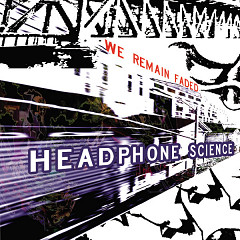
    No Type has blossomed from one of the first Net-based labels to a solid platform for experimental music, touching upon minimalist and improvisational electronics, noise, musique actuelle, renegade electro-acoustics — and with Headphone Science, sliced and diced hip-hop. Exploring cut-and-paste, rough-hewn beat tangents that bear reference to the sampledelia of Scott Herren (PreFuse 73), the slices of Anticon and the dark surrealism of Sixtoo (and possible other Spooky DJs as well), the Science (Dustin Craig) nonetheless also nods to the emotive feel that governs Boards of Canada. Craig recombinates classical melodies with contemporary digital techniques. Microscopic particles are embedded deep within rumbling breaks while traditional piano melodies hold the refrain, a hard-hitting approach that buoys its melancholia. Comparisons in this case are futile, and unnecessary — the Science expands upon sonic directions that are bubbling in the air today, and performs it well enough that the disc fades not, etching into one’s head with repeated listenings. That said, We Remain Faded crossfades its uniqueness into the vagaries of its predecessors and thus orbits the same demons and inspirations that guide the genre’s conventions. Breakout begins to rumble in the Science’s treatment of low, basstone-lines and the use of microsound and inventive percussion. Larcenous demonstrates flashes of inspiration with complicated programming and abstract samples, while the opening instrumental establishes the disc’s watermark. But it is To Dine in Distance that is the soft risk, incorporating a guy-girl break-up conversation alongside acoustic guitar. What saves Craig from indulgence is the supremely disjointed dub-treatment to the instruments and delicate trumpet — a successful experiment.

    … the disc fades not, etching into one’s head with repeated listenings.

    Fractures dans Sonoloco Record Reviews

    «Review», Ingvar Loco Nordin, Sonoloco Record Reviews, 1 juin 2004
    mardi 1 juin 2004 Presse

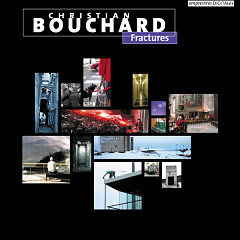
    Christian Bouchard was born amidst the turmoil of the revolutionary year of 1968, when students and workers of the Old World raged against the rulers of Europe, and while the U.S.A. was torn apart by the Vietnam War.

    Bouchard released his premier recording in 1995; a prepared guitar venture. Simultaneously, he dispersed his first attempts at electroacoustics. This proved successful, and he went on to studies with Yves Daoust. Bouchard has of late been awarded several prizes for his electroacoustics.

    The first work on this empreintes DIGITALes CD is Angle mort; a recent piece completed in 2002. The subtitles regarding the sequence of sounding events tell a story in themselves: Duel-1; Accident; Duel-2; Morphinic Night; Transfer; Microscopic Cohabitation / Scattered Memories — and the dedication gives it away too: “To my bike-riding friend”.

    These titles remind me of an August Strindberg short story, in which a man who has just lost his wife to illness and death reads through a paper of notes all the way from the engagement to the marriage to the wife’s death and the funeral arrangements; a whole life and existence summed up by short notes on a piece of paper.

    Christian Bouchard explains that he to begin with aimed at a sound world that would picture the struggle between viruses and antibodies as well as the sounds a patient would pick up at intensive care, with all the machinery around him in his dreamy state of sedation. As Bouchard was working with this, he received the news of a friend’s motorcycle accident, which threw the sound process in a somewhat different direction.

    The sound sources are submitted in Bouchard’s linear notes: “electronic sounds, oral noises, breathing, crowds, lifts, street corners, mechanical objects”.

    The work commences in a spur of cut-up white noise, splices of electronic rumbles and aural atmospheres that appear almost percussive in their sudden appearances and disappearances, as if the world was turned off and on at the whim of a child of God, playing in the nursery of the universe. It could also be mistaken for a little techno unit so and so — but it’s a different story!

    Bouchard’s cut-ups work. He doesn’t keep them up too long, but simply lets the lightning-fast excisions swoop past in precipitous angles that leave you ducking and dodging until reality starts filling up your consciousness with a seeping, wheezing fog of moist audio. It’s a more constant flow of oxygen finding its way up your nostrils and deep inside your auditory meatuses.

    As the action gets more intense, hammering down on your nerve-ends in a vibrating hell-hound breath, sounds out of a human oral cavity drools down your listening like honey down a spoon you just lifted out of a jar…

    As the piece progresses, it appears to lift you up by the neck like a kitten, speeding you through a shaman state of mind, in which secrets of life and the world are presented to you in a sonically transformed, symbolic kind of way, as in some of the most Stockhausenesque Stockhausen works (Oktophonie, Kathinkas Gesang), or like in Rolf Enström’s brilliant shaman electroacoustic work Tjidtjag & Tjidtjaggaise (Prix Italia 1987!), wherein Jonas Edvard Steggo’s Saami yoik (recorded on site in 1952) naming the two Lapland mountain peaks is turned around into another, hitherto invisible (unheard!) realm, wherein the shaman travels to the beyond and back with you, the listener, in a steady grasp.

    Bouchard manages the same notion, albeit with the victim of the motorcycle accident as the traveler, levitated out of his gravitational position in the midst of all that intensive care equipment, floating under the ceiling with all those hoses and tubes hooked up, looking like the source of life floating in weightlessness, being tapped by an alien breed, and the concrete walls of the gigantic hospital suddenly transparent like the lungs of a fish grasping for air on the pier, the whole building an organism full of cellular activity and flowing fluids of necessities, as the gravitational conversations go on between celestial bodies in deep space…

    Flakes of memories drift by, familiar voices disguised in phase shifts, childhood fears magnified, a father that reaches to the sky, his hat up there blocking the sun, the creaking of the baby carriage tearing the world apart…

    Sounds of traffic and cafeterias bring adulthood and meager spirituality; the meaningless gestures of day-to-day curling back as a curse… and the beeping of life-supporting hi-tech reaches the mind in a mimicry of Terry Riley organs, feed-back and all, finally reducing existence to its bare core; a singularity of pain and pleasure and all the states in between, from a root canal to an orgasm in an instant.

    Piece number 2 (tracks 2 — 4) is Trois miniatures en suite from 1997 — Bouchard’s first digitally produced electroacoustic work, which was made from a set of rules concerning duration and other aspects. For example, the composer is instructed to “look for soundscapes bearing the traces of the human activity that will be the only material for a miniature. Include the complete selected samples at least once.”

    Bouchard made three pieces according to these instructions, here presenting them as a suite.

    The first miniature is called Sacréboules, which mixes a passing airplane with two Chinese balls rolling, plus the sounds of a brook.

    The second one is Le point de vue du parcomètre, which Bouchard calls a “superimposition of soundscapes from a single point of view.”

    Thirdly Bouchard presents Tonicité “for base material, a single sound take.”

    Sacréboules sounds different from what the description suggests. It opens in a prickly, hardly audible, high-pitch, randomly percussive mood, perhaps an electronically transformed flow of water over rocks and pebbles (the brook), but this cannot be determined save by the confirmation of the composer, should you ask him. These sharp, beautifully trickling triangle sounds soon are accompanied by a harsh and overwhelmingly brutal, dark noise (probably the airplane), wherein the triangle sounds take on the shape of church bells which in turn bend into some sage bell bulgings from undersea consciousnesses, withdrawing into a sound world reminiscent of Pierre Henry’s Le Livre des Morts égyptien, which however is based on manipulated grand piano sounds.

    At the end the live shot of reality is revealed. Quite an exiting piece, extremely cleverly organized! This is true, vibrant, artistic sound wizardry! Many should listen and learn here! It is in the handling of small means and short durations that the true artist is revealed.

    Le point de vue du parcomètre immediately appears to be dealing with time — or perhaps the illusory measuring of time… You hear a clock being wound and the ticking of wristwatches, on a backdrop of church bells… but it’s like trying to grasp the air in your hand och running for the end of the rainbow; simply a malfunction of our way of thinking, of our way of organizing existence in our mind; a wrongly formulated question.

    Atmospheres of human societies rise in the soundscape, echoing in town mall reverberations or subway station environments, as the true nature of time looses us in a 300 000 kilometer per second flyby… constituting an aspect of space, wherein gravity is mere curved time, and our fates are smeared out on the walls of the time-space continuum like God-given graffiti…

    The third part of Trois miniatures en suiteTonicité — opens in the raw, natural vicinity of a backing dump truck, and the traffic aspect keeps up in it’s identifiable shape for a short while, until a softly panning, very benevolent and pleasurable sound soothes you and your comrades on this journey of lives…

    The soaring sensation keeps up, in a laid-back flow of time and distance, albeit after a while reminiscent of the horrendous but spiritually enlightening Ligeti -flight of 2001 — a Space Odyssey — which in fact was a shaman journey not unlike the one Rolf Enström pictures via Jonas Steggo’s yoik in Tjidtjag & Tjidtjaggaise, mentioned above.

    This, again, proves the brilliance of Christian Bouchard’s performance. It’s quite unlikely for anyone to be able to chisel such a wondrous and spiritually provoking piece of sound art out of such a meager source material — but Bouchard manages! Congratulations! This really livens me up!

    Parcelles (2002 — 2003) comes in two sections, the first on tracks 5–11, the second on tracks 12–16.

    Bouchard has a way with words, too, explaining quite poetically the aim of Parcelles. Please go to his page at empreintes DIGITALes’ site to read his whole statement. However, some of what he says boils down to the fact that he is fascinated by “magical moments” found in his sound environments, and that he tries to record those and utilize them in his art, much like a painter catches “landscapes, abstract forms” etcetera, filtering them through his personality, through his frames of reference. He calls them “fragments of moments”.

    Bouchard meticulously submits the sources of Parcelles: Iron brake out my windowSirens-Children in the nearby parkFill in the Crier at the Montréal FestivalSecrets of a Stranger in Brussels; St Michel’s CathedralNoon Comings and Goings at Saint-Malo/Intra murosWaiting for the Boeing in Paris/the ConcordeTo All Passers-by, Thanks!; very close to my micsAnd It Was So Quiet; between two carsLeap-piano, Child’s Play, at a Jazz FestivalNoted Landscape at La MalbaieSaint-Laurent BoulevardA Fragment of Solitude at Orly.

    The iron brakes out Bouchard’s window are turned into a bronze age lure in a mystical veil of age and dreamy textures — and thus it goes on through the entire Parcelles work, both parts; surprising utilizations and manipulations of windows in time, slices of reality taking on their hidden characteristics in fluent, poetic presentations that say something more and different than what is apparent just through the sum of the sounding parts — and therein lies the brilliance, the true quality of this sound art, which charms me more than most things I’ve heard lately. I can’t find one dull moment in Bouchard’s pieces. He’s the right man at the right place!

    I can’t find one dull moment in Bouchard’s pieces. He’s the right man at the right place!
    Aparanthesi, John Oswald dans Musicworks

    «Oswald is the future of music», Udo Kasemets, Musicworks, no 89, 1 juin 2004
    mardi 1 juin 2004 Presse

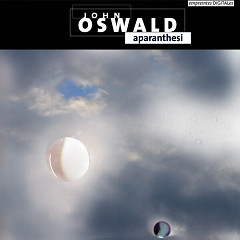
    “Perhaps the earliest sound O remembers noticing was the summer cicada. Later there was a dilemma — was the cicada biological or electrical? Where did it come from?” O is none other than John Oswald, and this quote appears early on in An Aparathentic Bio, an autobiographical memoir included in the package containing a compact disc featuring a most extraordinary, imaginative, and intelligent work of sonic art. (Indeed, I could continue with a whole series of alliterative i-words to describe the qualities of the CD: inspired, inquisitive, intimate, inviting, involving, illuminating, informing, and on and on.) When I call it a package, I don’t mean it’s packaging in the commercial sense. Sure, it has an appealing cover design. But that, too, is part of the completeness of the whole presentation. Not only is there one of Oswald’s inimitable (another i-word) photo-images on the exterior of the slide-in case, but there are also hidden images inside the cover tube. The autobiographical notes are printed on the hard covers that protect the CD. And a folded three quarters of a meter-long sheet carries, in small print, two columns of text on each side of an interview where John Oswald discusses in great detail the making and contents of the recording. Nothing of the above is window- dressing. Oswald’s work is never compartmentalized. Every aspect of research, preparation, realization, and presentation is part of a whole. So, when he writes about O’s curiosity about the cicada; or how O explored the innards of a transistor radio to understand its secrets; or how O experimented with the variable speeds of a phonograph and of reel-to-reel tape recorders; Oswald suggests to the reader that intimate involvement (yes, the i-words) with the reality of sounds and their sources is the foundation of any true musical experience. He invites (i-word!) the reader to enter into O’s world, where what appears to be simple and mundane will eventually emerge as intricate (another i-word) and even quite miraculous. Mind you, the music on the CD can be enjoyed without knowing anything about its maker and makings. Its sounds are organized so sensitively, elegantly, and competently, that their pure physicality draws the listener into the soundscape, and holds her or him there until the almost inaudible fadeout which brings both of the pieces on the disc to a close. Any attempt to describe the pieces in the framework of a brief review is doomed to failure. The parting points for the pieces are the most elementary tunings known to anybody with even the most cursory interest in sonic reality. The first Aparanthesi is based on the frequency 440 Hz — the fundamental tuning tone (named ‘A’) of the Western musical system. For the second aporanthesi Oswald chose the North American electrical standard, 60 Hz as its tuning base. As a plain sine tone, or a piano or cello sound (the only two “conventional” instruments employed), their choice may appear utterly mundane. But the commonality disappears when Oswald exploits the numerous variables underwhich these materials can be exhibited. For instance, there is a delicate but definite difference between hearing the piano range’s eight As as struck on the keyboard, and as they are modulated from a single-source A. Oswald describes one of his processes where the eighty-eight keys of a piano are all tuned to one A (“which sounds like a three-inch long guitar”). By “pitching up” or “pitching down” each of the eighty-eight keys one can imagine a “virtual” grand piano that can grow from its initial length of just ten inches to a monster of over one hundred feet. Not only does Oswald tune the sine, piano, and cello tones to the basic pitch (or its multiples) of the piece, but he does the same with the sounds of thunder, birds, foghorns, and cattle. But it is not just the choice of the sounds — synthetic, instrumental, and of nature — that makes listening to the two Aparanthesi such a special experience; it is also John Oswald’s ability to handle the fadings in and out, the blendings and unblendings, and the spacings and timings of the various materials and their combinations with exquisite taste and acoustic sensitivity. In other words, it is the supreme artistry of John Oswald that gives Aparanthesi its uniquely special quality. I suggested earlier that listening to this CD is thoroughly enjoyable even without reading any of the texts included in the package. (By the way, the package is bilingual: An Aparathentic Bio is in French, the interview in English. Nevertheless, much is to be gained by taking time and with O’s formative years and his personality through his own words. It is not an autobiography like most. It is not about “Look what I have achieved”; it is about “Look — everything, even the smallest, the simplest, is interesting.” And the three-meters-long transcript of the descriptive interview provides a wonderful guide to the listener on how to become an informed partner of a musical process from its genesis in the researcher’s mind to the final consummation in the listener’s ear. Every serious music student should spend hours (and days) with Aparanthesi. Elsewhere in this issue of Musicworks I suggest that we are at the end of an era of musical development in Western culture, and that a new era is in the primal stage of its making. If the clarity of mind, intellectual discipline, and aural sensitivity that went into the process of the production of Aparanthesi is an indication of the direction music of the twenty-first century will take, the future is bright.

    … a most extraordinary, imaginative, and intelligent work of sonic art.
  • 11
  • 12
  • 13
  • 14
  • 15
  • 16
  • 17
  • 18
  • 19