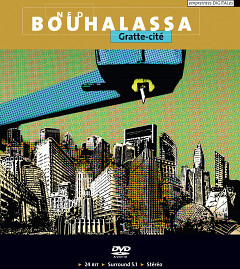
Ned Bouhalassa, for some reason, is such a familiar name to me that I instantly was sure that I had reviewed his work before within the framework of empreintes DIGITALes, but I hadn’t! After some bewildered thinking I found that he’d been a frequent participant at the CEC mailinglist, and that was the solution to my sudden problem. Bouhalassa introduces his DVD-Audio in such a graphic and catchy way that I might as well quote him here:
“The title of this disc translates to ‘cityscraper’ In preparing the sonic materials for these pieces, I selected, like a DJ, what I liked out of my large collection of recordings, though in my case, these are recordings of city soundscapes. I then imagined a fantasy, where a gigantic vinyl record’s grooves are replaced by the jagged outline of skyscrapers, and I, a giant, drop an impossibly-large needle and begin to ‘play’ the city.”
Track 1. The Lighthouse (2005) [6:41]
This work isn’t solely a sound work in its own right, but was composed for a video by Khrystell E Burlin; The Lighthouse; the third part of the triptych Theseus. Bouhalassa opens up his cloud of ingredients; motioning towards “loops of filtered noise, synthesizer textures, urban samples, horse hoof rhythms, creaking doors, a bell, drum and bass sounds, break beats, crackling smack downs, radio whispers from an old war” and more.
The music commences on that double vision view; a jangling of hinges (perhaps a merchant opening up onto the street in Lahore) and a symphonic low-key string section from Tchaikovsky’s late 1800s, right before a contaminated glass of water in St Petersburg.
After a little while the two worlds are indistinguishable, as the soughing of the distant engines of the city take on their own collective symphonic traits; the factory siren appearing in the brass section. Gray voices without words leaking out of the central station move like bubbles on water deep inside the city’s consciousness, moving the matter-of-factly weights of internal meaning. The clicketycklicking horseshoes across cobbled streets remind me — because of the electroacoustic environment — of Alain Savouret’s Don Quixotte Corporation (1980 — 81).
Insectlike beats wheeze out of the background sonic pollution like cockroaches out of cracks in Dallas kitchens, soon becoming so obtrusively mechanic that the insects, if indeed they retain their guises, must be a case of robot entomology.
A grinding machine may as well be an old style fuzz box guitar in Bristol, UK, and the munching beats the repercussions of a boat engine hid deep beneath the hull on a vessel out on the Avon.
At times the soundscape solidifies into crystalline worlds of sharp angles, and yet other times reality gets a grip as familiar street scenes condensate on the window of the mind, only to dissipate in the passing of time units.
Mostly, though, it’s a maze of dreams you journey through Ned Bouhalassa’s opening work on this phonogram. I can even hear and feel the swinging on a swing; that fluctuation in gravity and that smooth air rushing back round your face…
Tracks 2 — 6. Urban Cuts (2005) [34:06]: Montréal 1 / Montréal 2 / Las Vegas / Berlin 1 / Berlin 2
Fortner Anderson [texts] Delphine Measroch [cello] Christian Olsen [drums]
Life seems so incredibly natural and self-evident in these cuts, although it is so brittle and elusive in its many temporal identities, as we shall se as we change bodies at the end of the turnstile. Nutritional processes well forth in Bouhalassa’s Urban Cuts, unstoppable even by death, which really isn’t any clear line at all, since processes keep working matter long after that over-dramatized change. Life is a carnival and death too; a meaty, smacking, bulging meat feast, fucking and farting, Rabelaisian, as is this music, which works right inside these natural processes, these exchanges of nutrients and wastes; wastes that become nutrients, noises that become sounds that become music that become mathematic and philosophy and high ends in themselves!
Ingredients from human and other terrestrial life fly up and flutter around like flakes of soot in Ned Bouhalassa’s Urban Cuts, too many examples to really mention, except that the stitching together of these expressions of energy excites you as a listener. It is easy to do these kinds of mosaics these days, when you don’t have to cut and splice like Stockhausen in Kontakte — so the creative process is, in a funny way, wrung over to the listener and his perceptive intelligence. Out of Urban Cuts the experienced listener may construct many a situation, different on each run-through.
The composer explains that he’s mixed sounds from three great cities; Montréal, Las Vegas and Berlin, and also that he cooperated with live musicians herein; Delphine Measroch on cello and Christian Olsen on drums.
At times the haphazard feeling of randomness gives way to seemingly more constructed stretches of audio, and even long, bending drones, in which the spoken parts emerge, either as a murmur bubbling in the distance, like a mirage along a desert highway, or right up your face, close; the rancid breath of the words gushing up your nostrils, bouncing off the corrugated iron of Rio de Janeiro hillside slums, here and there in fascist drum beats setting the pace of an obsessive march through your mysteriously migrating mind.
I like it when the talk touches on Harry Partch and Barstow! I like it when Bouhalassa sounds like Mike Daily in Alarm!
Tracks 7 — 10. mOrpheus (2003) [15:42]: Orpheus’ First Dream / Orpheus Wakes Up / The Train Station / Alexanderplatz
Ned Bouhalassa explains that this piece is “a loose interpretation” of the myth of Orpheus & Eurydice, involving a motion from rural Quebec to Berlin, swirling through the cityscape of the German city.
The music commences on such a gradual level that you begin to check if the amplifier really is on, but slowly an ambience grows on you, like a slow Saturday morning awakening after a hard workweek. The environment you find yourself in is a mixture of the natural and the synthetic, like it often is in Bouhalassa’s sound world. The composer lets on that he’s used sonic ingredients from the farm of his friend Michael Smith. Out of this soaring, glaring coat of mind rise more definite, contoured sonic objects, sounding like piano tones flying through an atmosphere that makes them sway and wobble. Percussive events mix in, although painted in a heavy coat of ambience, and after a while a rock n’ roll tour de force moves like a fist inside a leather glove, in semi-darkness.
The atmosphere thins out, placing you at four o clock in the morning on a lawn in a Berlin park, your pants wet from the dew. History is sleeping, and your heart picks up a heavy rhythm — or is it the trembling vitality of your mind shaking you up, when nothing else is very obvious around you?
A grated scent of a pop melody struts softly through your memory, but always at arm length’s distance, never getting any closer, and then… “Einstegien bitte!” — a crude female voice talking at you from out of the German orderliness, and a train picks up speed, while the female rigor is sucked up in the composer’s sound-poetic permutation, reaching it’s individual Einheit, which dances up through the escape shaft of your mind. Language and dreams, Eisenbahn und Träume!
Through an atmosphere of echoing tunnel steps of a city and a gray mist of anonymities a Kraftwerk rhythm taps its fingers absentmindedly against the table top of the present, while your legs stretch far out of reach, entangled in a future that isn’t yet determined.
Track 11. Impulse (1999) [13:59]
Ned Bouhalassa defines this work as rather indefinable; as “spaces that are not clearly comfortable or unpleasant” — a Bardo journey, then, it seems, in which reflections of one’s own mind builds the scenery. “The doors and resonating hallways push us to the edges of our imagination”. Bouhalassa explains that he’s made field recordings in the basement of the National Film Board in Montréal, using them as “a kind of narrative”.
Indeed, the piece starts up like a car engine, with a car engine! It doesn’t take long, though, before a sense of unreality, or dreamscape, takes over — and as in many other works of the composer, the mix of reality and synthesizing of that reality swirls the listener with almost brute force and suddenness. Behind a bland pop beat an echo of the mysteriously unknown keeps your ears towards the unexpected open, and before you know it — like driving a car into a bank of fog — everything has changed, and you start to wonder who you are…
Track 12. Songe errant (2005) [5:50]
This is presented as a bagatelle, a minuscule, passing daydream: “A postcard to trigger some memories” A door on screechy hinges opens the piece with historical homages. Water flushes down a kitchen sink, and a hardly visible (audible) distant character inside the ambience grows on you like a fever, slowly encompassing the whole sounding space like a hovering swarm of bees. Distant reflections of sound from a reality that once was yours leaks into the bee swarm in a muffled amnesia. The situation is unclear, as if you’re coming to in a hospital bed after anesthesia, or like gaining new consciousness again and again, as you are reborn, over and over. Glary reflections of repetitious Renaissance atmospheres shift centuries into the circling present, which takes you in its determined hands and holds you up to yourself to watch, closely — as all symbols of force and might fall away from you, outwards, in a gesture of God’s open hand — which is summer —, while a female voice out of the mist of the mind sounds like an Irish folk song whisper, though it really is a recording of instructions blaring out of an airport speaker, talking about unaccompanied baggage. Brian Eno-type musical figures carry you in a meditative mood down the duration of whatever situation you’re in, as the truth of impermanence becomes ever more evident. All times are now, all places here — and Ned Bouhalassa’s Songe errant makes you feel like life is just a memory; that you remember your life, minute by minute — and that this remembrance IS life…

![Francis Dhomont [Lisbonne (Portugal), 30 novembre 2018]](https://res.electrocd.com/image.php/image/d/dhomont_fr.9171.jpg?width=n2&cropratio=1:1)