Although she has released pieces on compilations since 1995, Intérieurs harmoniques is composer Elizabeth Hoffman’s first full-length CD. It features six fine electroacoustic works realized at her New York City studio between 2001 and 2011, and mastered for this recording by Dominique Bassal. After listening to this CD it is clear that the composer is adept at juxtaposing separate timbral layers, related through various processing techniques, into kaleidoscopic collage forms. These pieces, unified through conceptual or abstract exploration, are firmly situated within the acousmatic tradition.
According to the composer’s liner notes, Resonants, the first piece in this collection, presents an “aural puzzle” in which the sounds “seem to be both activated and self-activating.” The listener is pulled between what she calls “reduced listening” and “source sound listening” (Pierre Schaeffer’s terms). I take reduced listening to mean a focused type of listening in which one notices subtle changes of timbre, as if listening to an object close-up. In Resonants one hears readily identifiable objects such as cymbals or bells, often manipulated via amplitude modulation. The collage form favored by the composer is one in which distinct material layers sound simultaneously in juxtaposition. For example, repeated groups of percussive sounds in the foreground are placed against a drone backdrop. But the effect is so much more than mere juxtaposition since Hoffman’s layers shift in and out of perceptual focus, which she achieves through careful changes of amplitude and spatial trajectory. Nothing is static in this piece. Sounds morph from one extreme timbre to another. This is evident when about a third of the way into the piece a low, rumbling timpani-like sound changes into a brittle swarm of insects. All of this culminates, at the golden section, into a poignant moment where a highly resonant, low-pitch drone comes into the foreground, followed by drum-like sounds that serve to mark this moment while also supplanting it. Resonants is a continuous, through-composed piece, though materials are obviously reused and transformed. During the last 40 seconds or so the texture finally thins out, revealing an intriguing palette of “timbral resonance.”
The second piece, Water Spirits, combines water and vocal sounds that are sonically transformed by algorithms created by the composer to modify microrhythmic and timbral details. The effect sounds very close to granular synthesis. According to Hoffman, the algorithms she uses “rearrange or eliminate data [to create] statistically accurate but temporally jumbled waveforms or sequentially accurate but incomplete waveforms.” Her description might imply a messy, inconsistent array of sounds, but this is not the case. Hoffman wants the listener to experience “a slightly askew tactility of otherwise familiar sounds.” She is largely successful in this endeavor, though the algorithms she uses work over her material without coming up with much that one might describe as novel or surprising. This might have occurred if she had submitted the water and vocal sounds to more variation, or combined them in a more timbrally unified manner such as one hears in many electroacoustic pieces by Paul Lansky. Also, one gets the sense that this piece would carry more tactile or visceral weight if heard in a concert setting on large and powerful speakers, which would allow the low frequencies she uses to literally move the listener’s body.
In Songstressed, one of the best pieces on this CD, Hoffman is unafraid to let her textures remain thin and transparent, implying more with less, if you will. The general pacing of events is relaxed and patient. Frequency bandwidths slowly come into focus and then dissipate, wavelike. Near the beginning of the piece there is a low, rumbling timbre that sounds as if one were listening to a chorus of voices slowed down and processed through a low-pass filter. From here, Hoffman gradually introduces birdsong and bird chatter, effectively spatialized via slow panning. The birdcall recordings she uses are amplitude-modulated to create a dynamic warbling effect, which is further manipulated through convolution reverb-like techniques. The overall sense of this piece is of a long build-up to something that never happens, not unlike what occurs in Samuel Beckett’s plays but on a much smaller time frame. The piece seems to end unexpectedly at 9:40, however—about a minute and a half before the actual end. At this point the composer allows the unprocessed birdsong to be heard intact, and then within long trails of resonance.
In D-ness Hoffman uses violin samples in order to explore the violin’s natural resonance characteristics. When I first heard this piece, a surreal image of D major pixies frolicking at a fiddler’s tailgating party came to mind. The composer describes D-ness as “exuberant” and “sunny.” Images and adjectives aside, this piece uses convolution reverb fed with effectively layered string attacks in sharp relief. The delicate, unsteady moments are the most effective, especially where the composer seems to use a fast, pulse-wave modulator to amplitude-modulate the violin materials, sounding as if you’re hearing these materials through a perforated wall in your cochlea. The piece ends with a long fade-out in which the sampled violin sound briefly makes an appearance in an unprocessed form.
Allamuchy, the fifth piece on this CD, begins with a thick, flanged frequency-modulation patch. Other materials carefully surround and interact with this primary timbral focus, palpably swirling around the listener as they are developed. The effect is filmic in scope and quite engaging. About halfway through the piece the composer shifts gears and introduces restless flapping and walking sounds, while continuing the swirling effect from the first half of the piece. About 1:45 from the end a slowed-down, crow-like sound is heard, juxtaposed with low-pass filtered noise, sounding not unlike a subway or ocean environment. The progression from a key-centered texture in the first half, to the noisecentered materials in the second half, is tangibly coherent.
In the final piece, Soundendipities, Hoffman wanted to convey in sound a “hyper-frenetic immobility.” The texture is supposed to “suggest an external world seen too close up for one to recognize any substances.” In this respect the beginning of the piece is promising. One hears a rich, timestretched, convolution-reverb drone texture with sounds that are largely unrecognizable. Various tremolo speeds and depths gradually enter and exit, each time threatening to destabilize the predominant texture. Timbres fade in and out while others remain in an undulating stasis. For the former, Hoffman creates some that sound like a randomized pinball machine. For the latter, she creates some elegant drones from comb-filtering techniques. This is the shortest piece on the CD, and one gets the sense that its length lends a certain kind of intensity, or event compression, that is not necessarily the case with some of the earlier pieces. As the piece fades out one is left with the feeling that it ends a little too early, creating a desire to hear more.
Hoffman favors organic development cast within a collage form. She seems less concerned with the smaller subtleties of timbre than with the big picture. The works on this disc, all between 9 and 14 minutes, tend to reveal their unprocessed sonic materials near the end, after they’ve been thoroughly processed and developed. After listening to this CD you’ll want to hear more by this composer.
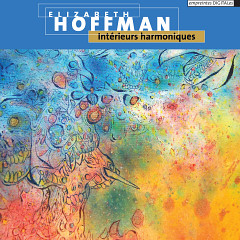
Finally, a word about the CD’s packaging: The empreintes DIGITALes package seems a little slapdash, mostly due to the use of extrathin cardboard. In fact it’s so thin that the slightest pressure from the shrink-wrap distorts its square shape. Also, the CD itself is not housed in a tray card, but instead is partially contained in a haphazard half piece of folded cardboard that easily falls out, and is much more difficult to return to its original configuration. Nevertheless, the package features a nicely rendered, Chagall-like painting by Giles Lyon.

![Andrew Lewis [Photo: Bea Borgers, Bruxelles (Belgique), 27 octobre 2018]](https://res.electrocd.com/image.php/image/l/lewis_an.9194.jpg?width=n2&cropratio=1:1)