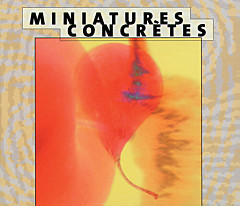
Miniatures concrètes is a CD of 24 three-minute works by 25 composers and is a very worthy successor to the same label’s excellent Électro clips (25 pieces by 25 composers) which appeared in 1990. Miniatures concrètes, however is quite different from its predecessor. More than simply a collection of short pieces it’s a strangely coherent ‘suite’ lasting for over 70 minutes. How much this was the conscious intention of the label’s artistic director, Jean-François Denis, is unclear, but for me it certainly works like this. The CD is both fascinating and fun. All of the works repay repeated and closer listening, whilst most are also immediately attractive.
Although there is no explicit information in the CD booklet on the ideas behind the project, it is apparent from individual composers’ notes that each was given (the same) three recorded sounds and asked to divide their piece into two sections of 15 seconds and 2 minutes 45 seconds. I have to admit to being initially sceptical, but the quality of the pieces and the variety of styles and approaches, along with the additional sound materials chosen by each composer, mean that the results are wonderfully varied. And the ordering of the tracks, itself an act of (unaccredited) composition, gives the whole disc a level of structural interest which I hadn’t expected.
Listening to the pieces, the ‘given’ sounds start to become obvious, sometimes apparently untreated, often transformed, extended and mixed. But even when we hear them clearly, just what the made the sounds is never certain, and different composers suggest different solutions to the riddle through their contextualisation. As for the added materials, some composers play with recognisable, ‘real’ sounds, others with more abstract colours; some pieces seem to suggest narrative, some make reference to other musics, and others occupy more surreal landscapes. Successive pieces fluctuate between beautiful and frantic, severe and humorous, enigmatic and filmic (including Sylvia Eckermann and Mathias Fuchs’ contribution to the ‘Horror and Suspense’ genre!), and the range of possibilities from music to sound-art is thoroughly explored so your ears are forever jumping between different sorts of listening.
In the end it’s difficult to pick out pieces or composers for special mention. Perhaps there are pieces which are better than others, but it is the combination of pieces and the threads which link them together which make this CD such a success, and none of the pieces is superfluous to it. The following brief descriptions, then, just give a taste of the variety.
In Jacques Tremblay’s fiery opening, Le Vidoir, sounds spin and collide, manic echoes of a dozen different musics viciously intercut. Kim Hedås’ piece, Princess Bat with the Underground Stars, has a wonderful clarity of layering, sudden changes in pacing and extremes of space marking out a landscape which is inhabited by surreal creatures — close-up metal insects giving way to larger life forms in huge imaginary spaces.
Andrew Yencken’s ‘day job’ as a sound editor for film is reflected in his choice of materials for Balanço which is a succession of superbly articulated transitions between vivid realities. Roger Doyle, on the other hand, throws melodic fragments together with a sampler to create a hectic, crazy musical world like a wild fairground organ in The First Spirit Level, a headlong rush to the sudden three minute cut-off.
Natasha Barrett’s gestures in Racing Through, Racing Unseen, are distinct and powerful and there is a real sense of control of materials from the naturalistic to the synthetic. Monique Jean’s Lacrimous, on the other hand, plays much more with ambiguity, her subtle mixing and transformation allowing sounds to surface then dissolve gently back into textures.
From Le Vidoir to the final piece, Justice Olsson’s gently rhythmic and melodic A Man is a Delicate Flame, the composers have left their distinctive prints (and in at least two cases, echoes of yet other composers!), yet, however different, the trail of shared materials links them powerfully together.
In teaching I found Électro clips invaluable, and Miniatures concrètes too is a rich resource. It is immediately useful as an introduction to those new to the technology or new to working with recorded sound, showing how fairly ordinary sounds can be put into a number of musical contexts in some pretty extraordinary ways. And to have these distillations of so many styles for comparison gives a powerful incentive to dig further into other pieces by some of the same composers.
Miniatures concrètes, is a hugely enjoyable CD and a fascinating snapshot of just some of the composers working in the late nineties, which I would thoroughly recommend.

![Robert Normandeau [Photo: Caroline Campeau, Montréal (Québec), September 3, 2021]](https://res.electrocd.com/image.php/image/n/normandeau_ro.12007.jpg?width=n2&cropratio=1:1)