electrocd

More from the blog

27 results
  • 1
  • 2
  • 3
  • 4
  • 5
  • Isostasie in Avant Music News

    “AMN Review”, Michael Eisenberg, Avant Music News, February 15, 2021
    Wednesday, February 17, 2021 Press

    Natasha Barrett paints with sound… but the color of her canvas is black.

    After not hearing this wonderful release for several years, I recently went back and revisited much of her catalog (through headphones) and was amazed at the, lets call it 3-D’ness of this release, as well as the other empreintes DIGITALes release Bouteilles de Klein from 2010. The sense of multi-dimensionality in these recordings (and others not on this label) is at first curious, as in “wow, this is unusual” but then quickly graduates to utter fascination and childlike marvel at the sound tableau that is laid out in front, above, below and behind you.

    I mean, this stuff is totally surreal! What’s interesting to me is, as much as Ms. Barrett seems to live and breathe technology, her sound sources are primarily natural and elemental. Reading some of the notes on her website/blog she’s not afraid to go out into the world to capture the environment as field recordings. Some of these excursions sound downright risky. The longest piece on this record, Viva la Selva! takes us on an 18-minute sonic trip through a Central American rain forest. Incorporeal / intangible sounds seem to approach the listener from all directions. Human sounds are sometimes substituted for animal sounds, and the distinction is often blurred. The rain forest at night sounds at once inviting, and at the same time menacing. The spatiality of it all is astounding.

    Speaking of spatiality, this is a quality that turns up in most of her music. I opened this write-up by saying she paints on a black surface. I say this because the sensory perceptions that this listener gets while experiencing her music seems to come from some dark landscape and not from any particular direction in space. In the piece The Utility of Space, human voice and other indeterminate sounds appear to be materializing from a pitch-black velvet source, only to be momentarily illuminated to allow the brain to register that they are even there. My favorite piece on the album Red Snow has so many sonic easter eggs that delight the listener upon discovery it’s almost overkill. Between all the micro sounds that are spinning around the 3-dimensional sound stage and the more organic earthly sounds like footsteps in crunchy snow… the mind just struggles to keep up with it all.

    The shorter pieces on this album are no less appealing. The opening 3 works form a trilogy entitled Three Fictions and each presents the listener to a different micro-climate or meteorological event. Upon these backdrops, the composer added a whispered female voice that imbues a phantasmagorical / mystical quality to the piece. The whispered voice takes shape out of nowhere with nothing concrete holding it in place… a whisp of nothingness that somehow forms itself upon the listener’s psyche, if only for a few seconds before disintegrating into something less than its molecular structure… forever.

    This is music that does not reveal itself completely on the first, or for that matter the tenth listening. Instead, each visit back to these works is like listening to it fresh. New sounds that you swear you’ve never heard before appear out of nowhere. One can only relax and let it wash over you. If you are a fan of ambisonic or binaural recordings, recommending Natasha Barrett will be an easy sell. If you are a more seasoned Acousmatic listener but have never heard her, I would suggest running (not walking) to your favorite vendor and take the plunge. Careful headphone listening is strongly recommended. The composer makes ample use of deep, subsonic frequencies. Personally, from a guy who likes to listen to Acousmatic music at fairly high volumes, Barrett’s music doesn’t require this at all. In fact, as a word of caution, these deep (not bassy, but DEEP) sounds can really do a number on headphones or earbuds. Lower volume is in order here, and it in no way takes away from the enjoyment of the experience. Without headphones, a subwoofer will work wonders. Isostasie is a fantastic point of departure! I plan on doing a future write up of Bouteilles de Klein soon.

    … I would suggest running (not walking) to your favorite vendor and take the plunge.

    Isostasie, Rhizomes, Évidence matérielle, Traces, Jeu d’ombres, Sources / scènes, Tao, La limite du bruit, Jonty Harrison, Åke Parmerud, Denis Smalley, Annette Vande Gorne, empreintes DIGITALes in electrocd.com

    “An Itinerary Through Northern Europe”, François Couture, electrocd.com, February 9, 2004
    Monday, February 9, 2004 Press

    This is a casual listening path, an invitation to travel — not a guided tour per se, more of an itinerary, akin to Romantic-era travel literature. So this will be a listening itinerary, an invitation to discover a highly subjective selection of electroacoustic composers from a specific corner of the world. Our destination: Northern Europe.

    France reigns over European electroacoustic music like a despotic queen. The persisting influence of Pierre Schaeffer’s work — even more than 50 years after the invention of what he has called “musique concrète” — and the gravitational pull of the Ina-GRM tend to hide from the rest of the world the work being accomplished elsewhere in Europe.

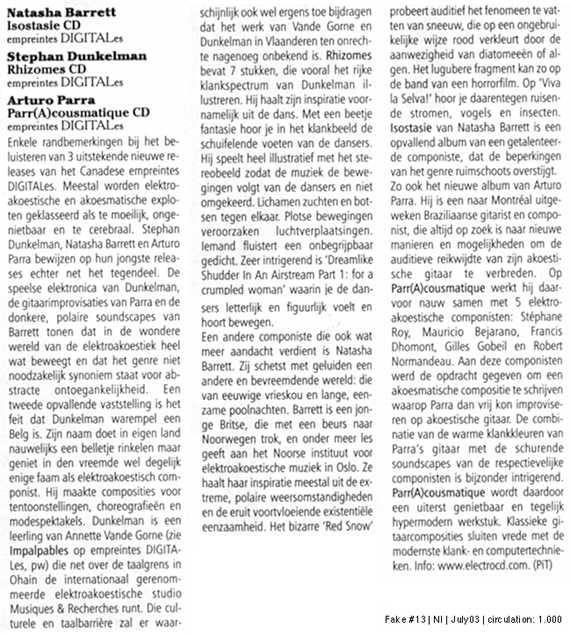
    So let’s start our journey in one of France’s neighbors, Belgium. The country owes much of its electroacoustic activity to Annette Vande Gorne, the indefatigable animator of the Musiques & Recherches center. Her music displays a strong sense of serenity, something rare in the field of tape music. Tao, a cycle about the five base elements (air, earth, metal, fire and water), remains a classic. In it she explores every possible transformation of the sounds associated to these elements with an uncommon level of artistry and poetry. A student of Vande Gorne, Stephan Dunkelman has picked up on her grace, a grace he transmutes into movement. Often the result of a collaboration with choreographers, his works are driven by an inner force that substitutes the sensuality of movement to Vande Gorne’s philosophical — almost mystical — depth. His pieces Rituellipses and Thru, Above and Between, released on the album Rhizomes, deserve your attention.

    A jump across the Northern Sea and we set foot on English ground. Birmingham has become an important creative node in electroacoustic music, thanks to the work of composer Jonty Harrsison and his Birmingham ElectroAcoustic Sound Theatre (better known as BEAST), a laboratory for experimentation and sound diffusion that has helped many talented composers in developing their art. Harrison’s music is an essential listen. His piece Klang (released on Évidence matérielle) ranks among the best-known electroacoustic works of the last 25 years. His precise sound constructions and his distinctive way of compressing sound matter into streams of energy put him up there with Pierre Henry, Francis Dhomont and Bernard Bernard Parmegiani. One can follow the traces of his techniques into the works of Adrian Moore, one of his students, especially in the latter’s fondness for putting simple sound sources (marker on a white board, tin foil) through complex transformations. Sieve, from the album Traces, uses a catchy playfulness to make this transformative process transparent.

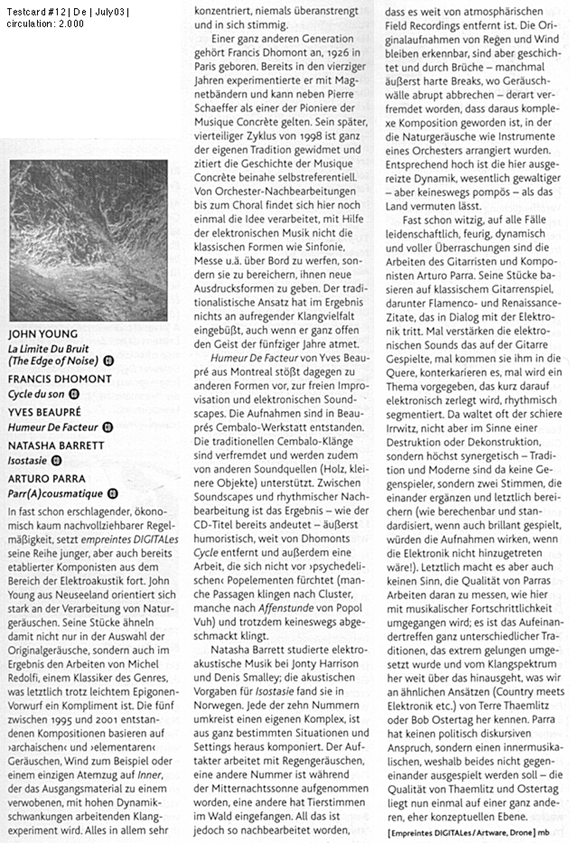
    Denis Smalley was born and raised in New Zealand, but he has been living in the UK since the mid-‘70s. His contributions to the acousmatic corpus and to the development of sound diffusion make him not only the contemporary but in a sense the acolyte of Harrison. Furthermore, the two composers share a similar interest in form and in the choreographed displacement of abstract sound objects through space and time. Wind Chimes (on Impacts intérieurs) and Base Metals (on Sources/Scènes) are good illustrations of the slightly cold yet fascinating beauty of his music. John Young, one of his students — and another New-Zealander who studied and now teaches in England), follows a similar approach, although he replaces Smalley’s elemental sound sources with more emotionally charged images. The works featured on his CD La limite du bruit offer to the listener several occasions to dive into his or her own memories, the sound of a squeaky swing or a creaky door turning into avatars of Proust’s madeleine. Time, Motion and Memory is a choice cut.

    Scandinavian electroacoustic music is still too largely ignored on our side of the Atlantic, but empreintes DIGITALes’ catalog allows us to make a short stop to round up our peregrinations. Natasha Barrett has studied with Harrison and Smalley and has been involved in BEAST, but since 1998 she has elected Norway as her base camp. There, she has stepped away from the style of her teachers and has sought inspiration in the Nordic cold. Her Three Fictions, released on Isostasie, deserve many listens. And let me bring this listening path to an end with one of the key composers in electroacoustic music today, the Swedish Åke Parmerud, whose Renaissance (on Jeu d’ombres) pays tribute to the analog synthesizer without resorting to nostalgic tricks.

    Isostasie, Rhizomes, Parr(A)cousmatique in Skug

    “Kritik”, Tobias Bolt, Skug, no. 54, June 14, 2003
    Saturday, June 14, 2003 Press

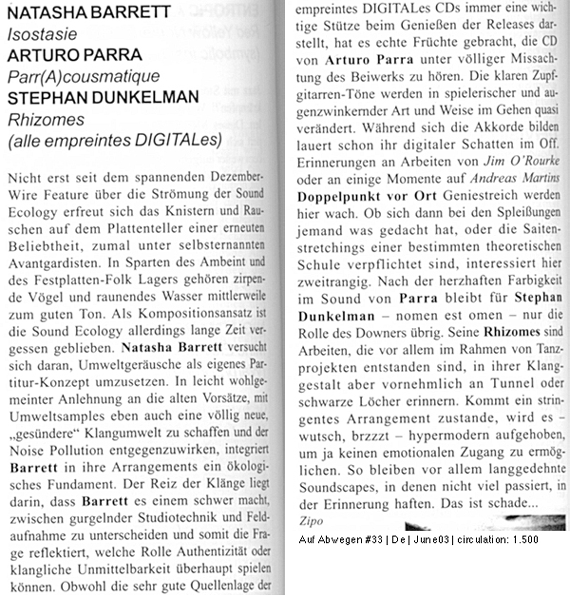
    Der, zumeist im geologischen Zusammenhang verwendete, und einen Gleichgewichtszustand beschreibende Begriff der»Isostasie«ist der Titel von Natasha Barrets drittem Album, auf dem die Komponistin und Sound-Ökologin verschiedene lokale Naturphänomene, wie die Mitternachtssonne oder »Roten Schnee« mittels elektroakustischer Klangforschungen abstrakt umreißt. Die zehn glasklaren, kalten Impressionen aus ihrer Wahlheimat Norwegen, durchwegs spannend und mit einer ausgeprägten Liebe zum Detail gestaltet, fegen wie ein eisiger Nordwind aus den Boxen und kristallisieren zu glitzernden Klangskulpuren voll gespenstischer Schönheit.

    Noch ein wenig abstrakter kommt das Album des belgischen Komponisten Stephan Dunkelman daher. Seine nicht nur für Konzerte, sondern auch für Ausstellungen und Tanzaufführungen komponierten Stücke spielen gekonnt mit Musik im Raum/Zeit-Kontext, sowie laut/leise-Kontrasten. Die zu Beginn etwas diffus anmutenden Soundscapes geraten mit zunehmender Spieldauer zu einem durchaus hörenswerten Ganzen, in dem sich die verschiedenen Geräusche tatsächlich wie»Rhizome«(dieser ursprünglich aus der Botanik stammende Begriff wurde von Deleuze und Guattari als Metapher für Hypertextualität verwendet) von den Spitzen weg in verschiedenste Richtungen fortpflanzen.

    Der Titel von Arturo Parras Album wiederum weist ganz konkret auf seine Entstehungsweise hin: fünf »acousmatische« Stücke für Tape, von Parra an ebenso viele verschiedene Komponisten in Auftrag gegeben, werden auf»Parr(A)cousmatique«von dem kolumbianischen Gitarristen mit seinem expressiven Spiel auf der akustischen Gitarre konterkariert. Ein atmosphärisch unglaublich dicht geratenes Album, in dem sich ruhige, einfühlsame Passagen mit explosiven Fingerpickings und stakkatoartigen Rhythmusattacken abwechseln. Das in Parras Spiel omnipräsente lebensfreudige Flamencofeeling paart sich hier auf ganz wunderbare, ungewöhnliche Weise mit der Musique Concrète der Tape-Kompositionen. Eine absolute Empfehlung. Alle drei Veröffentlichungen beinhalten in den äußerst ansprechend gestalteten Pappkarton-Schubern umfangreiches Informationsmaterial, darunter Biographien, Details zum Release sowie Kommentare der Künstler zu den einzelnen Stücken in englischer und französischer Sprache.

    Eine absolute Empfehlung.
  • 1
  • 2
  • 3
  • 4
  • 5