
Haïkus
Annette Vande Gorne
… cette fois à Montréal, c’est son chapeau de compositrice en 2022, car elle n’a pas dit son dernier son
! — PAN M 360, Québec
Both come solidly and completely recommended
! — Avant Music News
Octaves de la musique 2021: Album de l’année — Musique contemporaine — Lauréat
- Composer(s): Annette Vande Gorne
- Author(s): Miguel Mesquita da Cunha
- Cover image: Luc Beauchemin
- Fédération Wallonie-Bruxelles (Administration générale de la culture, Service de la musique)
CD (IMED 20164, 2020)
- 1Haïkus (2016-20), 57:16fixed medium
- 1Jour de l’an [New Year’s Day] [1/2] (2020), 4:39
- 1Feux d’artifice (d’après Debussy) [Fireworks (After Debussy)], 4:39
- 2Printemps [Spring] (2016), 8:02
- 2Jeux d’oiseaux [Bird Games], 2:55
- 3Jeux d’eau [Water Games], 2:24
- 4Jeux d’enfants [Children’s Games], 2:40
- 5Été [Summer] (2018-19), 11:24
- 5Jeux d’insectes lancinants [Nagging Insect Games], 2:45
- 6Songe d’un après-midi d’été [A Midsummer Afternoon’s Dream], 5:06
- 7Voyage immobile [Motionless Journey], 1:24
- 8Danse folle des feux follets [Witty Dance of The Wisps], 1:55
- 9Automne [Autumn] (2019-20), 13:03
- 9Jeux mécaniques [Mechanical Games], 4:36
- 10Jeux étendus, brouillard [Extensive Games, Fog], 2:53
- 11Jeux fragmentés, feuilles d’automne [Fragmented Games, Autumn Leaves] (2020), 2:34
- 12Jeux répétés [Repeated Games], 2:54
- 13Hiver [Winter] (2016-18), 14:07
- 13Jeux de pas sur la neige [Footsteps on The Snow], 2:15
- 14Jeux monotones [Monotonous Games], 3:58
- 15Jeux de grains au coin du feu [Games of Grains by The Fire], 3:12
- 16Jeux de sons [Sound Games], 4:30
- 17Jour de l’an [New Year’s Day] [2/2] (2020), 5:56
- 17Jour de fête [Celebration Day], 5:56
- Label: empreintes DIGITALes
- IMED 20164
- 2020
- UCC 771028216420
- Total duration: 57:16
- OGpak
- 125 mm × 125 mm × 10 mm
- 50 g
Download (IMED 20164_NUM, 2020)
- This item can be downloaded and/or listened to at empreintesdigitales.bandcamp.com.
- 1Haïkus (2016-20), 57:16fixed medium
- 1Jour de l’an [New Year’s Day] [1/2] (2020), 4:39
- 1Feux d’artifice (d’après Debussy) [Fireworks (After Debussy)], 4:39
- 2Printemps [Spring] (2016), 8:02
- 2Jeux d’oiseaux [Bird Games], 2:55
- 3Jeux d’eau [Water Games], 2:24
- 4Jeux d’enfants [Children’s Games], 2:40
- 5Été [Summer] (2018-19), 11:24
- 5Jeux d’insectes lancinants [Nagging Insect Games], 2:45
- 6Songe d’un après-midi d’été [A Midsummer Afternoon’s Dream], 5:06
- 7Voyage immobile [Motionless Journey], 1:24
- 8Danse folle des feux follets [Witty Dance of The Wisps], 1:55
- 9Automne [Autumn] (2019-20), 13:03
- 9Jeux mécaniques [Mechanical Games], 4:36
- 10Jeux étendus, brouillard [Extensive Games, Fog], 2:53
- 11Jeux fragmentés, feuilles d’automne [Fragmented Games, Autumn Leaves] (2020), 2:34
- 12Jeux répétés [Repeated Games], 2:54
- 13Hiver [Winter] (2016-18), 14:07
- 13Jeux de pas sur la neige [Footsteps on The Snow], 2:15
- 14Jeux monotones [Monotonous Games], 3:58
- 15Jeux de grains au coin du feu [Games of Grains by The Fire], 3:12
- 16Jeux de sons [Sound Games], 4:30
- 17Jour de l’an [New Year’s Day] [2/2] (2020), 5:56
- 17Jour de fête [Celebration Day], 5:56
- Label: empreintes DIGITALes
- IMED 20164_NUM
- 2020
- UCC 771028216482
- Total duration: 57:16
Liner notes
Dear Annette,
Dear Annette,
To assemble iridescences as fleeting as fundamental particles (cohobated in your electronic still with much patience and desire), to compose sonic spurts out of those scattered myriads, to bring forth new theories out of their fulguration, and to let whoever listens to them completely free to chase their light – while listening to your
What you stretched out in front of our eyes was not a corny saccharine springtime, but the sacred crescendo of lively mornings, decisive beginnings where sap shoots up vigorously so that summer may come, when the opening of the most delicate of buds is imbued with imperative absolute – may Life outlive the winter of oblivion.
I perceived more than trite landscapes, I perceived a concertante power
May that springtime come
—
About the Cover Illustration
Luc Beauchemin,
Some recommended items

In the press
Akousma: Annette Vande Gorne et son œuvre haïkusmatique
AMN Review
Well, shame on me for neglecting to do a write-up on Belgian composer
First the preliminaries… like all empreintes DIGITALes releases, they are available at electrocd.com. Healthy length sound samples of the specific two I’ll be talking about,
… people sitting around with their eyes closed in front of two loudspeakers.
The rest is history, as they say. She proceeded with several years of electroacoustic training courses and workshops through the GRM in Paris and finally, in 1977, studied under
Her calling was found and the fact that the Acousmatic community as well as the public at large are still benefiting from her continuing activity is a boon to us all. My bolding above is important. All my write-ups about Acousmatic music have been from the perspective of a giant fan boy. I’m not a creator or composer of this art but I am an intense listener (and still learning how to listen to this music to achieve max. Nirvana… nope, haven’t made it there yet). I’m a card-carrying member of the public.
Unfortunately, the discipline seems to be mired in an impenetrable maze of high-brow, academic tech talk along with a “boys and their toy’s” equipment fetish. In a couple of lengthy interviews by
”The opening to the public is also important because music can only exist if the public knows it.”
Additionally, per the above interview… she considers the studio as simply a tool to achieve her goals. Outside of the studio, since Acousmatic music shares a relationship with a fixed medium… the Acousmonium (the large loudspeaker speaker array originally conceived by
To all of this, I give a HUGE BRAVO
Speaking of imagination, the very nature of Acousmatic music I surmise, is to engage a relationship between sound presenting in space over time (on a fixed medium) and the listener. Optimally, the goal is to enable the listener (or at least this listener) to develop a highly personal mental narrative facilitated by the composer which, of course, demands nothing less than a healthy dollop of attention. Anything less defeats the purpose, and… in my opinion lessens or even negates the experience. Before I get into the albums, there is another concept that
“If electroacoustic and, particularly, acousmatic music could be in the plan of social and artistic life as
I’m not 100
Let’s get into the music on these albums. If sound is the paint, then space is the canvas and the composer (and/or the diffuser) is the catalyst (artist). On
The overarching concept on this album is the five (Japanese) seasons but her intent is
… to bring together, as much as possible, the historical repertoire of highbrow European music and current studio music writing practices
There is that word… that dreaded word… highbrow, but this time used to describe European classical music. Reading the above quote, I was glad that she didn’t use the word in the context of Acousmatic music. Score one for Team Lowbrow
This piece was inspired by the shortness of the haiku and its long resonance in the imagination. It evokes contrasting realms from the five Japanese seasons set within an ambiophonic space (spread over 16 channels in concert).
(Note… like me, if anyone was confused about the “five seasons”, the Japanese consider New Year’s Day before their spring kicks in as a season on to itself.)
So, the album is split between the 5 seasons with several smaller “haikus” comprising each section. Hidden/embedded into the general Acousmatic tableaux there are snippets and traces of those “highbrow” European composers like
I’ve been using the word “epic” quite a bit in my last several write-ups about Acousmatic music. Artists in the discipline (
The myriad bells on this release stand out immediately. It sounds like most of them are untransformed in the studio with the composer reaching down to the essence of their physical being. The strike, the tone, the decay… all of this is heard, or rather experienced deeply, in stunning detail. This is the physical embodiment of Acousmatic music that the composer has complete control over (
The usage of bells on
The opening piece,
I must say that each time I compose a piece with text, I start by deeply analyzing the text
I don’t speak French but per
Without knowing the meaning, some may say that I’m only at the half-way mark of hearing this piece. To that I’d say, “Ok, I’m good with that”. The intended effect, one of “horror” is indeed successfully conveyed. The delivery and intonation of the un-transformed voice is steeped with a preternatural air, but it’s when the voice is studio transformed that the (black) magic begins to happen. Reducing to a metaphorical description… it’s like the atmosphere got sucked out of the listening space and the human voice-matter becomes a base, elemental, atavistic thing. Yes, quite malevolent, and for the 30-minute duration… quite alluring in its malevolence.
The album ends with
Both come solidly and completely recommended
Kritiek
Middels
Note
J’ai écouté tes
Note
J’ai adoré tes
Recensione
8
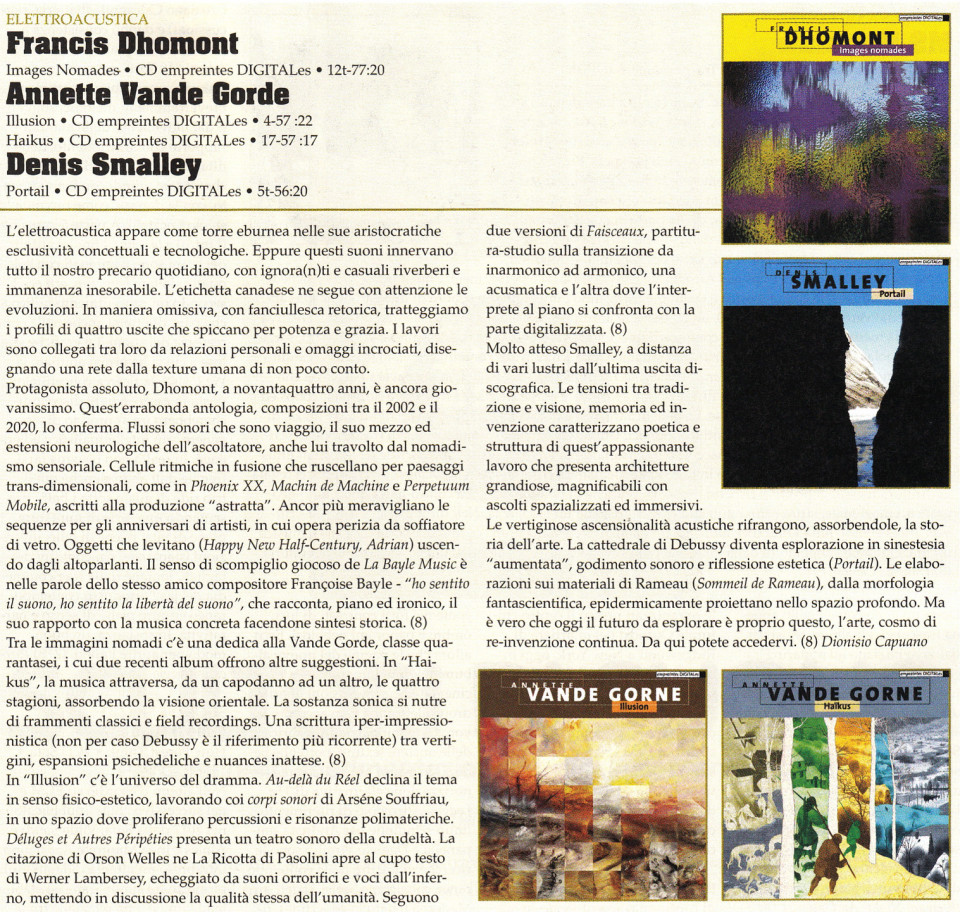
Recensione
La compositrice belga
Uscito per DIGITALes, etichetta discografica nata nel 1990 che ha base a Montréal, celebre per i lavori minimali ed elettroacustici pubblicati nel corso degli anni,
Guardando al mondo dell’elettronica, della musica classica, della poesia contemporanea e anche di quella del passato,
Essendo una rappresentante brillante della cosiddetta acousmatic music,
Kritik
Haiku ist eine japanische Art der Poesie und das Album besteht laut der Künstlerin aus fünf Teilen und insgesamt 17 Haiku’s. Nun, da das Album überwiegend ohne Worte auskommt (ein paar gesampelte Wortfetzen bilden die Ausnahme), hat sie wohl einen musikalischen Weg gefunden, diese umzusetzen. Fak ist, das die 17 Stücke des Albums mit sehr vielen elektronischen Geräuschen und eingespielten Fieldrecordings daherkommt, es aber trotzdem schafft, diese wie klassische Kompositionen klingen zu lassen. Dabei haben einige Stücke die Leichtigkeit eines Debussy. Allerdings werden auch Contemporary Klänge, aus der Elektronik ebenso wie von echten Instrumenten erzeugt, eingesetzt, aber selbst diese wirken in dem Gesamtkontext nicht wie Fremdkörper. Dies liegt an einem scheinbar permanent präsenten Grundsound, der das Rückgrat für die Komposition ist.
Man merkt dem Album die Erfahrung der Künstlerin an, denn hier klingt nichts nach sinnlosem Geräusch, nein alles fügt sich zu einem Ganzem. Und in diese abstruse Welt kann sich der Hörer wunderbar hineinziehen lassen und seinen eigenen Film dazu ablaufen lassen. Vermutlich wird es ein Film Noir oder ein früher
Wie auch immer, die unglaublich vielfältige Klangwelt auf diesem Werk macht eine Mischung aus Fieldrecording, Klassik und Contemporary zu einem wirklichen Hörerlebnis, das man tatsächlich auch als Ganzes durchhören kann. Ein Referenzwerk. 19 / 20.
Kritik
Annette Vande Gorne, mit Jg. 1946 die belgische Grande Dame der Elektroakustik, kehrt mit Haïkus (IMED 20164) zu alten Meistern zurück, zu Bashō und Breughel, dessen “Jäger im Schnee” ihr Thema illustriert. Angeregt durch Haïkus ihres Landsmanns Werner Lambersy (Le Mangeur de nèfles, Au pied du vent), kreist sie, gerahmt durch “Jour de l’an” (als fünfter japanischer Jahreszeit), von “Printemps” über “Été” und “Automne” zu “Hiver”. Mit einer Sensibilität, die Vivaldis Jahreszeiten-Zyklus und dessen Widerhall bei Jean Michel Jarre filtert durch die ästhetische Maßgabe von Haikumeister Bashōs “fließender Bestän- digkeit” und Baudelaires “ordre et beauté” als apollinischem Ideal, auf das sich schon Vande Gornes Lehrmeister Pierre Schaeffer berufen hat. Das Ganze als klangliches Ge- webe aus 17 Haikus mit 12 “Jeux”, Spielen von Vögeln, Insekten, Kindern, des Wassers und von Feuerfunken, fragmentierten, wiederholten, monotonen Spielen und tänzerischen oder träumerischen Momenten. Mit kontinuierlicher Aboutness und spurenelementarer Rückbindung an immer wieder Debussy, Schumann, Schubert, Poulenc, Messiaen, Du- fourt, Ligeti und als kollegialer Tribut an Pierre Henry, R Murray Schafer, Bernard Parmegiani und François Bayle verschmilzt Vande Gorne romantische Phantasie mit impressio- nistischen Augenblicken und solchen durch Dziga Vertovs Kameraauge. Vom krachenden Neujahrsfeuerwerk in surrealer Dehnung und kristallisiertem Debussy-Piano hin zu be- zwitscherten und sprudelnden Szenen und einem von Möven aufgemischten Spielplatz, jeweils in elektroakustischen und orchestralen Konvulsionen. Mit Hummeln und Grillen steigt die Sonne, Faun faulenzt in stagnierender Hitze, Donner grummelt, Liszt irrlichtert. Danach, zwischen glissandierenden Wooshes, Pressluftgehämmer, Flugzeuggebrumm und jauliger Sitar, Herbstnebel und Herbstlaub, debussyesk und raschelig. Schließlich kratzen Schlittschuhkufen über ein Piano, die Zeit scheint eingefroren, gedämpfter Gesang loopt, Stimmen zucken in schmelzendem Gebrodel, metalloider Klingklang verhallt in eisiger Luft. Bis zuletzt Tempelglocken und Gongs ein neues Jahr begrüßen.
Bassin ouvert
In gewohnt makellos attraktiver Aufmachung präsentiert das frankokanadische Speziallabel empreintes DIGITALes mit zwei neuen CDs das Schaffen der maßgeblich von
1946 zu Charleroi geboren, gehört
Die
Die vier Tracks von
Note
La comparaison de l’écoute en stéréo des
Mais comme si ce n’était pas suffisant, ce fut aussi — avec
Bravo deux fois, chère Annette
Les
Une
D’abord l’espace joyeux
Plus dynamique, la série
Dans la troisième série,
La série
Un rideau de pluie s’interpose en granulations obliques aux couleurs vocales et raies colorées (15). Le silence s’installe, en grappe de résonances glacées, nuances de froid, tempo lent, sommeil glacé (16).
Survient un effet de gamelan, éclaté dans l’espace et la profondeur. Soulèvement central. Vaste élargissement résonant… C’est le 17 – l’autre