electrocd

Jonty Harrison

49 results
  • 1
  • 2
  • 3
  • 4
  • 5
  • 6
  • 7
  • 8
  • 9
  • April 11, 2002: 50th Anniversary Concert for Jonty Harrison

    Thursday, March 14, 2002 In concert

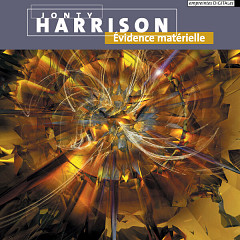
    Thursday April 11, 2002, the “ElectroacousticWALES” concert will celebrate Jonty Harrison’s 50th birthday. His compositions Splintering, Surface Tension and Sorties, from his most recent CD Évidence matérielle will be presented alongside new works by Ozzie Johnstone, Rick Nance and Stellios Giannoulakis. Directed by Andrew Lewis, the event will be held during the Bangor New Music festival, held from April 10 to 13, 2002 at the University of Wales Bangor (UK).

    Évidence matérielle, Jonty Harrison in Le Devoir

    “Trois aspects du bonheur”, François Tousignant, Le Devoir, May 19, 2001
    Saturday, May 19, 2001 Press

    Il faut bien que je vous parle de ce disque pour deux choses. La première s’impose: la beauté de la musique. Jonty Harrison est un très grand compositeur et cette sorte de portrait nous emmène dans tellement d’univers variés qu’on s’étonne de la puissance d’imagination dont est capable l’espèce humaine. Ici, le critique a tout dit et laisse la place à votre bon vouloir d’entendre en vous le recommandant à tout le moins chaudement, même aux rébarbatifs à l’acousmatique.

    La seconde est une vraie farce, de celles qu’on ne commet qu’avec la plus complète sincérité. J’ose donc ici une sorte d’impudique confidence. En entendant Klang (œuvre magnifique), je n’ai pu m’empêcher de penser à des cloches japonaises du temple. Je maintiens: c’en est vraiment le son. Mais une amie m’a dit se retrouver dans sa cuisine et ses casseroles en entendant cela. Quelle honte: je croyais à plus de noblesse et pourtant oui: ce sont des casseroles: je fus berné et m’en confesse sans modestie.

    Jamais batterie de cuisine ne fut si résonnante et riche de potentialité. Et, effectivement, la poésie sonore s’enrichit de cette vision qui trouve sa source dans le hasard du quotidien; Cage avait raison de dire que la musique, dans le fond est plus dans l’oreille de celui qui écoute que dans celle de celui la fait. Il y a toujours un impondérable quelque part que l’artiste transforme et qui — Jonty Harrison — devient révélateur. On voudrait bien des mots pour dire cela. Heureusement il y a mieux, à savoir la musique. C’est plus que suffisant.

    … un très grand compositeur… on s’étonne de la puissance d’imagination dont est capable l’espèce humaine.

    Évidence matérielle, Jonty Harrison in The Georgia Straight

    “Evidence Often Extraordinary”, Alexander Varty, The Georgia Straight, April 1, 2001
    Sunday, April 1, 2001 Press

    It’s not unusual to hear people talk about recordings that take you on a journey, usually in the context of sounds that are tropical, uplifting, or expansively — and expensively—produced. Jonty Harrison’s Sorties, however, doesn’t so much lead you through a sonic landscape as buridle you, blindfolded and confused, into the back of a car, destination unknown.

    A series of linked soundscape vignettes, this 15-minute piece begins placidly enough, perhaps any ordinary urban street. Heels click against the pavement; cars — thrum by on what sounds like wet asphalt; children’s voices clatter from the reflective shop windows nearby; an indistinct bass line wafts from a second-floor studio. But then the mood changes: the squealing of subway brakes leads to a minor scuffle, after witch a door slams shut and the ambient noises fade to black. But the work is far from being over. Keys rattle against locks, tumblers turn, an oddly musical creak — electronically processed saxophone? — signifies the opening of another door.

    In this new world, it’s raining; thunder booms, and then the downpour stops as the listener kicks along a shingle beach, waves plashing nearby, before being pulled through yet another door into a leafy garden of birdsong; in the distance, a puzzled child cries “Mommy! There’s a shoe!

    What domestic or criminal drama is being played out here remains unexplained, as the listener is quickly taken away from this pastoral scene. A buzzing fly morphs into droning industrial noise and then into a silvery synthesized chord, which in turn becomes the noise of a passing bus as the initial street reappears, this tune overlaid with a mesh of clicking and whirring. The piece continues for another minute or so until, finally, ominous low pulses signal its uneasy end.

    Sorties a title intended to be read for both its English and French meanings — is taken from Évidence matérielle, Harrison’s new CD on the Montréal-based empreintes DIGITALes label, and in the liner notes the composer explains that “the dominant sound image of the work is that of leaving (exiting, escaping, fleeing) an interior space for an exterior one, only to find that one is mysteriously and inevitably trapped once again in another ‘interior’.”

    Be that as it may, when one listens to this work on headphones, in a darkened room, it’s hard to detect that the listener has any hope of escape. Harrison’s sonic images have such presence that one really does seem kidnapped, swept away in the composer’s design, and although the feeling is not always-comfortable it’s as gripping as a pair of handcuffs.

    Sorties is an extraordinay piece, as are most of the other works collected on Évidence matérielle. The glorious, metallic physicality of Klang; the fractured yet evocative images of Splintering the appropriately transparent liquidity of Streams: all use a supposedly cool medium — electronic music — to paint warm portraits of human experience. Only Surface Tension fails to cohere: it’s an attempt to make music by sampling and manipulating the sounds of discarded packing materials and other rubbish, but those noises are too amorphous and its structure too indistinct to be fully involving.

    Harrison’s compositions are typical of those featured on empreintes DIGITALes, which with 58 titles in its catalogue is perhaps the world’s leading record label dedicated to electroacoustic music. Its productions run the gamut from “environmental” sounds made up of electronically manipulated field recordings to the purely digital concoctions of the recording studio, and its roster includes such Vancouver composers as Sergio Barroso, Paul Dolden, and Hildegard Westerkamp. Vancouver and Montréal are both hotbeds of this kind of work, but an indication of empreintes DIGITALes’ status in the world at large is that only one Canadian composer is represented in its four new releases. Accompanying Harrison’s CD are albums by his student and fellow Englishman Adrian Moore and New Zealand’s Denis Smalley, in addition to one from Montréal’s Louis Dufort.

    Space precludes full reviews of these, but it’s probably fair that all four composers share a common aesthetics — although whether that is the result of a shared philosophical outlook or something forced on them by the technology they’re working with is hard to say. Whatever the case, if you’re looking for drama Dufort is your man; his dynamic range is greater and his sounds harsher than those used by his English and Kiwi counterparts. But, like them, he’s interested in building long, flowing compositions from small sound sources. By compressing, stretching, and twisting familiar noises, and by the steady aecumulation of sonic detail, all four make music that is transporting — even if, as in Harrison’s Sorties, the journey isn’t always fun.

    … one really does seem kidnapped, swept away in the composer’s design…

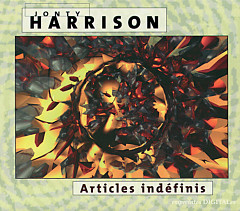
    Articles indéfinis, Jonty Harrison in Musicworks

    “Review”, André Mayer, Musicworks, no. 71, June 1, 1998
    Monday, June 1, 1998 Press

    Articles indéfinis is not as varied a collection as Contes de la memoire, but it still amply displays Harrison’s importance. The disc begins with Pair / Impair, recorded in 1978, a manic depressive composition in which Harrison sought to reconcile dynamics and stasis. The electronic and acoustic tones on Pair / Impair still seem otherwordly over twenty years later.

    The centrepiece of Articles indéfinis is … et ainsi de suite… (1992), an eleven-part suite of musique concrète. Harrison utilized wine glasses as his raw texture, then time-stretched and digitally manipulated the sounds to create a mesmerizing sonic canvas. The final piece, Hot Air (1995), is notable because it is a study of air — children’s balloons were merely a starting point for a complex exploration of the dynamics of breath and the energy needed to achieve it. The result essentially offers a wordless philosophical discussion on the concepts of air and heat.

    Appleton and Harrison’s work can be truly held up as visionary; their influence can be heard in modern electronic bands such as Germany’s Mouse on Mars and Britain’s Autechre, which have taken raw, sometimes unpalatable sound experiments and forged engaging and more commercially viable equivalents.

    Appleton and Harrison’s work can be truly held up as visionary…

    Michel Chion, Jonty Harrison in Le Devoir

    “Rien à voir?”, François Tousignant, Le Devoir, February 24, 1997
    Monday, February 24, 1997 Press

    La «communauté électroacoustique» était en fête en fin de semaine à Montréal. On n’a présenté pas moins de neuf concerts en quatre soirs dans la petite salle du Théâtre La Chapelle. Comme ce genre de manifestation est rare à Montréal, il faut reconnaitre avec plaisir que l’événement a été assez couru. C’est le type de soirées qui sont fascinantes car elles nous permettent d’entendre une interprétation autre de ce répertoire malheureusement négligé que celle figée sur le disque. Bien que ce dernier demeure toujours une porte ouverte sur ce répertoire, rien ne vaut une bonne écoute, calé en salle, comme pour les concerts instrumentaux.

    On peut alors profiter à fond de la spatialisation de la musique, du volume des sonorités. Je ne parle pas seulement du niveau d’intensité sonore, mais encore plus du poids relatif des sonorités telles que retransmises par l’orchestre de haut-parleurs (qu’on nomme aussi acousmonium). J’ai donc eu la chance d’assister à deux concerts.

    Je connaissais bien les pièces de Jonty Harrison. Au disque l’impression est plus que bonne. En salle, on est déçu. Si les œuvres ont toujours ce côté insolite de la non-régularité dans le temps et que le titillement cervical est encore stimulant, l’usage de l’acousmonium n’apporte que fort peu de choses sinon une profondeur dans la perspective avant-arrière du lieu du son. La sonorisation est belle et fort «agréable» à écouter: pas de coups d’assommoir gratuits, mais n’enrichit guère le propos. Le compositeur se révèle le être un interprète ordinaire on le regrette.

    Une écoute plurielle

    On ne saurait dire de même de Tu de Michel Chion. En virtuose de la mise en habitation de sa musique, Chion force une écoute plurielle. Les petites voix tournent dans l’espace et tissent un réseau de significations parallèles au texte dont le contenu est tout tiré de La Flûte enchantée. Le compositeur joue sur les attentes, les prévisions d’écoute, parfois les satisfaisant avec humour, souvent en leur donnant une orientation nouvelle.

    L’univers sonore est moins inaccoutumé que Harrison. Chion fait encore et toujours du Chion, ce qui est loin d’être un défaut, et il joue de la séduction et du raffinement avec une maestria généreuse. Ici encore, il faut souligner la grande «humanité» de la sonorisation. Dans un tel environnement acoustique, l’oreille est stimulée et l’intelligence sollicitée sans ostentation superfétatoire. Alors on embarque dans l’univers de l’œuvre et le temps passe très vite. On aurait aimé que ce «mystère» dure longtemps encore… tant la matière semble riche sous ses apparences naïves. On pense un peu au meilleur Tournier qui s’adresse aux enfants, disant des choses d’apparence simple, mais ô combien profondes, sans que l’on sache exactement quoi. N’est-ce après tout pas là un des mystères de la musique?

  • 1
  • 2
  • 3
  • 4
  • 5
  • 6
  • 7
  • 8
  • 9