electrocd

Robert Normandeau

77 results
  • 1
  • 2
  • 3
  • 4
  • 5
  • 6
  • 7
  • 8
  • 9
  • More reviews might be found in the pages of this artist’s albums.

    Explorer le son

    Christophe Huss, Le Devoir, November 27, 2007

    Si les quatre soirées d’Akousma (4), qui se tiendront de mercredi à samedi au Monument-National, nous promettent «de l’électro comme jamais vue!», c’est que la vidéo prendra une part non négligeable au cœur de ces concerts de musique acousmatique.

    Akousma est organisé par Réseaux des arts médiatiques, une société de concerts de musique électroacoustique fondée en 1991 par Gilles Gobeil, Robert Normandeau et Jean-François Denis. Réseaux définit la musique acousmatique de la manière suivante: «Un son acousmatique désigne un son que l’on entend sans déceler la cause physique qui lui a donné naissance; il devient possible de l’écouter pour lui-même, plutôt que de le cataloguer selon sa cause.»

    La musique électroacoustique, concrète ou acousmatique, selon les termes divers utilisés, doit beaucoup au Français Pierre Schaeffer, son inventeur, à son compatriote Pierre Henry, qui a le plus «popularisé» le genre et, bien sûr, au Québec, à Francis Dhomont, auquel la précédente édition d’Akousma avait rendu hommage. On signalera d’ailleurs qu’un DVD consacré à Pierre Henry, L’Art des sons, est paru chez Juxtapositions (distribution Naxos) il y a une semaine.

    Le but de Réseaux est de faire de Montréal la capitale nord-américaine de l’électroacoustique. À l’occasion d’Akousma, vingt haut-parleurs relaieront les créations conçues préalablement en studio. La soirée d’ouverture sera consacrée à l’anglo-norvégienne Natasha Barrett (Angleterre, Norvège). Jeudi, le Portugais Miguel Azguime livrera une «performance multitechnologique» mêlant audio et vidéo avec, sur deux écrans, un traitement électronique des images et du son en temps réel, additionné d’une spatialisation sonore et vocale.

    Vendredi Laurie Radford dialoguera avec le Quatuor Bozzini (Québec) dans «Les ponts de l’espace», la soirée de clôture de samedi dressant un portrait de Gilles Gobeil intitulé «Exploration des grands espaces». Tous les concerts sont précédés d’un avant-programme, avec, notamment, des œuvres primées de jeunes compositeurs.

    Parallèlement, des cours de maître, ateliers et conférences ouverts gratuitement au public, auront lieu avec Miguel Azguime, Natasha Barrett et Laurie Radford jeudi 29 novembre à 13h à la Faculté de musique de l’Université de Montréal.

    Le but de Réseaux est de faire de Montréal la capitale nord-américaine de l’électroacoustique.

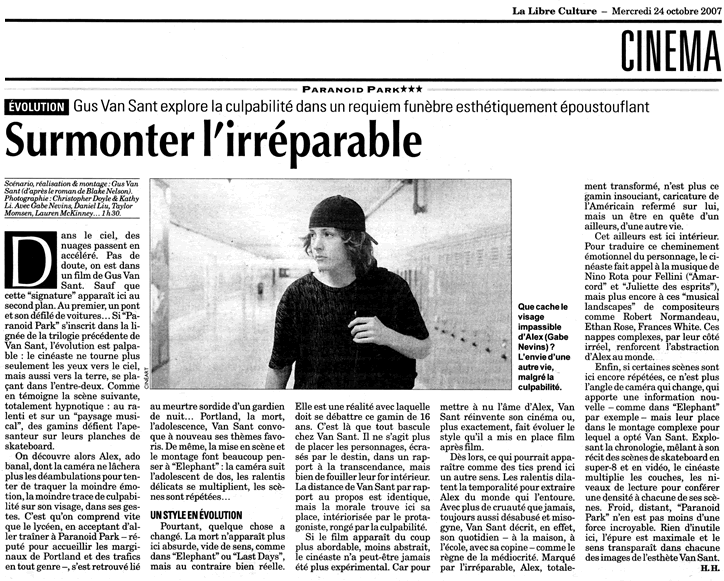
    Surmonter l’irréparable

    HH, La Libre Belgique, October 24, 2007

    Gus Van Sant explore la culpabilité dans un requiem funèbre esthétiquement époustouflant.

    Dans le ciel, des nuages passent en accéléré. Pas de doute, on est dans un film de Gus Van Sant. Sauf que cette «signature» apparaît ici au second plan. Au premier, un pont et son défilé de voitures… Si Paranoid Park s’inscrit dans la lignée de la trilogie précédente de Van Sant, l’évolution est palpable: le cinéaste ne tourne plus seulement les yeux vers le ciel, mais aussi vers la terre, se plaçant dans l’entre-deux. Comme en témoigne la scène suivante, totalement hypnotique: au ralenti et sur un «paysage musical», des gamins défient l’apesanteur sur leurs planches de skateboard.

    On découvre alors Alex, ado banal, dont la caméra ne lâchera plus les déambulations pour tenter de traquer la moindre émotion, la moindre trace de culpabilité sur son visage, dans ses gestes. C’est qu’on comprend vite que le lycéen, en acceptant d’aller traîner à Paranoid Park — réputé pour accueillir les marginaux de Portland et des trafics en tout genre —, s’est retrouvé lié au meurtre sordide d’un gardien de nuit… Portland, la mort, l’adolescence, Van Sant convoque à nouveau ses thèmes favoris. De même, la mise en scène et le montage font beaucoup penser à Elephant: la caméra suit l’adolescent de dos, les ralentis délicats se multiplient, les scènes sont répétées…

    Un style en évolution

    Pourtant, quelque chose a changé. La mort n’apparaît plus ici absurde, vide de sens, comme dans Elephant ou Last Days, mais au contraire bien réelle. Elle est une réalité avec laquelle doit se débattre ce gamin de 16 ans. C’est là que tout bascule chez Van Sant. Il ne s’agit plus de placer les personnages, écrasés par le destin, dans un rapport à la transcendance, mais bien de fouiller leur for intérieur. La distance de Van Sant par rapport au propos est identique, mais la morale trouve ici sa place, intériorisée par le protagoniste, rongé par la culpabilité.

    Si le film apparaît du coup plus abordable, moins abstrait, le cinéaste n’a peut-être jamais été plus expérimental. Car pour mettre à nu l’âme d’Alex, Van Sant réinvente son cinéma ou, plus exactement, fait évoluer le style qu’il a mis en place film après film.

    Dès lors, ce qui pourrait apparaître comme des tics prend ici un autre sens. Les ralentis dilatent la temporalité pour extraire Alex du monde qui l’entoure. Avec plus de cruauté que jamais, toujours aussi désabusé et misogyne, Van Sant décrit, en effet, son quotidien — à la maison, à l’école, avec sa copine — comme le règne de la médiocrité. Marqué par l’irréparable, Alex, totalement transformé, n’est plus ce gamin insouciant, caricature de l’Américain refermé sur lui, mais un être en quête d’un ailleurs, d’une autre vie.

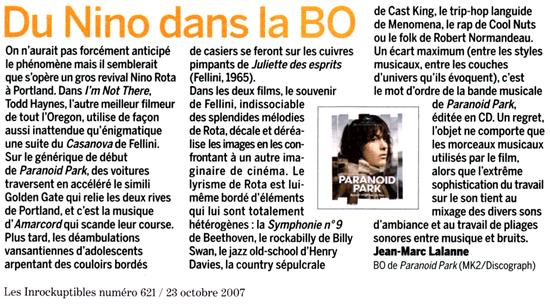
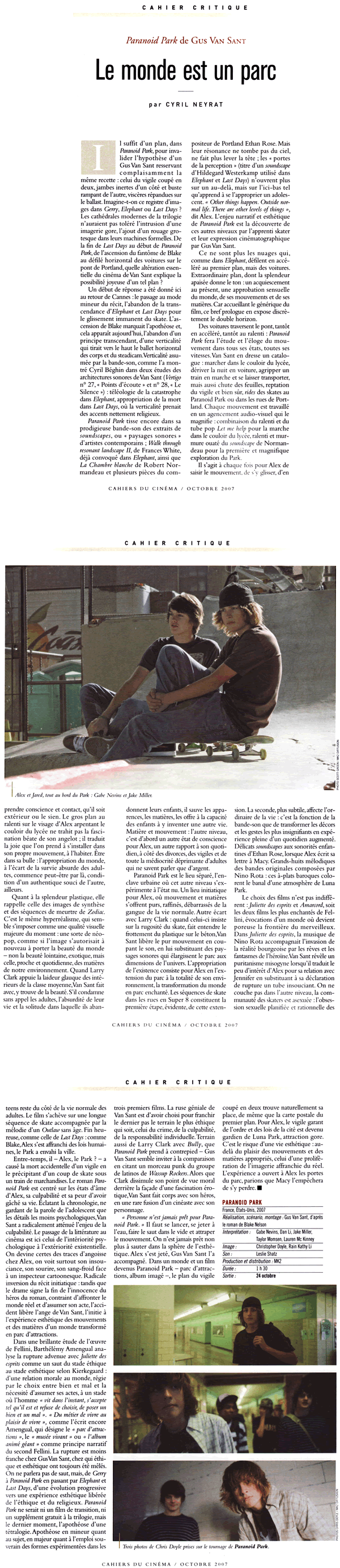
    Cet ailleurs est ici intérieur. Pour traduire ce cheminement émotionnel du personnage, le cinéaste fait appel à la musique de Nino Rota pour Fellini (Amarcord et Juliette des esprits), mais plus encore à ces «musical landscapes» de compositeurs comme Robert Normandeau, Ethan Rose, Frances White. Ces nappes complexes, par leur côté irréel, renforcent l’abstraction d’Alex au monde.

    Enfin, si certaines scènes sont ici encore répétées, ce n’est plus l’angle de caméra qui change, qui apporte une information nouvelle — comme dans Elephant par exemple — mais leur place dans le montage complexe pour lequel a opté Van Sant. Explosant la chronologie, mêlant à son récit des scènes de skateboard en super-8 et en vidéo, le cinéaste multiplie les couches, les niveaux de lecture pour conférer une densité à chacune de ses scènes. Froid, distant, Paranoid Park n’en est pas moins d’une force incroyable. Rien d’inutile ici, l’épure est maximale et le sens transparaît dans chacune des images de l’esthète Van Sant.

    Pour traduire ce cheminement émotionnel […] le cinéaste fait appel […] à ces «musical landscapes» de compositeurs comme Robert Normandeau

    Rien à voir II — Music for Loudspeakers

    David Fujino, The Live Music Report, January 15, 2007

    Understand — it’s an evening of electroacoustic music.

    At centre stage there’s a chair and table. A box sitting on the table emits a pinpoint red light. Cables sprawl from the box onto the floor and lead off stage.

    Both the stage and the audience sit in the dark, for there’s nothing to see, and there are no musicians on the stage.

    The sound technician, Paul Hodge, stands with his control boards and monitors in the middle of the audience. Hodge will end up being as much a performer as each of the composers who work at his side to control and alter their pre-recorded electroacoustic music, music which is not produced by musical instruments.

    For its part, the audience has comfortably huddled together in the centre of their rows in order to sit in a sound universe produced by four strategically placed speakers. The audience sits, waiting for ‘playback.’

    Ann Southam’s Fluke Sound (1989), with its mysterious, late night mood, was a composition of measured and well-placed sounds recorded from three Revox open reel track tape recorders and two Synthi AKS voltage control synthesizers. Southam’s piece was largely characterized by a ringing telephone sound that continually rang and rang as a connecting motif through the criss-cross and layered waves of new sound that kept dropping in and later faded out entirely. The ‘fluke’ in the title refers to the lucky coincidence of making a new composition by putting two separate compositions together.

    The historical part of electroacoustic music was beautifully represented by György Ligeti’s pioneering pieces, Glissandi (1957) and Artikulation (1958). This ‘historical’ reference does not mean to say that the recently departed Ligeti (1923-2006) is anything but startling, original, and always exciting to listen to. Glissandi — with its opening sensual sound like a steel guitar glide — is a beautifully imagined exploration of all manner of glissandi — the short, long, burpey, and longer. Artikulation is all about the tissue of sound that results when new sound elements meet. It starts with the sound of huge water gurgles as they mutate into electronic droplets and then become highly animated, electronic atmospheres.

    Meanwhile, the symphonic dimension (or the grand gesture) of electroacoustic music was represented by Gilles Gobeil’s often exciting and occasionally nervous-making Ombres, espaces, silences… (2005) and by Robert Normandeau’s more intellectually planned out (or so it seemed) composition, Palimpseste (2005, 06).

    Palimpseste — with its recorded and manipulated vocal sounds — was crafted by Normandeau into five sections, each with a different rhythm, timbre, dynamic, emotional quality, and space. At times it was unclear when the piece was finished, but what touched the audience was the audible scope and ambition of this inter-layered composition, whereas Ombres, espaces, silences… by Gobeil — which started with a loud wind storm and a vast scale ‘THX sound’ — grew dramatically and surely into a true ‘cinema of the ear.’ ‘Cinema of the ear’ is Normandeau’s phrase to describe his composition Palimpseste, but to these ears, ‘cinema of the ear’ better describes Ombres, espaces, silences…. Notable were its quick jabs of violence and loud cosmic door slams; plus its adventurous mixing of tones with noise in startlingly forceful ways that made Gobeil’s composition stand out as one of the more expressive compositions played this evening. The sounds seemed to emanate from deep space.

    John Oliver’s Nylong Symphony (excerpt 2005) was a composition of electroacoustic music with a solo guitarist, Oliver himself, on stage. A drone established itself — and over and against it, Oliver played Flamenco and Middle Eastern styled passages, then he moved into an extended sequence where he rapidly ping-pong-ed single notes inside a vibrating framework that was like a suspended Flamenco guitar strum. While playing his guitar, Oliver was kept busy looking back and forth between the music on his stand and the computer screen, but despite all this activity, the music increasingly began to sound the same.

    The most engaging compositions this evening were surely those with a clear sense of form — a holistic sense of form, perhaps, but nonetheless a sense of form — something which open-eared audiences intuitively respond to.

    [January 13, 2007, Isabel Bader Theatre, Toronto]

    The most engaging compositions this evening were surely those with a clear sense of form […] something which open-eared audiences intuitively respond to.

    trans_canada Festival: Trends in Acousmatics and Soundscapes

    Wibke Bantelmann, Computer Music Journal, no. 29:3, September 1, 2005

    The trans_canada festival of electroacoustic music by Canadian composers at the Zentrum für Kunst und Medientechnologie (ZKM) in Karlsruhe was certainly no everyday experience for the interested German public. A festival of acousmatic music—and acousmatic music only—is quite unusal. The German avant-garde music scene is still uncommonly lively, but most composers prefer either instrumental music (with electroacoustic elements) or multimedia works. The idea of invisible music seems not to touch the German musical sensibility.

    Despite this, 460 visitors found their way to ZKM. During 10-13 February, 2005, they experienced a four day-long plunge into the Canadian way of composing, and had the opportunity to learn more about the “Canadian Example” as Daniel Teruggi of the Groupe de recherches musicales (GRM) called it in his paper. According to Mr. Teruggi, the liveliness and outstanding quality of the electroacoustic music scene in Canada is the result of good composers but also of academically sound research and training and a wide range of philosophical approaches to music. The opening of the festival showed another aspect of this “example.” Paul Dubois, the present Canadian ambassador to Germany, came from Berlin to open the festival—cultural policy in Canada apparently knows and supports the electroacoustic scene intensely, quite contrary to German policy.

    Francis Dhomont, Robert Normandeau, Gilles Gobeil, Nicolas Bernier, Hildegard Westerkamp, and Louis Dufort took part in the festival and presented works (Ned Bouhalassa was invited but for health reasons was unable to attend). Nine pieces were commissioned by ZKM and received their world premieres at the festival.

    trans_canada not only offered an occasion for Germans to learn about Canadian acousmatic music; apparently, it also connected the Canadians themselves. “It seems we had to come to the ZKM in Karlsruhe to get together,” said Robert Normandeau at the last concert. And so, the Francophone composers from the east, rooted in the Paris school of “musique concrète,” met the Anglophone soundscape composers from the West coast. “I was very much surprised when Francis Dhomont told us that he does not like the original sounds to be changed so much that you can’t distinguish their origin any longer,” said Hildegard Westerkamp. “We are not as far away from each other as I used to think.”

    This proved to be quite true, as could be heard. The parallels between their new works, Brief an den Vater by Mr. Dhomont and Für Dich—For You by Ms. Westerkamp, were striking. Both compositions were not only inspired by but also formally based on literature and the structure, the sound, the rhythm of the text. The work by Mr. Dhomont, with the scraping of a pen as a sort of leitmotif, was no less abstract than Ms. Westerkamp’s music with its sea-sounds (gulls, wind, waves). And her fantasy land called “home” is not more “real” then his world of inner struggle. Both works showed an extreme sensitivity for subtle, delicate sounds which were spread in many layers, throwing shadows of sound, and constantly and slowly developing into new shapes and shades. The differences between the works seemed after all (to this listener at least) to be ones of personal style and expression than of basic principles.

    Another new work with words came from Darren Copeland. I don’t want to be inside me anymore was quite singular in the festival due to its definite focus on content, on a “real story.” This fact gave the piece a strong dramatic quality leaving hardly any room for imagination. The intention of the sounds to build around the absorbing, sometimes even vexatious, words seemed to force the listeners to constantly keep their full attention on the meaning of the text. It was a deeply impressive piece, even if it was to a certain extent more dramatic than musical. (Although other listeners might experience it differently if they do not understand the German text.)

    In a way, this work resembles a compositional style of a very different kind, that of Barry Truax. The connection may be found in the very sense of reality in both composer’s works: the reality of the feeling of isolation on one hand, and the reality of an existing landscape (streams, peaks, caves) on the other.

    Even Gilles Gobeil’s magnificent medieval drama, Ombres, espaces, silences…, followed roughly this direction. This piece was not about feeling or landscape, it was about reality, too, in this case the reality of history, only by far more sublime, sensitive, and imaginative. Not “cinema for the ear” but a “novel for the ear” (something like The Name of the Rose?)! However, the form and structure of this work is by far more of a narrative nature than strictly abstract-musical.

    It was Robert Normandeau and the youngsters of trans_canada who were most abstract, and therefore the strongest advocates of a true “invisible music.” It was not only not to be seen, it was not to be imagined. There was nothing real, nothing you could get hold of, it was more or less a complete deconstruction of sounds, ideas, narration. They appeared not to start from any landscape, be it imagined or real, inside or outside the head; they started from ideas, ideas of sound, ideas of form. Even the antique Writing Machine in the work by Nicolas Bernier was more a (slightly exotic) sound than a sense, more a historical reminiscence than an element of form.

    Coincidence shows her unaccountable face, experiment and surprise follow. You could hear experience and mastery in the work of Robert Normandeau, of course. You were always sure that it was him who played with coincidence and not the other way round. His world premiere, ZedKejeM, was highly dynamic, with the energy and rhythm from a dancefloor, but still showed the deepness, density, and versatility of a deep-thinking organizer of energy and fantasy. Every single sound seemed well calculated, the effects carefully set.

    The music of his younger colleagues, Mr. Bernier and Louis Dufort, was more spontaneous, wandering dreamily through all the possibilities of technique and sound, to find out what would happen. Mr. Dufort spread a richness and variety of colors in a free, open structure that simply followed the beauty of the sounds created. In contrast to that, Mr. Bernier followed an intellectual plan, he set his rules and let them work. One always sensed the will behind the music, one always tried to follow and understand the experiment instead of just enjoying the result. But, on the other hand, this method produced a certain strong energy in the work. This composer had the power to raise and hold the intellectual interest of the listener.

    All in all, it was fascinating to take in over a few days such a wide range of styles and personalities, and to learn a little about their methods.

    trans_canada also provided the chance to meet the composers in person. Each of them delivered a paper about their work. They could only give a rough survey, of course, in a 45-min talk. Rather than concentrating on techniques or software, most composers just tried to acquaint their colleagues and the small number of other interested people with their sources of inspiration, their opinions, their philosophy. Remarkable was the clear delivery of all the composers and the relaxed atmosphere of these sessions. There seemed to be no need to impress anyone, and not so much need to discuss, let alone debate. Everybody was open-minded and respected the others, as if trying to learn and understand, not to question fundamentals.

    It was like a good talk between colleagues and friends. Mr. Normandeau provided insight into his large archive of sound and his permanent work on the human voice. Mr. Gobeil expressed his preference for the sound of exotic instruments (like the Daxophone) and his dislike of techno music (inducing him to write a techno-piece). Mr. Dhomont talked about the relation between accident and control in his work, marking his own position somewhere between Pierre Boulez and John Cage:Boulez would say: ‘This is incidental, throw it away;Cage would say: ‘This is incidental, so I take it;’ I say: ‘Look, there is an interesting incident, but should I take it?’” He also used the opportunity to call for more polyphony in electroacoustic music instead of the exclusive concentration on creating the most original, most exotic new sound: “In an orchestra, you mix different instruments, but the single instrument becomes not less beautiful.”

    The exceptional environment of ZKM supported this beautiful richness of sounds and the inventiveness of the composers immensely. The two concert venues offer exquisite acoustics. They were equipped with 70 concert loudspeakers, placed in either circles or in a kind of “acousmonium surround environment.” This, in conjunction with the timbral and spatial qualities of the works, created an extraordinary musical experience.

    … it was fascinating to take in over a few days such a wide range of styles and personalities…
  • 1
  • 2
  • 3
  • 4
  • 5
  • 6
  • 7
  • 8
  • 9