I first encountered Hildegard Westerkamp’s music on the compilation CD Aerial #2, where her piece Cricket Voice appears. This uses recordings made when on a trip to the so-called “Zone of Silence” in the Mexican desert, most prominently a cricket’s night song. There are also various percussive sounds, created using desert plants such as dried up roots, dried palm leaves, and cactus spines. The cricket recording is played at various speeds, sounding like a cosmic heartbeat in places, and like peculiar birds in others. The piece has tremendous clarity of sound, and is beautiful in a very straightforward manner, but it’s the context, the concern to reflect the spirit of the sources in the music that stands out.
Hildegard is a prominent member of the World Forum for Acoustic Ecology (see this issue’s Directory), being coordinating editor of its periodical, The Soundscape Newsletter. She grew up in post-war Germany and emigrated to Canada in 1968. She has taught courses in Acoustic Communication at Simon Fraser University in Vancouver. She has composed a number of film soundtracks and has produced and hosted radio programs such as Soundwalking and Musica Nova on Vancouver Co-operative Radio.
You work with environmental situations. What’s so exciting about working in outdoors situations?
I work with any environmental situation, outdoor or indoor, urban or wilderness or rural. I work with environmental sounds exclusively. Sometimes I add a live instrument and/or voice. What’s so interesting? The meanings that environmental sounds hold for us. In other words, I am bringing into the concert/radio/gallery situation “instruments” that are familiar to the audience in one way or another, with which the audience has some kind of association or relationship (both personally or shared culturally). These meanings — as well as the actual recording experience that I have while gathering the sounds — play into my compositional process and usually give the pieces life (for me and the audience). I hardly ever use anyone else’s recordings, because I am not interested in recordings per se, but in the experience while recording.
Am I correct in saying that sound ecology is about making people aware of their auditive environment? How do you do that?
Yes, listening, “ear cleaning” is usually the first. Listening to everything. So that listeners begin to become conscious of the soundscape’s role in their lives, begin to discriminate between what is acceptable and what is unbearable, what is exciting, what is boring, what is low frequency, what is high frequency, what is quiet, what is noisy, what is relaxing, what is unsettling, what is acoustic, what is “schizophonic” (i.e. electroacoustic). This usually means that people will become aware of the acoustic imbalances in urban environments and can begin to rectify that, design their life in a more balanced fashion.
Asking people to make recordings is another step. As soon as we compare what a microphone “hears” to what our ears hear we inevitably sharpen our hearing sense.
Is there an aspect of protest in your sound projects? Against environmental pollution, for example?
Yes. His Master’s Voice is an angry satirical protest against the male macho voice that one hears so relentlessly here in the media. Cool Drool is a satire about Muzak. Other pieces may not necessarily be outright protest, but they will always comment on existing social and cultural situations.
My newest piece, Beneath The Forest Floor, takes listeners into the coastal forest of British Columbia, where one can still find a few ancient tree-stands. It also hopes to take the listener further into the inner depths of such a forest experience, into the forest in us.
There’s much technology involved in sound ecology, and also, I guess, in your music. Exactly how important is the technological aspect?
Of course, I need audio equipment for my work. Good quality equipment is absolutely necessary to be at all effective in what I want to say with my compositions. I also need good studio equipment. Much as I hate this dependence on technology (I do! Because it tends to have a life of its own. It can break down. It is expensive. It is always changing) I do like the direct aural interaction in the studio. Musical/acoustic decision making is completely aural and has a strong improvisational element to it. And this process appeals to me very much.
When your music is released on LP/CD/cassette you bring outdoor sounds into living room situations. I guess you give that transition a lot of thought. What are your considerations? What difficulties do you meet?
Once my pieces are on cassette or CD they take on a new life in the world. They become a new listening environment. They will have to put up with bad playback equipment and noisy living rooms, car radios, or distracted ears. I cannot control that situation and do not want to. I can try to make sure that my pieces somehow reach ears even through tiny speakers. I find it very important that my pieces are able to interact with any environment in which they happen to be played. A forest piece in an apartment by a freeway… well, can it draw the listener into the forest?
Do you prefer the outdoor environmental performances?
I have no preferences in that respect. They are two very different things. Outdoor performances are more nerve wracking usually if they involve equipment and I like to avoid them for that reason. I do like outdoor performances that do not involve electroaoustic technology. The Harbour Symphony that I was commissioned to compose for the Canada Pavilion here in Vancouver for EXPO ‘86 was a crazy piece with over 100 boat horns playing in the harbour of Vancouver. It was an exciting social event but as a composition in its own right really does not quite make it. The Globe and Mail was right when it commented that the piece sounded like “a bunch of happy elephants in a traffic jam”.
Gayle Young mentioned that as a woman, she has learned to work with her music in between ten other activities (like doing the dishes, feeding the children). What is your experience?
After my daughter was born, I became very aware of my time limitations. I realised that I had very little time to devote to myself or my work and learnt to take advantage of the little bit that I had. That’s when I realised I was a composer and became more serious about my compositional work. But, as opposed to some of my women composer colleagues, I was never good at composing between ten other activities. I had to make sure to have longer stretches of time in which I could close my studio door and just work. This was possible because my husband and I tried as much as possible to share the responsibilities of child-care evenly.
Do you think that you focus attention on other aspects of life, musical issues, environment, than men do? And does it show?
I find this very hard to answer. Yes, I do focus on other aspects of life beyond composing, for example, on environmental issues, cultural issues, on children and education, teenage issues as my daughter is a teenager now, on women’s issues, on my garden, my house, etcetera. But whether I do it more than men do I really do not know. I know a lot of women and men who have their fingers in many different activities and aspects of life, especially here in North America, where it is a way of life to do more than one thing.
Why do you think the number of (known!) women working with electronic music is so much smaller than that of men? There are all kinds of (male chauvinist) ideas that immediately come up (e.g. women fear technology, women don’t care about worldly matters, keep their thoughts closer to home), and a few examples that I have experienced in my environment: women start a career but break it off when they long for a child and become pregnant.
Again, this is hard to answer. In your question you have already suggested some of the possible reasons. I can only answer for myself. I like technology because it allows me to work aurally in the studio, to record the soundscape, etcetera. I don’t like it because in order to do my type of composing I have to spend too many hours in very inhuman, airless, dark studio environments, unhealthy places. This is enough of an issue for me to keep me from doing a lot of fancy stuff with technology.
I am particularly sensitive to the conditions of my work environment (and have become more so as I grow older) and perhaps, as a woman, have been allowed to acknowledge that sensitivity. Men have been taught to keep a “stiff upper lip” and to bear hardship. Women have not. So, I can only speculate — along with articulating my own experience — that because it itself is constructed in an alienating way but because the environments in which it exists are usually inhuman, inorganic and the furthest away from natural environments.
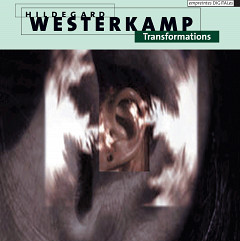
“If you’d like to hear her music, Hildegard has a series of five cassettes available, including tape pieces using urban sounds and vocal fragments; collages of spoken word, poetry, environmental sound and the music of other performers; and a document of the Harbour Symphony discussed above. Her music can also be found on the What Next and empreintes DIGITALes labels.”