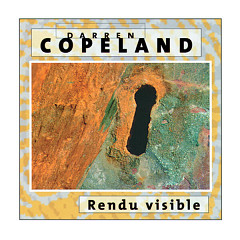
Darren Copeland’s compositional output for tape medium draws entirely on environmental sounds. His teachers have included Barry Truax (Simon Fraser University) and Jonty Harrison (University of Birmingham). Theatre soundtrack composition is a continuing influence on his thinking about music, and his most recent work crosses the boundaries between acousmatic art, radio art and theatre.
CD notes by the composer outline his perspective on the relationship between associative sound and visual imagery, a theme reflected in the titles that appear on this CD. His theoretical approach is explored in a recent article for The Journal of Electroacoustic Music (SANS) entitled ‘Indifference or Ambiguity’. Here, the composer argues for the need to centralize the associative properties of environmental sounds in acousmatic music practice.
There are three tracks on the CD: Rendered Visible; Reaching for Tomorrow; and Night Camera, made up of Maritime Vision, Prairie Dream and Vanishing at Sea. A wide palette of sonic material is drawn on throughout, and the overall production is outstanding.
The danger of the theoretical stance taken here is that in practice it runs the risk of degenerating into new age, ambient and environmental pap. On this CD, the skill and talent in layering and manipulating the material selected results in subtle and complex textures that are anything but trite. It is a fine balancing act superbly controlled for the most part, the results being often internally ambiguous and certainly poetic.
Rendered Visible quotes various natural sources that are combined with unfamiliar sounds. A refreshing aspect is the way the flux of the work is referenced to seemingly contradictory natural events. A sense of the dramatic carries this finely paced work forward.
The second track, Reaching for Tomorrow, again uses the technique of controlling tension and relaxation through the layering material. The sonic references are wider here, and include surrogate instrumental gestures. This creates a slowly evolving texture, brooding, sparse and foreboding.
The longest piece is Night Camera. The composer notes that ‘night camera’ is ‘an imaginary listening aid that like an infrared scanner allowing one to probe regions lying beyond the common, everyday frame of experience’. The analogy sets the frame of reference well, allowing one to enter a cinematic paradigm.
The three tracks that make up Night Camera each deal with a different type of environment within the general theme. Source material includes environmental and city sound references. Each work is powerfully evocative and the dynamic shape is carefully controlled throughout to keep the listener engaged.
The strength of this CD is its rich referencing to known/associative sound balanced and juxtaposed with unfamiliar material, and the manipulation of gestures and textures that are both familiar and exotic. A greater variety of generative methods may help to broaden the approach taken, adding to its versatility.
Combining notions of the theatrical and film scoring with acousmatic music overcomes many of the semiotic limitations of a purely acousmatic approach. It also has the potential to attract more than an academic audience for acousmatic art. The works presented here explore one way the two approaches may be synthesized.