electrocd

Blog

201 results
  • 7
  • 8
  • 9
  • 10
  • 11
  • 12
  • 13
  • 14
  • 15
  • Les corps éblouis in AllMusic

    “Review”, François Couture, AllMusic, September 1, 2001
    Saturday, September 1, 2001 Press

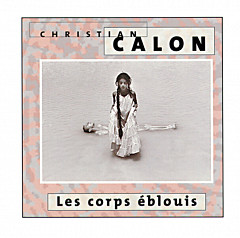
    Les corps éblouis (“Bedazzled Bodies”) is an EP released in 1998 by empreintes DIGITALes in its “Compact Compact” series. It contains only one work, the title track, first created in 1993 and revised the next year. The best example of Christian Calon’s work during his “second period” (while in Marseille, 1991-1995), it is meant as a complement to the full-length CD Ligne de vie: récits électriques which culled the best from his “first period” (in Montréal). This piece attempts to blend the metaphorical and the metaphysical in the transubstantiation of its sound source, an electric guitar. Moving away from the acousmatic esthetics of his 1980s works, the composer processes sound (instead of synthesizing it), but whatever the theories and techniques used, the result remains pure Calon. Washes of sounds revolve around the listener’s head in concentric circles until they reach a breaking point when they scatter away. This sequence occurs a few times, always with variations that alter the unity of the movement. The plasticity of Francis Dhomont’s works (especially Espace / Escape) can be felt throughout — it is no surprise that the mentor spacialized the piece when it was premiered.

    … the result remains pure Calon.

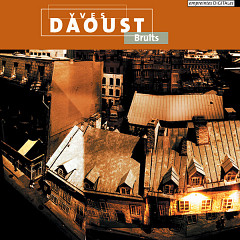
    Bruits in AllMusic

    “Review”, François Couture, AllMusic, September 1, 2001
    Saturday, September 1, 2001 Press

    The center of attention on Bruits, electroacoustic composer Yves Daoust’s third CD, is undeniably the 30 minute title suite. In three movements, he manages to remain true to his anecdotal writing style while completely renewing his palette. Unsuspecting listeners could mistake the first moments of Children’s Corner for a piece of experimental noise. The charge is surprisingly ferocious but quickly defused by the use of children laughs, shouts, and games. Still the piece follows a noise esthetic the likes of which had never appeared in Daoust’s work before. The round of surprises continues in Nuit where material from the first movement is recycled into a more abstract form. Here the music follows a tangent that brings it close to experimental electronica artists working outside the academic electroacoustic sphere, such as Fennesz and Carsten Nicolai. The third movement, Fête, uses field recordings of the various summer festivals in Montréal, bringing back a human factor and Daoust’s love for the anecdote. The three other pieces comprising this set are not necessarily more typical, but they clearly pale in comparison. An earlier version of Impromptu is available on Musiques naïves. This time, the tape part computer-derived from a Chopin piece is augmented by a piano part, a keyboard part, and more children sounds. La Gamme is a rare attempt at sound synthesis. Written for the bicentennial of the French Revolution, Ouverture is an electroacoustic hörspiel putting in correlation various moments in the history of Québec. Both poetic and political in nature, it will be lost on non-French speaking listeners.

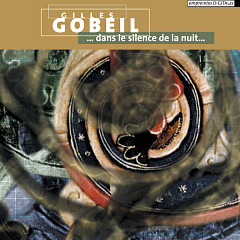
    … dans le silence de la nuit… in AllMusic

    “Review”, François Couture, AllMusic, September 1, 2001
    Saturday, September 1, 2001 Press

    This second CD by Gilles Gobeil develops a more literary theme, with three of the four pieces taking their inspiration in Marcel Proust, HG Wells, and Jules Verne. Yet, the composer’s style changed very little since the late-’80s/early-’90s pieces found on La mécanique des ruptures. If anything, his technique of violent contrasting has been pushed to farther extremes. Therefore … dans le silence de la nuit… (…In the Silence of Night…) sounds like more of the same. But again, the technique has been refined and where there used to be a flooring of textures now the listener often finds complete silence. The closing piece, Nuit cendre, gets very disturbing in this vein. Projet Proust is an electroacoustic interpretation of the first pages from the author’s mammoth cycle, accompanied by a pure (as in “not altered”) narration. Point de passage, an interpretation of Wells’ novel The Time Machine features more abrupt shifts and unexpected bangs. That is the crux of Gobeil’s art — truly a case of love-it-or-hate-it.

    … his technique of violent contrasting has been pushed to farther extremes.

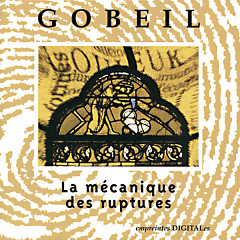
    La mécanique des ruptures in AllMusic

    “Review”, François Couture, AllMusic, September 1, 2001
    Saturday, September 1, 2001 Press

    La mécanique des ruptures (The Mechanics of Cleavage) is Gilles Gobeil’s first CD. The eight electroacoustic works culled here were created between 1985 and 1993 and vary from short clips Nous sommes heureux de…, one minute) to ambitious tape dramas (La ville machine, 15 minutes). In general, the longest pieces include an instrument or narration part. Suzanne Binet-Audet is featured on two such pieces playing ondes Martenot, one of the earliest synthesizers. Montréal electric guitarist René Lussier provided examples of his playing for Associations libres (Free Associations). But whatever the length or medium, Gobeil’s style remains pretty much the same throughout and could be (over)simplified to one single gesture: a door slamming shut. He throws buckets of sounds at the listener’s ears, multiplying contrasts between peaceful ambiances and sudden “bangs!,” often articulated by a short crescendo. This in-your-face approach to electroacoustics will please listeners who want “action” (i.e. loud ample movements of sound). Nonetheless, Le vertige inconnu remains Gobeil’s strongest piece, very powerful in its violent plasticity. La ville machine, almost taking the form of a hörspiel, is another highlight. Its story follows three confusing but interesting parallel narratives (in French in the piece, but provided in an English translation in the booklet). Recommended.

    … very powerful in its violent plasticity.

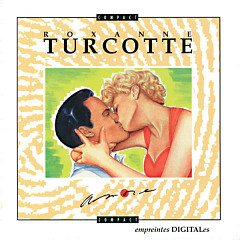
    Amore, Roxanne Turcotte in AllMusic

    “Portrait”, François Couture, AllMusic, September 1, 2001
    Saturday, September 1, 2001 Press

    Roxanne Turcotte’s activities are diversified, to say the least. Yet, even with a resume that includes a keyboardist role in a rock group, electroacoustic composer and children music composer, she barely made a dent in the music world. Her first album, Amore, was released in 1994.

    Born in Montréal in 1960, Turcotte always stayed in the big city. First and foremost a keyboardist, she began in rock and jazz groups, recording an LP with Kaméléon in 1982. Not shy of genre crossings, she entered the Master program in electroacoustic music at the Université de Montréal, studying its secrets with Marcelle Deschênes and Francis Dhomont while also studying piano and composition with Serge Garant. She began creating electroacoustic music, but also music for multimedia projects and, surprisingly, children music, each aspect of her career permeating the others. In 1994 the prestigious record label empreintes DIGITALes released her first CD of electroacoustic music, Amore. The reception was mixed, her style of cinema for the ear relying strongly on synthesized music and sound collage. She participated to the 1999 and 2000 editions of the Futura Festival in Crest (France) and the 2001 Bourges Festival.

    … her style of cinema for the ear relying strongly on synthesized music and sound collage.

    Clair de terre in AllMusic

    “Review”, François Couture, AllMusic, September 1, 2001
    Saturday, September 1, 2001 Press

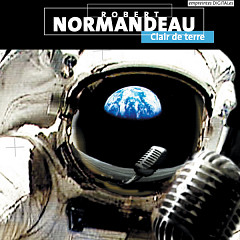
    Clair de terre (Earthlight), Robert Normandeau’s fourth CD, adds three works to his available catalog. All were created between 1999-2001, thus this album picks up where Figures (1999) left. Malina could be seen as an acousmatic study of the shakuhachi, a Japanese bamboo flute. One would expect a particularly ethereal piece, but Normandeau manages to find strange twists and turns to the soothing sound of the instrument. Erinyes continues to explore the deconstruction of speech into onomatopoeia. This time, the composer used the recording of a production of Sophocles’ Electra for sound material. The piece does not reach the same heights as the prize-winning Le renard et la rose, the previous installment in the series. The highlight of this disc is the 36 minute suite Clair de Terre. Through 13 short movements, Normandeau revisits some of his favorite sounds and techniques, devising an ersatz of his own work while framing the whole thing with a space-age theme. He clearly enjoyed the process — so does the listener, won over by the buoyancy and playfulness of the work. From freeze techniques to more basic sound collage and even an ephemeral reconstructed beat, Clair de Terre is fundamentally entertaining, a rare comment for electroacoustic music. The relation of some of the parts with the whole are not always as strong (or obvious) as they should, but one sympathetically looks over the details.

    Clair de terre is fundamentally entertaining, a rare comment for electroacoustic music.
  • 7
  • 8
  • 9
  • 10
  • 11
  • 12
  • 13
  • 14
  • 15